Prepared by: AsiaQuartz Editorial Team
Technical review by: AsiaQuartz Product, QC & Supply Chain Team
Last updated: July 2026
First, quick answer: As of August 8, 2026, silica regulation differs sharply by market. Australia prohibits covered engineered stone benchtops, panels and slabs that meet its statutory definition. Specifically, including a crystalline-silica threshold of at least 1% by weight; import of those covered goods has been prohibited since January 1, 2025. The United States regulates occupational exposure at the federal level through OSHA rather than through a federal product ban; California is actively considering emergency restrictions on fabrication and installation of engineered stone countertops containing more than 1% crystalline silica.
First, the European Union regulates respirable crystalline silica generated by work processes under worker-protection legislation, with an EU binding 8-hour limit value of 0.1 mg/m³ and no EU-wide engineered-stone product prohibition identified in this review. China has no national engineered-stone product ban identified. But its product-standard framework changed materially on August 1, 2026, when mandatory standard GB 46028-2025 took effect.
For importers, the practical question is not simply whether a material is called “quartz” or “silica-free.” Confirm the exact product definition. Composition, manufacturing route, intended use, destination jurisdiction and evidence package before shipment.
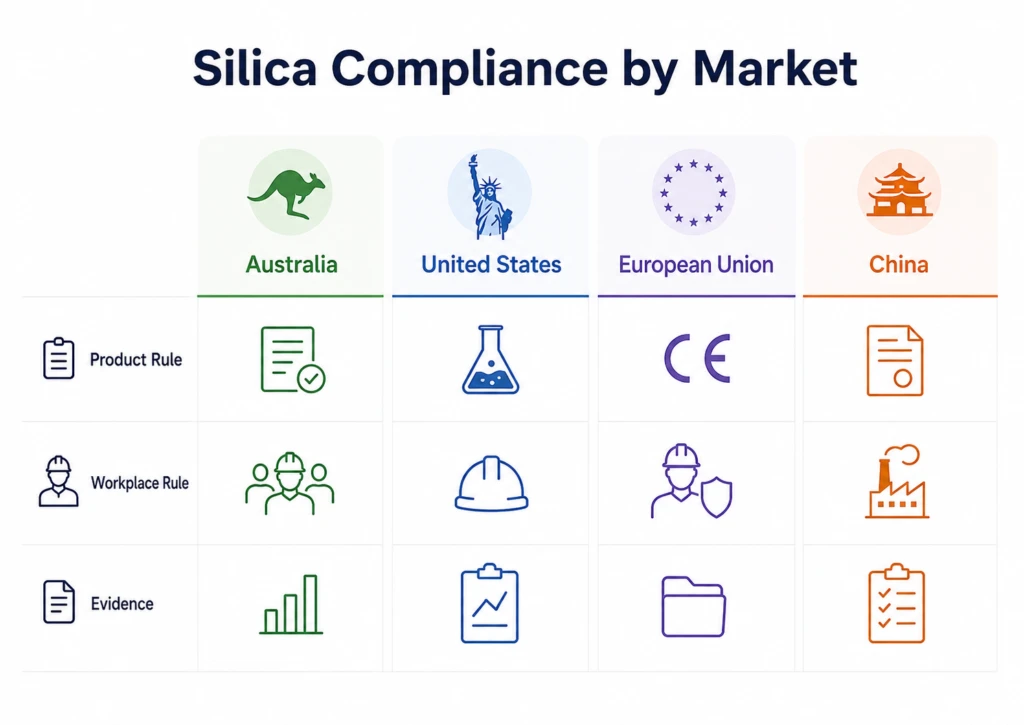
Silica Regulation at a Glance: Four Markets, One Table
First, the table below is a procurement-level summary as of August 8, 2026. It is not a substitute for product-specific legal, customs or occupational-health review.
| 🇦🇺 Australia | 🇺🇸 United States | 🇪🇺 European Union | 🇨🇳 China | |
|---|---|---|---|---|
| Regulatory model | Effective — prohibition on covered engineered stone | Exposure standard — federal workplace controls; California rulemaking active | Exposure limit — worker-protection framework | Standards-based — mandatory and voluntary product standards + workplace controls |
| Key framework | Model WHS engineered-stone prohibition + Customs import prohibition | OSHA 29 CFR 1926.1153 and 29 CFR 1910.1053; state-plan requirements may add obligations | Directive 2004/37/EC as amended (CMRD), including RCS dust generated by a work process | GB 46028-2025; GB/T 41919-2022; GB 6566-2010 where applicable; workplace and environmental rules |
| Key threshold / exposure value | At least 1% crystalline silica is one element of the engineered-stone definition | PEL 50 µg/m³; Action Level 25 µg/m³ as 8-hour TWA | EU binding 8-hour OEL: 0.1 mg/m³ for respirable crystalline silica dust generated by a work process | No national silica-content product-ban threshold identified |
| Product prohibition? | Yes, for covered engineered stone benchtops, panels and slabs | No federal silica-content product ban identified | No EU-wide engineered-stone product ban identified | No national engineered-stone product ban identified |
| Import implication | Covered engineered stone benchtops, panels and slabs are prohibited imports | Silica rules are principally downstream workplace obligations; separate customs/trade rules still apply | Silica framework is principally workplace-focused; product rules may arise under other EU/national regimes | Exports must satisfy Chinese production requirements and the destination market’s product/import rules |
First, Regulatory status note: The summaries above reflect official sources reviewed through August 8, 2026. State, member-state, provincial and product-specific requirements may differ. Specifically, recheck the destination authority before relying on this table for a live shipment.
Australia — National Prohibition on Covered Engineered Stone
First, australia has the most restrictive national regime among the four markets reviewed here. But the prohibition is defined by product type and statutory criteria rather than by the marketing name alone.
Two-Stage Timeline
First, Stage 1 — July 1, 2024: manufacture, supply, processing and installation of covered engineered stone benchtops. Panels and slabs became prohibited under the WHS framework across Australian jurisdictions, subject to limited exceptions and jurisdiction-specific implementation details.
First, Stage 2 — January 1, 2025: covered engineered stone benchtops. Panels and slabs became prohibited imports under regulation 5M of the Customs (Prohibited Imports) Regulations 1956.
Use the Legal Definition, Not a Category Shortcut
Under the model WHS definition, a product must meet all of the following criteria to be engineered stone for the prohibition:
- It contains at least 1% crystalline silica by weight.
- It is created by combining natural stone materials with other chemical constituents such as water, resins or pigments.
- It becomes hardened.
First, the definition also excludes specified product types, including concrete and cement products, bricks and pavers, ceramic wall and floor tiles. And resin-free porcelain and sintered stone. Specifically, products containing less than 1% crystalline silica do not meet the engineered-stone definition on that criterion. But work with other crystalline-silica-containing materials can still be subject to WHS controls.
First, Do not rely on the label alone: “Silica-free,” “low silica,” “porcelain-look” or another commercial description does not establish import classification. The product’s actual composition, construction and linkage between the tested sample and imported goods matter.
Evidence for Importers
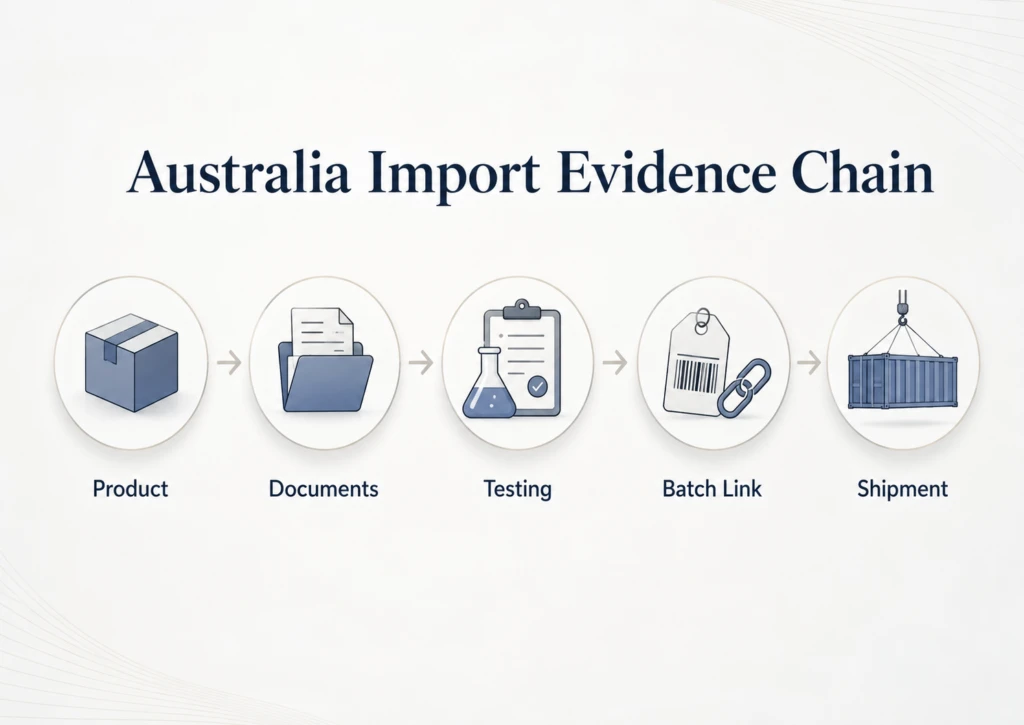
First, the Australian Border Force requires importers to be able to show that evidence relates to the goods being imported. Useful linkage evidence can include batch numbers, sampling procedures, photographs and records describing what was sampled. If testing is used, the method and laboratory must be appropriate to the question being answered.
First, aBF guidance states that overseas testing certificates may be accepted when the laboratory is recognised under the NATA mutual-recognition framework and is accredited by its national authority for relevant engineered-stone testing. If ABF requests border testing, it accepts certificates from NATA-accredited laboratories using methods such as petrographic analysis and X-ray diffraction.
First, For importers: Treat the first shipment of a new low-silica or silica-free engineered surface as a classification-and-evidence project, not merely a purchasing order. Link the tested sample to the exact goods, retain batch and formulation records. And confirm the evidence package with your Australian customs broker before loading.
2026 Updates: HCIS and Exemption Guidance
Safe Work Australia continued publishing operational guidance through 2026 that importers should be aware of:
- Exemption infographic (2026): Safe Work Australia published a visual guide clarifying who qualifies for the pre-ban stock exemption and the <1% crystalline silica threshold — useful for traders assessing whether legacy inventory or low-silica product can still be supplied.
- HCIS launch: The Hazardous Chemical Information System (HCIS) platform was relaunched by Safe Work Australia in 2026, consolidating chemical safety and occupational exposure limit data relevant to crystalline silica and other fabrication chemicals.
- Exposure limit consultation: Safe Work Australia’s consultation on workplace exposure limits for nine chemicals (including crystalline silica) closed in August 2026, with a Decision Regulation Impact Statement (DRIS) evaluating the proposed limits.
For a full rundown of the simultaneous 2026 regulatory wave across Australia, California. The EU and US federal policy — including the Cal/OSHA silica advisory committee and EU NEPSI activity — see our dedicated analysis: The Global Silica Crackdown: What the 2026 Regulatory Wave Means for Quartz Buyers.
United States — Federal Exposure Controls, with California Rulemaking in Motion
At the federal level, OSHA regulates occupational exposure to respirable crystalline silica rather than imposing a silica-content ban on engineered-stone products. Import legality should therefore be separated from downstream fabrication and installation obligations, as well as from unrelated customs or trade-remedy issues.
Federal Framework: OSHA Silica Standards
- Construction (29 CFR 1926.1153): PEL of 50 µg/m³ as an 8-hour TWA and Action Level of 25 µg/m³.
- General Industry and Maritime (29 CFR 1910.1053): the same PEL and Action Level, together with exposure assessment, engineering-control, respiratory-protection, medical-surveillance and recordkeeping requirements where applicable.
First, these are employer obligations triggered by occupational exposure. They are not a federal composition specification for quartz slabs.
California: Active Emergency Rulemaking, Not Yet an Import Ban
First, california needs to be described separately from the federal framework. On July 31, 2026. Specifically, cal/OSHA convened an advisory meeting on proposed emergency rulemaking to prohibit fabrication of engineered stone countertops and similar products containing more than 1% crystalline silica. The rulemaking followed Petition 609, which requested restrictions on fabrication and installation.
First, Status as of August 8, 2026: California is actively considering a fabrication/installation prohibition through emergency rulemaking. This should not be described as an enacted California import or retail-sale ban. Specifically, buyers serving California should monitor Cal/OSHA and the Occupational Safety and Health Standards Board before each procurement cycle.
What This Means for Importers
- Federal OSHA silica standards do not themselves prohibit importing or selling engineered stone based on silica content.
- Your downstream fabricators and installers may have substantial exposure-control obligations.
- California sourcing decisions should account for the possibility of near-term fabrication restrictions, not just current federal rules.
- Product-specific SDS, composition information and independent test evidence can support buyer risk assessment, but they do not replace workplace exposure-control requirements.
European Union — Worker Protection Through a Binding RCS Limit
First, the EU framework controls respirable crystalline silica generated by work processes through occupational-health legislation. It should not be presented as a product-composition approval system.
EU-Level Framework
First, directive 2004/37/EC as amended covers work involving exposure to respirable crystalline silica dust generated by a work process and sets an EU binding 8-hour occupational exposure limit of 0.1 mg/m³. Member states implement the directive in national law and may adopt stricter requirements.
- The core silica rule is workplace-focused.
- Employers must assess and control exposure and comply with applicable health-surveillance and worker-protection duties.
- Product placement, construction-product documentation, chemicals obligations and national building rules are separate questions and should be reviewed for the exact product and member state.
What This Means for Importers
First, no EU-wide engineered-stone product prohibition was identified in the official sources reviewed for this article. That does not mean every transaction is automatically compliant: buyers should check the destination member state’s worker-safety rules and any product-specific obligations that apply to the intended use.
China — Standards-Based Regulation, with a New Mandatory Standard Now Effective
First, china does not currently use an Australia-style national engineered-stone product prohibition. The more relevant procurement question is which mandatory and recommended standards apply to the specific artificial-stone product. Specifically, together with workplace, environmental and destination-market requirements.
Current Product-Standards Framework
- GB 46028-2025 — Safety technical requirements for building decorative stone: a mandatory national standard published August 1, 2025 and effective August 1, 2026. Buyers should confirm its exact scope and applicable clauses against the product being sourced.
- GB/T 41919-2022 — Artificial stone building slab: a current recommended national standard for artificial-stone building slabs.
- GB 6566-2010 — Limits of radionuclides in building materials: may be relevant depending on product classification and application.
- GB/T 47191-2026 — Analytical methods for chemical composition of resin-based artificial stone: published February 27, 2026 and scheduled to take effect September 1, 2026.
First, Important correction for 2026: GB 46028-2025 is not an unverified industry reference. It is an official mandatory national standard and, as of this article’s publication date, is already effective.
What This Means for Importers
- Do not treat “China compliant” as a substitute for destination-market compliance.
- Ask the manufacturer which Chinese standards apply to the exact SKU and intended use, and request current test or conformity records where relevant.
- For low-silica or silica-free programs, composition and test evidence still need to match the destination market’s definitions and border requirements.
- Production address, formulation identity, batch records and export documents should form one consistent evidence chain.
First, requirements differ by jurisdiction. Cross-check your market against our silica-free surface review by destination market before import or fabrication planning.
Import Decision Matrix: Match the Product to the Destination Market
First, this matrix is intentionally phrased as a screening tool rather than a legal clearance table. Market access depends on the exact goods and evidence.
| Product Type | Australia | United States | EU | China (Domestic) |
|---|---|---|---|---|
| Covered engineered stone ≥1% crystalline silica | ⛔ Prohibited for covered benchtops, panels and slabs | ⚠️ Workplace rules — no federal silica-content product ban; check California developments | ⚠️ Workplace rules — apply EU/national RCS controls | ⚠️ Standards apply — verify applicable GB requirements |
| Engineered surface <1% crystalline silica | ⚠️ Verify classification — below 1% does not meet the silica criterion of the engineered-stone definition; evidence must match the goods | ⚠️ Verify use — workplace exposure rules remain relevant to actual dust generated | ⚠️ Verify use — national workplace rules remain relevant | ⚠️ Verify standards |
| Resin-free porcelain / sintered stone | ✅ Generally excluded from engineered-stone definition; confirm product construction | ✅ Product-level access generally available; workplace rules still apply where dust is generated | ✅ Product-level access generally available; check national rules | ⚠️ Verify applicable standards |
| Natural stone | ✅ Not engineered stone; separate crystalline-silica work controls can still apply | ✅ Product-level access generally available; OSHA exposure rules can still apply during processing | ✅ Product-level access generally available; RCS limits can still apply during processing | ⚠️ Verify applicable standards |
Evidence Strategy by Market
| Market | Core Evidence / Applicable Requirements | Recommended Buyer File | Confirmation Point |
|---|---|---|---|
| Australia | Evidence showing the goods are not prohibited engineered stone; product-linked testing where needed | Product identity, formulation/composition declaration, batch linkage, sampling record, photos, competent-lab test report | Confirm classification and evidence with customs broker; follow ABF testing requirements if requested |
| United States | Applicable hazard communication and downstream OSHA exposure-control duties | SDS, product composition information, TDS, buyer-requested test data, state-rule review | Check destination state and fabricator obligations; monitor California rulemaking |
| EU | Applicable workplace RCS controls plus any product/chemical/construction rules relevant to the SKU and end use | SDS where applicable, TDS, composition/test evidence, member-state documentation | Confirm national OEL implementation and any product-specific obligations |
| China | Applicable mandatory and recommended standards, including GB 46028-2025 where in scope | Product standard declarations, relevant test records, TDS/SDS, factory QC and batch records | Confirm exact product classification and applicable GB/GB-T clauses |
FAQ
First, potentially. A product containing less than 1% crystalline silica does not meet that element of Australia’s engineered-stone definition. However, a laboratory result by itself should not be treated as automatic border clearance. Specifically, the evidence should relate to the actual goods being imported. And the Australian Border Force may request further information, product classification evidence, or additional testing where the product’s status is unclear.
First, not simply because they import quartz slabs. OSHA’s 50 µg/m³ permissible exposure limit is an occupational exposure limit that applies to covered employers and workers exposed to respirable crystalline silica. Specifically, an importer that also operates fabrication, cutting, grinding, or other processes that generate respirable crystalline silica may have its own OSHA obligations. Importers should also expect downstream fabricators and distributors to request SDS, composition, and silica-content information for their own compliance programs.
First, cal/OSHA is actively pursuing emergency rulemaking concerning fabrication of engineered stone countertops and similar products containing more than 1% crystalline silica. An advisory meeting was held on July 31, 2026. As of August 8, 2026, this should be described as active rulemaking rather than an enacted California import, retail-sale, or statewide product ban. Buyers should monitor the latest Cal/OSHA rulemaking record before relying on a fixed compliance position.
First, no EU-wide engineered-stone product prohibition was identified in the official sources reviewed for this article. The EU primarily regulates occupational exposure to respirable crystalline silica generated by work processes, including a binding 8-hour occupational exposure limit of 0.1 mg/m³ at EU level. Specifically, individual member states may adopt stricter or additional requirements, so country-specific review remains necessary.
First, yes, potentially, but acceptance is conditional. The laboratory should have appropriate accreditation for the relevant testing. And the test method must be suitable for establishing the product characteristic being claimed. Just as importantly, the tested sample must be traceably linked to the goods being imported through information such as product codes. Specifically, batch numbers, sampling records, photographs. Or other documented identifiers. In particular, importers should confirm the proposed evidence package with their customs broker or the Australian Border Force before the first shipment.
First, no. Australian Border Force guidance refers to methods such as X-ray diffraction (XRD) and petrographic analysis. The appropriate method depends on what needs to be established about the product, the material matrix, the reporting threshold. And the laboratory’s validated procedure. Buyers should not use an occupational air-monitoring method such as NIOSH 7500 as a generic bulk-product certification method without laboratory confirmation that the method and sample preparation are appropriate for the material being tested.
First, yes. China’s official national standards database lists GB 46028-2025, Safety Technical Requirements for Building Decorative Stone. As published on August 1, 2025, with an implementation date of August 1, 2026. It is a mandatory national standard. Specifically, buyers sourcing artificial stone from China should confirm which clauses apply to the exact product category, composition, intended use. And production route being purchased.
Review Your Product’s Market-Specific Compliance
First, every market has different requirements. We help importers match products, documentation and specifications to destination-market regulatory expectations.
Related Reading
- Engineered Stone Ban Guide — What Buyers, Importers & Fabricators Need to Know
- The Silica-Free Shift — What the 2024–2026 Regulatory Changes Mean
- Silica-Free & Low-Silica Engineered Surfaces
- Silica-Free Quartz Procurement: What B2B Buyers Should Know Before Sourcing
- Silica-Free Surface Guides
- AsiaQuartz Supply Chain — Production Routes, Origin Records & Container Planning
How this article was prepared:
- Australia: Scope, definitions and import guidance were checked against Safe Work Australia and Australian Border Force guidance, including the three-part engineered-stone definition, the less-than-1% example, sample-to-goods traceability and ABF testing expectations.
- United States: Federal exposure values were checked against OSHA’s respirable crystalline silica standards. California status was checked against Cal/OSHA’s July 31, 2026 emergency-rulemaking advisory materials.
- European Union: The EU binding occupational exposure limit for respirable crystalline silica dust generated by a work process was checked against the consolidated text of Directive 2004/37/EC as amended.
- China: Standard status and effective dates were checked against the National Public Service Platform for Standards Information, including GB 46028-2025, GB/T 41919-2022 and GB/T 47191-2026.
- Limitations: This article is a cross-market screening guide, not legal, customs or occupational-health advice. Product classification, national implementation, state/member-state rules and border practice can change and may depend on the exact goods.
First, About this article: AsiaQuartz-specific supply observations are used only for procurement context. Regulatory conclusions are grounded in the official sources listed below and should be rechecked before a live transaction.
First, Information status: Reviewed through August 8, 2026. Australia — prohibition on covered engineered stone is effective; import prohibition effective January 1, 2025. Specifically, uS federal — OSHA exposure standards effective; no federal silica-content product ban identified. California — emergency rulemaking on fabrication of engineered stone >1% crystalline silica is active, with a July 31, 2026 advisory meeting. In particular, eU — binding RCS worker-exposure framework effective; no EU-wide engineered-stone product prohibition identified in this review. China — GB 46028-2025 became effective August 1, 2026; GB/T 47191-2026 is scheduled for September 1, 2026. For example, recheck official authorities before shipment.
Sources and References
- Safe Work Australia, Engineered stone ban, accessed August 8, 2026.
- Australian Border Force, Engineered stone — prohibited goods guidance, accessed August 8, 2026.
- US OSHA, Crystalline Silica and 29 CFR 1926.1153 / 1910.1053 resources, accessed August 8, 2026.
- California Department of Industrial Relations / Cal/OSHA, Emergency Silica Advisory Meeting — July 31, 2026, accessed August 8, 2026.
- EUR-Lex, Directive 2004/37/EC as amended, including the 0.1 mg/m³ 8-hour limit for respirable crystalline silica dust generated by a work process, accessed August 8, 2026.
- Standardization Administration of China, GB 46028-2025, Safety technical requirements for building decorative stone, effective August 1, 2026.
- Standardization Administration of China, GB/T 41919-2022, Artificial stone building slab, current.
- Standardization Administration of China, GB/T 47191-2026, Analytical methods for chemical composition of resin-based artificial stone, effective September 1, 2026.
- AsiaQuartz SSOT v1.1, claim guardrails and supply-program context, reviewed July 2026.
Continue Reading
- Engineered Stone Ban Guide — Timeline of global regulatory developments
- Silica-Free Quartz Procurement Guide — What to verify before sourcing
- All Silica-Free Surface Guides — Complete guide collection