By AsiaQuartz Editorial Team
Technical review by AsiaQuartz Product, QC & Supply Chain Team
Updated: June 2026
⚠ Regulatory Freshness Notice (Updated August 10, 2026): This article reflects the global regulatory landscape as of July 6, 2026, with the following updates added August 10, 2026. China’s GB 46028-2025 national stone safety standard came into force August 1, 2026, requiring wall-mounted stone panels to be a minimum of 20mm (2cm) thick. Caesarstone’s ICON zero-silica series (Crystalline-Silica Free Surface) formally launched in the US market in 2025, marking the first major Western brand to enter the silica-free category at scale. Regulations continue to evolve; always consult your local government official announcements and a qualified legal advisor for the latest requirements applicable to your jurisdiction.
Executive Summary
The global engineered stone discussion is no longer just a workplace-safety topic. It now affects import planning, product documentation, buyer submittals, retailer labeling, and long-term surface category strategy.
Here are the five things every quartz buyer needs to know in July 2026:
📌 Australia remains the clearest product-level case — engineered stone containing ≥1% crystalline silica is banned for manufacture, supply, processing, installation, and import. Low-silica alternatives are exempt and widely available.
📌 The US has no federal product ban — but California Prop 65 warning requirements, OSHA silica dust limits, and California DIR enforcement on artificial stone fabrication are tightening the compliance environment for fabricators and retailers.
📌 The hard evidence is documentation, not marketing claims — crystalline silica XRD test reports, SDS files, batch traceability records, and pre-shipment QC evidence are now the buyer’s best defense against regulatory risk.
📌 The product response is not “stop selling quartz” — it is to build a flexible surface portfolio: standard quartz, low-silica engineered stone, silica-free alternatives, printed quartz, prefabs, and cut-to-size formats.
📌 Suppliers who provide documentation-first procurement programs will win the next 3–5 years of B2B quartz trade. AsiaQuartz supports buyers with multi-origin supply planning, silica-free surface review, sample approval, batch QC evidence, and container-level supply programs.
Introduction: The Quartz Industry Is Changing — but the Market Is Not Ending
If you buy, import, fabricate, or specify quartz surfaces, you have probably heard the word “ban” repeatedly since 2024. Australia moved first. California is tightening scrutiny around artificial stone fabrication. The UK HSE issued engineered-stone guidance and launched inspections in May 2026. The conversation about silica dust safety has gone from trade journals to homeowner Facebook groups.
The practical question for B2B buyers is not whether the quartz market disappears. It does not. The real question is how to build a safer, more documented, more flexible surface supply program. Buyers now need to know which documents matter, which regulations apply to their destination market, and which product categories reduce risk without reducing design options.
This article answers those questions for importers, distributors, fabricators, builders, and project buyers. It walks through the timeline, explains what crystalline silica actually is, breaks down how each stakeholder is affected, and provides a concrete sourcing framework you can use today.
AsiaQuartz positions this issue as a sourcing and documentation problem, not a panic story. Our product center includes engineered quartz products, printed quartz, prefabs, cut-to-size pieces, terrazzo, and silica-free surface options. For product recommendations based on your market: asiaquartz.com/contact-us/
1. What Is the Engineered Stone Ban?
The phrase “engineered stone ban” usually refers to restrictions on high-silica artificial stone products — especially quartz-style benchtops, panels, and slabs that release respirable crystalline silica during cutting, grinding, and polishing. Different countries have taken different approaches: some use product bans, others tighten workplace exposure limits, and some require warning labels at the point of sale.
In Australia, the legal definition is especially important. Safe Work Australia defines engineered stone as an artificial product that contains at least 1% crystalline silica by weight, created by combining natural stone materials with a binding agent, and hardened through a manufacturing process. Products below the 1% threshold are not subject to the ban.
1.1 Timeline for Buyers
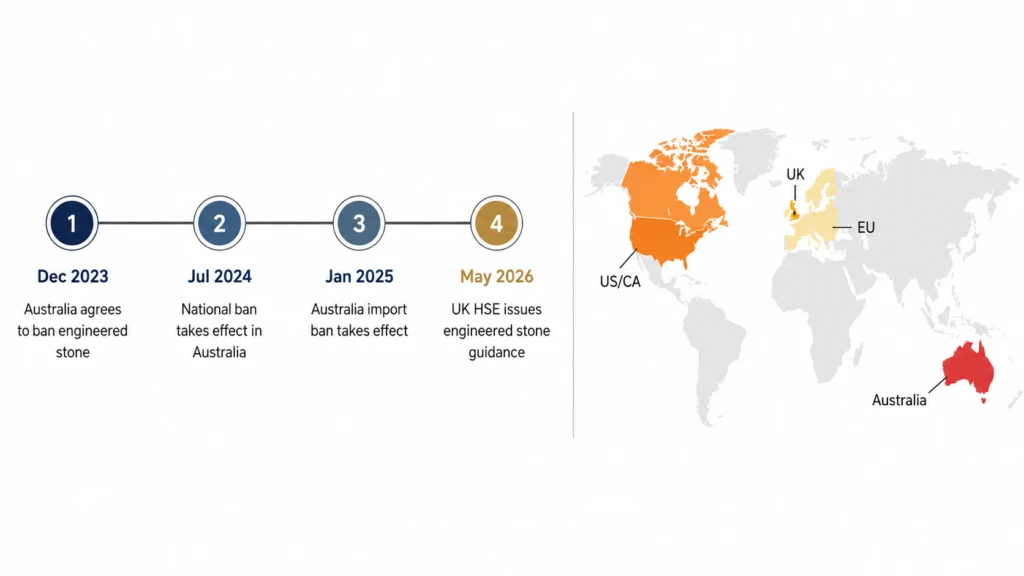
| Date | Regulatory / Market Development | Buyer Meaning |
|---|---|---|
| Dec 2023 | Australian WHS ministers agreed to implement an engineered stone ban | Australia became the first major warning signal for global quartz buyers |
| July 1, 2024 | Australia implemented the ban on manufacture, supply, processing, and installation | Australian buyers needed compliant alternatives; legacy-stone inventory became unsellable domestically |
| Jan 1, 2025 | Australia banned import of engineered stone benchtops, panels, and slabs meeting the legal definition | Importers need composition evidence before shipping AU-bound containers |
| 2025–2026 | In the United States, OSHA/NIOSH attention on engineered stone silicosis increased; California DIR intensified artificial-stone scrutiny | US buyers should treat silica documentation, SDS files, and low-silica product programs as insurance, not optional extras |
| May 2026 | The UK HSE issued engineered-stone guidance and launched inspections | UK-facing buyers should prepare for stricter fabrication scrutiny and lower-silica material preferences in commercial specifications |
| 2026+ | More markets are expected to focus on exposure control, product documentation, and labeling requirements | The procurement advantage moves to suppliers that can provide batch-specific silica evidence across multiple origins |
1.2 Australia: The Clearest Product-Level Restriction
Australia is the most important case study because it combines domestic workplace restrictions with an import prohibition. The most important threshold is the 1% crystalline silica line. Products at or above 1% are banned. Products below 1%, verified by independent lab testing, are exempt.
🔑 Key update (July 2026): The Australian market has now successfully transitioned. Low-silica alternative products have been widely adopted across the supply chain — from importers to fabricators to end consumers. This proves that the market for compliant surface products is not only viable, but growing. For global buyers, Australia is the proof-of-concept.
This is why a vague “silica free” marketing claim is not enough. Buyers should request a current test report (XRD or equivalent), review the detection limit, check whether the report is linked to the product series or batch, and match the documentation to the shipment. If a supplier cannot provide batch-specific XRD data within 48 hours of your request, cross them off your shortlist.
1.3 United States and California: No Federal Product Ban, but Stronger Exposure and Warning Pressure
The United States has not adopted a nationwide product ban on quartz or engineered stone as of this update. However, the risk environment is more serious than a simple “legal or illegal” question. OSHA’s respirable crystalline silica standard for construction sets strict exposure limits. NIOSH has published science bulletins specifically on engineered stone and silicosis. California DIR is actively developing artificial stone / silicosis policy in 2026.
California adds two additional layers of concern:
1️⃣ Proposition 65 requires clear warning labels before significant exposure to listed chemicals, including respirable crystalline silica. This means any quartz slab sold or fabricated in California must carry a Prop 65 warning at the point of sale.
2️⃣ California workplace-safety authorities have been particularly aggressive on artificial stone fabrication inspections. Los Angeles County and other jurisdictions now require wet-cutting methods and dust control on fabrication sites.
⚠ Practical advice for California sellers: Beyond the Prop 65 warning label itself, always keep a copy of the manufacturer’s Safety Data Sheet (SDS/MSDS) on file. Retail inspections and contractor submittal packages increasingly request this document as proof of due diligence. If your supplier cannot provide a batch-specific SDS, treat that as a red flag.
📥 Need help with Prop 65 compliance? AsiaQuartz provides a Prop 65 Compliance Starter Kit — including label templates, MSDS documentation guides, and a retail inspection readiness checklist. Request your copy at: asiaquartz.com/contact-us/
For California planning, link low-silica product research to a product-side evidence package: test reports, SDS, technical data sheets, batch records, QC photos, packing photos, and container documents. AsiaQuartz can provide this documentation as standard with every shipment.
1.4 United Kingdom: Guidance and Inspections Are Now Active
The UK has not announced an Australia-style product ban, but the HSE moved more aggressively in 2026. Its engineered-stone guidance tells employers to move toward low-silica material where possible, use on-tool water suppression, ensure proper ventilation, and implement health surveillance programs for workers. UK-facing buyers and fabricators should prepare for stricter scrutiny. A formal regulatory proposal is widely expected by late 2026 or early 2027.
1.5 European Union and Other Markets: Fragmented, but Buyers Are Watching
The EU does not have a single bloc-wide engineered stone product ban like Australia. Most European scrutiny remains focused on worker exposure, respirable crystalline silica controls, and occupational health documentation. Germany and France have tightened workplace silica exposure limits. However, if the UK moves forward with a ban, expect ripple effects across Europe within 2–3 years. The Middle East and Southeast Asia remain currently unaffected by bans, but global trends suggest compliance requirements may emerge within 3–5 years.
🔄 New in August 2026
The regulatory picture keeps moving. Since this guide was updated (July 2026), three additional developments have landed: Safe Work Australia relaunched the Hazardous Chemical Information System (HCIS) and published exemption infographics clarifying who qualifies for the engineered stone ban exceptions; the EU’s NEPSI network ran silicosis workshops in Brussels and Belgium (February–March 2026, 60+ and 50+ participants respectively); and Yale NSI published open-access air-monitoring research on crystalline silica exposure levels at stone fabrication facilities.
We’ve mapped the full 2026 regulatory wave — including the Cal/OSHA silica advisory committee (formed May 2026), EU NEPSI activity, SWA’s 2026 HCIS launch, and the interplay between state, federal and EU occupational policy — in our dedicated analysis: The Global Silica Crackdown: What the 2026 Regulatory Wave Means for Quartz Buyers →
2. Section 301 Tariffs: The New Cost Layer
Three days ago, something changed that’s going to reshape quartz supply chains faster than regulation did.
On July 24, 2026 — the day after Section 122’s 10% temporary surcharge expired — the USTR finalized a new Section 301 tariff on 60 economies, citing “failure to effectively prohibit forced labor imports.” The timing wasn’t accidental. The 10% surcharge under Section 122 had a 150-day statutory clock. When it ran out, the administration didn’t let the tariff wall come down — they replaced it with something wider and, in most cases, higher.
What Changed on July 24
The old Section 122 surcharge was a flat 10% on essentially everything, with limited exclusions. The new Section 301 tariff splits the world into two tiers:
| Tier | Rate | Economies | Quartz Supply Relevance |
|---|---|---|---|
| Higher | 12.5% | 46 economies: China, Hong Kong, Vietnam, Japan, South Korea, India, Australia, etc. | China, Vietnam, and India — the three largest quartz-exporting origins outside Turkey — all in this tier |
| Lower | 10% | 14 economies: EU, UK, Canada, Mexico, Indonesia, Taiwan (with MFN offset mechanism) | Indonesia and Taiwan are emerging quartz origins; Turkey ships from the lower tier |
The key detail most people miss: China doesn’t get the MFN offset mechanism. For China-origin quartz, the 12.5% stacks directly on top of base HTS duty + existing Section 301 (25%) + AD/CVD. For some HTS subheadings, that means the tariff layer count just went from four to five — and the stack got incrementally taller.
Vietnam got hit harder than many expected. Vietnamese quartz — which importers had been turning to as a way around China’s AD/CVD — now faces a 12.5% Section 301 tariff that Vietnam-origin goods didn’t previously carry. The price advantage of Vietnam-sourced slabs over China-origin just narrowed, not because China got cheaper, but because Vietnam got more expensive.
⚠ The Vietnam assumption just got more expensive: We’ve had multiple clients over the last year who shifted their supply from Chinese factories to “Vietnamese factories” — some genuine, some not. For the ones with genuine Vietnam manufacturing, the math still works better than China AD/CVD. But the 12.5% Section 301 tariff is a new line item that didn’t exist on July 23. If your landed-cost model for Vietnam was built before this week, it’s missing 12.5% of your entered value. Re-run the model before your next PO.
What This Means for Quartz Imports by Origin
| Origin | AD/CVD | Old Section 301 (25%) | New Section 301 (12.5%) | Net Impact of the Change |
|---|---|---|---|---|
| China | Yes — up to 300%+ China-wide AD, CVD up to ~190% | Yes — 25% on covered subheadings | Yes — 12.5%, stacks on top | +12.5% on entered value vs. prior 10% Section 122 — effectively +2.5% net increase, but Section 122 was temporary while this has no stated sunset |
| Vietnam | No — but anti-circumvention risk remains | No | Yes — 12.5%, entirely new | +12.5% on entered value that didn’t previously exist — substantial new cost on Vietnam quartz |
| India | Yes — producer-specific AD/CVD rates | No | Yes — 12.5%, entirely new | +12.5% new tariff layer. Combined with existing AD/CVD, India’s total duty burden increased |
| Turkey | Yes — producer-specific AD/CVD rates | No | Yes — 12.5%, entirely new | +12.5% new layer. Turkey quartz — previously one of the “cleaner” origins — now carries an additional tariff |
| Indonesia | No | No | 10% — lower tier | +10% new tariff. Indonesia is one of few quartz origins in the lower 10% tier |
| Malaysia | No | No | 12.5% — higher tier | +12.5% new tariff. Malaysia quartz operations exist but are smaller-scale |
The Lawsuit: Two Importers Push Back
Same day the tariff took effect, two US small businesses — a New York spice importer called Burlap & Barrel and a California watch retailer — filed suit at the Court of International Trade. Their argument: the administration used Section 301 to do something it was never designed to do — impose broad tariffs on 60 economies based on a systemic claim about “forced labor enforcement,” not on specific trade practices or specific countries.
This isn’t the same legal team’s first rodeo. Burlap & Barrel won a similar challenge against the Section 122 tariff back in May 2026, when the Court of International Trade ruled that Section 122’s statutory conditions weren’t met. This new lawsuit argues that Section 301 — historically used for country-specific or sector-specific trade disputes — doesn’t authorize what amounts to a near-universal tariff.
Will the lawsuit succeed? Unknown. The legal basis for Section 301 is broader than Section 122, and the administration clearly wrote the order to survive judicial review this time. But here’s what matters for importers right now: the tariff is in effect today. CBP is collecting it. Your broker needs to account for it. If the courts strike it down later and refunds become available, that’s a future problem — but your current POs and entries need to reflect current reality.
The Ripple Effects on Quartz Sourcing Strategy
Let me connect the dots between regulation and tariffs, because that’s where most importers are getting stuck.
Cost sensitivity is going up across the board. The quartz buyer in mid-2026 isn’t just paying more for slabs — they’re paying more for freight, more for insurance, more for customs brokerage (because entries are more complex), and now more in tariffs. Every percentage point on the duty stack gets multiplied by the entered value of a 20-ton container of quartz. On a $30/sqm product at 400 sqm per container, 12.5% is $1,500. That’s real money that either comes out of margin or gets passed to the end customer.
Transshipment demand is increasing — and so is scrutiny. As the China tariff stack grows taller, the economic incentive to route production through third countries grows with it. Malaysia, Vietnam, Indonesia — these are where we’re seeing new quartz production capacity and where importers are asking us to verify manufacturing. But here’s the thing: CBP knows this. Every time a new tariff layer goes on, the enforcement focus on origin verification intensifies. If you’re sourcing from Southeast Asia, your documentation needs to be better, not worse, than it was for direct China sourcing — because CBP is looking harder.
Zero-silica and high-value products become more attractive. When the base product carries a heavy tariff burden, the premium for differentiation shrinks as a percentage of total landed cost. A zero-silica slab at $45/sqm that avoids Australia’s import ban and satisfies California’s emerging requirements starts to look like a better deal when a conventional slab at $28/sqm arrives at $55/sqm after tariffs, freight, and compliance risk. We’ve seen this shift happening for about six months, but the Section 301 tariff accelerates it — because the tariff applies equally to low-end and high-end product, it disproportionately hurts the former.
Live Status — US Tariff Layers for Quartz Surface Products (updated July 27, 2026):
| Layer | Status | Applies to |
|---|---|---|
| Base HTS duty | Permanent — general or preferential rate depending on classification and origin | All imports — some subheadings carry Free rate |
| Section 301 — China 25% (original) | In effect for covered subheadings | Chinese-origin products under covered HTS subheadings — confirm applicability and exclusion status with broker |
| Section 122 surcharge (10%) | Expired July 23, 2026 | No longer in effect — replaced by new Section 301 |
| Section 301 — forced labor (new) | In effect July 24, 2026 — 12.5% for 46 economies (incl. China, Vietnam, India), 10% for 14 economies | Broadly applicable — confirm HTS coverage and tier with broker. China does not receive MFN offset |
| AD/CVD orders | In effect | China, India, Turkey — rates vary by exporter/producer |
| Section 201 safeguard | Decision stage passed July 17, 2026; no proclamation found as of July 27 | Would apply to all sources if implemented |
Multi-layer tariff stack: base HTS duty + original Section 301 (China-origin, 25%) + new Section 301 forced-labor tariff (12.5% most origins, 10% some) + AD/CVD by origin/producer + Section 201 if implemented Certificate of Origin alone; supplier assurances about tariff treatment; pre-July-24 landed-cost models that don’t include the new 12.5% layer
Is the new 301 tariff the same as the old Section 122 surcharge?
No. The Section 122 surcharge expired July 23 and is gone. The new tariff uses a different legal authority (Section 301), covers 60 specific economies rather than all imports, and the rates are 10–12.5% instead of a flat 10%. The practical effect for most quartz importers: your tariff rate just went up 2.5% compared to last week, and there’s no built-in expiration date on this one.
Does the new Section 301 apply to Vietnam quartz?
Yes — Vietnam is in the 12.5% tier. This is a completely new tariff layer that didn’t exist before July 24. Vietnamese quartz previously had no Section 301 exposure at all. If you switched from China to Vietnam sourcing in the last year, congratulations — you dodged the AD/CVD bullet, but you just picked up a 12.5% tariff that you need to factor into your next order.
I’ve been shipping through Malaysia. Am I in the 10% tier?
No. Malaysia is in the 12.5% higher tier, same as China and Vietnam. Only 14 economies got the 10% rate. Check the full list with your customs broker — the tier assignment matters for cost modeling.
Is there a quartz origin that avoids all of this?
I wish more buyers asked this before their PO went out. There’s no “clean” origin right now. Every major quartz-producing country faces some combination of AD/CVD, Section 301, or both. The question isn’t “which origin avoids tariffs” — it’s “which origin has the lowest total landed cost after all applicable duties, and can I document the origin well enough to survive CBP review?” Different answers for different products, volumes, and supply chains.
Will the lawsuit kill the tariff?
Unlikely in the short term. The Burlap & Barrel challenge has legal arguments behind it — Section 301 wasn’t designed for near-universal application — but the administration structured this order more carefully than Section 122, and the courts move slowly. If you’re making sourcing decisions this quarter, assume the tariff stays. If it gets struck down later, treat any refund as a bonus, not a budget line item.
Need an updated landed-cost review that includes the new Section 301 layer?
Send us your destination market, product type, proposed origin, and estimated volume. We’ll help you model the full chain — silica compliance + tariffs + documentation — before you commit.
Request Updated Landed Cost Review →
3. How the Ban and Silica Rules Affect Each Buyer Type
3.1 Importers and Distributors
If you import slabs for resale, your biggest risk is buying inventory that becomes hard to sell, hard to document, or impossible to import into a regulated market. Your supplier shortlist should now include factories or trading partners that can support documentation-led procurement.
Your action plan:
- Review the full product portfolio before quoting — compare standard quartz, low-silica, silica-free, printed quartz, and prefab options
- Use multi-origin planning (China, Vietnam, Thailand) to reduce single-origin risk, compare lead times, and plan tariff exposure — see our supply chain program for origin options and container planning
- Verify silica-content documents — ask whether they are product-series based, batch-specific, or only generic marketing files
- Build a separate SKU bucket for silica-free or low-silica surface programs rather than waiting until a regulation forces emergency sourcing
3.2 Fabricators and Installers
Fabricators face the highest direct health and enforcement risk because cutting and finishing operations generate dust. Low-silica materials can reduce source hazard, but they do not remove the need for workplace controls.
Your action plan:
- Use wet methods or effective on-tool dust control as required by local regulations
- Do not rely on dry sweeping or compressed air cleaning — these re-suspend respirable silica dust
- Train workers on material hazards, tool setup, respiratory protective equipment, cleaning, slurry handling, and health surveillance requirements
- Consider prefab and cut-to-size formats that reduce in-shop cutting — review prefabricated quartz countertops and cut-to-size quartz project supply options
3.3 Builders, Developers, Architects, and Project Buyers
Project buyers increasingly need submittal-ready material files, not just attractive samples. Hotels, apartments, clinics, schools, public-facing interiors, and multi-unit developments may ask for silica content, SDS, performance data, and batch traceability as part of the specification package.
Your action plan:
- For design-driven commercial projects, printed quartz slabs support marble-look visuals, batch matching, and QC documentation
- For markets requiring lower silica content, review our silica-free engineered stone and low-silica quartz-look alternatives — request samples and XRD documentation: asiaquartz.com/contact-us/
- LEED, WELL, and other green building certifications are increasingly rewarding low-silica and silica-free material specifications — specifying now positions your firm ahead of the curve
4. Low-Silica and Silica-Free Surface Options
4.1 What “Low-Silica” and “Silica-Free” Really Mean
“Low-silica quartz” and “silica-free quartz” are common search phrases, but buyers should use precise language. Many alternatives are better described as low-silica engineered stone, silica-free engineered stone, or quartz-look alternative surfaces. The key distinction: traditional quartz uses high-silica natural quartz aggregate. Low-silica alternatives replace the quartz aggregate with materials such as feldspar, recycled glass, or porcelain-derived minerals, combined with specialized resin binders.
The phrase “less than 1% crystalline silica” matters because it is the key regulatory threshold in Australia’s exemption framework. However, the claim must be supported by a credible, batch-linked test report — not a generic factory certificate. See Section 5.1 for the full compliance checklist.
🔬 Why XRD Is the Gold Standard for Silica Testing: X-Ray Diffraction is the only method that can definitively identify and quantify crystalline silica at the molecular level. Unlike basic chemical analysis, XRD distinguishes crystalline silica (the hazardous form) from amorphous silica (harmless). This is why regulators worldwide accept only XRD — not generic “chemical composition” reports — as proof of compliance. When requesting test reports, always insist on XRD.
4.2 Standard Quartz vs Low-Silica / Silica-Free Alternatives
| Factor | Traditional Quartz | Low-Silica / Silica-Free Program |
|---|---|---|
| Material direction | Quartz-based engineered stone with conventional mineral content | Alternative minerals, recycled glass, or low-silica formulations replacing quartz aggregate |
| Crystalline silica | Varies by formulation; traditional quartz can be high-silica (90%+) | Targeted at 0% or <1% options depending on product series and batch verification |
| Best-fit markets | Established quartz markets, distributor inventory, standard projects | Australia-facing review, California planning, UK/EU risk reduction, commercial specification packages |
| Buyer evidence | SDS, technical data, QC records, product specs, sample approval | XRD or equivalent crystalline-silica evidence, SDS, detection limit, batch traceability, sample-to-shipment linking |
| Appearance | Classic white, grey, Carrara, Calacatta, solids, marble look | Quartz-look and marble-look options available; final range depends on manufacturer and product series |
| Commercial caution | Legal status depends on market and fabrication controls | Still requires safe fabrication controls and local compliance review; reduced source hazard ≠ zero hazard |
4.3 Where Printed Quartz Fits
Printed quartz is not the same as low-silica material by default. It is a design and production method for controlling marble-look visuals, pattern direction, and batch repeatability with high precision. The reason it belongs in this discussion: AsiaQuartz’s printed quartz production can be paired with low-silica formulations, giving buyers a product that satisfies both the design requirements of commercial projects and the documentation requirements of regulated markets.
For more information on printed quartz specifications, samples, and low-silica pairing options, visit: asiaquartz.com/contact-us/
5. How to Source Compliant or Future-Ready Quartz Surfaces in 2026
5.1 Supplier Compliance Checklist — Before You Pay a Deposit
Before sending a deposit to any supplier, verify that their documentation package includes all three of the following:
| # | Required Item | What to Check | Red Flag |
|---|---|---|---|
| 1 | Crystalline silica test report | Method (XRD), lab name, detection limit, sample ID, product series name | Only a marketing certificate or a report that does not match the ordered product |
| 2 | Lab accreditation | ISO/IEC 17025 — SGS, Intertek, Bureau Veritas, or equivalent | Report from an unidentified lab or “in-house factory testing” without third-party verification |
| 3 | Batch traceability | Batch number, production date, PO reference, approved sample link, shipment match | Report reused across unrelated colors, batches, or customers; no PO reference |
Rule of thumb: If a supplier cannot provide all three within 48 hours of your request, cross them off your shortlist.
5.2 Documents to Request
- Crystalline silica content report with clear test method (XRD preferred) and detection limit
- SDS or MSDS for the specific product series and latest formulation
- Technical data sheet with slab size, thickness, finish, density, water absorption, stain resistance, and heat-use notes
- Batch records linking the approved sample, current production batch, and shipment
- Pre-shipment QC files: full-slab photos, surface inspection, thickness checks, packing documentation
- If exporting to Australia: Safe Work Australia exemption documentation
- If selling in California: MSDS backup copy for retail inspection readiness
5.3 QC Checklist Before Shipment
For a detailed buyer-side inspection guide, see our QC & Packing Guides. Before approving a shipment, verify all five:
- Color tone and pattern consistency across the full batch
- Slab dimensions, thickness tolerance, finish, edge condition, and visible defects
- Surface issues — no pinholes, cracks, resin pooling, contamination, or polishing inconsistency
- Packing structure — slab separation, corner protection, crate labeling, container loading angle
- Document match — test reports, SDS files, batch photos, invoice, packing list, and shipping documents all align
5.4 Questions to Ask Your Supplier
A reputable factory should answer all eight without hesitation:
1. “Can you provide a current crystalline silica test report for this product series or batch?”
2. “Which lab performed the testing, and what method and detection limit were used?”
3. “Does the SDS match the exact product name, formula, and production batch?”
4. “Can the approved sample be linked to batch photos before shipment?”
5. “Can you support low-silica or silica-free alternatives for the same destination market?”
6. “Can you provide pre-shipment slab photos, packing photos, labels, and loading records before balance payment?”
7. “Can you support China + Vietnam or other multi-origin planning if regulations, tariffs, or lead times change?”
8. “What is the MOQ for the selected color, thickness, finish, and documentation requirement?”
6. FAQ:
In most markets, yes. The strongest product-level ban is Australia’s engineered stone ban. In the United States, there is no federal product ban. California Prop 65 requires warning labels but does not ban the product. The UK and EU have not enacted product bans but have tightened fabrication and exposure rules. However, low-silica quartz (<1% crystalline silica) is exempt from Australia’s ban and is the safest option for future-proofing your supply chain.
It means the product contains less than 1% crystalline silica by weight as measured by XRD or an equivalent lab method. The 1% threshold is Australia’s regulatory cutoff: products below it are exempt from the ban. A credible test report must include the method used, the lab’s accreditation, the detection limit, and the specific product name or batch ID. A generic factory “certificate” without batch-specific, third-party verification is not sufficient.
It is a common search term, but it may not be technically precise. Many products are better described as silica-free engineered stone or low-silica quartz-look alternatives — because they replace traditional high-silica quartz aggregate with alternative minerals. Always check the specific product’s test report rather than relying on marketing terminology.
No. Lower-silica material reduces the source hazard, but fabrication still requires proper controls based on the actual material, task, local regulations, and exposure assessment. Fabricators should continue using required wet methods, ventilation, and respiratory protective equipment regardless of the material’s silica content.
A credible crystalline silica test report (XRD method, third-party lab, batch-specific). This is the single document that regulators, customs authorities, and commercial clients ask for. SDS, technical data sheets, batch records, and QC photos support it — but without the XRD report, you cannot prove compliance. See Section 5.1 for the full checklist.
Many low-silica and silica-free engineered surfaces are available in familiar marble-look, Calacatta, Carrara, solid color, and commercial neutral designs. However, appearance, finish, slab size, hardness, and fabrication behavior can vary between manufacturers. Always review physical samples — not just catalog images — before ordering.
Create a separate low-silica or silica-free product review program. Start with samples, test files, SDS, MOQ, lead time, and target customer segments. Then compare standard quartz, printed quartz, prefabs, and lower-silica engineered surfaces for each market you serve. Build your compliant inventory bucket before regulations force an emergency pivot.
AsiaQuartz can review your product program, provide samples, offer low-silica or silica-free options, discuss printed quartz designs, plan multi-origin supply routes, and provide batch QC documents with every shipment. Share your destination market, buyer type, surface interest, approximate quantity, and timeline at: asiaquartz.com/contact-us/
Yes. GB 46028-2025, China’s revised national stone safety standard, came into force on August 1, 2026. For wall-mounted stone panels and slabs, the standard mandates a minimum thickness of 20mm (2cm). Slabs below this threshold cannot be used in wall applications under the new standard. For buyers importing from China, this effectively raises the minimum usable thickness for wall-panel and high-rise facade applications. Standard 20mm and 30mm export slab formats are fully compliant. Buyers sourcing 12mm or 15mm format slabs for wall use should verify that the target market’s standard allows it, or consider upgrading to 20mm minimum. See our Quartz Slab Sizes & Thicknesses Guide for a full format comparison.
Caesarstone launched its ICON series — marketed as Crystalline-Silica Free Surface — in the US market in 2025. It is the first major Western engineered stone brand to launch a dedicated zero-silica product line at scale, directly targeting buyers in Australia, the EU, and other markets where silica content is now a procurement requirement. For China-based suppliers including AsiaQuartz, the ICON launch validates market demand for zero-silica surfaces and raises buyer expectations around documentation, testing, and batch traceability. Suppliers who can provide XRD test reports, SDS files, and independent third-party verification will have a competitive advantage as the market matures.
7. Conclusion: The Ban Is a Supply-Chain Signal, Not the End of Quartz
The engineered stone ban discussion is a market signal. It tells buyers that surface sourcing is moving from color-and-price purchasing toward documentation-led procurement. The winning buyers will not simply wait for regulations to force action — they will build flexible, documented, multi-origin supply programs now.
For importers and distributors, this creates a chance to build a future-ready product shelf and capture premium-market share as regulations expand. For fabricators, it supports safer shop planning and better customer trust in an increasingly safety-conscious market. For builders and commercial project buyers, it reduces submittal friction — specifications that arrive with complete silica documentation, SDS files, and batch evidence are faster to approve and harder to challenge.
📥 Download the Compliance Resource Pack
《Global Engineered Stone Compliance Guide & XRD Test Report Sample》
Need compliant low-silica quartz for your market? To request samples, XRD reports, Prop 65 compliance documents, or pricing for your specific destination, visit:
Please include: destination market, buyer type, surface interest, approximate quantity, and timeline.
About AsiaQuartz
AsiaQuartz is a B2B quartz surface supplier built for buyers who need controlled supply, practical communication, documentation, and container planning — not one-time retail transactions. We support engineered quartz, printed quartz, prefabs, cut-to-size, terrazzo, value-line, and project-ready surface programs from China and Vietnam.
Key resources for buyers:
- Silica-Free Surfaces — low-silica and silica-free engineered stone slab options, test files, batch QC, and sample review
- Printed Quartz Slabs — marble-look commercial project surfaces with batch matching and pre-shipment QC support
- Supply Chain — China, Vietnam, and Thailand multi-origin planning, supply continuity, and landed-cost review
- QC & Packing Guides — buyer education on documentation, inspection, and container preparation
All inquiries: asiaquartz.com/contact-us/ | Browse all guides: asiaquartz.com/guides/