CUT-TO-SIZE PROJECT SPECIFICATIONS

Cut-to-Size Quartz Specifications for Drawing-Based Project Supply

Review the quartz product, approved drawing, piece schedule, fabrication details and project controls required to produce cut-to-size components for a defined building, unit, room or project phase.

  • Drawing & Piece Schedule
  • Material & Fabrication Approval
  • QC, Labels & Project Packing

Specification principle: every finished component should remain traceable to the approved product, current drawing revision, piece number and project location throughout production and delivery.

Quick Specifications

Quick Cut-to-Size Project Specifications

Use these six areas to structure an initial cut-to-size project review. Final production requirements should remain connected to the selected quartz product, current drawing, piece schedule and approved project reference.

Cut-to-size quartz project components prepared for drawing and piece schedule review Project Specification Review
Cut-to-Size Principle Every Piece Needs a Project Reference

A finished component should be traceable to the approved drawing, piece number and intended project location rather than identified only by product color or nominal dimensions.

Project Review / Six Areas

Define These Records Before Production

Start with the project structure and approved material, then connect each finished piece to the current drawing, fabrication requirements and delivery controls.

Project Reference

Building, Phase, Unit or Room

Project-Specific

Define the project hierarchy used to identify where each component belongs, including building, floor, phase, unit, room, area or other location reference.

Product Reference

Quartz Product & Visual

Approved Product Reference

Confirm the selected product code, finish, approved sample or visual reference and the material requirements applicable to the project.

Drawing Control

Current Drawing Revision

One Controlled Version

Identify the drawing number, revision and approval status that define the current finished geometry and fabrication instructions.

Piece Schedule

Piece ID, Quantity & Location

Component-Level Traceability

Connect every finished component to its piece number, quantity, orientation and intended unit, room, area or project phase.

Fabrication Scope

Finished Component Details

Drawing-Based

Define finished dimensions, thickness, edges, splashes, cutouts, holes, corners, seams, orientation and other applicable fabrication details.

QC & Delivery Control

Labels, Packing & Project Grouping

Order-Specific

Define the inspection scope, piece identification, package grouping and delivery references required to keep finished components traceable through shipment.

Master Record

Keep One Current Project Version

Product reference, drawing revision, piece schedule and project location should remain aligned. If a drawing, fixture, quantity, orientation or piece allocation changes, the affected components should be reviewed before fabrication continues.

Planning scope: cut-to-size supply is project-specific. Product availability, material requirements, dimensions, fabrication feasibility, tolerances, QC, labeling and packing are confirmed against the current approved project and order records.

Drawing & Dimension Control

Freeze the Drawing Before Production Release

Each cut-to-size component should be produced from one controlled drawing revision. Finished geometry, measurement references, tolerances and piece identification should be clear before the affected components enter production.

Drawing Record / Current Approved Version

Define the Finished Component

Production should follow the finished component geometry and its current project reference—not only a nominal slab size, rough-cut blank or outdated drawing.

Drawing principle: fabrication references such as edges, holes, cutouts, splashes and fixture conditions should be identified on the applicable drawing or linked fabrication record.

Drawing Control / 01

Drawing Revision

Use one clearly identified drawing version for the current production release and prevent superseded information from remaining active.

Confirm Drawing number, revision, approval date, release status, applicable project phase and superseded version control.
Drawing Control / 02

Finished Geometry

Record the dimensions of the actual finished component rather than relying only on nominal material or rough-cut dimensions.

Confirm Finished length, width or depth, relevant returns, splash dimensions, corner geometry, orientation and measurement units.
Drawing Control / 03

Datum & Tolerance

Dimensions are only useful when the measurement basis and applicable acceptance requirement are understood by the relevant project parties.

Confirm Datum or reference points, measurement direction, critical dimensions, applicable tolerance, interfaces and required inspection basis.
Drawing Control / 04

Piece Identity & Location

Every drawing-controlled component should remain identifiable within the project instead of being treated as an anonymous finished piece.

Confirm Piece number, building, floor, unit, room or area, left-right orientation, quantity and applicable project or production phase.
Revision Control / Four Checks

Control Changes Before the Affected Pieces Are Released

When a project drawing changes, identify exactly what changed and which components are affected before production continues.

  • Check / 01 Change Description Record the dimension, geometry, location, fixture reference or other requirement that changed.
  • Check / 02 Affected Pieces Identify the relevant piece numbers, quantities, units, rooms, areas or project phases.
  • Check / 03 Approval Status Record whether the revision is pending, approved, replaced, released or cancelled.
  • Check / 04 Production Status Check whether affected pieces are unstarted, in production, completed or require correction.

Drawing scope: dimensions, tolerances, datum points, joints, support conditions, fixture references, site interfaces and installation-related requirements should be reviewed by the applicable project parties. Detailed edge profiles, cutouts, holes, seams and other fabrication conditions can then be controlled through the applicable fabrication record before production.

Material & Visual Approval

Lock the Material Reference Before Project Fabrication

Approve the exact quartz product and the visual references required for the current project release. Product code, physical sample, full-slab appearance and permitted visual variation should remain connected throughout the review.

Quartz samples and material references for cut-to-size project approval Material Reference Review
Approval Principle Approve More Than a Color Name

The approved material record should connect the exact quartz product with an identified physical sample, full-slab visual reference and the variation accepted for the current project.

Approval Area / 01

Exact Product Reference

Identify the actual quartz product being approved instead of relying only on a general color name, collection name or inspiration image.

Confirm Product code, finish, applicable product version, surface reference, relevant technical record and current approval status.
Approval Area / 02

Physical Sample Approval

Use an identified physical sample to establish the local color, finish and detail that will be used as an approval and comparison reference.

Confirm Sample code, approved face, finish, local tone, visual detail, approval date, approver and retained comparison reference where applicable.
Approval Area / 03

Full-Slab Visual & Pattern

A small sample cannot show the overall pattern scale, vein direction, distribution, repetition or relationship between larger visible areas.

Confirm Full-slab appearance, overall pattern scale, vein or pattern direction, distribution, orientation and any agreed layout reference.
Approval Area / 04

Variation & Future Phases

Define the acceptable visual variation for the current project and keep useful references for later phases, replacement pieces or repeat requirements.

Confirm Permitted visual variation, phase relationship, retained sample or records, comparison method and known limitations for future replenishment.
Material Approval / Four References

Keep the Approved Material Traceable

The production team and project reviewer should be able to identify which product and visual references apply to the current release without relying on an ambiguous color name.

  • Reference / 01 Product Reference Exact product code, finish, applicable version and current approval status.
  • Reference / 02 Physical Sample Identified sample, approval date and retained comparison reference where applicable.
  • Reference / 03 Full-Slab Visual Overall pattern, direction, distribution and applicable visual or layout reference.
  • Reference / 04 Project Release Identify the project phase or release to which the approved material reference applies.

Material approval scope: a physical sample or digital image cannot represent every visual characteristic of a complete slab or guarantee identical appearance across every slab, phase or future production run. Final visual acceptance should remain connected to the exact selected product and the approval references agreed for the current project release.

Fabrication Detail Review

Convert the Approved Drawing into Fabrication Instructions

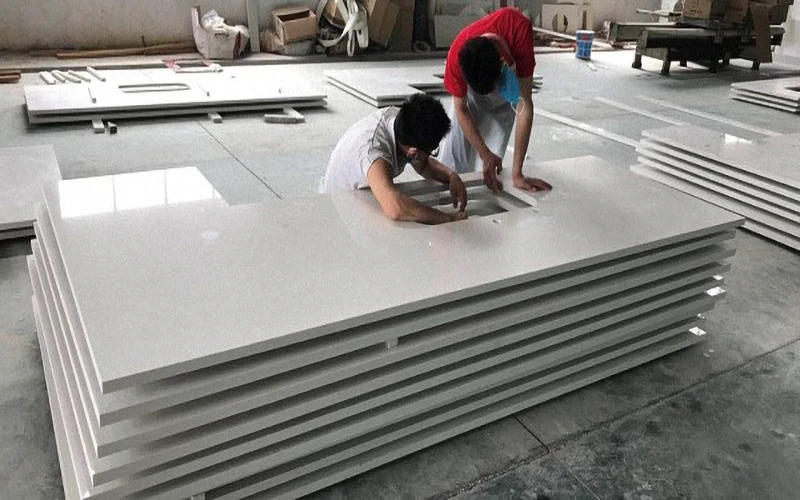
Translate the approved component geometry into the machining and finishing instructions required for each finished piece. Edge conditions, fixture openings, seams, assembly relationships and special processing notes should remain connected to the current drawing and piece reference.

Cut-to-size quartz component undergoing drawing-based cutout fabrication Drawing-Based Fabrication
Fabrication Principle Process the Exact Approved Piece

Fabrication instructions should identify the piece, visible faces, edge conditions, fixture references, assembly relationships and other processing requirements that apply to the current component.

Fabrication Area / 01

Edge & Visible Face Map

Identify which edges and surfaces remain visible after installation and define the finish required for each exposed condition.

Confirm Exposed and concealed edges, polished faces, edge profile, laminated or mitered construction, returns, end conditions, visible face and front-back orientation.
Fabrication Area / 02

Cutouts, Holes & Fixtures

Connect each factory opening to the current fixture, model or approved template instead of relying on a generic sink or appliance description.

Confirm Sink or cooktop reference, cutout geometry, reveal or overhang, corner radii, faucet and accessory holes, centerlines, clearances and applicable fixture information.
Fabrication Area / 03

Seams, Corners & Assembly

Define how adjoining pieces, returns, splashes and corners relate so individual components are fabricated for the intended assembly condition.

Confirm Seam position, joint type, inside and outside corners, returns, backsplash relationships, adjacent-piece orientation, assembly sequence and relevant alignment instructions.
Fabrication Area / 04

Special Processing & Fragile Areas

Highlight component conditions that require additional processing control, reinforcement, support or protection during fabrication and internal handling.

Confirm Narrow bridges, thin sections, large openings, fragile corners, reinforcement requirements, special support, lifting points, orientation and handling restrictions where applicable.
Fabrication Record / Four Controls

Keep the Processing Instructions Traceable

Each fabrication instruction should be identifiable at component level and remain connected to the current drawing and piece reference throughout production.

  • Control / 01 Piece Reference Piece number, project location, orientation and applicable component or assembly group.
  • Control / 02 Edge & Face Map Exposed edges, finished surfaces, visible face, returns and applicable edge construction.
  • Control / 03 Fixture & Opening Reference Applicable fixture, template, cutout, hole and other opening information for the component.
  • Control / 04 Assembly Relationship Seams, adjoining pieces, returns, corners and relationships required for the intended assembly.

Fabrication scope: fixture data, templates, edge maps, seam relationships, assembly requirements and special processing instructions should be reviewed against the current approved drawing and component reference. Site measurements, structural support, final fitting, field seams and installation remain subject to the responsibilities and requirements of the applicable project parties.

Piece IDs, Labels & Project Packing

Keep Every Finished Piece Traceable Through Project Packing

Connect each approved cut-to-size component to a consistent piece ID, project location, label and package group so the finished pieces remain identifiable from production through shipment preparation.

Piece-to-Package Map

Use One Identification Structure

A piece number should remain connected to the intended project location and the package in which that component is shipped.

  1. K-A01 Unit A / Kitchen / Left PKG-A01
  2. K-A02 Unit A / Kitchen / Right PKG-A01
  3. V-A01 Unit A / Bath 01 PKG-A02
  4. V-A02 Unit A / Bath 02 PKG-A02
  • Piece Piece ID, quantity, orientation and applicable component group.
  • Location Building, unit, room, area or other agreed project location reference.
  • Package Package number and the group of finished components contained within it.
  • Release Applicable project phase or shipment release to which the package belongs.

Identification principle: use the same piece and location references on the applicable production record, physical label and package list wherever the current order requires traceability.

Packing Control / 01

Piece ID Mapping

Use the project piece schedule as the source for identifying which finished component belongs to each location and package group.

Confirm Piece ID, intended location, quantity, orientation, component group, applicable project release and assigned package number.
Packing Control / 02

Piece Label Content

Identify the component with structured project information rather than relying on a handwritten description or product color name alone.

Confirm Project reference, piece ID, unit or room, orientation, quantity, package number and relevant handling or visible-face mark where applicable.
Packing Control / 03

Package Grouping & Protection

Group related finished pieces while considering component geometry, exposed edges, openings and other conditions that influence protection during transport.

Confirm Package number, contained pieces, separators, supports, exposed-edge protection, cutout protection, stacking direction and other component-specific protection requirements.
Packing Control / 04

Package List & Release Reference

Keep a package-level record showing which finished pieces are included and which project release or shipment group the package belongs to.

Confirm Package ID, contained piece IDs, quantities, project phase, destination reference and applicable package or shipment release identification.
Traceability Chain / Four Connections

Keep the Piece-to-Package Record Aligned

A project package should be traceable back to the individual finished components and the intended project locations contained within that package.

  • Connection / 01 Piece Identity Piece ID, orientation, quantity and applicable component group.
  • Connection / 02 Project Location Building, floor, unit, room, area or other agreed destination within the project.
  • Connection / 03 Package Identity Package number, contained piece IDs and applicable protection or handling reference.
  • Connection / 04 Project Release Project phase, shipment group or other release reference applicable to the package.

Label and packing scope: label format, package grouping, supports, separators, protection materials and package records should be defined according to the finished components and current order. Final packing design remains dependent on component geometry, fragile areas, transport conditions and the agreed shipment requirements.

Order-Specific QC & Shipment Release

Inspect the Current Project Release Before Shipment Approval

Inspect finished cut-to-size components against the current approved order references. Acceptance criteria, inspection records, identified exceptions and the final shipment release should remain connected to the affected piece and project phase.

QC Area / 01

Inspection Basis

Inspect against the same current references that define the approved finished component rather than checking against an isolated drawing, sample or verbal instruction.

Confirm Current product reference, drawing revision, piece schedule, fabrication reference, project phase and applicable QC or order requirements.
QC Area / 02

Finished Piece Inspection

Define which characteristics of the finished components will be checked and how the inspection results will be documented before release.

Confirm Applicable dimensional checks, visual and surface condition, fabrication condition, piece identity, inspection method, sampling basis, photos and acceptance criteria where agreed.
QC Area / 03

Exceptions & Disposition

Keep identified differences connected to the affected pieces and prevent unresolved items from being treated as part of an approved shipment release.

Confirm Issue description, affected piece IDs, quantities, supporting evidence, hold status, correction, replacement, accepted deviation, approval responsibility and final disposition.
QC Area / 04

Shipment Release Record

Create one release record that connects the inspected pieces, resolved exceptions and applicable packages to the shipment or project phase being approved.

Confirm Release number, included piece IDs, inspection status, approved exceptions, package references, destination, release date and applicable approval authority.
Release File / Four Connected Records

Keep the Shipment Release File Connected

The final release file should show what was approved, what was inspected, how identified differences were resolved and which pieces and packages were authorized for the current shipment or project phase.

  • Record / 01 Approved Reference Current product, drawing, piece schedule, fabrication and project release references.
  • Record / 02 Inspection Record Applicable inspection scope, results, measurements, photos and acceptance status.
  • Record / 03 Exception Record Identified differences, affected pieces, corrective action and final disposition.
  • Record / 04 Shipment & Receiving Reference Released package list, destination and applicable shipment information needed for receiving reference.

QC and release scope: inspection methods, sampling, acceptance criteria, measurements, photos, exception handling and release authority are defined according to the selected product and current order where applicable. Supplier QC and shipment-release records do not replace receiving inspection, final site measurement, structural and support review, fixture verification, local fitting, installation responsibility or agreed claims procedures.

Cut-to-Size Project Supply Review

Ready to Review a Cut-to-Size Quartz Project?

Share the selected quartz reference, available drawings or piece schedule, expected quantity, destination and target timing. AsiaQuartz can review the applicable fabrication, QC, labeling, packing and project supply requirements for the current order.

You do not need a complete project package to start. Preliminary drawings, partial piece schedules or early quantities can be reviewed first. Open technical and supply requirements can then be clarified against the selected product and current project.

Cut-to-Size Project FAQ

Common Questions About Cut-to-Size Quartz Projects

Review the key questions around drawing-based quartz supply, project files, material approval, fabrication, piece traceability, QC and shipment release.

What is cut-to-size quartz project supply?

Cut-to-size quartz project supply uses approved project drawings and piece schedules to define individual finished components before shipment. Each piece can be connected to a specific project location, fabrication requirement and identification reference.

Depending on the confirmed scope, factory work may include sizing, selected edge processing, cutouts, holes, splashes, component identification and project-based packing.

What information is needed to start a cut-to-size supply review?

Start with the selected quartz reference, available project drawing or piece schedule, expected quantity, destination and target timing. Known fabrication, QC, labeling or packing requirements can also be included.

A complete project package is not required for the initial discussion. Preliminary drawings, partial schedules or early quantities can be reviewed first, with open requirements clarified before final production approval.

How are drawings and piece schedules controlled?

Production should follow one clearly identified current drawing revision. The drawing should define the applicable finished geometry and reference points, while the piece schedule connects each component to its piece ID, quantity, orientation and intended project location.

When a drawing or schedule changes, the affected components should be identified and reviewed before those pieces continue into production.

How is the quartz material and visual appearance approved?

Material approval should identify the exact quartz product and the visual references applicable to the current project release. Depending on the product, this may include an identified physical sample and full-slab visual review.

A small sample can support local color, finish and detail review, while a full-slab visual is more useful for overall pattern scale, direction, distribution and agreed visual variation.

How are fabrication details and piece identification connected?

Fabrication instructions should remain connected to the applicable drawing and piece reference. This can include exposed edges, visible faces, fixture openings, holes, seams, adjoining pieces, orientation and other component-specific processing requirements.

The same piece ID should then remain consistent through the piece schedule, physical label and package record so the finished component can be traced to the correct project location.

How are QC and shipment release confirmed?

Final inspection should reference the current approved product, drawing, piece schedule and applicable fabrication requirements. The order may define dimensional, visual, fabrication and identification checks together with the required inspection records.

Identified exceptions should remain connected to the affected piece IDs until they are resolved. Shipment release can then identify the accepted pieces, applicable packages, approved exceptions and current project or shipment phase.

When should I choose cut-to-size instead of prefabs or full slabs?

Cut-to-size supply is generally more appropriate when individual components are controlled by project drawings, piece schedules and specific locations such as units, rooms or project phases.

Prefab supply is better suited to repeat component formats with defined factory preparation, while full-slab supply is more appropriate when templating, cutting and fabrication will be completed locally after delivery.

FAQ scope: these answers provide general project specification and supply-planning guidance. Final product availability, fabrication feasibility, tolerances, QC, labeling, packing, timing, shipment requirements and commercial terms remain specific to the selected quartz product and current order.

Request Samples, Pricing, or Supply Support

Tell us your target product, destination market, and estimated quantity. AsiaQuartz will review sample options, current availability, QC support, and container planning.

Request a Quartz Supply Quote

Tell us your product requirements, volume, and destination. Our team will review your request and provide suitable supply options.

✅ Your Quartz Quote Request Submitted Successfully!

We have received your inquiry, our sales team will contact you within 24 business hours with detailed quartz pricing & supply plan.

Thanks for choosing AsiaQuartz.