By AsiaQuartz Editorial Team
Technical review by AsiaQuartz Product, QC & Supply Chain Team
Updated: June 2026
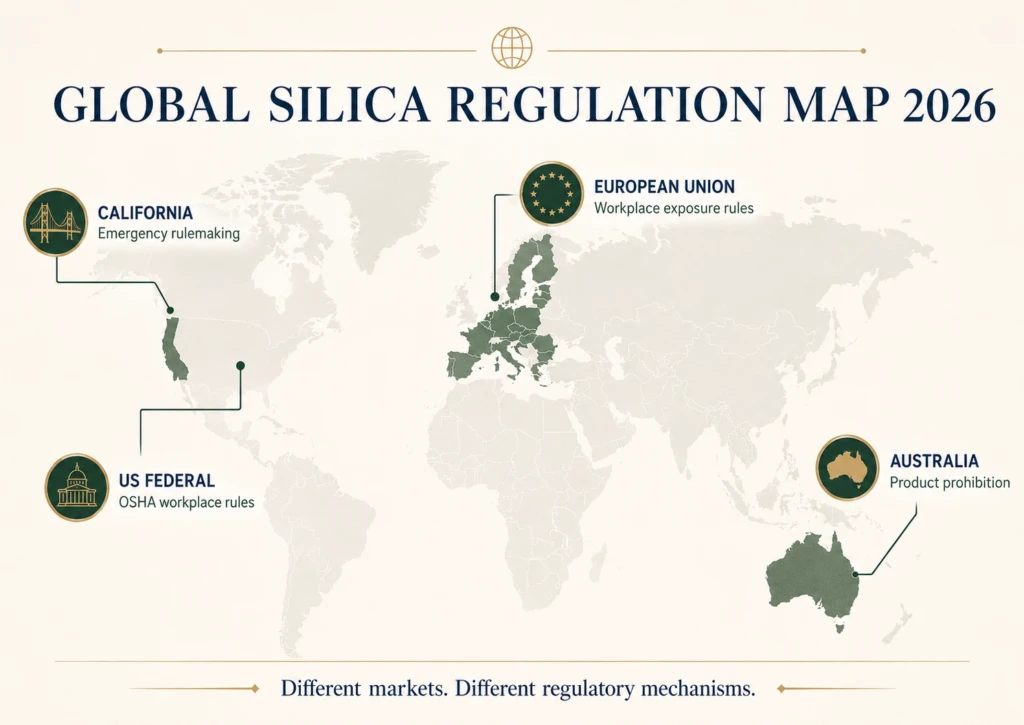
First, silica regulation is no longer moving in one direction or through one legal mechanism. Australia has a product prohibition for defined engineered stone benchtops, panels and slabs. Specifically, california is in active emergency rulemaking around fabrication of engineered stone containing more than 1% crystalline silica. The European Union continues to regulate respirable crystalline silica primarily through workplace exposure controls. While US federal OSHA continues enforcement under its existing silica standards and has refreshed engineered-stone safety guidance in 2026.
For international quartz buyers, the important point is that these systems are not equivalent. A product that can be imported into one market may still create a difficult fabrication-compliance position in another. Procurement therefore has to separate three questions: Is the product legally in scope? However, can it be fabricated under the destination market’s workplace rules? Can the supplier prove the product identity and silica position with evidence linked to the exact goods?
First, Quick answer: Australia currently has the clearest product-level restriction. California is moving through emergency rulemaking but should not be described as having an Australian-style product or import ban as of this review. Specifically, the EU and US federal systems remain primarily workplace-exposure regimes. Buyers should treat product composition evidence, test-method suitability, SKU identity and destination-market rules as separate checks.
Why 2026 Is Different
First, the 2024–2025 period was dominated by Australia’s engineered-stone prohibition and the first wave of reformulated products. In 2026, the issue has broadened. Specifically, california has moved beyond general discussion into an emergency-rulemaking process; NEPSI has renewed Europe-wide attention on artificial-stone fabrication; US OSHA continues targeted engineered-stone enforcement and now highlights a 2026 OSHA-NIOSH hazard alert; and Australia is refining post-ban implementation while transitioning its broader airborne-contaminant framework to workplace exposure limits from December 2026.
First, this creates a more complicated buyer environment. “Zero-silica,” “low-silica,” “mineral surface,” “porcelain,” “sintered stone” and conventional engineered quartz can sit in different regulatory categories depending on composition. Resin content, product form, work process and jurisdiction. Specifically, marketing names are not a substitute for classification.
Australia: Product Prohibition Plus Import Controls
What is actually prohibited
First, australia’s national engineered-stone prohibition took effect from July 1, 2024 for manufacture, supply, processing and installation of engineered stone benchtops, panels and slabs. The import prohibition for engineered stone benchtops, panels and slabs took effect on January 1, 2025.
For the model WHS framework, an engineered stone product is defined by multiple criteria. The product must contain at least 1% crystalline silica by weight, be created by combining natural stone materials with other chemical constituents such as resins or pigments. And become hardened. Certain product categories — including qualifying resin-free sintered stone and porcelain — are excluded from the engineered-stone definition.
First, Important distinction: A benchtop, panel or slab containing less than 1% crystalline silica is not simply “exempt because it is zero-silica.” Under the model definition. It does not meet the crystalline-silica criterion for engineered stone. Specifically, buyers should still confirm the full product definition, composition and evidence rather than relying on a marketing label.
Legacy stone and exemptions
First, the broad transitional arrangement for older contracts ended in 2024. In 2026, limited work with legacy engineered stone remains permitted for purposes such as removal. Specifically, repair, minor modification and disposal, subject to applicable controls and notification rules. Separate exemption, research, analysis and sampling pathways also exist. In particular, buyers should not treat old stock as a general commercial route for new supply.
What Australian importers need to show
First, australian Border Force guidance is especially useful because it describes the evidence chain at the border. Importers of benchtops, panels and slabs that resemble engineered stone may need documents showing why the goods are not prohibited engineered stone. If testing is required, the certificate should first address whether the product is engineered stone; if it is. The certificate should state the crystalline-silica percentage. Specifically, the test documentation also needs to be linkable to the actual goods being imported.
First, aBF notes that border testing may use methods such as petrographic analysis or X-ray diffraction and recommends NATA-accredited laboratories for the most reliable results. That means “send us an XRD” is too simplistic as a procurement instruction: the method. Specifically, laboratory, sample identity, product classification question and link to the shipment all matter.
2026 workplace update
First, australia is also transitioning from workplace exposure standards (WES) to workplace exposure limits (WEL) from December 1, 2026. Safe Work Australia stated in June 2026 that ministers did not reach majority support for changing the proposed limits for nine chemicals, including respirable crystalline silica. So those exposure levels will remain unchanged at the transition. The current Australian workplace exposure standard for respirable crystalline silica is 0.05 mg/m³ as an eight-hour TWA.
Buyer takeaway for Australia
For Australia-bound supply, the strongest procurement file is not a single “zero-silica certificate.” It is a product-linked evidence package: exact SKU and finish. Composition information, appropriate test evidence, sample identity, supplier declaration. And shipment documents that make it possible to connect the technical file to the goods at the border.
California: Emergency Rulemaking Is Now the Key Development
From petition to emergency-rulemaking process
First, california moved materially further in 2026 than the original draft of this article reflected. On May 21, 2026. Specifically, the Occupational Safety and Health Standards Board voted to grant a petition in part and asked Cal/OSHA to prepare the findings needed for emergency rulemaking. Cal/OSHA then convened a July 31, 2026 advisory meeting specifically on a proposed emergency regulation to prohibit fabrication of engineered stone countertops and similar products containing more than 1% crystalline silica.
First, this is a significant regulatory development, but buyers should keep the legal status precise. The July 31 action was an advisory meeting in an emergency-rulemaking process. Specifically, this article does not treat the proposed >1% fabrication prohibition as an already effective statewide product or import ban. Buyers should check the current Cal/OSHA and Occupational Safety and Health Standards Board pages before making a shipment, specification or inventory decision.
What is already in force
First, california already has enhanced silica protections under Title 8, section 5204. Cal/OSHA classifies machining and similar work on artificial stone containing more than 0.1% crystalline silica as a high-exposure trigger task requiring enhanced protections. Specifically, the current permissible exposure limit is 50 µg/m³ as an eight-hour TWA, with an action level of 25 µg/m³.
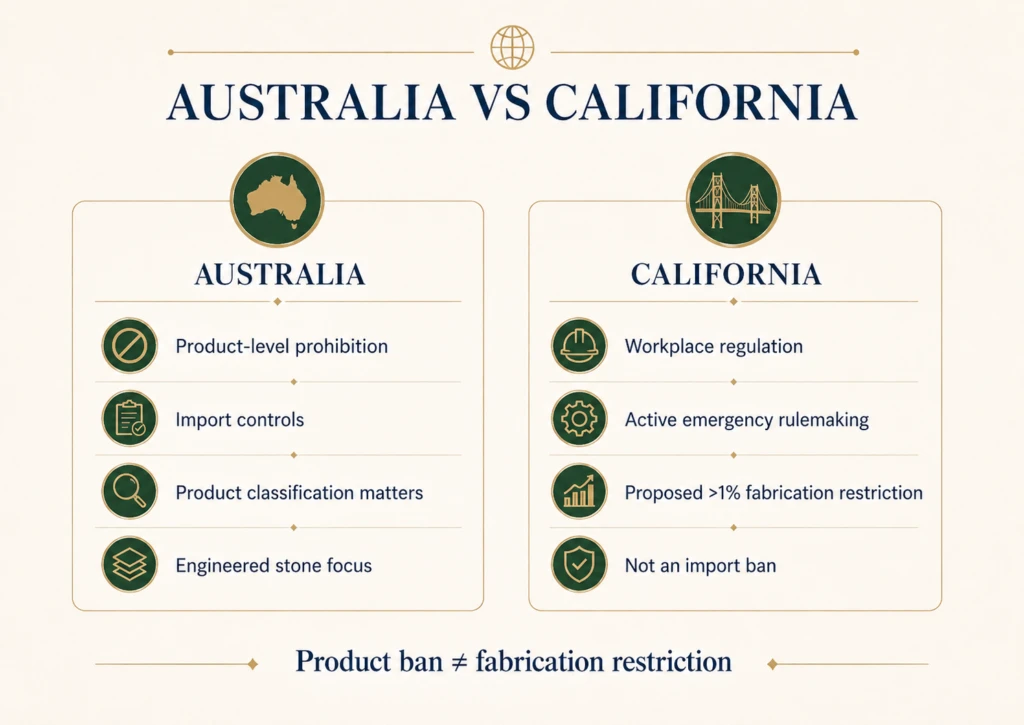
First, these rules are about worker exposure and fabrication practices. They should not be described as a customs prohibition on importing quartz slabs into California.
What it means for buyers
First, the procurement risk is downstream. If California adopts a fabrication prohibition for engineered stone above the proposed threshold, the commercial value of affected slabs could change even if the goods remain importable at the federal border. Specifically, distributors serving California should therefore review product silica content and fabrication feasibility before committing to long inventory positions.
First, Buyer implication: California is a good example of why “importable” and “commercially fabricable” are not the same question. Monitor both customs rules and workplace rules.
European Union: Binding Workplace Limit, Renewed 2026 Industry Focus
The EU framework remains occupational, not an EU-wide product ban
First, the EU has a binding occupational exposure limit for respirable crystalline silica dust generated by a work process of 0.1 mg/m³. The legal framework also recognizes good-practice initiatives such as NEPSI as complementary tools. Specifically, member States implement EU requirements through national law and may maintain or adopt stricter measures. So buyers should not assume one identical fabrication rule across every EU country.
Why 2026 still matters
First, nEPSI’s 2026 activity shows that artificial-stone fabrication remains an active European occupational-health issue. A February 12 seminar in Brussels brought together approximately 60 participants from social partners, authorities. Academia and health-and-safety fields to discuss artificial stone and safe working practices. A March 19 Belgian seminar drew more than 50 participants and focused on prevention of occupational exposure to respirable crystalline silica.
First, these events do not create a new EU product ban. They do show continuing regulatory and industry attention to exposure control, particularly where artificial stone is cut, ground or polished.
What it means for buyers
For EU-bound programs, buyers should distinguish product documentation from fabricator workplace records. An SDS, composition declaration and product-specific technical file can support the customer’s risk assessment. But workplace air-monitoring records and exposure-control plans belong to the fabricator or employer. A supplier should not promise “air monitoring records for the product” as if they were a product certificate.
United States Federal: OSHA Exposure Rules, Not a Federal Product Ban
The federal silica standard
First, uS federal OSHA continues to regulate respirable crystalline silica through workplace standards rather than an engineered-stone product prohibition. In general industry, the permissible exposure limit is 50 µg/m³ as an eight-hour TWA. And the action level is 25 µg/m³. The construction standard uses the same PEL and includes specified exposure-control methods for covered tasks.
First, oSHA’s engineered-stone focused inspection initiative and National Emphasis Program continue to make countertop fabrication a visible enforcement area. OSHA’s silica resource page also highlights a new 2026 OSHA-NIOSH hazard alert on worker exposure during countertop manufacturing, finishing and installation.
Buyer implication
At the federal level, a low-silica or zero-silica product may reduce the silica hazard profile. But procurement teams should not turn the OSHA PEL into a product specification. However, the PEL is an airborne workplace exposure limit, not a maximum silica-content percentage for an imported slab.
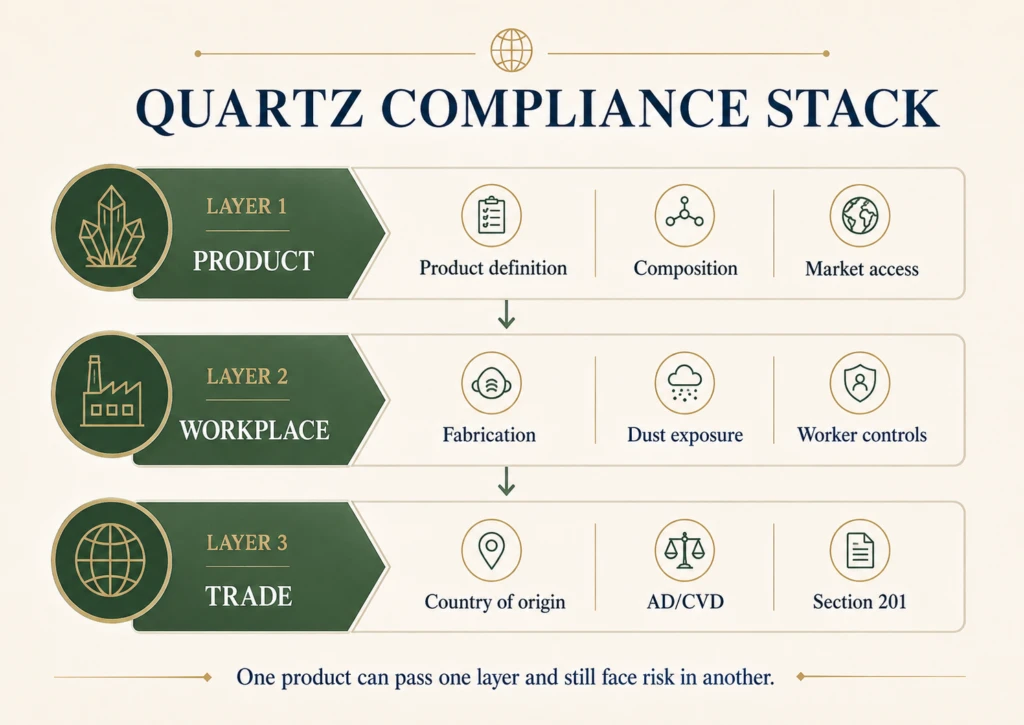
A separate trade layer: AD/CVD and the Section 201 safeguard
First, trade measures are commercially important but should be kept conceptually separate from silica regulation. Existing antidumping and countervailing duty orders on quartz surface products from China remained in place following the 2025 sunset review. Specifically, separately, the USITC recommended a Section 201 tariff-rate quota in May 2026 after finding serious injury from increased imports.
On July 31, 2026. Reuters reported that the President signed a proclamation imposing a tariff-rate quota on quartz surface product imports from several countries. Because final implementation details — including covered countries, tariff treatment, quota administration, HTS changes and effective dates — determine actual landed cost. Buyers should verify the current Federal Register, USTR. However, cBP and HTSUS position before quoting a duty rate or building a sourcing strategy around the measure.
Do not mix the two: silica rules answer worker-health and product-classification questions; AD/CVD and Section 201 answer customs and trade-remedy questions. A product can be favorable on one axis and difficult on the other.
Cross-Market Comparison for Quartz Buyers
| Market | Main mechanism | Current buyer implication | What to verify |
|---|---|---|---|
| Australia | Product prohibition for defined engineered stone benchtops, panels and slabs; import prohibition from Jan. 1, 2025 | Product classification directly determines market access | Exact composition, product definition, test method, report-to-goods linkage, import evidence |
| California | Existing workplace silica rules plus active emergency rulemaking on >1% engineered-stone fabrication | No Australian-style import ban should be assumed; fabrication risk is changing | Current Cal/OSHA rulemaking status, product silica content, downstream fabrication route |
| European Union | Binding occupational RCS limit plus national implementation and NEPSI good-practice framework | Fabricator compliance drives product acceptance; country rules may differ | Product technical file, SDS, national workplace requirements, customer fabrication controls |
| United States — Federal | OSHA workplace exposure standards; separate customs/trade remedies | No federal engineered-stone silica-content product ban; trade costs must be reviewed separately | OSHA exposure-control obligations for fabricators; current AD/CVD and Section 201 implementation for imports |
What Buyers Should Do Right Now
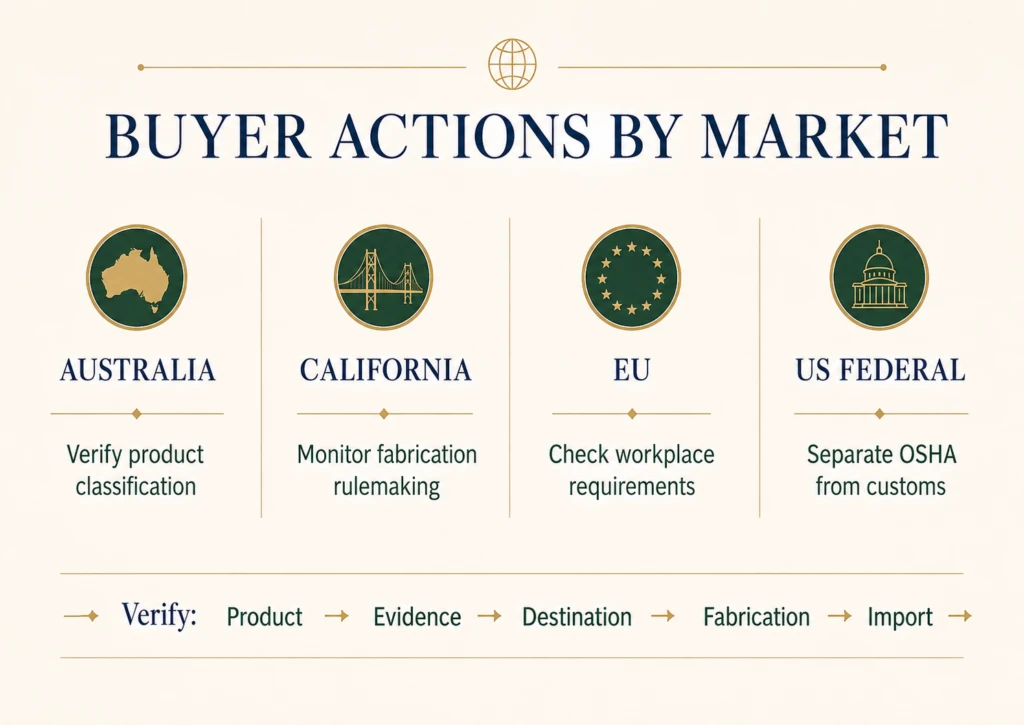
First, buyers should take a practical approach. First, define the exact question you need to answer. Specifically, are you trying to show that a product falls outside a ban, support a workplace risk review, satisfy a customer requirement. Or evaluate import exposure? In particular, each goal requires different documents, so the first step is to identify the purpose clearly.
1. Start with the destination-market question
Before you ask for certificates or test reports, confirm what the destination market actually requires. This step helps you avoid collecting documents that look useful but do not answer the real compliance question. In most cases, buyers should match the evidence request to the market, the product category, and the intended use.
2. For Australia, build a goods-linked import file
For Australia, confirm the exact SKU, product type, and composition of the imported goods. Then request supporting test evidence and product documentation that can be tied directly to that shipment. In other words, the file should relate to the actual goods being imported. Not to a general product family or a marketing claim.
3. For California, treat the >1% proposal as active rulemaking
For California, buyers should treat the proposed >1% crystalline silica rule as active rulemaking, not as enacted law. Therefore, do not make long-term inventory or fabrication decisions based on assumptions alone. However, instead, follow current Cal/OSHA and Standards Board updates and review the latest official notices before taking action.
4. For EU programs, review both EU-wide and local rules
For EU-related sourcing, check the destination country as well as the EU baseline. The EU framework sets an occupational exposure approach, but member states may apply stricter or additional requirements. As a result, buyers should confirm national rules before approving material for a specific market.
5. Separate import questions from workplace questions
First, buyers should also separate customs and import questions from workplace exposure questions. A silica-content report, an SDS. And a batch-linked test file may support sourcing review, but they do not automatically answer employer exposure obligations. Specifically, likewise, workplace dust-control rules do not automatically determine whether a product can enter a market.
6. Ask for traceable evidence, not just broad claims
First, finally, buyers should request evidence that is specific, traceable, and current. Useful examples include XRD or equivalent composition testing, SDS documentation, batch-linked production records, and sample approval files. Specifically, this approach creates a clearer purchasing record and reduces the risk of relying on incomplete or overly broad compliance claims.
First, Bottom line: There is no single “global silica rule.” Australia regulates defined engineered stone at the product level; California is moving toward possible fabrication restrictions through emergency rulemaking; the EU and US federal systems remain primarily workplace-exposure regimes. The common buyer requirement is stronger evidence: know exactly what the product is, what rule applies at destination. And whether the supplier can link the technical file to the goods you are buying.
First, Planning a quartz or silica-free program across multiple markets? Request a supply review to compare product options. Documentation requirements, QC and supply routes for your target destinations.
How this article was prepared:
- Regulatory information: Reviewed against official Safe Work Australia, Australian Border Force, California DIR/Cal/OSHA, OSHA, EUR-Lex, NEPSI and USITC materials available through August 12, 2026.
- Trade-status note: The July 31, 2026 presidential safeguard action is reported by Reuters. Buyers should use official Federal Register, USTR, CBP and HTSUS implementation documents for transaction-level duty treatment.
- Product evidence: Testing methods and documentation should be selected according to the regulatory or technical question being answered. No single report format is assumed to satisfy every market.
- Limitations: This article provides general B2B and educational information, not legal, customs, regulatory, occupational-health or laboratory advice.
First, Information status: Research cutoff August 12, 2026. Regulatory status and trade measures may change after publication. Specifically, buyers should verify current official requirements before shipment, fabrication, specification or contract commitment.
Sources and References
- Safe Work Australia, “Engineered stone ban,” accessed August 12, 2026. Safe Work Australia.
- Australian Border Force, “Engineered stone,” import prohibition and evidence guidance, accessed August 12, 2026. Australian Border Force.
- Safe Work Australia, “Publication: Decision Regulation Impact Statement: Proposed workplace exposure limits for 9 chemicals,” June 24, 2026. Safe Work Australia.
- Safe Work Australia, “WHS duties for silica,” current RCS exposure standard guidance. Safe Work Australia.
- California Department of Industrial Relations, “Standards Board Advances Efforts to Protect Workers from Silicosis,” May 22, 2026. California DIR.
- Cal/OSHA, “Emergency Rulemaking to Prohibit the Fabrication of Engineered Stone Countertops Containing More than One Percent Crystalline Silica Advisory Meeting,” July 31, 2026. Cal/OSHA.
- Cal/OSHA, “Respirable Crystalline Silica Standards and Resources,” July 2026. Cal/OSHA.
- EUR-Lex, Directive (EU) 2017/2398, binding occupational exposure limit for respirable crystalline silica dust. EUR-Lex.
- NEPSI, 2026 events: Seminar on Stones and Belgian RCS prevention seminar. NEPSI.
- US OSHA, 29 CFR 1910.1053, Respirable Crystalline Silica. OSHA.
- US OSHA, Crystalline Silica overview and 2026 OSHA-NIOSH countertop hazard alert. OSHA.
- USITC, “USITC Makes Determinations in Five-Year (Sunset) Reviews Concerning Quartz Surface Products from China,” January 10, 2025. USITC.
- USITC, “USITC Announces Remedy Recommendations in its Global Safeguard Investigation Involving Imports of Quartz Surface Products,” May 5, 2026. USITC.
- Reuters, “Trump signs proclamation on safeguard measure for quartz surface imports,” July 31, 2026.