Prepared by: AsiaQuartz Editorial Team
Technical review by: AsiaQuartz Product, QC & Supply Chain Team
Last updated: July 2026
First, ask a supplier for a marble-look engineered surface with low or non-detectable crystalline silica. And the conversation becomes more complicated than ordering either a standard printed quartz slab or a plain low-silica surface.
First, a supplier may have a light-coloured alternative-mineral slab. Another may have convincing printed veining on conventional quartz. Specifically, the difficult part is proving that the same finished product delivers the required appearance, fabrication performance, batch consistency. And silica documentation.
First, this guide is for importers, distributors, fabricators, and project buyers who need decorative surfaces for silica-sensitive markets or specifications. It explains the available product routes, the extra QC questions created by decorative layers. And the documentation chain required before a product is described as “silica-free,” “zero silica,” or “low silica.”
First, Regulatory starting point: Australia prohibits work involving covered engineered-stone benchtops, panels. And slabs that meet the legal definition, including a crystalline-silica concentration of at least 1% by weight. A covered product containing less than 1% falls outside that specific definition. But jurisdictional requirements and controlled-processing duties still need to be checked. In Great Britain, the current approach is not an Australian-style product ban: HSE requires employers to control silica exposure and. As of 2026, is enforcing guidance that rules out uncontrolled dry processing and encourages lower-silica materials. Verify the current rules in the actual destination market.
First, Low silica does not mean dust-free or risk-free. Cutting, grinding, drilling, polishing. And cleanup can generate hazardous dust from many mineral products. Specifically, material selection does not replace wet processing, effective extraction, respiratory protection, housekeeping, training, exposure assessment, or health surveillance where required.
If you need a broader explanation of the policy and purchasing framework first, see the Engineered Stone Ban Guide and the Silica-Free Quartz Procurement Guide.
1. Why Decorative + Silica-Free Is Harder Than It Sounds
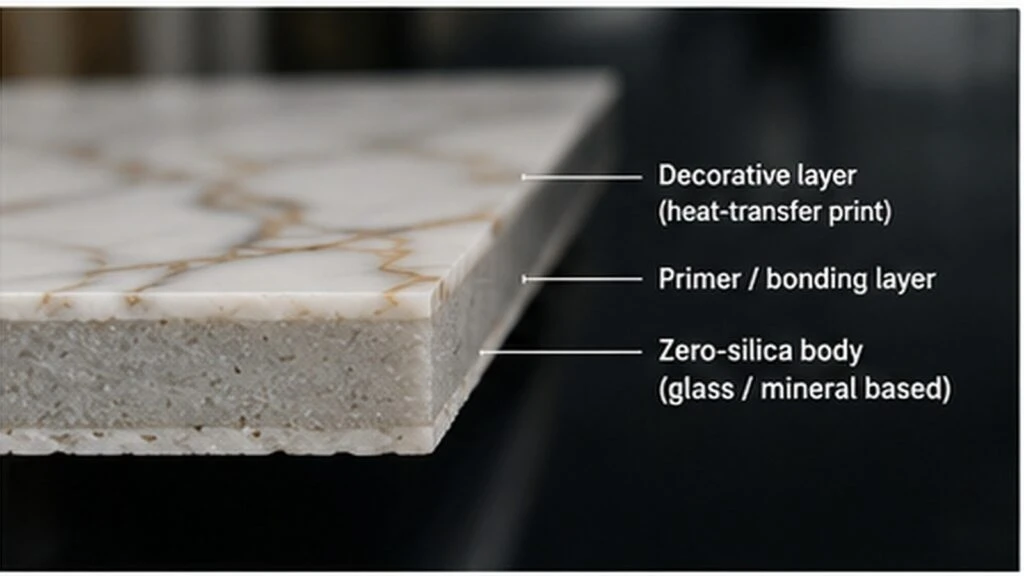
First, Conventional engineered quartz usually relies on a high proportion of quartz aggregate. Because quartz is crystalline silica, a product designed around that raw-material system cannot normally be converted into a sub-1% product through a minor resin or pigment adjustment. The filler system and formulation need to change.
First, A different body changes the decorative process. Alternative engineered-stone bodies may use glass, aluminium hydroxide, ceramic-derived materials. Or other mineral fillers. Specifically, their colour, opacity, thermal response, surface preparation. And interaction with primers, inks. Or coatings can differ from conventional quartz. A printing process that performs well on one substrate should not automatically be assumed to perform the same way on another.
First, Two claims must be controlled at once. “Decorative” is a visual and performance claim. “Silica-free” or “low silica” is a composition and documentation claim. A polished sample can look convincing while lacking a defensible test record. A well-documented low-silica body can still fail colour, print durability. Or fabrication requirements.
First, Supplier catalogues rarely prove the combined capability. Online listings and showroom slabs can identify potential suppliers. But they do not establish current formulation control, production repeatability, test scope, or batch traceability. Specifically, buyers need evidence tied to the exact SKU and decorative system being ordered.
2. Three Product Routes — and Their Different Risks
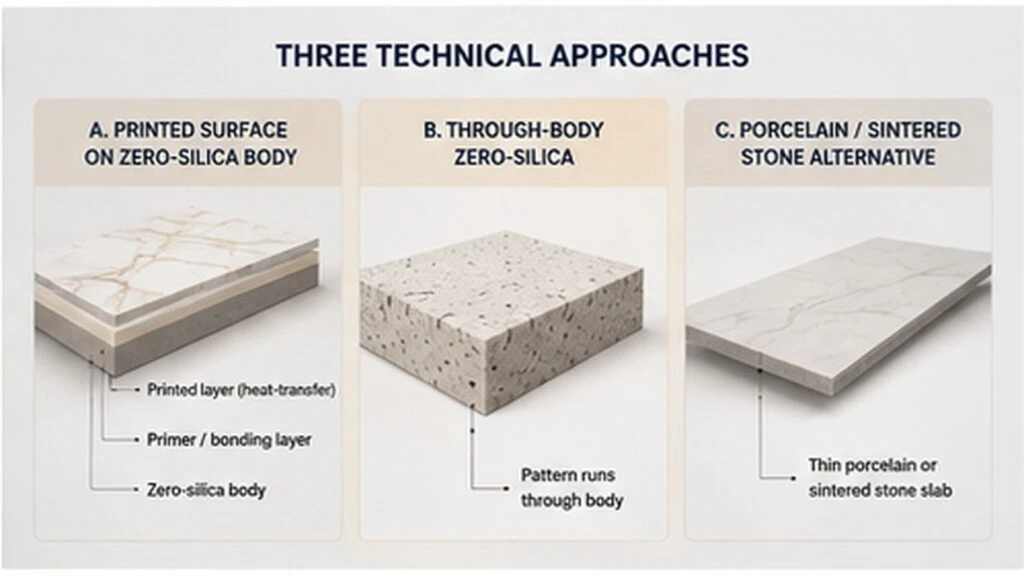
Route A: Alternative-Mineral Body + Printed or Transfer-Applied Decoration
First, this route applies a decorative image or pattern system to a resin-bound body formulated with low or non-detectable crystalline silica. Depending on the supplier, the decoration may involve transfer printing, digital printing, primers, penetrating colour systems, or protective surface treatments.
First, What can work: It can produce defined marble-look movement, directional veins. And a wider design range than many solid-colour low-silica products. Specifically, it also retains a slab format familiar to buyers of resin-bound engineered surfaces.
First, What must be verified: The complete decorative system must be validated on the actual alternative-mineral substrate. Substrate preparation, primer, ink or transfer layer, cure conditions, coating thickness. And production environment may all affect separation resistance, abrasion behaviour, colour. And chemical resistance. A test result from conventional printed quartz is not transferable evidence unless the product construction is equivalent.
First, Sample trap: One carefully selected slab proves that the supplier can make one acceptable slab. It does not prove that the process is stable across a production batch. Specifically, ask how the supplier controls substrate formulation, surface preparation, printing parameters, cure conditions, visual approval, and change management.
Route B: Alternative-Mineral Body + Integrated or Through-Body Veining
First, instead of relying on a separate surface image, this route creates colour movement or veins during mixing, distribution, pressing, and curing. The visual effect may extend into the slab body, which can improve the appearance of cut edges, sink cut-outs. And mitred details.
First, What can work: There is no discrete decorative film to separate from the body. And fabrication can reveal more natural-looking edge continuity than a surface-only image.
First, What must be verified: Alternative fillers can flow, compact, absorb pigment, and cure differently from quartz aggregate. The buyer should evaluate vein definition, full-slab balance, repeat frequency, edge appearance, sample-to-bulk colour. And variation rules. “Through-body” should be confirmed by cutting and polishing a representative sample, not accepted from a catalogue description.
Route C: Resin-Free Porcelain or Sintered Stone
First, porcelain and resin-free sintered stone are not quartz and should not be marketed as quartz. They are separate product categories with mature digital-decoration technology and different fabrication, edge, handling, and installation requirements.
First, they are also not automatically free of crystalline silica. Their mineral composition can include silica-bearing materials. Specifically, under Australia’s model WHS definition, porcelain and sintered stone are excluded from the engineered-stone category when they do not contain resin; that legal exclusion is not the same thing as a laboratory finding of zero crystalline silica. Controlled processing and worker-protection requirements may still apply.
For a project that requests a marble-look, resin-free alternative rather than quartz specifically, porcelain or sintered stone may be suitable. The fabricator must confirm tooling, cutting parameters, edge options, handling, and installation capability before substitution.
| Route | Product Construction | Main Advantage | Main Verification Risk | Buyer Action |
|---|---|---|---|---|
| A: Printed alternative-mineral body | Decorative system applied to a resin-bound low-silica or non-detect body | Wide marble-look design range | Decorative-system compatibility and durability | Test the finished construction and control batch changes |
| B: Integrated veining | Veins created within the alternative-mineral body during production | Better edge and cut-out continuity | Pattern repeatability, colour, and full-slab balance | Approve full slabs and fabricated samples |
| C: Porcelain / sintered stone | Resin-free ceramic or sintered slab with digital decoration | Mature decorative technology | Misclassification as quartz and fabrication mismatch | Confirm legal category, composition, tooling, and project acceptance |
3. QC Checks Specific to Decorative Low-Silica Surfaces
First, standard slab QC still applies: dimensions, thickness, flatness, polish, defects, labelling, packing, and quantity. Decorative low-silica products add another layer of product-specific controls.
Product Identity and Formulation Control
First, every report and commercial document should identify the exact SKU, formulation version, decorative process, and sampled production source. Ask how the supplier handles a change in filler source, resin, primer, ink, coating, production line. Or decorative file. A report tied to an old or different construction should not be treated as evidence for the current order.
Crystalline-Silica Test Scope and Sampling
First, x-ray diffraction can identify crystalline silica phases. But the report is only as useful as the sampling plan, sample preparation, analytical method, detection or reporting limit, and product identification. Specifically, request a report from a competent laboratory that clearly states:
- The exact product and formulation tested
- Whether the sample represented the body, the decorative component, or a composite of the finished slab
- The crystalline-silica phases assessed
- The analytical method and any laboratory accreditation relevant to the test
- The detection or reporting limit and how “not detected” is defined
- The sampling date, production source, and batch or lot reference where available
First, a whole-slab composite sample may be appropriate for some product claims. But a very thin decorative layer can be diluted in the total sample mass. Specifically, where the decorative formulation is uncertain, request component disclosure and discuss separate or targeted testing of the body and decorative system with the laboratory. The sampling and test plan should be agreed with the destination-market adviser or regulator when compliance depends on a specific threshold.
Decorative-Layer Separation Resistance
First, do not simply write “ISO 2409 passed” into a purchase specification without checking whether the method fits the coating thickness, texture, and substrate. ISO 2409 is a cross-cut classification method for coating resistance to separation; it is not a quantitative measurement of adhesion and is not suitable for every coating construction. Specifically, aSTM D3359 was developed for relatively ductile coatings on metallic substrates and has stated limitations when applied elsewhere.
First, ask the supplier and laboratory to select and document an appropriate method for the actual product construction. The report should identify the substrate, surface preparation, decorative layers, coating thickness, cure condition, test method, classification or result, and acceptance criterion. Specifically, where a quantitative adhesion value is required, a pull-off method such as ISO 4624 may be considered by the qualified laboratory if technically suitable.
Abrasion, Chemical, Heat, and Light Exposure
First, tests should reflect the intended application. A countertop program may need abrasion, stain and chemical resistance, heat-related evaluation. And cleaning-agent compatibility. A wall panel may have different acceptance criteria. Specifically, lightfastness or accelerated UV testing is relevant where the product will receive significant daylight or exterior exposure. But an interior-only product should not be marketed for exterior use without suitable evidence.
Visual and Fabrication Approval
First, approve the actual product combination under controlled lighting and at full-slab scale where pattern distribution matters. The QC plan should address:
- Base-body undertone and opacity
- Pattern scale, direction, repeat, and acceptable variation
- Sample-to-bulk colour range
- Surface gloss and print clarity
- Cut edge, polished edge, mitre, groove, and sink cut-out appearance
- Chipping, burning, delamination, or colour change during fabrication trials
| QC Area | Why It Matters | Minimum Buyer Evidence |
|---|---|---|
| Product and formulation identity | Reports are not transferable across different constructions | SKU, formulation version, production source, and change-control record |
| Crystalline-silica testing | “Zero silica” has no universal marketing certification | Product-specific report with method, sample scope, detection limit, and lab details |
| Decorative-system durability | Alternative substrates can change coating performance | Applicable separation, abrasion, chemical, and heat test results with acceptance criteria |
| Full-slab visual control | Small samples cannot show repeat, distribution, or slab balance | Approved full-slab images, retained reference, and batch comparison record |
| Fabrication compatibility | A visually acceptable slab may behave differently during cutting and finishing | Fabricated trial piece and written processing guidance |
4. The Documentation Package Buyers Should Request
The document list should be written into the RFQ, PI, specification, or quality agreement before production. A typical package includes:
- Product specification and formulation identifier. Exact SKU, dimensions, thickness, finish, decorative route, intended use, and current formulation version.
- Technical Data Sheet and Safety Data Sheet. Both should identify the supplied product and disclose composition and hazards at the level required by the relevant rules.
- Product-specific crystalline-silica report. It should identify the sample, method, laboratory, test date, detection or reporting limit, and result. The required sampling plan should be agreed for the destination market and product claim.
- Decorative-performance reports. Appropriate separation-resistance, abrasion, chemical, heat, lightfastness, or other performance data for the actual body-plus-decoration construction.
- Visual approval and retained reference. Approved physical sample or controlled full-slab record, together with variation rules and a batch comparison process.
- Batch QC and traceability records. Production date, lot or batch, line, inspection result, slab labels, packing list, and links to the approved SKU.
- Change-notification commitment. The supplier should notify the buyer before changing raw materials, formulation, decorative files, coatings, production source, or test scope.
- Commercial and shipment documents. PI, invoice, packing list, country-of-origin evidence, packing records, and shipping documents should use product codes consistent with the technical file.
First, “Zero silica” is a claim, not a universal certification mark. Some suppliers use the phrase to mean “no quartz aggregate,” some mean “below a laboratory reporting limit,” and others mean “below a particular market threshold.” Procurement-grade documentation must define the claim. Identify the product, explain the test method and reporting limit. And maintain traceability to the shipment.
5. How to Compare Suppliers and Pricing
First, do not rank suppliers using a platform listing or a single price per square metre. Decorative low-silica pricing is affected by the body formulation, decorative route, slab format, coating system, colour volume, testing, documentation, packing. And order size.
First, a low online listing price may refer to a plain domestic-grade slab. A minimum ex-factory quantity, a non-export packing standard. Or a product without the testing and traceability required by the buyer. Specifically, it is not a reliable benchmark for a finished decorative export program.
Compare suppliers using a capability matrix:
| Evaluation Area | Questions to Ask |
|---|---|
| Production transparency | Which facility and line make the body and apply the decoration? Who owns the specification and release decision? |
| Test-document control | Do the reports identify the exact current product? What is the test method, detection limit, and laboratory scope? |
| Decorative capability | Can the supplier show full slabs, repeat rules, fabricated edges, and batch comparison records? |
| Change control | What happens if the filler, resin, primer, ink, coating, file, or production site changes? |
| Export execution | Can the supplier provide shipment-specific QC, traceability, protective packing, loading records, and consistent documentation? |
| Commercial accountability | Who signs the PI, receives payment, approves shipment, and handles corrective action? |
First, the best supplier is not necessarily the factory with the widest catalogue or the lowest starting price. It is the supplier that can tie the approved appearance, tested construction, batch records, packing, and commercial responsibility into one controlled order.
6. A Practical Procurement Sequence
First, Step 1: Define the destination-market requirement. Write the exact legal, project, or customer requirement. Do not use “zero silica” as the complete specification. Specifically, state the crystalline-silica threshold or reporting requirement, test expectations, product category, and intended use.
First, Step 2: Choose the product route. Decide whether the requirement is for resin-bound engineered stone, through-body decorative material. Or a resin-free porcelain/sintered alternative. Specifically, confirm that the project and fabricator accept that category.
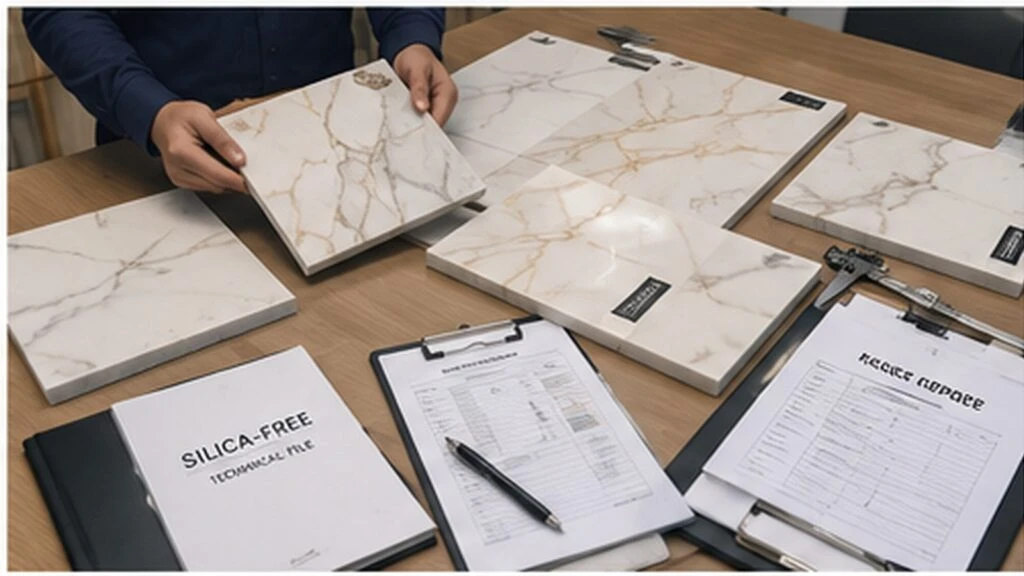
First, Step 3: Request the technical file before ordering samples. Review the TDS. SDS, current silica report, product identity, decorative-process description. And available performance tests. A catalogue image is not a technical file.
First, Step 4: Approve a production-representative sample. Evaluate colour, print or vein quality, undertone, finish, and fabricated edges. Retain an approved reference and define the acceptable variation range.
First, Step 5: Fabricate a trial piece. Cut, drill, polish, mitre, groove. And clean the material using the intended tooling and controls. Specifically, record chipping, heat response, edge appearance, print behaviour, and finishing requirements.
First, Step 6: Write the QC and change-control requirements into the order. Define inspection timing. Test records, full-slab review, traceability, packing, non-conformance handling. And approval required for any formulation or production-source change.
First, Step 7: Inspect before balance payment and shipment. Compare production against the retained reference. Review batch and test documentation, inspect packing. And confirm product codes across the slab labels, packing list, invoice, and technical file.

FAQ:
First, products are marketed for this requirement, including printed alternative-mineral bodies and integrated-vein formulations. Availability alone is not proof. Specifically, confirm that the exact finished product is outside the Australian engineered-stone definition, verify the current jurisdictional position. And review product-specific testing, sampling, traceability, and fabrication controls before purchase.
First, there is no universal answer. Performance depends on the body, surface preparation, primer, decorative layer, protective system, curing, and intended use. Specifically, test results must apply to the actual product construction rather than a conventional quartz product using a similar print process.
First, that depends on the product construction and the laboratory’s sampling plan. A representative whole-product test may support the finished-product claim. But a very thin layer can be diluted in a composite sample. Specifically, where the decorative formulation is uncertain, ask the laboratory or destination-market adviser whether separate component testing, formulation disclosure. Or targeted sampling is needed.
First, no. “Not detected” means the analyte was not detected above the method’s stated detection or reporting limit in the tested sample. The report should state the method, limit, sample identity, and result. Specifically, do not translate “not detected” into an absolute zero claim without qualification.
First, no. They may contain crystalline silica even though resin-free porcelain and sintered stone are excluded from Australia’s engineered-stone definition. They remain separate product categories and may still require dust controls during processing.
First, not automatically. ISO 2409 classifies resistance to separation using a cross-cut method; it is not a quantitative adhesion measurement and has limits relating to coating thickness and texture. Specifically, the supplier and qualified laboratory should select a method appropriate to the actual substrate and decorative system and define the acceptance criterion before testing.
First, product identity and change notification. A strong first-order report does not protect the buyer if the supplier later changes the filler. Resin, coating, decorative file. Or production source without re-approval. Require a formulation/version reference, retained sample, batch traceability, and written change-control process.
Before supplier comparison, review our silica-free decorative quartz program overview to lock the material route and documentation package first.
The Bottom Line
First, decorative low-silica engineered surfaces are commercially relevant. But the buying process requires more than combining a marble-look image with a “zero silica” label.
First, the product must be controlled as one construction: body, decorative system, finish, test sample, formulation version, batch, packing, and shipment documents. Buyers should verify the silica claim and decorative performance independently, then link both to the exact ordered SKU through traceability and change control.
First, ask for the product-specific test report. Ask what was sampled. Specifically, ask whether the decorative system was included. Ask for a fabricated trial and batch-level visual record. Most importantly, do not accept a catalogue label in place of a defined specification.
Request a Decorative Low-Silica Supply Review
How this article was prepared:
- Regulatory context: Australia’s definition and prohibition were reviewed against Safe Work Australia guidance current to July 30, 2026. Great Britain information was reviewed against Health and Safety Executive guidance and 2026 enforcement communications. Destination-market rules can differ and change.
- Technical standards: Coating-test descriptions were checked against the published scopes of ISO 2409:2020 and ASTM D3359-23. Crystalline-silica analytical context was reviewed against NIOSH Method 7500 and NIOSH silica guidance. The suitability of any method for a specific product must be confirmed by a competent laboratory.
- Product and procurement analysis: The product-route and QC framework reflects general engineered-surface supply practice and AsiaQuartz product, QC, and supply-chain review. It is not test data for a specific supplier or SKU.
- Pricing: No universal price or platform-listing price is presented as an export benchmark. Commercial terms must be confirmed for the exact specification, quantity, documentation package, packing, origin, and destination.
- Limitations: This article is not legal, regulatory, occupational-health, laboratory, customs, or project-specification advice. Buyers, employers, fabricators, and installers remain responsible for obtaining product-specific documentation and complying with applicable requirements.
First, Information status: Based on information reviewed through July 30, 2026. Regulations, supplier capability, product availability, test methods, customs treatment. And commercial terms may change. A small sample does not represent every characteristic of a full slab or every permitted production variation.
Sources and References
- Safe Work Australia — Silica: Engineered stone ban
- Safe Work Australia — Guidance supporting the engineered-stone ban
- UK Health and Safety Executive — Working engineered stone: Control silica risk
- ISO 2409:2020 — Paints and varnishes: Cross-cut test
- ASTM D3359-23 — Rating adhesion by tape test
- NIOSH Method 7500 — Crystalline silica by X-ray diffraction
Continue Reading
- Silica-Free Quartz Procurement: What B2B Buyers Should Know Before Sourcing — Supplier verification, testing documentation, pricing factors, and the core procurement framework.
- Engineered Stone Ban Guide: What Buyers, Importers & Fabricators Must Know — Jurisdiction-specific policy and procurement implications.
- What Is Printed Quartz? A B2B Guide to Benefits, Limitations, QC, and Sourcing — Decorative technology and the checks buyers should complete before ordering.
- The Silica-Free Shift: 2024–2026 Bans and the Global Quartz Industry — How alternative materials and lower-silica products are reshaping sourcing decisions.
- Quartz Slab QC & Packing Guide for Importers — The standard slab-inspection and packing controls that still apply.
- Ready to source? Explore AsiaQuartz Silica-Free Surface options →