By AsiaQuartz Editorial Team
Technical review by AsiaQuartz Product, QC & Supply Chain Team
Updated: June 2026
For quartz and surface importers serving Australia, silica compliance is no longer only a factory-floor issue. SafeWork NSW is expanding worker registration, inspection, exposure-notification and health-monitoring systems. While Australia’s national engineered-stone prohibition continues to shape which products can be supplied and processed. The practical buyer question is therefore not simply “Does this product contain silica?” but “How is the product classified, what evidence supports that classification. And what obligations apply when the material is processed in NSW?”
NSW silica enforcement — quick buyer summary
- NSW’s Silica Worker Register is mandatory for workers undertaking high-risk crystalline silica substance processing.
- SafeWork NSW continues active inspections, improvement notices, prohibition notices and WES-exceedance notifications across silica-exposed industries.
- Silica remains a named hazardous-substances priority in SafeWork NSW’s 2026–27 Regulatory Statement.
- For importers, product evidence should be matched to the exact product and regulatory question; a marketing term such as “low-silica” is not, by itself, proof of Australian market eligibility.
Quick Answers
First, What does the NSW Silica Worker Register show?
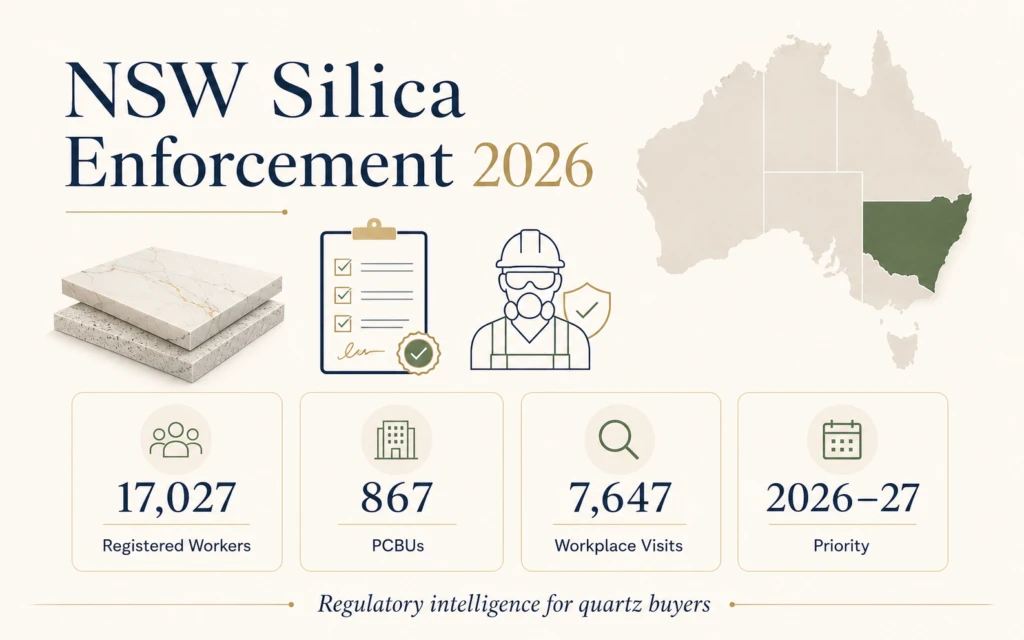
SafeWork NSW launched the register on October 1, 2025. By February 2026, SafeWork NSW reported 13,295 registered workers and 669 PCBUs. Specifically, the NSW Silica Dashboard snapshot used for this article showed 17,027 workers and 867 PCBUs as of June 30, 2026.
First, Who must be registered?
PCBUs must register workers who undertake high-risk processing of crystalline silica substances, generally within 28 days of the worker starting that high-risk work. Registration is not triggered merely because a business handles an imported surface product.
First, Is silica still an enforcement priority in 2026–27?
Yes. SafeWork NSW lists hazardous substances as one of four key regulatory priorities and specifically identifies silica. Specifically, the regulator reported more than 145 silica-related notices and more than 45 silicosis reports in the preceding 12 months.
First, Can quartz importers still supply Australia?
Yes, depending on the product. Buyers must distinguish prohibited engineered stone from products that fall outside the engineered-stone definition or otherwise satisfy applicable rules. Specifically, product classification and evidence should be reviewed before shipment rather than inferred from the words “zero-silica,” “low-silica,” “mineral surface,” or “quartz alternative.”
Why NSW Enforcement Data Matters for Importers
First, australia’s engineered-stone prohibition operates at the national policy level. While state and territory regulators enforce workplace health and safety requirements in their jurisdictions. In NSW, SafeWork NSW now has a growing enforcement infrastructure around crystalline silica: worker registration. Air-monitoring notifications, health-monitoring requirements, workplace inspections and targeted regulatory priorities.
For importers, these systems matter because they influence what fabricators and distributors will ask from suppliers. Customers increasingly need to understand what the product is, whether its processing is permitted, how much crystalline silica it contains. And what workplace controls apply when it is cut, ground or polished.
First, Important: “At least 1% crystalline silica” is one element of Australia’s engineered-stone definition. It should not be treated as a stand-alone rule that automatically classifies every material containing 1% or more crystalline silica as prohibited engineered stone. Specifically, product composition, manufacturing route and the complete regulatory definition must be reviewed.
Silica Worker Register: What the Numbers Mean
First, the NSW Silica Worker Register (SWR) requires relevant PCBUs to register workers undertaking high-risk processing of crystalline silica substances. SafeWork NSW states that each relevant worker must generally be registered within 28 days of starting high-risk silica processing work.
Registration Snapshot
| Metric | Count | Reference point |
|---|---|---|
| Workers registered | 17,027 | NSW Silica Dashboard snapshot, June 30, 2026 |
| PCBUs with registered workers | 867 | NSW Silica Dashboard snapshot, June 30, 2026 |
| Workers in tunnelling projects | 4,237 | SafeWork NSW communique, February 17, 2026 |
| PCBUs in tunnelling projects | 57 | SafeWork NSW communique, February 17, 2026 |
First, the register is not an engineered-stone register. It covers workers undertaking high-risk processing of crystalline silica substances across sectors such as construction, tunnelling, manufacturing and stonemasonry. Specifically, being listed on the register also does not mean a worker has necessarily been exposed above the legal limit; SafeWork NSW describes it as a preventative system that helps identify workers who may require health monitoring.
What This Means for Surface Suppliers
First, a surface supplier should not assume that every customer cutting a silica-containing product must automatically register every worker. The PCBU must assess whether the processing is high risk. Specifically, safeWork NSW says that assessment should consider the type of processing, silica form and concentration, frequency and duration, likely airborne exposure. And relevant air- or health-monitoring results.
For buyers, this reinforces an important distinction: product silica content is an input to workplace risk assessment. Not a substitute for it.
Enforcement Activity: Inspections, Notices and WES Exceedances
First, safeWork NSW has conducted silica-related inspections across construction, engineered stone and other silica-exposed industries since 2018. The NSW Silica Dashboard snapshot used for this article reported the following cumulative enforcement activity through June 2026.
Cumulative Enforcement (July 2018 – June 2026)
| Action Type | Count |
|---|---|
| Workplace visits (total) | 7,647 |
| — Construction | 4,842 |
| — Engineered stone | 1,815 |
| — Other industries | 999 |
| Improvement notices | 3,616 |
| Prohibition notices for uncontrolled silica dust exposure | 231 |
| On-the-spot fines for dry cutting without controls | 34 |
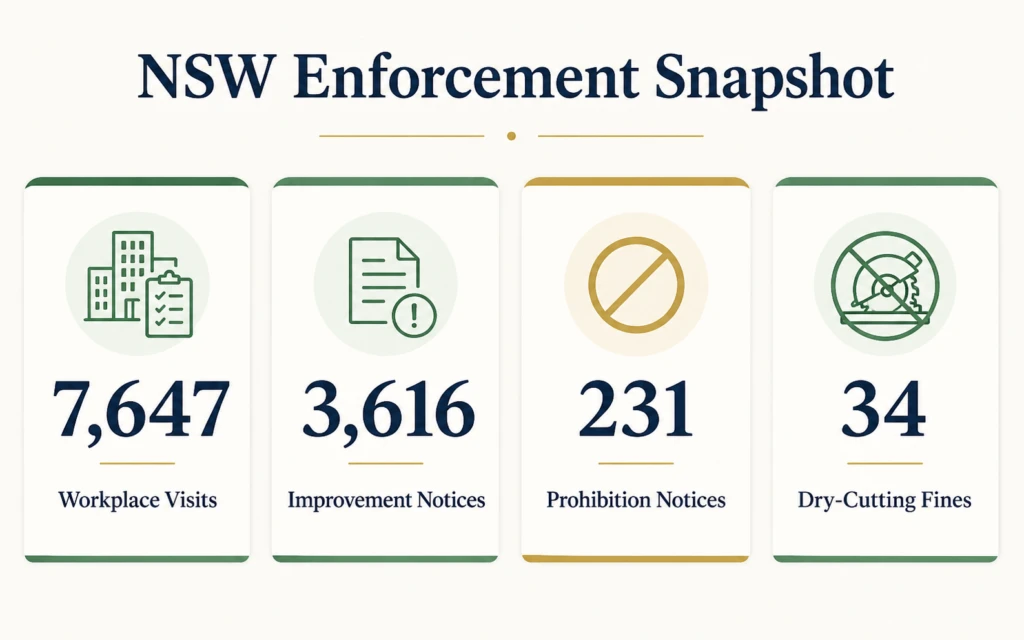
First, Source: NSW Silica Dashboard snapshot accessed August 12, 2026. Dashboard figures should be treated as time-specific and may change after publication.
WES Exceedance Notifications
Since September 1, 2024. PCBUs undertaking high-risk crystalline silica processing in NSW must notify SafeWork NSW when air-monitoring results exceed the respirable crystalline silica workplace exposure standard. However, the current WES is 0.05 mg/m³ as an eight-hour time-weighted average. SafeWork NSW requires notification as soon as reasonably practicable and no later than 14 days after receiving the relevant air-monitoring result.
- 2024 (from September): 50 WES exceedance notices
- 2025: 204 notices, excluding mining
- 2026 H1: 107 notices in the dashboard snapshot used for this article
First, these figures cover silica exposure across multiple industries. They should not be interpreted as engineered-stone-only enforcement data.
Silicosis Data: Why the Issue Remains Active
First, nSW continues to record confirmed silicosis diagnoses. The data should be read as an occupational-health indicator rather than as a measure of current product demand: silicosis can reflect historical exposure over many years. And cases occur across engineered stone, construction and other silica-generating industries.
Confirmed Silicosis Cases Reported in NSW
| Financial Year | Cases | Deaths |
|---|---|---|
| 2024–25 | 59 | 5 |
| 2023–24 | 115 | 10 |
| 2022–23 | 65 | 9 |
| 2021–22 | 64 | 10 |
| 2020–21 | 57 | 7 |
| 2019–20 | 107 | — |
Source: NSW Silica Dashboard snapshot accessed August 12, 2026.
FY2026 Snapshot
First, the dashboard snapshot used for this article reported 52 confirmed cases in July 2025–June 2026. Of these, 10 were associated with manufactured/engineered stone and 26 with construction. Specifically, the figures underline why silica remains a regulatory priority. But they do not establish that a particular current product or supplier caused a reported case.
2026–27 Regulatory Priorities: Silica Remains a Named Risk
First, safeWork NSW’s 2026–27 Regulatory Statement identifies four priority areas: falls from heights, psychosocial risks, hazardous substances, and mobile plant, vehicles and fixed machinery. Under hazardous substances, SafeWork NSW specifically highlights silica and reports that inspectors issued more than 145 silica-related notices and received more than 45 reports of silicosis cases during the preceding 12 months.
First, the Tunnelling Dust Safety Taskforce also continues to operate. This is important context because NSW’s silica enforcement framework now extends well beyond benchtop fabrication into other high-risk processing environments.
WES to WEL: What Changes on December 1, 2026
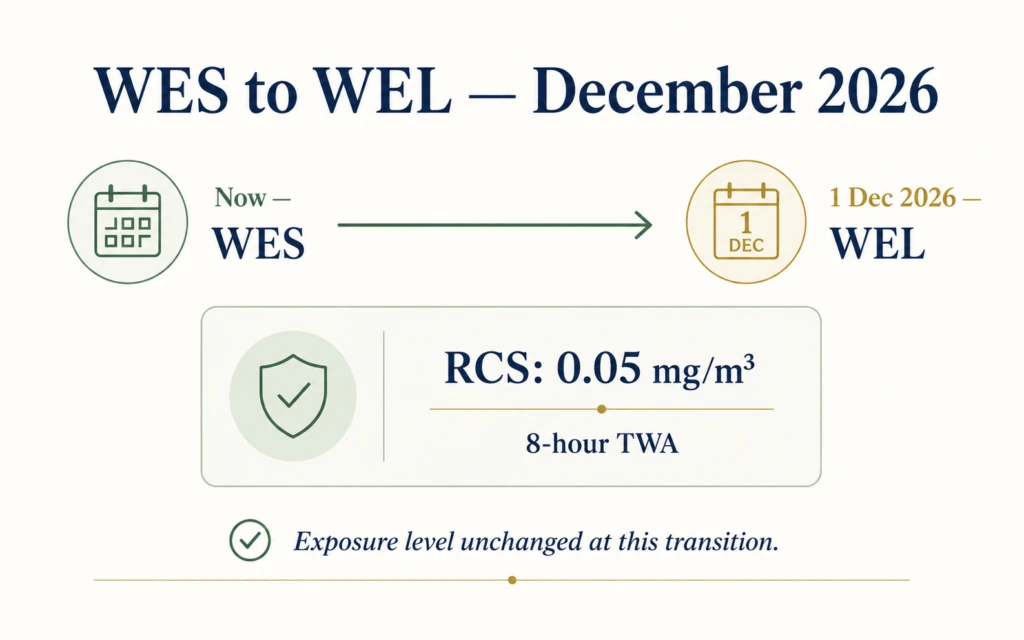
First, australia will transition from the term workplace exposure standards (WES) to workplace exposure limits (WEL) on December 1, 2026. Until then, PCBUs must continue to comply with the existing WES framework.
For respirable crystalline silica, Safe Work Australia confirmed in June 2026 that there will be no change to the exposure level on December 1. 2026 because ministers did not reach majority support for a new level for the nine chemicals under additional review. The RCS level will therefore remain aligned with the current 0.05 mg/m³ eight-hour TWA when the terminology transitions from WES to WEL.
For suppliers, this is mainly a terminology and customer-communication change. Workplace exposure limits apply to airborne workplace exposure; they are not product silica-content specifications.
What Surface Importers Should Actually Prepare
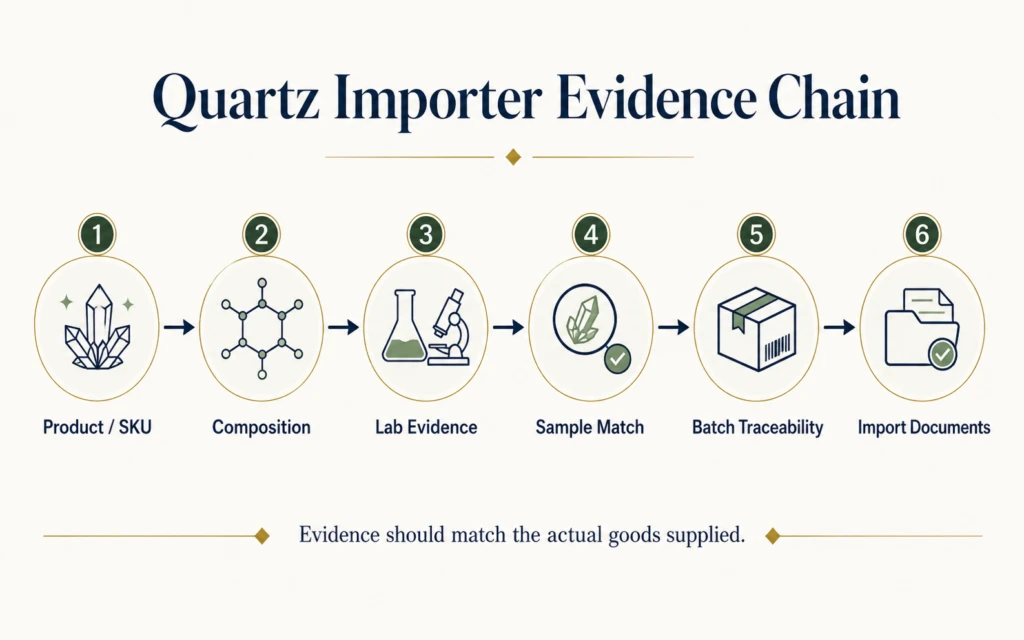
First, nSW’s enforcement data does not create a universal rule requiring every importer to hold the same laboratory document. Instead, buyers should build evidence around the exact regulatory and commercial question they need to answer.
| Buyer Evidence | Why It Matters |
|---|---|
| Exact product / SKU identification | Links technical evidence to the product actually being purchased. |
| Composition information | Supports product classification and customer risk assessment. |
| Appropriate laboratory evidence | May support crystalline-silica or product-classification questions when the method fits the purpose. |
| Test method and laboratory identity | Helps the buyer assess whether the report actually answers the regulatory question. |
| Sample / report match | Reduces the risk that evidence relates to a different formulation or product. |
| Production and batch traceability | Provides a clearer link between approved evidence and subsequent supply. |
| Shipping / import documents | Helps connect the technical file to the goods being imported where required. |
First, Do not over-standardise the test method. XRD can be relevant to crystalline mineral-phase identification or quantification. But the appropriate test method depends on the question being answered. Specifically, buyers should avoid treating a single generic XRD certificate — or an SDS alone — as universal proof of Australian product classification.
Why Zero-Silica Alternatives Are Receiving More Attention
First, australia’s prohibition and NSW’s workplace enforcement both increase the commercial value of products that can be clearly classified outside the prohibited engineered-stone category and supported by traceable technical evidence. This is one reason silica-free engineered surfaces and other alternative surface categories are receiving more attention from Australian distributors and fabricators.
First, however, low-silica is not the same as Australia-compliant. A reduced-silica product may still meet the engineered-stone definition if it contains at least 1% crystalline silica and satisfies the other definition criteria. Buyers should therefore evaluate the exact composition and product category rather than assuming that “low-silica” automatically creates a compliant pathway.
For product options and documentation strategy, see our Silica-Free & Low-Silica Surfaces page and Zero-Silica Quartz Australia Buyer Guide.
Next Steps for Quartz Importers
- Classify the product before negotiating around a marketing label. Confirm what the material actually is and whether it falls within the engineered-stone definition for Australia.
- Ask for product-linked evidence. Match composition data, laboratory reports and supplier declarations to the exact SKU, formulation and approved sample.
- Separate importer evidence from workplace obligations. SWR registration, health monitoring, silica risk-control plans and air monitoring are PCBU/workplace duties; suppliers can support customers with product information but should not present those duties as supplier certificates.
- Review low-silica claims carefully. Reduced silica may improve exposure risk, but it does not automatically solve Australia’s product-prohibition question.
- Monitor the December 2026 WEL transition. Update customer-facing terminology and review any new jurisdiction-specific implementation guidance.
Need to build an Australia-ready surface supply file?
First, asiaQuartz can review product options, available composition and laboratory evidence, sample approval requirements. QC records and supply documentation for your target market. Request a supply review.
How this article was prepared:
- NSW regulatory information: Reviewed against SafeWork NSW’s Silica Worker Register guidance, crystalline silica technical guidance, WES exceedance notification requirements, 2026–27 Regulatory Statement and Tunnelling Dust Safety Taskforce communications.
- Dashboard data: Registration, enforcement and silicosis figures identified as NSW Silica Dashboard snapshots are time-specific figures recorded in the source material accessed August 12, 2026. Live dashboard values may change after publication.
- National framework: Product-prohibition and WES/WEL context was reviewed against Safe Work Australia guidance. Importers should also review Australian Border Force requirements for border evidence where applicable.
- Limitations: This article provides general business and educational information. It is not legal, customs, laboratory, regulatory or occupational-health advice. Obligations depend on product classification, workplace activities, jurisdiction and any applicable permissions or exemptions.
First, Information status: Based on publicly available information reviewed through August 12, 2026. Regulations, enforcement priorities, dashboard values and workplace requirements may change. Specifically, buyers should verify current requirements with the relevant regulator, customs authority and qualified professionals before shipment, fabrication or contract commitment.
Sources and References
- SafeWork NSW, “Silica worker register (SWR) notification,” accessed August 12, 2026. SafeWork NSW.
- SafeWork NSW, “Tunnelling Dust Safety Taskforce Communique,” February 17, 2026. SafeWork NSW.
- SafeWork NSW, “SafeWork NSW redefines its priorities in new 2026–27 Regulatory Statement,” July 1, 2026. SafeWork NSW.
- SafeWork NSW, “Workplace Exposure Standard (WES) exceedance notification,” accessed August 12, 2026. SafeWork NSW.
- SafeWork NSW, “Crystalline silica – technical fact sheet,” accessed August 12, 2026. SafeWork NSW.
- NSW Government, NSW Silica Dashboard, snapshot accessed August 12, 2026. Supports the time-specific registration, enforcement and silicosis figures reported in this article.
- Safe Work Australia, “Engineered stone ban,” accessed August 12, 2026. Safe Work Australia.
- Safe Work Australia, “Publication: Decision Regulation Impact Statement: Proposed workplace exposure limits for 9 chemicals,” June 24, 2026. Safe Work Australia.
- Australian Border Force, “Engineered stone,” import prohibition and evidence guidance, accessed August 12, 2026. Australian Border Force.
Related Reading
- Silica Compliance by Market: Australia, US, EU & China — cross-market regulatory comparison.
- The Global Silica Regulatory Wave: What 2026 Means for Quartz Buyers — 2026 developments across Australia, California, the EU and US.
- Engineered Stone Ban Guide — Australian prohibition, definitions and buyer implications.
- Zero-Silica Quartz Australia: Buyer & Importer Guide — product evidence and sourcing considerations for Australia.
- Silica-Free & Low-Silica Surfaces — product direction and B2B supply review.
- Silica-Free Surface Guides — full guide cluster.