Prepared by: AsiaQuartz Editorial Team
Technical review by: AsiaQuartz Product, QC & Supply Chain Team
Last updated: July 2026
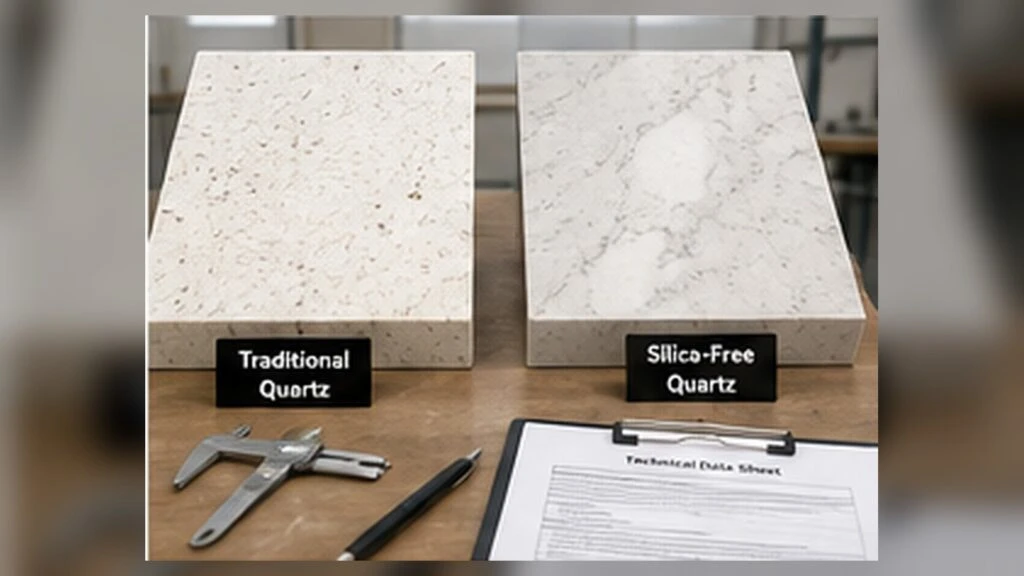
This silica-free quartz comparison helps B2B buyers evaluate cost, performance, fabrication requirements, compliance risk and application fit.
Silica-free quartz is no longer a niche catalogue item. Importers, distributors and project buyers are now asking whether a lower-crystalline-silica or silica-free resin-bound slab can reduce fabrication risk, satisfy market requirements and still deliver the appearance, yield and durability expected from traditional engineered quartz.
The correct answer is not a universal “switch” or “stay.” It depends on the destination market, the exact product formulation, the application, the fabricator’s process, the documentation package and the total landed cost—not only the FOB price.
Scope of this comparison
This guide compares two resin-bound slab categories: conventional engineered quartz containing substantial crystalline-silica aggregate, and alternative-aggregate slabs marketed as silica-free or very low in crystalline silica. It does not compare porcelain, resin-free sintered stone, natural stone or acrylic solid surface. Product performance and legal treatment must be verified for the specific SKU and destination market.
First, Define What “Silica-Free” Means for the Product
“Silica-free” is a commercial description, not a complete technical specification. A slab may replace crystalline quartz or cristobalite with recycled glass, glass frit, alumina trihydrate, other minerals or proprietary blends. Glass can contain silica in an amorphous form, so a claim about crystalline silica is not the same as a claim that the product contains no silicon dioxide.
For procurement, the important question is measurable: what crystalline-silica phases are present in the finished product, at what reported concentration, using what sample preparation and reporting limit?
Minimum evidence for a crystalline-silica claim
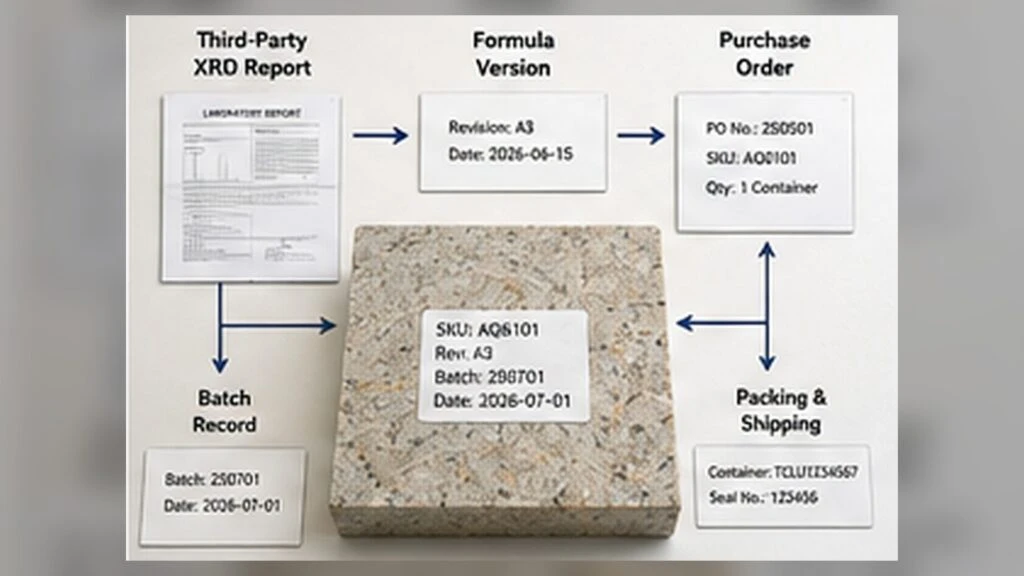
- Product identity: exact SKU, formulation or revision code, thickness, finish and production route.
- Representative sample: a finished-product sample that represents the body and any decorative layer, with the sampling method recorded.
- Third-party mineral analysis: a report from a competent laboratory that identifies the analytical method, crystalline phases evaluated, detection or reporting limits, uncertainty where available, and the result for quartz, cristobalite and tridymite as applicable.
- Laboratory scope: evidence that the laboratory is competent for the method and sample type; accreditation should be checked against the actual scope, not only the laboratory logo.
- Change control: a requirement to re-evaluate the claim when the aggregate, resin, pigment, decorative layer, supplier or production route changes.
- Traceability: a link between the tested product version and the purchase order, production batch and shipment records.
Do not confuse workplace air methods with bulk-product certification.
NIOSH Method 7500 is an XRD method for crystalline silica collected on air-sampling filters. It is useful for occupational exposure assessment, but it should not automatically be cited as the method for quantifying crystalline silica in a finished slab. Ask the laboratory to state the bulk-material method, sample preparation, reporting limit and suitability for the product matrix.
Cost Comparison: Build a Landed-Cost Model, Not a Price Table
There is no reliable universal premium for silica-free quartz. Price differences change with aggregate route, resin system, colour, printed decoration, finish, slab size, MOQ, factory changeover, testing requirements and order volume. A fixed “per slab” range becomes stale quickly and can be misleading when used across factories or markets.
Compare both options using the same written specification and the same cost boundary:
| Cost Element | Questions for Traditional Quartz | Questions for Silica-Free Quartz |
|---|---|---|
| Product quotation | Is the quote tied to the exact colour, finish, size, thickness and packaging? | Is the quote tied to the tested formulation and decorative route? |
| MOQ and changeover | Can standard production be combined with other orders? | Is there a dedicated run, line-cleaning requirement or minimum batch? |
| Sampling and development | Are existing references sufficient? | Is a new colour, print file or formulation trial required? |
| Testing and documentation | Which performance and workplace documents are required? | Add finished-product crystalline-silica evidence and formulation traceability. |
| Fabrication yield | Use established cutting, polishing and repair assumptions. | Run trial cutting, edge polishing, mitres, sink cut-outs and adhesive compatibility checks. |
| Logistics | Model legal payload, slab count, crate weight and breakage allowance. | Use the same model; do not assume identical density or slabs per container. |
| Customs and trade remedies | Confirm classification, origin, scope and exporter-specific cash deposits. | Composition may change classification or scope analysis, but it does not create an automatic exemption. |
| Commercial risk | Include claims, rejected slabs, regulatory exposure and customer acceptance. | Include document gaps, formulation changes, market acceptance and replacement lead time. |
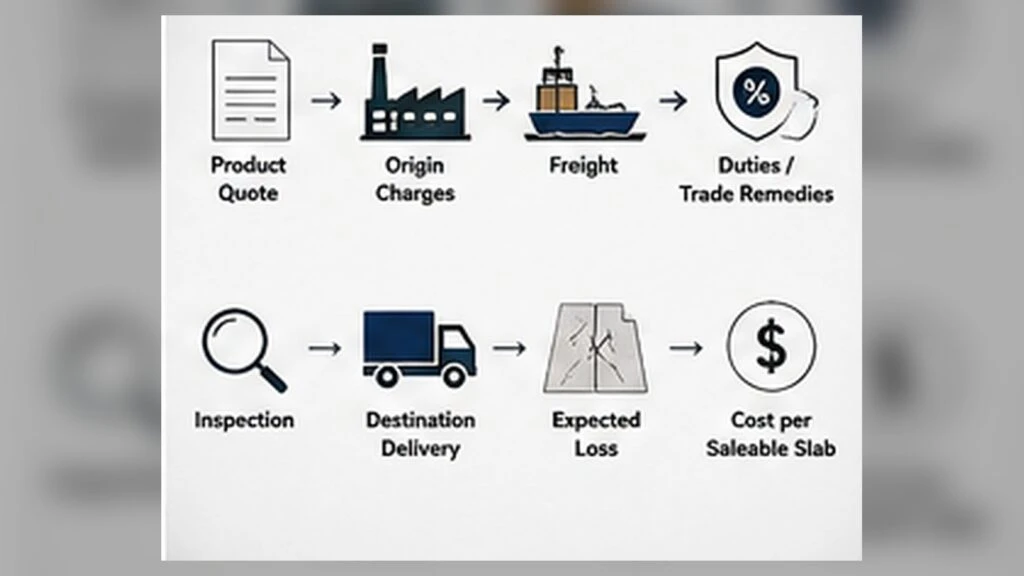
A practical landed-cost model is:
Landed cost per saleable slab = (product + inland origin + export charges + freight + insurance + duties/trade remedies + destination charges + inland delivery + inspection/testing + expected loss) ÷ saleable slabs received.
For US imports, do not insert a single “combined AD/CVD rate” into every model. Quartz surface-product orders from China are subject to written scope language, product-specific rulings and exporter or entity-specific cash-deposit instructions. The written scope—not the HTS code alone—is controlling. A customs broker can classify a product, but a binding scope question may require Commerce review.
Performance: Compare Test Evidence, Not Category Reputation
Traditional quartz does not automatically outperform every silica-free formulation, and silica-free quartz does not automatically match traditional quartz. Resin chemistry, aggregate shape and grading, compaction, cure, decorative-layer construction, finish and thickness all affect performance.
| Performance Area | What to Verify | Why a Simple Category Ranking Fails |
|---|---|---|
| Scratch and abrasion | Applicable abrasion/scratch method, finish, load, cycles and acceptance criteria. | Mohs hardness of an ingredient does not directly predict the scratch behaviour of a resin-bound composite surface. |
| Stain and chemical resistance | SKU-specific exposure to the actual cleaners, foods, cosmetics or chemicals used in the project. | Resin cure, porosity and finish can matter more than the aggregate label. |
| Heat and thermal shock | Declared use limits, hot-object or thermal-shock test conditions and care instructions. | Both categories are resin-bound and generally require protection from direct high heat. |
| Flexural and impact behaviour | Test method, specimen orientation, thickness, support conditions and edge-impact trial. | Formulation and processing can reverse the result between two products in the same category. |
| Colour and UV stability | Indoor/outdoor rating, light-exposure test, colour measurement conditions and warranty exclusions. | Pigments, resin and decorative layers—not only aggregate—control colour change. |
| Fabrication | Sawing, CNC routing, mitres, edge polishing, repair, adhesives and printed-edge appearance. | A laboratory pass does not prove acceptable yield or appearance in the buyer’s fabrication process. |
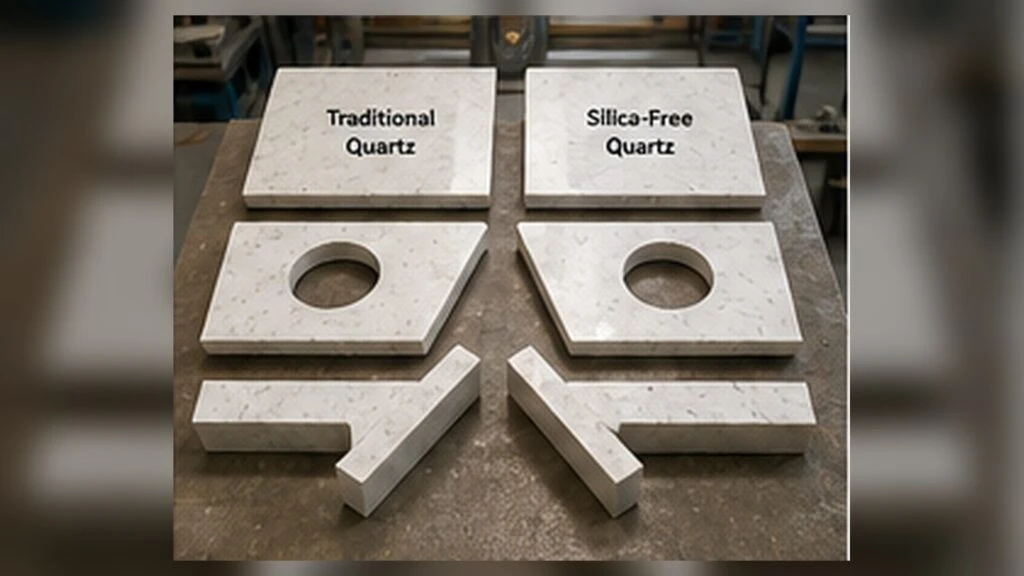
Recommended qualification sequence
Approve the product identity and documents first, then test a physical sample, then fabricate a representative trial piece, and only then approve a production batch. For printed products, include edge appearance, decorative-layer durability, print-file version and full-slab pattern scale in the approval.
Regulatory Context by Market
Australia
Australia’s model work health and safety rules prohibit work involving the manufacture, supply, processing or installation of engineered stone benchtops, panels or slabs that meet the legal definition, including a crystalline-silica concentration of at least 1% by weight. An artificial resin-bound slab reported below 1% crystalline silica may fall outside that definition, but the product identity, sample and analytical result must still be defensible. Other dust and workplace-safety duties remain.
California and the wider United States
California has a permanent respirable-crystalline-silica standard with enhanced controls for artificial and certain natural stone work. In 2026, California also began emergency rulemaking and advisory work on a proposed prohibition covering fabrication of artificial-stone products containing more than 1% crystalline silica. That proposal should not be described as an already-effective product ban unless and until the regulation is adopted.
At federal level, OSHA’s silica rules remain exposure-based. Lower crystalline-silica content can reduce one hazard source, but it does not automatically remove employer duties or make dry fabrication acceptable. Dust from glass, mineral filler, resin and other ingredients still requires risk assessment and appropriate controls.
European Union
EU Directive 2017/2398 added work involving respirable crystalline-silica dust generated by a work process to the Carcinogens and Mutagens framework and established an occupational exposure limit. Requirements are implemented through national law. This is an occupational-exposure regime, not an EU-wide ban on selling engineered quartz.
Which Product Route Fits the Order?
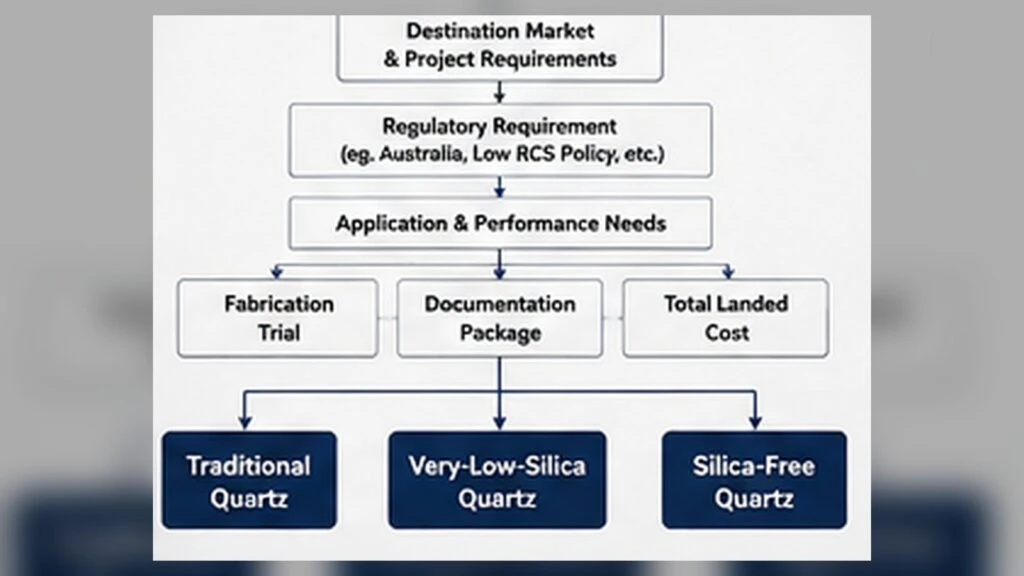
| Order Condition | Likely Direction | Approval Gate |
|---|---|---|
| Australian benchtop, panel or slab work | A product demonstrably outside the prohibited engineered-stone definition | Product identity, representative crystalline-silica report and local compliance review |
| Fabricator actively reducing RCS exposure | Evaluate very-low-crystalline-silica or silica-free options | Workplace risk assessment, trial fabrication and dust-control plan |
| Price-sensitive market with no product prohibition | Compare both categories | Full landed cost, legal scope and customer demand |
| High-design printed project | Choose by approved visual and durability evidence, not category name | Large sample, full-slab images, edge trial and batch-control agreement |
| US import from China | Obtain product-specific customs and trade-remedy review | Written scope analysis, origin evidence and current cash-deposit instructions |
Before building your landed-cost model, verify the material route in our silica-free vs low-silica surface classification.
Purchase-Order Checklist
- Exact product name, SKU, formulation/revision code, dimensions, thickness and finish
- Approved physical sample and, for patterned products, full-slab visual approval
- Crystalline-silica report requirements, sample identity, reporting limit and change-control trigger
- Applicable performance tests with methods, test conditions and acceptance criteria
- Fabrication trial covering cutting, holes, mitres, edges, repair and adhesives
- Batch colour/pattern rules, print-file version and replenishment plan
- Packaging, labels, production records, QC photos and retained reference sample
- Destination-market legal, customs, AD/CVD and origin review
- Warranty boundaries, claim procedure and replacement responsibility
FAQ
Not necessarily. Glass and other materials may contain amorphous silica. The procurement issue is usually the concentration of crystalline silica—quartz, cristobalite and tridymite—in the finished product.
It may substantially reduce the respirable-crystalline-silica hazard when the claim is valid, but fabrication can still generate other mineral, glass and resin dust. Employers must assess the actual process and maintain appropriate wet methods, extraction, housekeeping, training and respiratory protection where required.
There is no universal “90-day” or “six-month” validity rule for every market. The correct frequency depends on legal requirements, formulation stability, supplier controls and contract risk. At minimum, the report must clearly apply to the product version being shipped, and any material or process change should trigger review and possible retesting.
Possibly in some product configurations, but never assume. Commerce’s written scope focuses on composition and contains specific inclusions and exclusions. Obtain product-specific advice from a qualified customs professional and consider a scope ruling when uncertainty is material.
Further Reading
- Silica-Free Decorative Quartz: B2B Buyer Guide
- Silica-Free Decorative Quartz QC Checklist
- Engineered Stone Regulation and Compliance Guide
- Quartz Slab Supply Chain Guide
Official references reviewed
- Safe Work Australia — Engineered stone ban
- Cal/OSHA — Respirable crystalline silica standards and resources
- Cal/OSHA — 2026 artificial-stone rulemaking advisory information
- US OSHA — 29 CFR 1910.1053
- EUR-Lex — Directive (EU) 2017/2398
- US Department of Commerce — Quartz surface products from China scope information
Limitation: This article is procurement guidance, not legal, customs, occupational-health or engineering advice. Verify the current rules and product-specific facts for the actual transaction.