By AsiaQuartz Editorial Team
Technical review by AsiaQuartz Product, QC & Supply Chain Team
Updated: June 2026
First, every few years the quartz industry gets asked the same question by a new wave of buyers: should we be sourcing sintered stone instead? Right now. With silica regulations tightening and large-format porcelain slabs getting cheaper, that question is louder than it’s been in a long time. And it deserves a straight answer — but a straight answer requires looking at the two materials as procurement problems, not just as surfaces.
First, we coordinate quartz supply for importers and project buyers across North America, Australia. And Southeast Asia, and we’ve watched the sintered stone wave roll in over the last few years. Specifically, some buyers moved aggressively and built strong programs on porcelain slabs. Others moved because porcelain looked cheaper per square meter and discovered the difference evaporates once you price fabrication, breakage, and edge work. In this guide we give you the sourcing-side comparison we wish someone had handed us before our first sintered stone RFQ: supplier structure. Price models, thickness economics, container planning, QC. And the 2026 compliance angle.
Knowledge Tree — Skip to What You Need
- Quick sourcing comparison table
- Supplier structure: who actually makes what
- Price models & thickness economics
- Container planning & breakage risk
- QC differences at the factory
- 2026 compliance: the silica angle
- Sourcing decision framework & FAQ
First, Scope note: This guide compares engineered quartz in general with sintered stone and large-format porcelain slabs, from a procurement and sourcing perspective. If your decision is specifically about printed quartz (decorative ink-jet quartz with marble-look surfaces) versus porcelain, we have a dedicated comparison — Printed Quartz vs. Natural Marble vs. Porcelain — because the design-control question changes the calculus. Specifically, the two guides cover different product decisions and can be read together for a full picture.
The Quick Sourcing Comparison
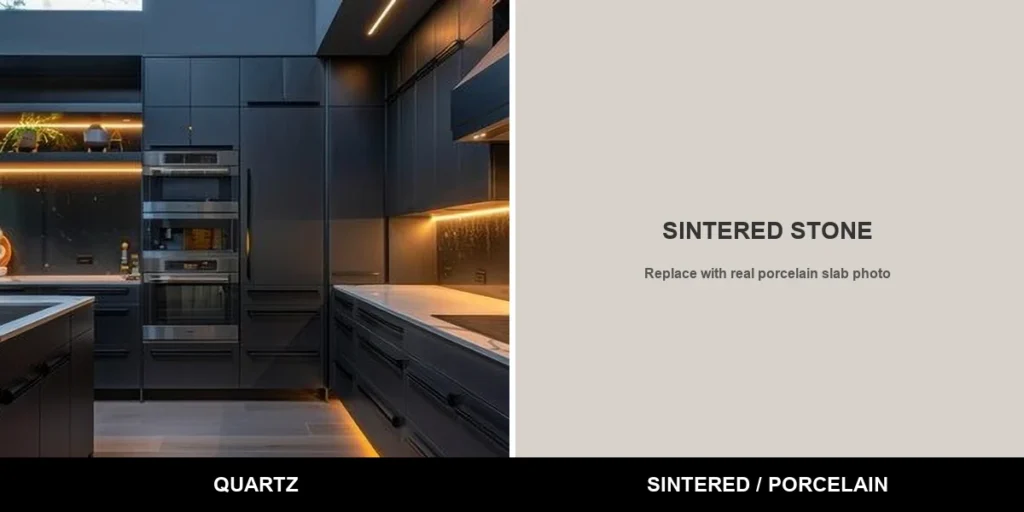
First, the table below compares the two materials the way a sourcing manager thinks: where the product comes from. How price behaves, how it ships. And where the risk sits. Material-level performance (heat, scratch, UV. Specifically, design control) gets covered in our quartz slab guides and the printed quartz guide — this table stays on procurement.
At-a-glance comparison: the eight sourcing factors that drive the decision
| Sourcing factor | Engineered quartz | Sintered stone / porcelain slab |
|---|---|---|
| Production base | Engineered stone lines (mixing, pressing, curing, polishing) — mature, standardized | Ceramic / tile manufacturing lines with large-format pressing and kiln sintering — capacity concentrated in fewer players |
| Typical thickness range | Standard 20 mm and 30 mm; 12/15 mm special-use only | 6–20 mm common; 12 mm a frequent countertop choice; thinner formats for walls and facades |
| Weight per area | Heavier at standard thicknesses; predictable density per product | Lighter at thin formats; density is lower than quartz — weight advantage shrinks at 20 mm |
| Price behavior | Stable, recipe-driven; price varies by design, finish, and grade | Aggressive entry pricing in thin formats; tooling/processing costs often underestimated |
| Repeat-order matching | Strong with documented batch controls and retained samples | Good batch consistency from kiln-controlled production; design runs can be discontinued |
| Breakage / handling risk | Moderate; brittle but forgiving under normal slab handling | Higher in thin formats; edge chipping and transit breakage need stronger packing discipline |
| 2026 silica compliance | Under engineered-stone scrutiny; documentation (SDS, silica content, COA) now routine | Fired ceramic product — generally outside engineered-stone bans; lower crystalline silica exposure profile |
| Fabrication ecosystem | Fabricators widely equipped and experienced | Needs diamond tooling, CNC experience, and careful edge handling; less universal |
First, read that table once more and you’ll see the real difference isn’t “which is prettier.” It’s that quartz is a mature, standardized manufacturing category with a deep fabrication ecosystem. While sintered stone is a newer large-format category with thinner economics and a different risk profile. For some buyers that’s exactly why they switch; for others it’s exactly why they stay.
Supplier Structure: Who Actually Makes What
The two products come from different factory worlds, and that shapes your supplier evaluation from day one.
Quartz comes from engineered stone plants
First, quartz slabs come from engineered stone manufacturers: factories with mixing systems, vibro-compression presses, curing lines, and polishing lines. The supplier landscape is broad — hundreds of producers across China and other manufacturing hubs, at very different quality levels. Specifically, that breadth is why supplier evaluation frameworks exist: you can compare factories on equipment, batch discipline, and QC process. Our quartz slab supplier guide and the supply chain guide cover how to run that comparison.
Sintered stone comes from the ceramic industry
First, sintered stone and large-format porcelain slabs come out of the ceramic industry: body preparation, high-pressure large-format pressing, digital decoration. And kiln firing at high temperature. Specifically, capacity is more concentrated — large-format kiln lines are expensive, and fewer players operate them. That changes the negotiation dynamic: your supplier shortlist for sintered stone may be shorter. And the factories you deal with may be bigger and less flexible than a mid-size engineered stone plant.
First, there’s also a practical overlap worth knowing: several large Chinese producers make both quartz and sintered stone. And some source quartz slabs from partner plants. If you’re comparing the two materials, it’s worth asking a dual-line supplier for both catalogs — it simplifies logistics and gives you a single QC relationship. But don’t assume one line’s quality carries over to the other; evaluate each product stream on its own.
Price Models & Thickness Economics
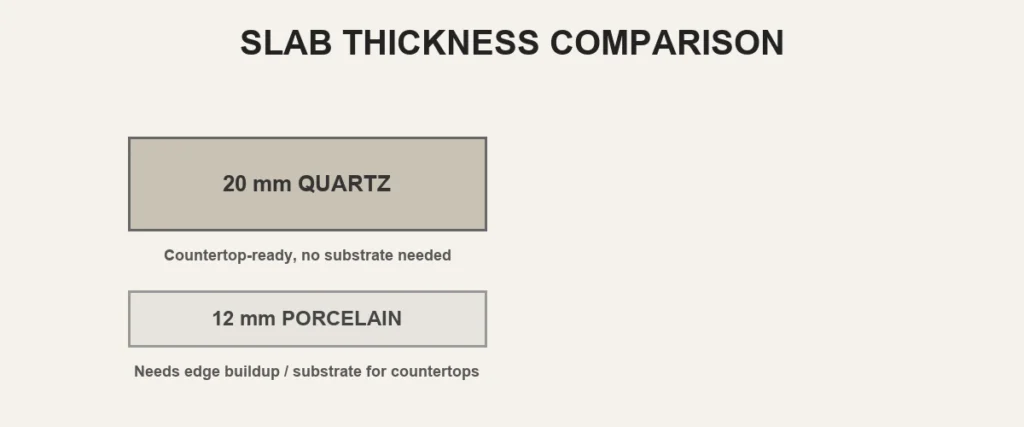
First, this is where the “porcelain is cheaper” story gets complicated. And it’s worth understanding the math before you build a business case on it.
Thin-format pricing vs. countertop reality
On a raw per-square-meter basis, thin-format sintered stone (6–12 mm) frequently undercuts quartz at standard thickness. That’s a real advantage for wall cladding, facades, and other applications where 20 mm would be overkill. But countertops are where the comparison gets dangerous. A 12 mm porcelain slab needs edge buildup or a supporting substrate in many countertop configurations; a 20 mm quartz slab doesn’t. Once you add fabrication — mitered edges, built-up edges, reinforcement, specialized tooling. And more careful handling — the thin-format price advantage narrows, and in some markets it disappears entirely.
Forecastability and design-run continuity
First, quartz’s pricing is also more predictable across a program. Because the product is recipe-based, you can forecast per-slab cost, plan container loads. And re-order a matching design with documented batch controls. Sintered stone pricing is competitive. But design runs can be discontinued when a line switches patterns — which becomes a real problem if you need to top up a project a year later. If you’re running multi-phase projects, ask every sintered stone supplier how long a design run stays available before you commit.
First, one more pricing trap we’ve seen repeatedly: buyers compare the slab price and ignore the yield difference. Large-format slabs of either material get cut into countertop pieces, and the waste depends on your template layout. Before comparing prices per square meter, compare prices per installed kitchen — that’s the number that actually matters to your customer.
Container Planning & Breakage Risk
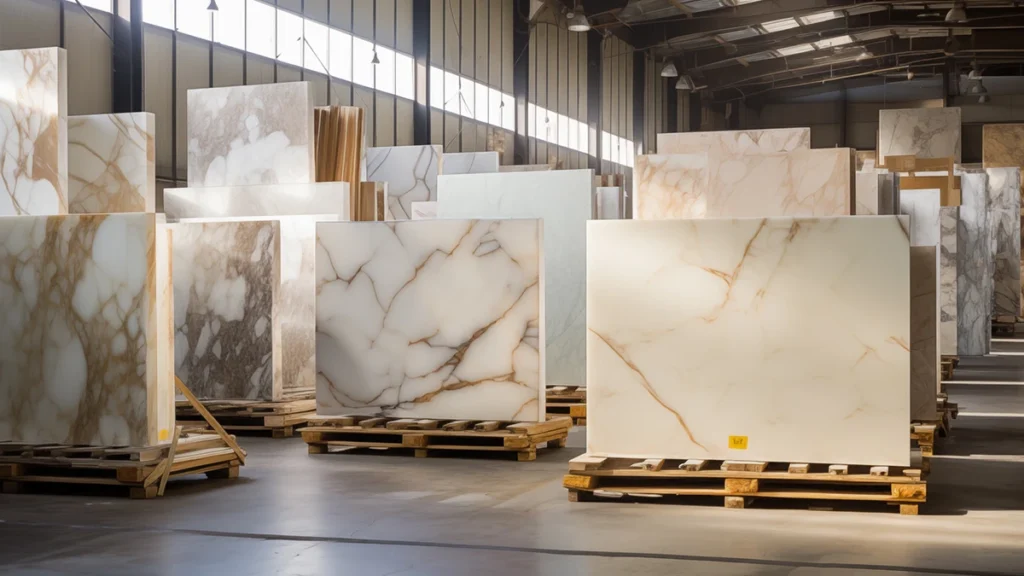
First, shipping economics differ in ways that don’t show up in a slab price list. Here’s what to plan for.
Quartz container planning is predictable
First, quartz, at standard 20/30 mm thickness, is heavy — and container counts for quartz are typically driven by both volume and weight. For US-bound shipments of the regular super-jumbo size (3200×1600 mm / 127×64 in, ≈55 sq ft per slab). Specifically, the approved packing reference is 7 bundles per 20 ft container: 30 mm slabs at 10 per bundle (70 slabs per container) or 20 mm slabs at 15 per bundle (105 slabs per container). That’s a planning baseline you can model before signing.
Sintered stone ships lighter but more brittle
First, sintered stone in thin formats is lighter. Which means more square meters per container and lower freight per square meter in some lanes. But thin porcelain is also more brittle. Edge chipping and transit breakage are the classic failure modes. And they punish weak packing: the bundle design, the A-frame, the interleaving. And the container loading sequence all matter more than they do for thicker quartz. If you switch to sintered stone. Budget for upgraded packing specifications and get the factory’s breakage history in writing — and verify the claim with QC photos of a real container, not just a sales sheet. Specifically, our QC & packing guide shows the inspection discipline we apply to slab shipments. And the same logic applies to porcelain with different thresholds.
First, there’s also a destination-market angle: if your customers’ fabricators aren’t set up for large-format porcelain (no CNC. No proper lifting equipment, no experience with thin slabs), your breakage risk doesn’t end at the port. Specifically, confirm downstream handling capability before you commit a container of thin porcelain to a market that’s never worked with it.
QC Differences at the Factory
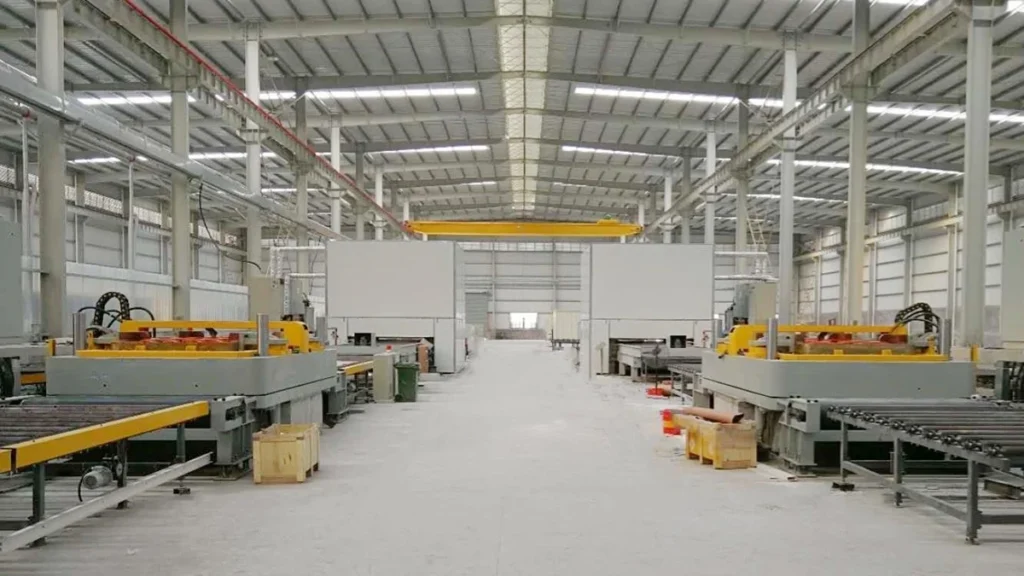
Both materials deserve factory QC, but the checklists differ in the same way the products differ.
Quartz QC priorities
- Color and pattern consistency against the approved sample and product code
- Surface defects: pinholes, resin-starved areas, polishing marks
- Batch-to-batch matching across production runs
- Thickness tolerance and edge consistency
- For decorative/printed quartz: pattern registration and repeat alignment
Sintered stone / porcelain QC priorities
- Calibration: thickness consistency across the slab (kiln-fired product can vary)
- Flatness and warpage — critical for large-format panels
- Surface defects: pinholes, glaze issues, decoration misregistration
- Edge quality after cutting; chipped or rolled edges are common in thin formats
- Batch consistency, plus confirmation the design is still in production for future top-ups
First, the QC posture differs too. Quartz QC is largely about matching a reference — sample, product code, batch record. Specifically, sintered stone QC is about dimensional discipline — flatness, calibration, edge integrity — plus design-run continuity. If you’re sourcing both, you need both checklists, and they don’t substitute for each other.
2026 Compliance: The Silica Angle
First, this is the factor that has genuinely moved sourcing decisions in 2025–2026. And it’s the main reason sintered stone keeps coming up in buyer conversations.
Quartz carries the engineered-stone documentation stack
First, engineered quartz sits at the center of the crystalline silica regulatory wave. Australia’s engineered stone ban took effect in 2024, with workplace exposure-limit reform scheduled to take effect December 1, 2026. In the US, California’s rulemaking and federal OSHA activity continue, and the EU’s NEPSI framework keeps pushing exposure limits down. The practical sourcing consequence: quartz buyers increasingly need silica content declarations, SDS, COA. And product compliance files as part of standard import paperwork. Our silica-free surfaces hub and the silica-free guides collection cover this landscape market by market. And the compliance map is the fastest way to see where your destination sits.
Sintered stone sits outside the bans — with a fabrication caveat
First, sintered stone and porcelain slabs are fired ceramic products. Crystalline silica is present in raw materials. But the finished product’s exposure profile is fundamentally different from resin-bound engineered stone — which is why porcelain/sintered products sit outside the engineered stone bans in most jurisdictions. For buyers who want to sidestep the engineered-stone compliance stack entirely, sintered stone is the cleaner path on paper.
But “outside the ban” isn’t “no compliance.” Porcelain slabs still face customs classification, tariff treatment, and destination-specific import rules. And remember the downstream side: if your customers’ fabricators cut sintered stone, silica dust from any siliceous material during cutting still triggers workplace exposure obligations in many jurisdictions. However, the product may sit outside the engineered stone ban; the fabrication process does not automatically escape the exposure rules. Check both before you market it as “compliance-free.”
Sourcing Decision Framework & FAQ
Here’s how we’d frame the decision if you’re choosing between quartz and sintered stone for a 2026 program:
- What applications dominate your order book? Countertops → quartz’s fabrication ecosystem and edge options matter; walls, facades, thin formats → sintered stone’s weight and format advantages matter.
- Are your customers’ fabricators equipped for the material? Verify CNC, tooling, and handling capability before you commit a container.
- Do you need repeat orders that match? Both can deliver, but quartz’s recipe-based matching is more forgiving; confirm design-run continuity with sintered stone suppliers.
- Is silica compliance a market differentiator for you? Sintered stone’s fired-ceramic profile helps; document the fabrication-side exposure rules anyway.
- What does the full landed-and-installed cost model say? Compare per installed kitchen, including freight, breakage, fabrication, and yield — not per square meter of slab.
FAQ
First, often yes on raw thin-format slab prices, and often no on installed cost. Model the full chain — fabrication, edge buildup, breakage, yield — before you commit.
First, yes. And they’re popular in some markets — but thin formats need edge treatment or substrate support. And fabricators need diamond tooling and CNC experience. Confirm your fabrication chain before sourcing.
First, fired ceramic products sit outside the engineered stone bans in most jurisdictions. But cutting any siliceous material still triggers workplace exposure rules in many places. Specifically, verify both the product and the fabrication side for your destination.
First, you can. But treat it as a new product launch, not a substitution: new samples, new fabrication training, new packing specs. And a new QC checklist. We’ve seen buyers treat it as a swap and eat the breakage and fabrication costs.
First, you can. But treat it as a new product launch, not a substitution: new samples, new fabrication training, new packing specs. And a new QC checklist. We’ve seen buyers treat it as a swap and eat the breakage and fabrication costs.
Comparing quartz vs sintered stone for your market?
First, send us your application mix and target markets — we’ll help you model both materials end to end: slab pricing. Container economics, fabrication requirements. And the compliance documentation each one needs in 2026. Request a sourcing review →
How This Article Was Prepared
- Regulatory and policy information: Summarized from publicly available legislative texts, regulatory announcements, and government agency publications as of August 2026. Source documents are cited in the article body where referenced.
- Industry context: Market observations and supply chain analysis are based on AsiaQuartz’s operational experience coordinating quartz supply and publicly available industry data. Container packing references follow AsiaQuartz’s approved US-bound packing reference for the regular super-jumbo size (3200 × 1600 mm format).
- Limitations: This article provides general business and educational information. It is not legal, customs, regulatory, or occupational-health advice. Importers, fabricators, and employers should consult qualified professionals for their specific situation. Regulatory requirements vary by jurisdiction and are subject to change.
About This Article
First, this article was prepared using current public information from government agencies, industry organizations, research institutions, trade publications, and other cited sources. AsiaQuartz-specific product and supply information was reviewed against the AsiaQuartz Single Source of Truth (SSOT). Specifically, external sources are used for market context and do not independently verify AsiaQuartz capabilities. Research and drafting tools may assist with source collection, structure, and language review. In particular, final claims, sources, and AsiaQuartz-specific information are reviewed before publication.
Information Status
First, based on publicly available information reviewed through August 15, 2026. Regulations, tariff treatment, customs classification, product availability, production routes, and commercial terms may change. Specifically, buyers should review the specific transaction with the relevant professionals and authorities. A small sample does not represent every characteristic of a full slab or every permitted production variation. Actual specifications should be confirmed through product-specific technical files and written order documents.
Sources and References
- Safe Work Australia, Engineered Stone Ban regulatory materials and workplace exposure limit reform, accessed August 2026
- US International Trade Commission, quartz slab trade case filings (safeguard/AD-CVD dockets), accessed August 2026
- EU NEPSI (European Network for Silica), Good Practice Guide and workplace exposure documentation, accessed August 2026
- Cal/OSHA, crystalline silica rulemaking materials, accessed August 2026
- AsiaQuartz SSOT, v1.1, last reviewed August 2026 (product specifications, packing reference, internal link registry)
Related Reading
- How to Choose a Quartz Slab Supplier for B2B Projects
- Quartz Slab Supply Chain Guide 2026: Origin, QC, Landed Cost & Container Risk
- Quartz Slab QC & Packing Guide for Importers
- What Is Printed Quartz? A B2B Guide
- Printed Quartz vs. Natural Marble vs. Porcelain: B2B Comparison
- Silica Compliance by Market: Australia, US, EU & China — A 2026 Regulatory Map
- Silica-Free Surface Guides — Full Collection