Prepared by: AsiaQuartz Editorial Team
Technical review by: AsiaQuartz Product, QC & Supply Chain Team
Last updated: July 2026
First, project buyers selecting surface materials for hotels, multi-unit residential developments, retail interiors. And commercial fit-outs face a genuine three-way decision: printed quartz, natural marble, or porcelain slabs. Specifically, each material belongs to a fundamentally different product category — engineered surface, natural stone. And sintered material, respectively — and each brings distinct performance characteristics, supply dynamics, and cost profiles to the table.
First, the wrong call doesn’t just affect aesthetics. It ripples into maintenance budgets, replacement planning, fabrication timelines, and supply continuity across project phases. Specifically, this guide walks through the core differences across eight practical dimensions, with a focus on what matters to procurement teams, specifiers. And commercial buyers who need repeatable outcomes across multiple units or properties.
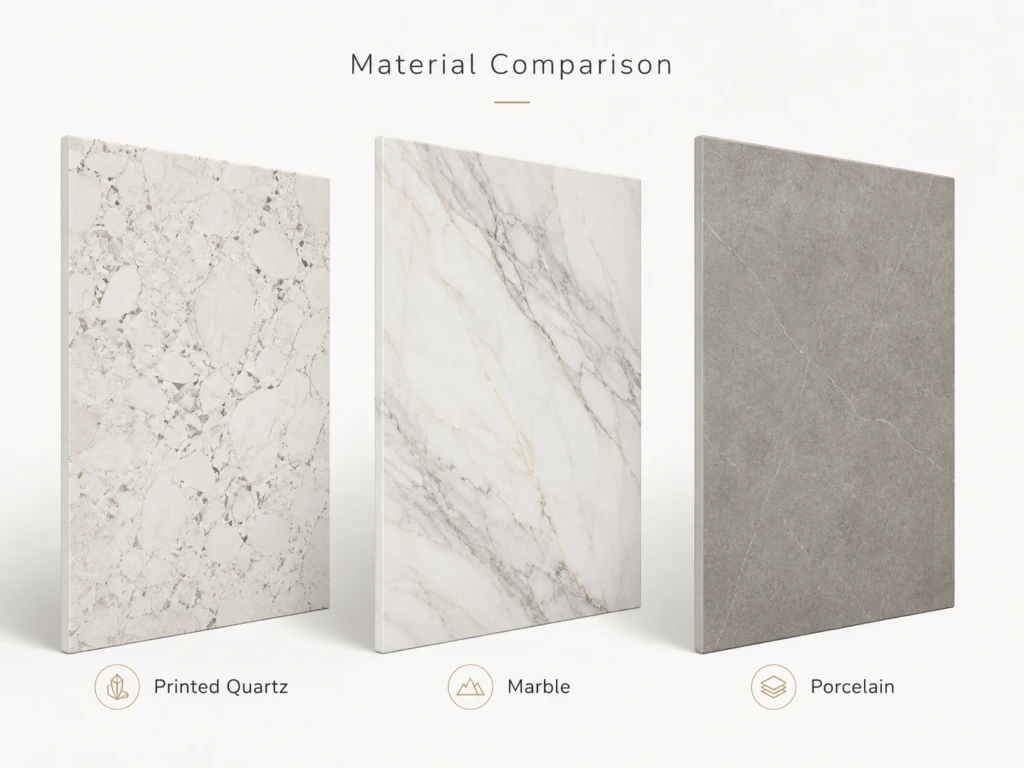
Three Materials at a Glance
Printed Quartz
First, printed quartz is an engineered surface program that uses controlled print technology to produce marble-look and other decorative visuals on an engineered slab substrate. Because the visual is manufactured rather than quarried, a well-controlled program can use documented design files. Specifically, approved full-slab references, retained samples and written variation limits to support project planning. Repeatability is not automatic: buyers should verify how the supplier controls print version, base tone, batch variation and later replenishment. In particular, typical applications include hotel reception desks, multi-unit apartment vanities, commercial bar tops, retail feature walls and hospitality countertops.
Natural Marble
First, natural marble is a metamorphic stone quarried from deposits around the world. Each slab carries geological variation in veining, tone and crystalline structure, which is a major part of its design value. Specifically, calcite-based marbles are vulnerable to acid etching. While stain absorption and the usefulness of an impregnating sealer depend on the specific stone, finish and use. For large commercial projects, buyers should plan slab selection, reservation, yield and replacement around natural variation rather than expect manufactured-style repeatability.
Porcelain Slabs and Sintered Surfaces
First, large-format porcelain slabs and sintered surfaces are related manufactured mineral products, but the terms are not universally interchangeable. Their raw-material recipes, forming methods, firing or sintering cycles, body structure, and product classifications vary by manufacturer. Specifically, many products in these categories are dense, low-absorption surfaces with strong heat, stain. And UV performance, which can make them suitable for countertops, façades, flooring, and sun-exposed applications. In particular, exact thicknesses, outdoor suitability, edge behavior. And fabrication requirements should be confirmed from the specific product’s technical file rather than assumed from the category name.
Material Comparison: Eight Decision Dimensions
First, Typical planning considerations. Not universal performance specifications. Specifically, all items should be confirmed using the exact product’s technical file, care instructions, and written order documents. The table below describes general material-category characteristics observed across the industry; individual products within each category may differ.
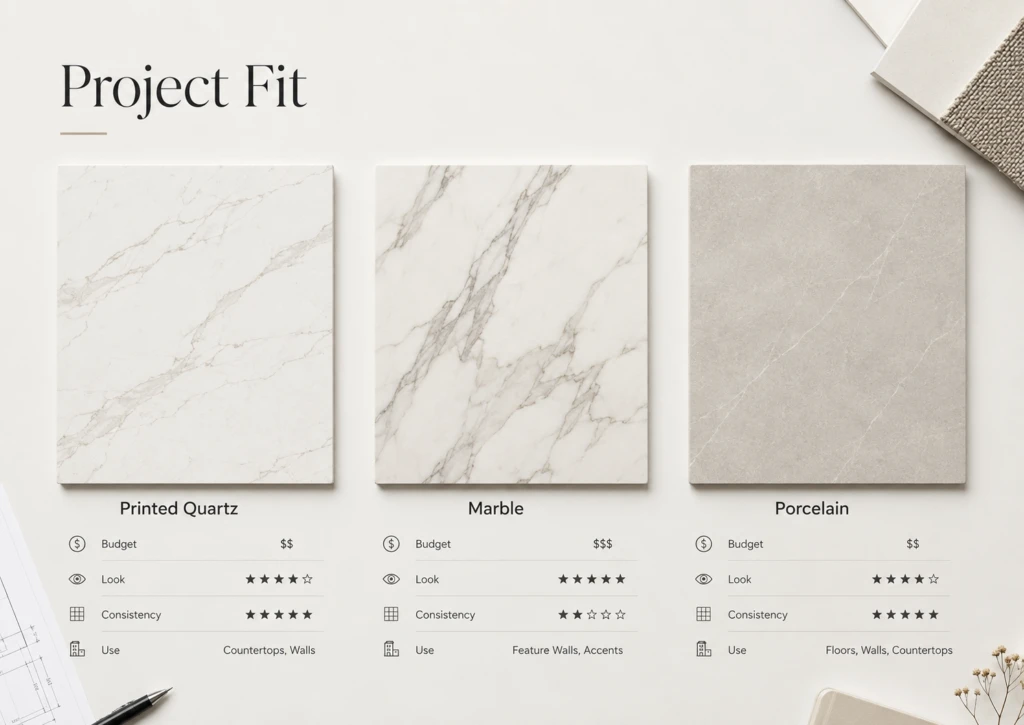
| Dimension | Printed Quartz (Engineered Surface) | Natural Marble (Natural Stone) | Porcelain Slab (Sintered Material) |
|---|---|---|---|
| Visual Control & Consistency | The visual is created through a controlled manufacturing process. When the supplier locks the approved design file, production parameters, reference sample, and variation rules, the result can be documented and reviewed at full-slab scale. Repeat-order similarity should still be verified against retained references rather than assumed. | Naturally variable. No two slabs are identical. Vein intensity, background tone, and pattern shift from block to block. Requires physical slab selection and reserving for larger runs. | Many products use digital decoration, through-body effects, or other controlled manufacturing methods. Industrial production can support repeatability, but shade, print, surface and production-campaign variation still need to be checked against the manufacturer’s lot-control guidance. |
| Durability (Scratch, Stain, Heat) | Good scratch and stain resistance under normal commercial use. Heat resistance varies by product — confirm using product-specific technical file. Surface protection depends on resin system and finish. | Performance varies significantly by marble type and finish. Calcite-based marbles are vulnerable to acid etching, and some stones can absorb oils or pigments if not adequately protected. Scratch, stain and heat behavior should be reviewed for the exact stone and intended use. | Many large-format porcelain and sintered products provide high scratch, stain, heat and UV resistance relative to resin-bound engineered quartz. Do not turn those category tendencies into a universal hot-pan, scratch-proof or exterior-performance guarantee; use the product-specific test data and installation guidance. |
| Maintenance Requirements | Low maintenance. Daily cleaning with mild detergent. No periodic sealing required for the engineered surface itself. Confirm finish-specific care with product documentation. | Maintenance depends on the stone’s mineralogy, porosity, finish and use. Many marble installations benefit from an impregnating sealer, but sealing is not a universal fixed-interval requirement and does not prevent acid etching. Mild, non-acidic cleaners are generally preferred; refinishing may be needed if the surface is etched or scratched. | Most products are low-absorption and do not require sealing of the slab surface. Routine cleaning is generally straightforward, but care instructions, joints, adhesives, exposed edges and exterior maintenance remain system-specific. |
| Cost Range (Relative, B2B Supply) | Pricing depends on design complexity, slab format, formulation, finish, order volume and origin. A controlled SKU and production-lot program can make quote normalization and replenishment planning more predictable than block-selected natural stone, but landed cost still requires order-specific calculation. | Widest cost range of the three. Basic commercial-grade marble can be budget-friendly; rare quarries and book-matched sets command very high premiums. Block availability, vein desirability, and slab yield drive price volatility. | Pricing varies by brand, thickness, format, finish, design, origin and order size. Thin formats can reduce material weight, but fabrication, substrate, edge build-up, handling and installation can change the installed-cost comparison. |
| Project Scalability | Well-controlled printed-quartz programs can support project-scale planning through approved full-slab references, retained samples, batch records and written variation rules. Later phases should be qualified against the approved reference because exact visual identity across distant production runs cannot be assumed. | Scalability is constrained by quarry output and block consistency. Specifying matching slabs for 200+ hotel vanities from the same quarry cut is logistically challenging. Projects may need to accept natural variation or mix batches. | Industrial production supports large-volume programs, but repeat orders can still vary by production campaign, shade, surface and print set. Large formats can reduce seam count where the cut plan and handling conditions allow. |
| Slab Size Availability | Common project references include approximately 3200×1600 mm, with selected production routes offering larger formats. 20 mm and 30 mm are common thicknesses. Confirm the exact usable size, trim allowance and thickness for the quoted SKU. | Highly variable by quarry and block. Slabs are cut from individual blocks — dimensions depend on natural block size. Thickness typically 20 mm or 30 mm, with selected quarries offering 18 mm. Large uninterrupted slabs command premiums. | Large formats and thin profiles are widely available, but dimensions differ by manufacturer and product line. Common thickness families include thin cladding formats and thicker countertop formats. Confirm usable dimensions, support requirements and fabrication limits from the exact technical file. |
| Installation Complexity | Fabrication may be compatible with equipment used for conventional engineered quartz, but the actual formulation, printed surface, edge treatment and seam design should be qualified with a fabrication trial. Tooling, feed rates, support and finishing practices remain product-specific. | Requires experienced stone installers. Weight, fragility during transport, and seam matching add complexity. Book-matched and vein-continued layouts require skilled layout planning. Rodding or mesh backing may be needed for structural integrity. | Fabrication commonly requires tooling and process settings suited to dense porcelain or sintered material. Thin formats may require substrate or system-specific support, and edge chipping risk depends on the product, blade, feed rate, cut sequence and handling method. |
| Environmental & Regulatory Considerations | Many engineered-quartz products contain crystalline silica and can generate respirable dust during cutting, grinding or polishing. Workplace controls and product restrictions vary by jurisdiction. For Australia, covered engineered stone benchtops, panels and slabs containing at least 1% crystalline silica are prohibited; other markets use different frameworks. | Natural stone is outside Australia’s engineered-stone definition, but natural stones can still contain crystalline silica and fabrication dust can remain an occupational-health issue. Environmental and workplace requirements therefore need to be assessed separately from engineered-stone product bans. | Regulatory treatment depends on product composition and jurisdiction. In Australia, porcelain and sintered stone are excluded from the engineered-stone definition when they do not contain resin. Processing can still generate mineral dust, so fabricators should follow the product SDS, local exposure rules and appropriate dust controls. |
Where Printed Quartz Creates Differentiated Value
First, printed quartz occupies a unique position in this three-material comparison. It combines the design control of an engineered process with the substantial, solid feel that buyers expect from a slab-format surface material. Specifically, here is where it creates distinct advantages for commercial project buyers:
Controlled Design Direction
With printed quartz, the visual can be managed as a controlled design reference rather than accepted solely as natural geological variation. Project teams can review the pattern, vein scale, base tone and contrast level before production. Then lock an approved full-slab reference and written variation limits. Natural marble is selected from the actual available slabs or blocks; porcelain and sintered products use their own controlled design systems. However, the useful distinction is not that one category is perfectly repeatable, but how each category manages variation.
Batch and Repeat-Order Planning
First, approved references, retained samples, full-slab visuals. Batch records and permitted variation rules can support repeat-order planning. A later hotel phase can be checked against the original approved visual file and retained reference instead of relying on memory or a small chip. Specifically, natural marble can be reserved and sequenced by slab or block, but later quarry material will not provide exact visual reproduction. Porcelain manufacturers can reproduce a design program, yet shade and production-campaign variation still need review.
Project-Oriented Supply
First, a project-oriented printed-quartz supply program can combine container planning, production-lot coordination. Approved-sample comparison, full-slab review and shipment-release records in one workflow. Specifically, those controls are supplier-program capabilities rather than automatic properties of every printed-quartz product. So buyers should confirm them in writing before relying on them for phased projects.
Cost Predictability
First, manufactured materials can make quantity planning and quote normalization easier because the buyer can define an SKU, format, finish and production lot. Natural marble pricing and yield are additionally influenced by block availability, slab selection and geological variation. In every category, compare total installed or landed cost rather than material price alone. Including fabrication yield, packaging, freight, handling, substrate requirements and expected replacement risk.
Scenario Decision Guide: Which Material Fits Which Project?
Hotel Lobby, Reception Desk & Public Areas — Printed Quartz Can Fit When Repeatability Matters
First, hotels need surfaces that look high-end, handle heavy daily traffic, and can be replicated across 100+ rooms and multiple properties. Printed quartz delivers controlled marble-look visuals with the consistency and supply planning to support phased openings and future renovation phases. Specifically, full-slab visual review means the design team signs off on the actual production reference, not a 10 cm sample.
Luxury Residential or Boutique Hospitality — Natural Marble Can Fit When Variation Is Valued
When the brief demands one-of-a-kind character and the client values natural provenance above repeatability. Marble is the authentic choice. A single statement island, a feature wall in a private residence. Or a 20-room boutique hotel where each vanity is intentionally unique — these are scenarios where variation is a feature. Be prepared for higher maintenance commitment and the reality that the replacement slab will not match the original.
Outdoor Kitchens, Façades & Sun-Exposed Surfaces — Review Porcelain / Sintered Options First
First, many porcelain and sintered products are designed for strong UV and heat performance. Which can make them attractive for outdoor bar tops, cladding and sun-exposed surfaces. Specifically, resin-bound engineered quartz generally needs explicit manufacturer approval for prolonged exterior UV exposure. Natural marble can be used outdoors in selected stones and climates, but weathering, freeze-thaw performance, finish and maintenance are stone-specific. In particular, verify the exact exterior-use rating rather than relying on category labels.
Multi-Unit Apartments & Builder Programs — Prioritize Repeatability and Fabrication Capacity
For large apartment programs, manufactured surfaces such as printed quartz. Other engineered surfaces and porcelain can simplify SKU control and multi-unit visual planning. However, natural stone can also be used successfully, but the buyer must manage slab variation, yield and reservation differently. The preferred route should be chosen after checking local fabrication capability, replacement strategy and the supplier’s batch-control evidence.
Restaurant Tabletops & Bar Counters — Match the Material to Heat, Acid and Rollout Requirements
If heat exposure is a major design condition. Many porcelain and sintered products provide a wider heat-performance margin than resin-bound engineered quartz, subject to the specific technical file. If rollout consistency and a controlled marble-look visual are the priority, printed quartz may be attractive. Calcite-based marble can work in hospitality. But acid-rich food and beverage service creates a higher etching and maintenance burden that the operator must be willing to accept.
Procurement Decision Checklist
When evaluating printed quartz, natural marble, and porcelain slabs for a commercial project, confirm the following points before making a material commitment:
- Design control or natural variation? Decide how much visual variation the project can accept. Manufactured surfaces can support controlled design references; natural marble requires slab-level selection and acceptance of geological variation.
- What is the maintenance budget and who will execute it? For marble, confirm acid sensitivity, stain behaviour, cleaning chemistry and whether the selected stone/finish benefits from an impregnating sealer. For manufactured surfaces, follow the exact product’s care instructions rather than relying on category assumptions.
- How many phases, and when? If Phase 2, Phase 3, or future renovation phases must match Phase 1 materials, printed quartz and porcelain are stronger candidates for visual continuity. Marble requires accepting natural batch-to-batch variation.
- Is there outdoor or direct-sun exposure? Confirm exterior-use approval, UV performance, water absorption, freeze-thaw behavior where relevant, fixing system and warranty for the exact product. Many porcelain/sintered products are strong candidates; resin-bound quartz generally needs explicit exterior approval, while natural-stone suitability is stone- and climate-specific.
- Do the local fabricators have the right tooling and process? Porcelain/sintered products and printed quartz can require different blades, feeds, support, edge and seam procedures. Confirm local fabrication capability with the exact SKU and, where the material is new to the shop, run a fabrication trial before specification approval.
- What slab format minimizes seams? All three materials are available in large formats (~3200×1600 mm or larger), but exact dimensions vary by product and production route. Confirm slab dimensions against your cut list before committing.
- Are there destination-market regulatory considerations? Some markets have introduced or are introducing restrictions on engineered stone with crystalline silica content. Verify current requirements for the project’s destination jurisdiction.
- Can the supplier provide full-slab visual approval and batch documentation? For printed quartz, confirm that the supply partner offers full-slab review, retained reference samples, batch records, and permitted visual-variation documentation — not just a 10×10 cm chip.
FAQ
First, it depends on the wear mechanism and the exact product. Many porcelain and sintered products provide strong scratch, heat, stain and UV performance. Specifically, printed quartz can provide good stain and wear performance for commercial interiors, but heat and fabrication limits are formulation-specific. Calcite-based marble is more vulnerable to acid etching and may require a more active maintenance plan. In particular, compare product-specific test data and care instructions rather than assigning one universal durability ranking.
First, printed quartz can produce convincing marble-look visuals, including Calacatta- and Statuario-inspired designs. The advantage is that the manufactured visual can be reviewed and managed against an approved reference. Specifically, natural marble can also be reviewed at full-slab scale. But buyers select from the actual slabs available rather than approving a reproducible design file. In particular, the two materials should therefore be compared as different visual-control models, not as exact substitutes.
First, cost relationships depend heavily on product grade, design complexity, slab dimensions, quantity. And origin, so precise comparisons without a specific product and order are unreliable. As a general planning reference: entry-level porcelain slabs and printed quartz are typically positioned in competitive commercial ranges; premium book-matched natural marble from sought-after quarries can be meaningfully higher than equivalent-look engineered alternatives. Printed quartz can support more predictable landed-cost planning because material pricing is not driven by quarry-block scarcity. Specifically, always obtain current supply-review pricing against your exact specification.
First, beyond the slab purchase price, factor in: (1) professional sealing at installation and periodic resealing throughout the material’s service life; (2) higher fabrication waste from working around natural fissures and inclusions; (3) the cost of reserving and holding selected slabs during project delays; and (4) the reality that a replacement slab for a damaged section will not match the original — a full-area replacement may be the only acceptable repair path. These items can add meaningfully to the total cost of ownership compared to engineered or sintered alternatives.
First, yes — porcelain slabs in 12 mm or 20 mm thickness are used for countertops, but the fabrication process differs. Porcelain requires diamond tooling rated for harder material, and thinner profiles may need substrate support for horizontal applications. Specifically, not all fabricators are equipped for porcelain, so confirm local capability before specifying. Mitigation of edge chipping during cutting is a known consideration that experienced porcelain fabricators manage with appropriate blade selection and feed rates.
For a 200+ room hotel, start with the project requirements rather than a category winner. Printed quartz can be strong where controlled visuals, batch records and phased replenishment are important. However, porcelain/sintered products can be attractive where heat, UV or thin-format requirements matter. Natural marble can also be used at scale. But the project must plan for slab selection, natural variation, reserve material and replacement strategy. The final choice should follow sample approval, full-slab review, fabrication trials and lifecycle-cost comparison.
First, many marble installations benefit from an impregnating sealer. But the need and reapplication interval depend on the stone, finish and use; sealing does not prevent acid etching. Specifically, printed quartz generally does not require the same impregnating-sealer routine as porous natural stone. While most porcelain slab surfaces do not require sealing. In particular, always follow the exact product and installation-system care instructions.
First, availability, production timing, and delivery are product- and order-specific for all three materials. Printed quartz and porcelain, as manufactured materials, can support production planning against confirmed orders — lead times depend on production scheduling, quantity. And current order book. Natural marble availability depends on quarry output, current block inventory. And the specific vein pattern desired — this introduces more variables that are outside the buyer’s control. For any material, confirm current lead-time estimates through a formal supply review against the exact specification and quantity.
Need to Compare Real Options for Your Project?
First, printed quartz, natural marble, and porcelain each have their place. The right choice depends on your specific project parameters — design requirements, phase planning, maintenance budget. And destination-market conditions.Request Supply Review
Discuss your project requirements, review printed quartz options, and confirm specifications, samples, production routes, and commercial terms.
How this article was prepared:
- Material category characteristics: Descriptions of printed quartz, natural marble, and porcelain (sintered stone) reflect industry-recognized material-category properties widely documented across manufacturer technical literature, stone-industry trade publications, and B2B buyer resources. Individual product performance within each category varies by formulation, production route, and supplier.
- Printed quartz program details: AsiaQuartz-specific product positioning, supply structure, and approved value language are sourced from the AsiaQuartz Single Source of Truth v1.1, last reviewed July 2026. Specific performance, specifications, production routes, and commercial terms are product- and order-specific.
- Relative cost relationships: General cost positioning (e.g., “typically positioned in the mid-range,” “widest cost range”) reflects commonly observed B2B market patterns and is not based on a single data set or fixed price comparison. Actual pricing must be confirmed through a supply review against the exact product, quantity, and order parameters.
- Industry observations: Material properties such as marble porosity and sealing requirements, porcelain heat and UV resistance, and quartz design consistency are drawn from stone-industry technical references, manufacturer care-and-maintenance guides, and trade-association resources widely available as of August 2026.
- Limitations: This article provides general material-category comparison for B2B project planning. It does not replace product-specific technical review. Confirm specifications, test data, commercial terms, and regulatory treatment for your exact product and order. Performance claims are qualified by product, formulation, and production route — not presented as category-wide guarantees.
First, About this article: This article was prepared using current public information from industry trade publications, manufacturer technical resources. And trade-association guidance. Specifically, asiaQuartz-specific product and supply information was reviewed against the AsiaQuartz Single Source of Truth (SSOT). External sources are used for market context and do not independently verify AsiaQuartz capabilities. In particular, research and drafting tools may assist with source collection, structure, and language review. Final claims, sources, and AsiaQuartz-specific information are reviewed before publication.
First, Information status: Based on publicly available information reviewed through August 8, 2026. Product availability, production routes, commercial terms, and regulatory requirements may change. Specifically, buyers should review the specific transaction with the relevant professionals and authorities. A small sample does not represent every characteristic of a full slab or every permitted production variation. Actual specifications should be confirmed through product-specific technical files and written order documents.
Sources and References
- AsiaQuartz SSOT v1.1, Modules 01–07, last reviewed July 2026. Supports: printed quartz product positioning, approved value language, supply structure, contact details, and mandatory qualification rules throughout.
- Natural Stone Institute, Care & Cleaning of Natural Stone, accessed August 2026. Supports: acid sensitivity of calcareous stones, cleaning guidance, and the qualification that sealing is stone- and use-specific rather than universally required on a fixed schedule.
- Natural Stone Institute, Marble, Onyx & Serpentine, accessed August 2026. Supports: marble mineralogy, acid sensitivity and exterior-use caveats.
- Natural Stone Institute, Silicosis: Scientific Research & Guidance, accessed August 2026. Supports: the point that natural-stone fabrication can also involve respirable crystalline silica exposure and requires workplace controls.
- Safe Work Australia, Engineered Stone Ban, accessed August 2026. Supports: Australia’s product-definition distinction between covered engineered stone and resin-free porcelain/sintered stone, while not replacing workplace dust-control obligations.
- Manufacturer technical data and fabrication manuals for the exact porcelain/sintered SKU should be used for heat, UV, stain, thickness, exterior-use and tooling claims. Category-level statements in this article are planning guidance only.
Related Reading
- What Is Printed Quartz? A B2B Buyer’s Introduction
- Printed Quartz in Commercial Projects: Hospitality, Multifamily & Retail Applications
- Commercial Quartz Sourcing Guide: Slab, Prefab & Project Supply
- Printed Quartz Slabs — Product Overview & Specifications
- How to Choose a Quartz Slab Supplier for B2B Projects
- Printed Quartz Guides Center