Prepared by: AsiaQuartz Editorial Team
Technical review by: AsiaQuartz Product, QC & Supply Chain Team
Last updated: July 2026
First, Australia’s engineered-stone market has fundamentally changed. Since July 1, 2024, work involving the manufacture, supply, processing and installation of covered engineered stone benchtops, panels and slabs has been prohibited. Since January 1, 2025, covered engineered stone benchtops, panels and slabs have also been prohibited imports. For Australian importers, the practical task is now to select alternative products and build an evidence file that proves the actual goods fall outside the prohibition.
First, this guide explains what the market commonly calls zero-silica quartz. How to assess suppliers in China and Southeast Asia, what evidence the Australian Border Force may expect. And how to control formulation and batch risk before shipment.
Australia’s Silica Ban: What Actually Changed
First, the most important point for buyers is that Australia’s prohibition is based on a defined class of product. Do not reduce it to the shorthand “all quartz is banned.”
The change occurred in two stages:
- July 1, 2024: manufacture, supply, processing and installation of covered engineered stone benchtops, panels and slabs became prohibited under the WHS framework across Australian jurisdictions, subject to limited exceptions and jurisdiction-specific implementation.
- January 1, 2025: covered engineered stone benchtops, panels and slabs became prohibited imports under regulation 5M of the Customs (Prohibited Imports) Regulations 1956.
The Three-Part Engineered-Stone Definition
Under the model WHS Regulations, an artificial product is engineered stone for the prohibition when it:
- contains at least 1% crystalline silica by weight;
- is created by combining natural stone materials with other chemical constituents such as water, resins or pigments; and
- becomes hardened.
First, the definition excludes specified product types such as concrete and cement products, ceramic tiles, and resin-free porcelain and sintered stone. Safe Work Australia also gives an artificial stone product containing less than 1% crystalline silica as an example of a product that is not prohibited because it does not meet the silica criterion of the definition.
First, Key takeaway for importers: A “silica-free” or “low-silica” label is not the compliance test. The evidence must establish what the product actually is, how it is made, its crystalline-silica content where relevant. And that the tested sample is traceably linked to the goods being imported.
What Zero-Silica Quartz Actually Is
First, the term “zero-silica quartz” is commercially useful but technically imprecise: quartz is itself crystalline silica. In practice, buyers use the term for engineered surfaces designed to provide a quartz-like slab format and visual language while replacing conventional quartz aggregate with alternative filler systems and controlling crystalline silica below the relevant product threshold.
The exact formulation matters more than the category name.
What Can Be Done
- Alternative filler systems: Manufacturers may use glass, calcium-carbonate-based materials, selected feldspathic or dolomitic materials, or engineered mineral blends. The material name alone does not prove low crystalline silica; natural-mineral fillers can contain quartz impurities and should be characterised in the finished formulation.
- Decorative design: Marble-look, solid, concrete-look and terrazzo-style visuals can be produced through pigmentation, printed decoration or other design processes. The exact process and achievable repeatability depend on the manufacturer and product route.
- Slab formats: Selected products are available in formats broadly comparable with conventional engineered surfaces, including planning ranges around 3200 × 1600 mm and common countertop thicknesses. Confirm the exact size, usable area and thickness from the product-specific specification.
What Changes Compared with Traditional Quartz
- Performance is formulation-specific: water absorption, flexural strength, impact behaviour, hardness, stain resistance, thermal response and fabrication behaviour should be supported by product-specific data and trials.
- Production maturity varies: some formulations have more production history than others. Buyers should evaluate batch repeatability, colour control and scale-up evidence rather than assuming every “zero-silica” line is equally mature.
- Testing must answer the right question: physical-performance tests and crystalline-silica identification are different tasks. Use competent laboratories and appropriate methods for each claim.
What this isn’t: This is not a loophole exercise or a one-report purchase decision. A compliant product program needs a repeatable formulation, a traceable product identity and an evidence file that remains connected to the goods shipped.
Sourcing Zero-Silica Quartz from China and Southeast Asia
First, suppliers in China and selected Southeast Asian production routes offer low-silica and silica-free engineered-surface programs. But supplier location alone says little about qualification. Specifically, evaluate the actual manufacturing plant, formulation control, test evidence and shipment traceability.
First, asiaQuartz coordinates product development, sample and specification review, order-specific QC, packing records and container-level supply planning from Xiamen, Fujian. In silica-free programs, three recurring procurement risks deserve particular attention:
- The sample problem: one tested sample proves the result for that sample. It does not by itself prove that later production batches, colours or formulation revisions will produce the same result.
- The formulation-family problem: visually related SKUs may not share an identical filler and binder system. Confirm which product codes are covered by the same formulation identity rather than assuming a whole catalogue is one formula.
- The evidence-linkage problem: a technically credible laboratory report still has limited procurement value if the tested sample cannot be linked to the SKU, formulation version, batch and goods being shipped.
Practical Sourcing Steps
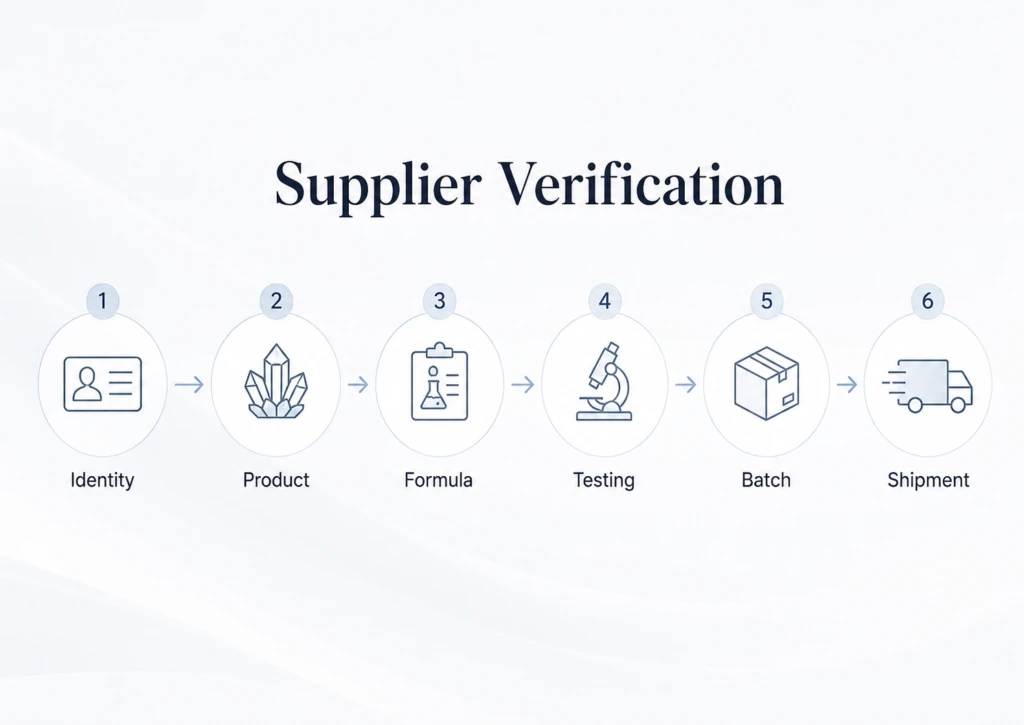
- Define the product identity before approving colours. Record the manufacturer, plant, SKU, formulation or formulation-family identifier, slab format and intended Australian use.
- Request evidence that matches the current production route. Test data should be current enough to represent the formulation and process being ordered. A material change, plant change or formulation revision should trigger review and, where appropriate, retesting.
- Verify the evidence chain. Compare product codes, batch identifiers, sampling records, photographs, laboratory reports and shipment records.
- Use source QC as a control layer. Order-specific inspection should confirm identity, visual acceptance, dimensions, finish, packing and the agreed documentation package. Composition testing should be added according to the buyer’s qualification and ongoing surveillance plan.
For a deeper look at the procurement process, see our Silica-Free Quartz Procurement Guide.
Documentation: Build Evidence for Product Classification
First, there is no single universal “silica-free certificate” that automatically clears every shipment. Australian Border Force guidance focuses on evidence that the goods are not prohibited engineered stone and on proving that any tested sample matches the imported goods.
Core Import Evidence
First, build a file that can connect the product description to the physical shipment. Depending on the product and the evidence already available, that file may include:
- Product identity and composition documents: TDS, SDS and/or manufacturer declarations that identify the SKU, formulation or product family and relevant composition information.
- Competent laboratory evidence: where testing is needed, use a laboratory and method appropriate to identifying the material and crystalline-silica content. ABF guidance refers to methods such as petrographic analysis and X-ray diffraction.
- Sample-to-goods traceability: batch numbers, sampling procedures, photographs and records showing what was sampled and how it relates to the shipment.
- Formulation and change control: written confirmation of the formulation version and a process for notifying the buyer when materials, manufacturing site or formulation change.
Australian Border Force Testing Expectations
First, aBF states that overseas test certificates may be accepted when the laboratory is recognised under NATA’s mutual-recognition framework and accredited by its national authority for relevant engineered-stone testing. If ABF requests testing at the border, it accepts certificates from NATA-accredited laboratories using methods such as petrographic analysis and XRD.
First, this distinction matters: an overseas report can support a pre-shipment evidence file. While border-requested testing is subject to ABF’s own laboratory expectations.
Procurement Controls Beyond Border Classification
- Product-specific physical-performance data relevant to the intended benchtop or surface application.
- Approved physical sample and, for printed designs, full-slab visual review.
- Batch records and retained references for repeat-order comparison.
- Order-specific QC, packing and loading records.
- A written response plan if composition or performance deviates from the approved product.
First, Red flag: a supplier provides a laboratory report but cannot show which current SKU. Formulation, plant or production batch it represents. Specifically, the issue is not simply the age of the report; the key question is whether it still represents the goods you plan to import.
Cost Comparison: Compare Compliant Alternatives, Not Just Material Price
First, exact price relationships vary by formulation, design, order volume, origin, test plan. Freight and fabrication route. A useful Australian comparison starts with products that can actually be supplied into the intended market and then calculates total installed cost.
Zero-Silica vs Traditional Quartz
First, some zero-silica formulations may carry a material premium relative to conventional quartz because of alternative raw materials. Production scale, testing and documentation. Specifically, that relationship is not universal and should be confirmed through current quotations. For Australia, conventional covered engineered stone is not a viable import benchmark. So the more useful commercial comparison is between compliant engineered surfaces, natural stone, porcelain/sintered products and other eligible alternatives.
Alternative Material Routes
- Granite and other natural stone: established supply routes and strong material performance, but natural colour and pattern variation can complicate multi-unit matching. Natural stone can also contain crystalline silica, so fabrication still requires appropriate dust controls.
- Marble: distinctive natural aesthetics, with stone-specific maintenance, acid sensitivity and sealing decisions. Review the exact stone rather than treating marble as one performance category.
- Porcelain / sintered stone: potentially strong heat, stain and exterior performance depending on the product. Fabrication tooling, edge design, substrate and thickness can materially affect installed cost.
- Low-silica or silica-free engineered surfaces: can preserve parts of the engineered-surface workflow and visual language, but require product-specific qualification and composition evidence.
For landed-cost planning, compare the same commercial basis: product price, packing, origin charges, ocean freight. Import costs, inspection/testing, inland freight, fabrication yield, installation and expected loss. However, see our Quartz Slab Supply Chain Guide.
For the Australian threshold and documentation scope, start with our silica-free and low-silica surface program overview and confirm the exact product classification.
Common Pitfalls and a Practical Verification Checklist
The most expensive mistakes usually come from treating a marketing category as if it were a controlled product specification.
| Supplier statement | Why to investigate | Better evidence request |
|---|---|---|
| “All our products are silica-free.” | Different colours or product families may use different fillers, binders or production routes. | A controlled SKU/formulation list and the evidence that applies to each formulation family. |
| “Here is our old test report.” | Age alone does not determine validity, but the report may predate formulation, supplier, plant or process changes. | Evidence that the tested formulation and production route are still the ones being supplied, plus retesting when material changes occur or under the agreed surveillance plan. |
| “XRF proves the product is below 1% crystalline silica.” | XRF measures elemental composition and cannot by itself distinguish crystalline silica phases such as quartz from other silicon-containing phases. | A competent laboratory method suited to mineral-phase identification/quantification, such as XRD or petrographic analysis where appropriate. |
| “The SDS says silica-free.” | An SDS is primarily a hazard-communication document and may use reporting thresholds that are not the same as Australia’s engineered-stone definition. | Product-linked composition evidence and, where needed, laboratory testing that directly addresses the crystalline-silica question. |
Supplier Verification Checklist
- The manufacturer, plant, SKU and formulation/formulation family are clearly identified.
- The laboratory evidence uses an appropriate method and names the tested product or provides a defensible link to the formulation family.
- Sampling records and batch identifiers connect the tested material to current production.
- Changes in filler, binder, pigment system, plant or production route trigger buyer notification and review.
- Physical-performance data and fabrication trials support the intended application; low silica does not automatically mean equivalent performance.
- Order-specific QC covers identity, visual acceptance, dimensions, finish, packing and the agreed evidence file.
- The supplier agreement defines what happens if a future batch no longer matches the approved composition or performance specification.
FAQ
First, strictly speaking, quartz is crystalline silica, so “zero-silica quartz” is a commercial shorthand rather than a mineralogical description. For procurement, define the actual engineered-surface formulation, filler system and crystalline-silica result instead of relying on the category name.
First, potentially. A product containing less than 1% crystalline silica does not meet that element of the model WHS engineered-stone definition. However, importers still need product-specific evidence that relates to the actual goods. And ABF may request additional information or testing where classification is unclear. Confirm the evidence package with your customs broker before shipment.
First, not necessarily in every qualification system. The defensible question is whether the laboratory evidence clearly applies to the goods being imported. If several SKUs genuinely share an identical controlled formulation, a buyer may build a formulation-family evidence strategy. But the supplier must document that relationship and maintain change control. Specifically, higher-risk products or formulation changes may justify SKU- or batch-specific testing.
First, there is no universal six- or twelve-month rule in the Australian import guidance reviewed for this article. Set the retest interval according to formulation stability, supplier controls, production changes, risk and your buyer qualification plan. A change in filler. Specifically, binder, plant, formulation or other material process condition should trigger review and potentially retesting.
First, check the laboratory’s accreditation, the method, sample identity and traceability to the goods. ABF says overseas certificates may be accepted when the laboratory is recognised under NATA’s mutual-recognition framework and accredited by its national authority for relevant testing. If ABF requests border testing, it expects NATA-accredited laboratory testing.
First, natural stone is outside Australia’s engineered-stone prohibition, but that does not mean silica risk disappears. Safe Work Australia notes that marble, granite and other natural materials can contain crystalline silica. And cutting or grinding can generate respirable dust. Material selection and workplace exposure control are separate decisions.
Explore Silica-Free Surface Options Request Supply Review
How this article was prepared:
- Regulatory and policy information: Reviewed against Safe Work Australia’s engineered-stone ban guidance, Australian Border Force engineered-stone import/testing guidance, the Customs (Prohibited Imports) Regulations and related WHS materials current through August 8, 2026.
- Industry context: Market observations and supply chain analysis are based on AsiaQuartz’s operational experience coordinating quartz and silica-free surface supply across China and Southeast Asian production programs, supplemented by publicly available industry data.
- Limitations: This article provides general business and educational information. It is not legal, customs, regulatory, or occupational-health advice. Importers, fabricators, and employers should consult qualified professionals for their specific situation. Regulatory requirements vary by jurisdiction and are subject to change. Product availability, formulations, specifications, test data, and commercial terms are reviewed for the specific product and order.
First, About this article: This article was prepared using current public information from government agencies. Industry organizations, research institutions, trade publications. And other cited sources. AsiaQuartz-specific product and supply information was reviewed against the AsiaQuartz Single Source of Truth (SSOT). Specifically, external sources are used for market context and do not independently verify AsiaQuartz capabilities. Research and drafting tools may assist with source collection, structure, and language review. In particular, final claims, sources, and AsiaQuartz-specific information are reviewed before publication.
First, Information status: Based on publicly available information reviewed through August 8, 2026. Regulations, customs treatment, product availability, production routes, and commercial terms may change. Specifically, buyers should review the specific transaction with the relevant professionals and authorities. A small sample does not represent every characteristic of a full slab or every permitted production variation. Actual specifications should be confirmed through product-specific technical files and written order documents. For Australia’s engineered stone prohibition: the supply, processing. And installation ban is effective from July 1, 2024; the import prohibition is effective from January 1, 2025 (Customs (Prohibited Imports) Regulations 1956, reg 5M).
Sources and References
- Safe Work Australia, “Engineered Stone Ban,” accessed August 8, 2026. https://www.safeworkaustralia.gov.au/safety-topic/hazards/silica/engineered-stone-ban — Supports: Sections 1-2 (ban dates, definition, threshold, exclusions, import prohibition details).
- Safe Work Australia, “What Is Crystalline Silica,” accessed August 8, 2026. https://www.safeworkaustralia.gov.au/safety-topic/hazards/silica/what-crystalline-silica — Supports: Section 2 (engineered stone silica content up to 97%).
- Australian Border Force, “Engineered stone,” prohibited goods guidance, accessed August 8, 2026. https://www.abf.gov.au/importing-exporting-and-manufacturing/prohibited-goods/categories/engineered-stone — Supports: product-to-sample traceability, overseas laboratory recognition, testing methods and border-testing expectations.
- Safe Work Australia, “Exemptions from the Engineered Stone Ban — Infographic,” last updated August 2025. https://www.safeworkaustralia.gov.au/doc/exemptions-esban — Supports: Section 1 (product exemptions context).
- Customs (Prohibited Imports) Regulations 1956 (Cth), regulation 5M, as amended. — Supports: Section 1 (legal basis for import prohibition from January 1, 2025).
- Work Health and Safety Amendment (Penalties and Engineered Stone and Crystalline Silica Substances) Regulations 2024 (Cth), Federal Register of Legislation, F2024L00766. — Supports: Section 1 (model WHS Regulation amendment implementing the ban).
- AsiaQuartz SSOT v1.1, Modules 01-08, last reviewed July 21, 2026. — Supports: Sections 3-5 (company identity, production network, product programs, supply chain framework, silica-free product positioning and qualification rules).
- AsiaQuartz internal supply coordination records, silica-free surface programs, anonymized aggregated patterns, reviewed August 2026. — Supports: Section 3 (sourcing landscape observations, buyer engagement patterns) and Section 6 (common pitfalls from operational experience).
Related Reading
- Silica-Free & Low-Silica Engineered Surfaces — Product program overview
- Engineered Stone Ban Guide for Buyers and Importers — Full regulatory context across multiple markets
- The Silica-Free Shift: What the 2024–2026 Bans Mean for Buyers, Fabricators, and the Global Quartz Industry — Industry-wide analysis
- Silica-Free Quartz Procurement: What B2B Buyers Should Know Before Sourcing — Step-by-step procurement framework
- Quartz Slab Supply Chain Guide — Production routes, landed cost, QC evidence, and container planning
- Silica-Free Surface Guides — Complete article collection