
Prepared by: AsiaQuartz Editorial Team
Technical review by: AsiaQuartz Product, QC & Supply Chain Team
Last updated: July 2026
First, Quick answer: GB 46028-2025 does not create a universal rule that every stone product under 20 mm is prohibited. Its thickness requirements are tied to specific material categories and dry-hung wall or facade applications. A supported kitchen countertop, a bonded wall panel. And a mechanically dry-hung panel are not the same application.
For importers, the practical value of the standard is not a generic “GB compliant” badge. It is the opportunity to request a product-specific evidence package showing the product classification. However, intended application, relevant clauses, test methods, tested specimen, manufacturing site. And traceability to the order being shipped.
Three points to remember
- GB 46028-2025 is a Chinese product-safety standard; it does not replace ASTM, EN, ISO, Australian, UK, US state, or project-specific requirements.
- The dry-hung thickness rules should not be applied automatically to countertops, vanity tops, furniture panels, or bonded interior panels.
- A test report is useful only when it clearly matches the product family, factory, thickness, finish, test method, and intended application under review.
1. What Changed on August 1, 2026?
First, gB 46028-2025 was published on August 1, 2025 and became effective on August 1, 2026. It establishes mandatory safety requirements for building decorative stone and specified auxiliary materials used in production or installation.
First, the standard matters because it creates a clearer national safety baseline for products placed on the Chinese market. For overseas buyers, however, it should be treated as one part of supplier due diligence rather than as an export certificate. Specifically, the importing country’s laws, the project specification, the sales contract, and the agreed test standards still control what must be supplied.
First, the most widely repeated industry headline — “stone under 2 cm can no longer be used on walls” — is incomplete. The standard distinguishes materials and applications. Specifically, the correct procurement question is not simply “How thick is the slab?” but:
- What material category is the product?
- How will it be installed?
- Which clause and test method apply to that installation?
- Does the evidence match the exact product being purchased?
2. What the Standard Covers
First, the standard applies to building decorative natural stone, synthetic stone, and specified auxiliary materials used in production. Its scope includes:
- Natural stone used for building decoration
- Synthetic stone, including resin-bonded and inorganic types
- Stone adhesives covered by referenced product and hazardous-substance standards
- Protective agents used in stone production or treatment
For quartz buyers, the key issue is classification. A resin-bonded engineered quartz slab should not be reviewed as if it were natural granite. And an inorganic engineered slab should not automatically be treated as resin-bonded quartz. However, the supplier should state the applicable product category in writing.
2.1 Radionuclide Requirements: Do Not Apply the Granite Table to Every Quartz Product
First, one important correction to many early summaries is that the radionuclide table in the standard is stated for natural granite. It uses the internal exposure index (IRa) and external exposure index (Iγ) and distinguishes building-use categories rather than a simple “interior versus exterior” split.
| Natural Granite Use Category | IRa | Iγ |
|---|---|---|
| Interior decoration of Class I civil buildings | ≤ 1.0 | ≤ 1.3 |
| Interior decoration of Class II civil buildings and industrial buildings | ≤ 1.3 | ≤ 1.9 |
First, importer note: Do not present this table as a universal engineered-quartz requirement. Ask the supplier to identify the applicable material classification and clause before using any radionuclide report in a technical file.
2.2 Dry-Hung Panel Thickness Requirements
First, the standard includes material-specific minimum thickness requirements for natural and synthetic stone panels used in dry-hung installations. These requirements concern mechanically suspended wall or facade systems and should be reviewed together with the exact product category. Specifically, surface condition, installation design. And applicable project code.
First, Why the “under 20 mm is banned” headline is misleading: The rule is not a universal ban on thin slabs. Some dry-hung material categories may require more than 20 mm, while supported countertops and bonded panels are different applications. Specifically, importers should verify the final standard table and the project’s installation design instead of applying one number to every product.
Because the official final text is now in force. Purchase specifications should not rely on values copied from an earlier draft, trade-media summary. Or supplier advertisement. Ask the supplier to provide the final clause reference and confirm the minimum required thickness for the exact material and application.
2.3 Flexural Performance and Freeze-Thaw Resistance
First, the standard references test methods for flexural performance and, where applicable, performance after freeze-thaw exposure. The relevant method depends on whether the product is natural stone or synthetic stone and whether it is intended for interior or exterior use.
For buyers, the useful questions are:
- Which test method and edition were used?
- Was the tested specimen the same product, thickness, and finish as the quoted item?
- Was the result obtained before or after the required conditioning or freeze-thaw cycle?
- Does the project or destination market require a different ASTM, EN, ISO, or local method?
Do not compare values from different methods as if they were interchangeable. A flexural result obtained under a GB/T method is not automatically equivalent to a value reported under an EN or ASTM method.
2.4 Adhesives and Protective Agents
First, gB 46028-2025 also addresses specified stone adhesives and protective agents through referenced product and hazardous-substance standards. This is relevant when the supplied system includes installation adhesives, dry-hanging epoxy, surface-treatment chemicals, or care products.
For ordinary resin-bonded quartz slabs, the polymer binder inside the slab is not the same thing as a separately supplied installation adhesive. Buyers should therefore avoid asking for one generic “adhesive certificate” and instead identify which chemical product is being reviewed, who manufactures it. And where it is used in the finished system.
3. Application Boundary: Countertop, Bonded Panel, or Dry-Hung Panel?
| Application | Typical Support Method | How to Review GB 46028 |
|---|---|---|
| Kitchen countertop or vanity top | Supported by cabinets, frames, or a substrate | Do not automatically apply the dry-hung wall-panel thickness rule. Verify product, fabrication, support, local code, and contract requirements. |
| Bonded interior wall panel | Adhesive or composite backing system | Review the panel system, adhesive, substrate, fire and building-code requirements. It is not the same as a mechanically dry-hung system. |
| Dry-hung interior wall or exterior facade panel | Mechanical anchors, brackets, or suspension system | Verify the final GB 46028 material-specific thickness requirement, flexural evidence, conditioning requirements, anchor design, and project code. |
| Cut-to-size furniture or decorative component | Project-specific frame, backing, or support | Classify the actual end use. Do not infer compliance from nominal slab thickness alone. |
4. What GB 46028 Means for Export Buyers
For products placed on the Chinese domestic market, compliance with a mandatory national standard has direct regulatory significance. For export products, the technical requirements agreed in the export contract remain important. And the destination market’s laws and project requirements continue to apply.
That creates a practical two-layer review for importers:
- Chinese manufacturing evidence: What classification, test reports, production controls, and traceability can the supplier provide under GB 46028 and related Chinese standards?
- Destination-market evidence: What separate reports, declarations, labels, workplace-safety information, building-code data, or project approvals are required where the product will be imported, fabricated, installed, and used?
A GB 46028 report may be useful supplementary evidence, but it does not automatically establish:
- Compliance with a destination country’s building code
- Compliance with crystalline-silica restrictions or workplace rules
- Food-contact suitability
- Fire performance
- ASTM, EN, ISO, or project-specific performance
- Compliance of every SKU, thickness, finish, factory, or future batch
5. What to Request from a Supplier
Replace the broad question “Are you GB 46028 compliant?” with a structured evidence request.
- Product classification statement. Ask whether the product is natural stone, resin-bonded synthetic stone, inorganic synthetic stone, or another category under the standard.
- Intended-application statement. State whether the product will be used as a supported countertop, bonded panel, dry-hung panel, floor, vanity top, furniture component, or another application.
- Clause-and-test matrix. Require the supplier to identify the applicable clause, referenced test method, report number, and result for each claim.
- Final-standard evidence. Confirm that the supplier is using the final GB 46028-2025 text rather than an earlier draft or trade-media summary.
- Product-specific test reports. The report should identify the legal manufacturer, production site, product family or SKU, thickness, finish, specimen description, test method and edition, report date, and result.
- Laboratory details. Record the laboratory name, accreditation or authorization information where relevant, and whether the report can be independently verified.
- Batch traceability. Link the tested product to the production lot, slab labels, QC records, packing list, and shipment documents for the order.
- Change-control commitment. Require notification if the formulation, raw-material source, factory, production line, thickness, finish, or testing laboratory changes.
- Destination-market test package. Keep ASTM, EN, ISO, silica-content, fire, food-contact, or other destination-specific evidence separate from the GB 46028 file.
First, Procurement principle: A strong compliance file should create a continuous chain from the applicable clause. To the test report, to the approved product, to the production batch. And finally to the slabs or components loaded for shipment.
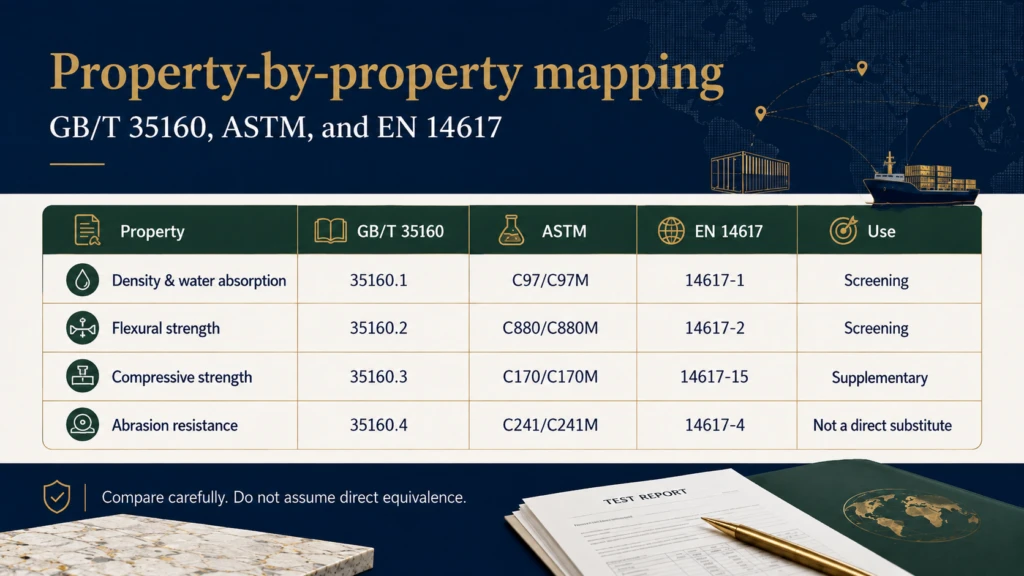
6. How to Review a Supplier Test Report
| Check | What to Verify | Common Red Flag |
|---|---|---|
| Manufacturer | Legal company and actual production site | Report belongs to a different factory or trading company |
| Product identity | SKU, formulation family, thickness, finish, and specimen | Only says “quartz slab” with no traceable model |
| Standard and method | Correct standard number, clause, referenced method, and edition | Draft standard, expired method, or unrelated test |
| Application | Countertop, bonded panel, dry-hung interior, facade, or other use | Supplier applies one report to every possible installation |
| Result and conclusion | Measured result, limit, conditioning, and pass/fail basis | Only a certificate cover page or marketing statement |
| Order traceability | Link to approved sample, batch, slab labels, and packing list | No connection between the tested sample and shipped goods |
Before approving a shipment, run the full product and document check in our silica-free and low-silica surface supply review.
7. Recommended Contract Wording
For orders where GB 46028 evidence is relevant, the purchase specification can include wording such as:
First, The supplier shall identify the applicable classification and clauses of GB 46028-2025 for the quoted product and intended application. Before production approval, the supplier shall provide product-specific supporting reports and shall notify the buyer of any change to the formulation. Specifically, raw-material source, manufacturing site, production line, thickness, finish. Or testing status that may affect the submitted evidence. In particular, gB 46028 documentation does not replace the destination-market tests and project requirements stated elsewhere in this purchase specification.
First, this clause should be adapted to the project and reviewed by the buyer’s technical, legal, customs. Or building-code advisers where necessary.
FAQ:
First, no universal conclusion should be drawn from the dry-hung thickness clause. A countertop supported by cabinets or a substrate is not the same installation as a mechanically dry-hung wall or facade panel. The product must still comply with any other applicable Chinese requirements, destination-market rules, project specifications, and contract terms.
First, no. The requirement depends on the material category and installation method, and some dry-hung categories may require more than 20 mm. Bonded panels, composite systems, and mechanically dry-hung panels should not be treated as one category. Specifically, verify the final table and the project design.
First, no. Ask which product, factory, thickness, finish, application, clause. And test method the declaration covers. A generic letter or badge is not a substitute for product-specific evidence and order traceability.
First, no. GB 46028 is not a crystalline-silica content certification. Silica-related claims require separate product-specific evidence under the relevant destination-market framework and an appropriate mineralogical testing method. Specifically, do not treat a general material-composition report or an XRF result alone as proof of crystalline-silica content.
First, usually not. The measured property may be similar, but specimen preparation, conditioning, loading rate, calculation, and acceptance criteria can differ. Specifically, use GB data as supplementary evidence unless the destination regulation or project specification explicitly accepts the method.
First, the export contract and destination-market requirements remain central. Ask the supplier to explain which Chinese requirements apply to the product and to provide the evidence agreed in the contract. Specifically, do not assume that domestic-standard documentation automatically satisfies the importing country.
First, use China’s official National Public Service Platform for Standards and search for GB 46028-2025 or the Chinese title 建筑装饰石材安全技术要求. The Chinese text is authoritative.
Related Reading
- Quartz Slab Sizes, Dimensions & Thickness Options — Review full-slab formats without confusing countertop thickness with dry-hung panel requirements
- Quartz Slab Supplier Guide — How importers can evaluate manufacturers, specifications, QC, and documentation
- Quartz Slab QC & Packing Guide for Importers — Build traceability from approved sample to loaded container
- Silica-Free Quartz Procurement Guide — Separate silica-content evidence from general product-safety documentation
- Engineered Stone Ban 2024–2026 — Review destination-market restrictions separately from GB 46028
- Quartz Supply Programs — Compare full slabs, prefabs, and project-based supply routes
Official references and methodology
- Standard record: National Public Service Platform for Standards — GB 46028-2025.
- Chinese legal framework: Standardization Law of the People’s Republic of China.
- Review method: This guide separates confirmed official status and scope from procurement interpretation. It intentionally avoids reproducing unverified draft-based thickness values.
- Limitations: This article is commercial procurement guidance, not legal, engineering, customs, or building-code advice. Verify the official standard, the project installation design, and destination-market requirements before ordering or approving a product.
- Last regulatory status check: August 3, 2026.
Request a Product & Documentation Review
Send the product type, thickness, intended application, destination market, and required test standards for an initial supply review.