
Prepared by: AsiaQuartz Editorial Team
Technical review by: AsiaQuartz Product, QC & Supply Chain Team
Last updated: July 2026
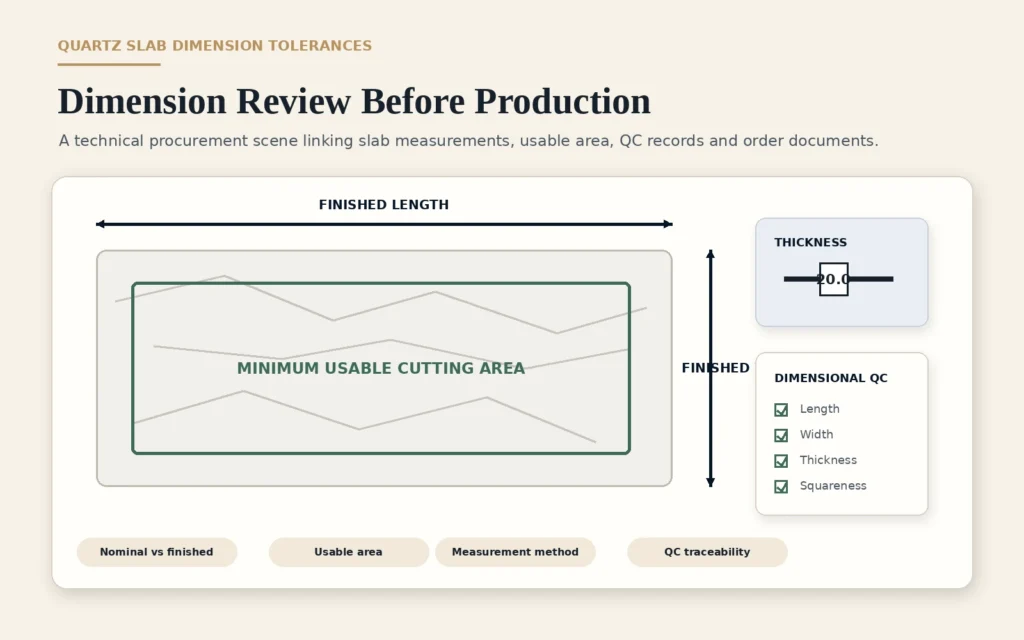
Quick answer: Do not purchase a quartz slab from the marketed format alone. A complete specification should separate the nominal format, guaranteed finished dimensions, minimum usable cutting area, thickness range, squareness or diagonal requirement, edge condition and measurement method. The tolerance must be declared by the supplier and accepted in writing for the exact product and order.
A quotation may show 3200 × 1600 × 20 mm, but that line does not automatically tell a fabricator how much material is guaranteed, whether the edges are trimmed, how thickness is measured, or whether the full face can be used for cutting. Those details matter more than the marketed number when a project includes large islands, repeated apartment layouts, cut-to-size pieces or tight replacement requirements.
This article focuses on quartz slab dimension tolerance and specification. For a broader comparison of common formats, thicknesses, weight and cutting yield, use the separate Quartz Slab Sizes, Dimensions & Thicknesses Guide.Table of Contents
- Five Dimension Terms
- Why Formats Vary
- RFQ and PO Fields
- Tolerance Categories
- Measurement Method
- Usable Cutting Area
- Weight and Loading
- Custom Formats
- Dimensional QC
- RFQ / PO Template
- Buyer Checklist
- FAQ
1. Separate the Five Size Terms
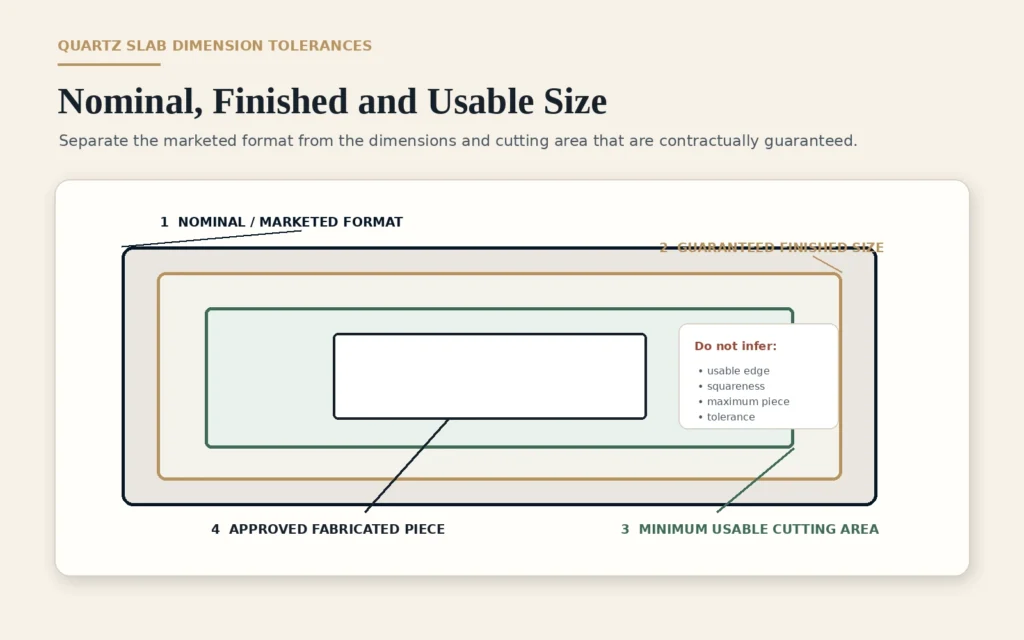
The phrase “slab size” can refer to several different measurements. A buyer should identify which one appears in the quotation and which one is contractually guaranteed.
| Term | What It Means | Why It Matters | Evidence to Request |
|---|---|---|---|
| Nominal or marketed format | The commercial name used for the slab format. | Useful for product comparison, but not sufficient for cutting approval. | Quotation and product data sheet. |
| Pressed or raw size | The slab size before final trimming, squaring or edge finishing. | Can be larger than the finished saleable slab and should not be treated as guaranteed cutting area. | Production-route declaration where relevant. |
| Guaranteed finished dimensions | The minimum and maximum length, width and thickness the supplier agrees to deliver. | This is the primary contractual dimension for receiving inspection. | Written min/max range and measurement method. |
| Minimum usable cutting area | The rectangular face area available after excluding non-usable perimeter, registration zones or approved edge conditions. | Determines whether a nesting plan or large finished piece actually fits. | Written usable-area declaration and full-slab visual. |
| Maximum fabricated piece size | The largest finished component the fabricator can safely and practically produce. | Depends on slab condition, equipment, support, cutouts, handling and installation—not only slab length. | Fabricator confirmation and approved drawing. |
Important distinction: Calibration primarily controls thickness and surface consistency. Trimming and squaring control finished length, width, edge straightness and diagonal relationship. A “calibrated slab” does not automatically prove a tighter length-and-width tolerance.
2. Why Quartz Slab Formats Vary by Manufacturer and Product
There is no single universal quartz slab dimension. Official product information from major manufacturers shows different standard and jumbo formats, as well as product-specific thickness availability. Cambria lists 310 × 141 cm standard slabs and 335 × 166 cm jumbo slabs, while Caesarstone and Silestone publish other format combinations and direct buyers to the exact product specification. See the official Cambria slab-size FAQ, Caesarstone design and specification page and Silestone format and thickness information.
| Published Example | Illustrative Format Information | Procurement Lesson |
|---|---|---|
| Cambria | Publishes separate standard and jumbo slab dimensions and multiple thicknesses. | Confirm maximum fabricated piece size with the fabricator, not from slab dimensions alone. |
| Caesarstone | Publishes standard and jumbo ranges, product-dependent thicknesses and stated dimensional variation for selected formats. | Use the exact color or product page and do not apply one tolerance to the full portfolio. |
| Silestone | Publishes more than one standard or jumbo format across applications and markets, with product-dependent thickness availability. | Confirm the exact SKU, application page and local supply program. |
| AsiaQuartz supply programs | Format, thickness, usable area and availability are confirmed by product and quotation. | Use the written order specification as the source of truth. |
A format such as 3200 × 1600 mm can be a common export option without being a global standard. The buyer should compare the guaranteed finished and usable dimensions rather than assuming two suppliers mean the same thing by “standard” or “jumbo.”
💡 2026 Update — China GB 46028-2025 (effective August 1, 2026): China’s revised national stone safety standard mandates a minimum thickness of 20mm (2cm) for wall-mounted stone panels. This effectively establishes 20mm as the minimum recommended export thickness for wall-panel applications. Buyers specifying 12mm or 15mm slabs for wall use should confirm destination-market acceptance of the lower thickness, or default to 20mm minimum.
3. Fields That Belong in the RFQ and Purchase Order
Product Identification
Product code, color, formulation or surface route, finish, thickness and production origin.
Dimensional Definition
Nominal format, guaranteed finished length and width, thickness range and minimum usable cutting area.
Geometry
Edge condition, squareness or diagonal requirement, straightness, flatness and accepted measurement method.
Inspection and Records
Sample plan, measuring equipment, measurement points, pass/fail rule, photos, batch traceability and nonconformity handling.
Use millimeters as the controlling unit when the order is manufactured and inspected in metric units. Inch conversions may be added for reference, but the PO should state which unit governs if converted values do not match exactly.
Avoid vague wording: “Standard size,” “jumbo size,” “industry tolerance” and “normal usable edge” are not measurable acceptance criteria. Replace them with declared dimensions, a measurement method and a written pass/fail rule.
4. Specify Tolerance by Category, Not as One Number
A single “± tolerance” cannot describe the full slab. The following properties should be considered separately.
| Property | What to Define | Typical Procurement Risk |
|---|---|---|
| Finished length and width | Minimum and maximum measured dimensions after trimming. | A nesting plan was prepared from nominal size but the guaranteed finished area was smaller. |
| Thickness range | Permitted minimum and maximum thickness and where measurements are taken. | Edge build-up, seam alignment or cut-to-size assembly becomes inconsistent. |
| Thickness variation across one slab | Maximum permitted difference between agreed measurement points. | A slab meets average thickness but varies across the face. |
| Squareness | Accepted method, such as diagonal comparison or corner measurement. | Large rectangular pieces do not nest or align as expected. |
| Edge straightness | Condition of each trimmed edge and how deviation is checked. | The slab cannot be referenced reliably against a cutting table or layout line. |
| Flatness or warpage | Support condition, measuring reference and accepted limit. | Results differ because the slab was measured on an unsuitable rack or uneven floor. |
| Usable perimeter | Any excluded border, registration zone, unfinished edge or approved cosmetic area. | The full nominal face was assumed to be cuttable. |
The correct values are product- and order-specific. A supplier may publish one type of dimensional variation for a selected product, while another supplier uses a different guaranteed range. The buyer should not import a number from another brand, marketplace listing or unrelated project.
5. Agree on the Measurement Method
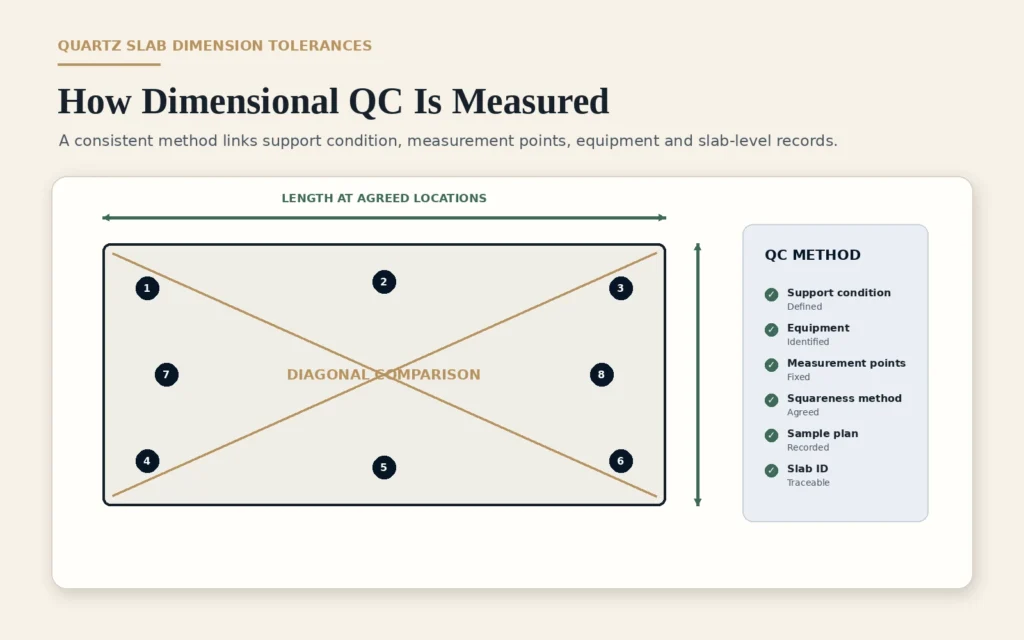
A dimensional tolerance has little value without a consistent measuring procedure. The RFQ or QC plan should identify:
- measurement condition: slab supported in the agreed orientation and on a suitable reference surface or rack;
- equipment: identified and verified tape, rule, gauge or other measuring device appropriate to the required precision;
- measurement points: locations for length, width and thickness readings;
- geometry method: how squareness, diagonal difference, straightness or flatness is assessed;
- sample plan: which slabs and how many slabs are measured;
- record format: slab ID, batch, values, photos, inspector, date and disposition.
Receiving inspection should reproduce the agreed method. A factory reading and a destination reading cannot be compared reliably when the slab is supported differently, measured at different points or checked with different precision.
Suggested Dimensional Record
| Record Field | Example of What to Capture |
|---|---|
| Slab identity | Product code, batch, bundle and slab number. |
| Finished dimensions | Length and width readings at the agreed locations. |
| Thickness map | Readings at agreed corners, edges and central points. |
| Geometry | Diagonal, squareness, straightness or flatness result using the agreed method. |
| Usable area | Declared usable rectangle and any excluded zones. |
| Disposition | Pass, hold, rework, downgrade or reject according to the written acceptance rule. |
6. Do Not Infer Usable Cutting Area from Nominal Size
There is no universal perimeter deduction that applies to every quartz slab. The non-usable area can depend on trimming, edge condition, pattern registration, surface route, printed alignment, approved cosmetic variation and the supplier’s finished-size policy.
For projects with tight nesting, ask the supplier to declare:
- guaranteed finished dimensions;
- minimum usable rectangular cutting area;
- any excluded perimeter or pattern-registration zone;
- edge condition and whether the slab is squared;
- maximum recommended fabricated piece where relevant;
- full-slab images linked to the product and production batch.
For printed or directional surfaces, also confirm pattern direction, intended top orientation and whether adjacent pieces require layout approval. The AsiaQuartz Printed Quartz supply page explains why full-slab review and order-specific approval matter for directional designs.
7. Dimensions Affect Weight and Loading—but Do Not Determine Container Quantity Alone
Slab weight = finished length × finished width × finished thickness × declared density
Use consistent units and the declared density of the exact SKU. The rack, timber, steel, protective materials and restraints add further weight. Container quantity must therefore be based on a product-specific loading plan, not a fixed number of slabs copied from another order.
Request a loading plan showing:
- slab quantity and unit weight;
- rack or A-frame weight;
- packing and protective-material weight;
- total gross weight and load distribution;
- restraint method and unloading assumptions;
- destination or route-specific weight restrictions where relevant.
For calculation and planning, see the Quartz Slab Weight & Container Loading Guide. For rack and storage review, use the Quartz Slab Storage Racks Guide.
8. Distinguish Trimmed Custom Size from a New Production Format
“Custom size” can describe two very different supply routes:
Trimmed from an Existing Slab
A standard slab is cut or squared to a smaller finished dimension. Feasibility depends on usable area, edge condition, yield and fabrication capability.
Produced in a Different Slab Format
The factory changes the production route, mold, pressing format or line arrangement. Feasibility, MOQ, trial requirements, cost and lead time must be quoted separately.
Do not assume that a non-standard length automatically requires a new mold, or that every factory can create a new full-slab format. The supplier should state which route is being quoted.
9. Build Dimensional QC into the Order
Dimensional inspection should be connected to the same batch and shipment records used for surface QC, packing and loading.
| Observation | Possible Implication | Evidence or Action Required |
|---|---|---|
| Measured finished size is below the written minimum. | Approved nesting or fabricated-piece plan may no longer fit. | Hold affected slabs; review piece allocation and written disposition. |
| Thickness readings vary beyond the agreed range. | Seam, edge, support or assembly risk. | Confirm measurement method, remap the slab and assess fabrication impact. |
| Diagonals or corners do not meet the agreed geometry rule. | Slab may not be square enough for the planned reference cut. | Review trimming, usable rectangle and rework feasibility. |
| Usable area is not shown in the inspection record. | Nominal size may be mistaken for guaranteed cutting area. | Add a usable-area declaration and marked full-slab image. |
| Records cannot be linked to bundle or slab IDs. | Results cannot be traced to the shipped material. | Correct labeling and document traceability before release. |
Use the Quartz Slab QC & Packing Guide to connect dimensional records with surface inspection, labels, packing photos and container evidence.
10. RFQ and Purchase-Order Dimension Template
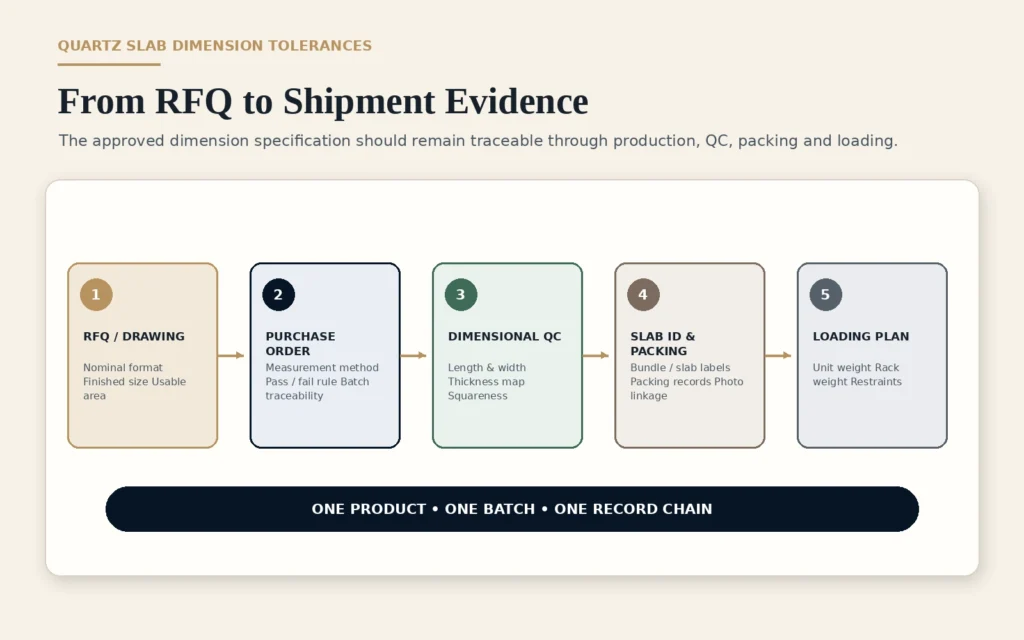
The following wording is a procurement template, not a universal tolerance specification. Replace each declaration with the values agreed for the exact product.
PRODUCT
Product code / color:
Formulation or product route:
Finish:
Production origin:

DIMENSION DEFINITION
Nominal format: ____ mm (L) × ____ mm (W) × ____ mm (T)
Guaranteed finished length: minimum ____ / maximum ____ mm
Guaranteed finished width: minimum ____ / maximum ____ mm
Permitted thickness range: ____ to ____ mm
Maximum permitted thickness variation within one slab: ____
Minimum usable cutting area: ____ mm × ____ mm
Excluded perimeter or registration zone: ____
Edge condition: raw / trimmed / squared / other: ____

GEOMETRY AND MEASUREMENT
Squareness or diagonal requirement: ____
Edge-straightness requirement: ____
Flatness / warpage requirement and support condition: ____
Measurement equipment: ____
Measurement points and method: ____
Controlling unit: metric / inch-pound

QC AND ACCEPTANCE
Inspection sample plan: ____
Required slab-level records: ____
Pass / hold / rework / reject rule: ____
Nonconformity approval authority: ____
Approved drawing or nesting-plan reference: ____
Batch, bundle and slab traceability required: yes / no
Where a project uses factory-cut components, attach the approved drawings and piece schedule. The Cut-to-Size Project Supply page explains the difference between slab supply and drawing-based finished components.
11. Buyer Checklist Before Order Confirmation
- Confirm that the quotation distinguishes nominal and guaranteed finished dimensions.
- Obtain a written minimum usable cutting area.
- State length, width and thickness in a fixed order and identify the controlling unit.
- Define thickness range and within-slab thickness variation separately.
- Agree how squareness, diagonals, straightness and flatness are measured.
- Confirm whether edges are raw, trimmed or squared.
- Check whether printed or directional designs have excluded registration zones.
- Link the nesting plan or fabricated-piece schedule to the approved slab format.
- Use the exact product density for weight calculations.
- Request an order-specific rack and container loading plan.
- Define the dimensional inspection sample and record format.
- Connect every record to product, batch, bundle and slab IDs.
- Write the pass/fail and nonconformity rules into the PO or quality agreement.
FAQ:
No. It is a common export format in some supply programs, but manufacturers publish different standard and jumbo dimensions. Confirm the exact SKU and written order specification.
Nominal size is the commercial format name or production target. Finished size is the measured saleable slab after applicable trimming and finishing, within the supplier’s written guaranteed range.
No. The excluded area varies by product, edge condition, production route and pattern requirements. Request a minimum usable rectangle in writing.
Not automatically. Calibration mainly concerns thickness and surface consistency. Finished length, width and squareness depend more directly on trimming and squaring operations.
Agree the measuring equipment, support condition, locations and number of readings. Record both the permitted thickness range and the maximum variation across one slab.
There is no universal number. It depends on finished dimensions, thickness, density, rack and packing weight, restraints, load distribution and route-specific weight limits.
No. ASTM C616 covers quartz-based natural dimension stone and explicitly excludes molded, cast or artificially aggregated units. It should not be cited as an engineered-quartz slab dimension standard.
For wall-mounted stone panels in China and most Asian markets, GB 46028-2025 — effective August 1, 2026 — mandates a minimum thickness of 20mm (2cm). For standard kitchen benchtops and horizontal surfaces, 20mm and 30mm are the dominant export formats. 12mm and 15mm slabs are suitable for vertical splashback and low-stress applications only — not structural or overhead installations. When in doubt, specify 20mm minimum and confirm with the fabricator before ordering.
Related reading:
- Quartz Slab Sizes, Dimensions & Thicknesses
- Quartz Slab Product Specifications
- Quartz Slab Weight & Container Loading Guide
- Quartz Slab QC & Packing Guide
- Cut-to-Size Project Supply
- Quartz Slab Supply Chain Guide
Sources and methodology
- Cambria — Quartz Countertops FAQ. Used as an official manufacturer example of standard, jumbo and thickness options, and the need to confirm maximum fabricated piece size with the fabricator.
- Caesarstone — Design & Specification. Used as an official example of product-specific slab dimensions, thickness availability and declared dimensional variation.
- Cosentino — Silestone Formats and Thicknesses. Used as an official example showing that format and thickness availability can vary by application, product and market page.
- ASTM C616/C616M-22. Used only to clarify that the standard covers quartz-based natural dimension stone and excludes molded, cast or artificially aggregated units.
- BS EN 14618:2009 — Agglomerated Stone, Terminology and Classification. Used for terminology and classification context, not as a universal slab-dimension tolerance standard.
Method: This article separates nominal format, finished dimensions, usable area and fabricated-piece size. It does not present a universal market size, tolerance, perimeter deduction, container quantity, waste percentage or custom-order lead time. Product-specific written specifications and order-level QC take priority.
Limitations: This is general B2B procurement guidance, not an engineering standard or a substitute for the supplier’s product-specific TDS, the fabricator’s equipment limits, approved drawings or a signed quality agreement.
Information status: Reviewed July 28, 2026. Manufacturer portfolios, product dimensions, thicknesses and standards may change.
Research and AI disclosure: Research and drafting tools assisted with source collection, structure and language review. Final technical claims and AsiaQuartz-specific information require human editorial and technical approval before publication.
Confirm Dimensions Before Production
Share the product code, required finished size, usable cutting area, drawings, quantity, destination and dimensional QC requirements. AsiaQuartz can review the slab format, measurement method, inspection records, packing and loading plan.