
Prepared by: AsiaQuartz Editorial Team
Technical review by: AsiaQuartz Product, QC & Supply Chain Team
Last updated: July 2026
Quick Answer
For B2B planning, a 3200 × 1600 mm quartz slab at 20 mm nominal thickness typically weighs 225–260 kg (approximately 500–570 lbs). At 30 mm, a slab of the same dimensions typically weighs 340–390 kg (approximately 750–860 lbs). Super jumbo slabs up to 3530 × 2000 × 30 mm can exceed 500 kg per piece.
These are planning estimates for net product weight. Actual per-slab weight depends on product formulation, density, actual thickness, dimensional tolerance and finish. Shipment gross weight additionally depends on the A-frame or crate, dunnage, strapping, securing materials, and the container tare — all of which affect total loaded weight, VGM, and destination planning, but do not change the slab’s own mass. Before booking freight, you need more than a planning estimate — you need a packing list with actual per-bundle weights, a crate or loading plan, and a Verified Gross Mass (VGM) declaration for the loaded container.
Why Weight Shapes Your Container Economics — Even Without a Per-Kilogram Freight Rate
Most B2B quartz buyers compare suppliers by FOB or FCA price per square metre. That’s only part of the picture. Weight affects your container economics in a way that’s less direct than a per-kilogram freight bill — but just as material:
- FCL base ocean freight is generally quoted per container for a standard shipment within the carrier’s weight acceptance policy — not directly per kilogram. However, slab format, nominal thickness and unit weight together determine how many square metres of material that per-container freight charge is spread across.
- Slab format and nominal thickness determine packing geometry — how many slabs physically fit in an A-frame or crate. Unit weight (density × volume) determines whether container payload, route limits, packing-frame capacity, or handling-equipment limits further reduce the practical count. Both matter, but through different mechanisms.
- When the same per-container freight is divided by fewer square metres, your freight cost per square metre rises. This is the weight-to-cost chain that matters for quartz buyers, and it has nothing to do with revenue-ton logic. (For LCL or breakbulk shipments, weight-or-measure charging may apply — but standard quartz slab orders are FCL.)
This article walks through the full weight-to-container process: calculating slab weight, understanding what really limits slab count per container, managing VGM, confirming destination route constraints, and using weight data in your purchase planning.
On This Page
- Calculate slab weight
- Estimate slabs per 20GP
- Packing list vs. VGM
- Route and axle limits
- Freight cost per m²
- Super jumbo handling
- Buyer questions
- Cargo insurance
- FAQ
Before You Start: Lock In Your Slab Specs
This guide assumes you’ve already chosen your slab dimensions and nominal thickness. If you’re still deciding between jumbo, project-size, and super jumbo formats, start with our Quartz Slab Sizes & Specifications Guide. Weight calculations only make sense once the slab format is confirmed.
1. How Quartz Slab Weight Is Estimated
Quartz slab weight follows a straightforward physical relationship: slab area × nominal thickness × material density. The variable that causes surprises isn’t the formula — it’s the density range and what happens when it meets packing and container constraints.
The Estimation Formula
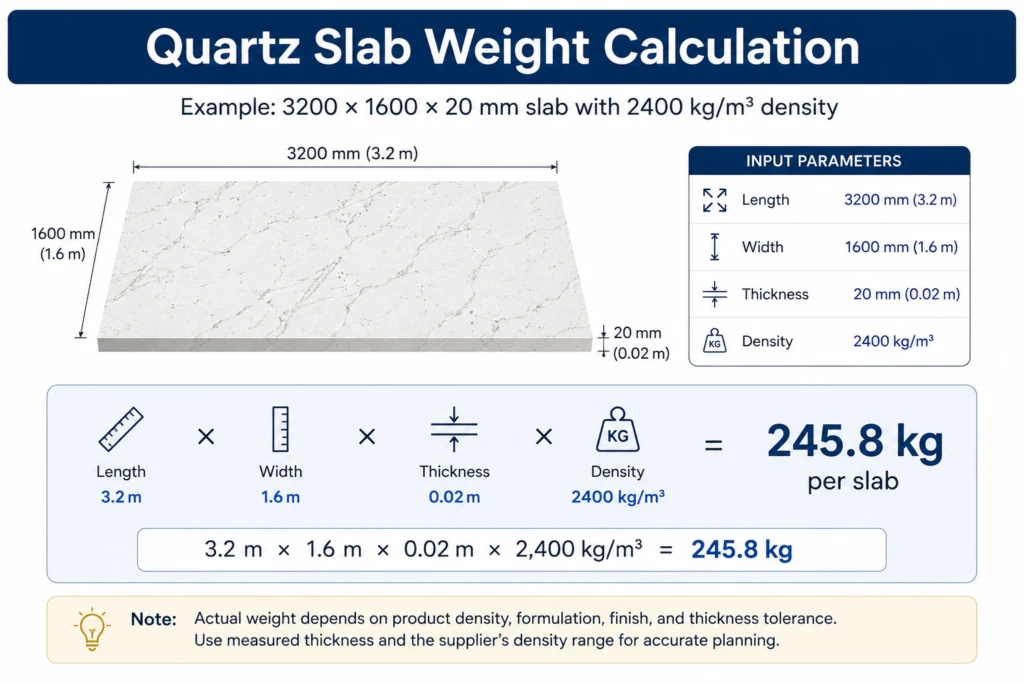
Slab Weight (kg) = Length (m) × Width (m) × Nominal Thickness (m) × Density (kg/m³)
Example for 3200 × 1600 × 20 mm at 2,400 kg/m³:
= 3.2 × 1.6 × 0.02 × 2,400
= 245.8 kg
At 2,200 kg/m³: ~225 kg | At 2,500 kg/m³: ~256 kg
Planning range for this format: ~225–260 kg
Engineered quartz density in AsiaQuartz-reviewed product specifications typically falls in the 2,200–2,500 kg/m³ range. This is an observed planning range, not a product-specific guarantee or an industry-wide mandatory band. Different formulations, filler systems, porosity levels and manufacturing processes can produce density values both within and outside this observed planning range.
Why Density Varies Between Products and Production Runs
- Mineral-to-resin ratio: Where denser mineral content replaces lower-density resin, final density may increase; filler type, particle grading and porosity also matter.
- Filler type and proportion: Mineral fillers vary in specific gravity
- Pigment and additive load: Darker or specialty colours may use different formulations
- Manufacturing process: Vibro-compaction pressure and curing affect the final slab density
Two slabs that look identical and share the same colour code can differ in density if they come from different production lines or formulation revisions. Weight variance between slabs in the same batch can be used as a plausibility and dimensional-consistency check, but it should not be treated as a stand-alone indicator of formulation quality, resin consistency, or overall product performance. Always confirm container-level weight from the actual factory packing list and, before shipment, from the VGM — never from a catalogue number alone.
Why You Need Actual Weights, Not Estimates
A supplier who quotes a single round-number “standard weight” per slab (e.g. 240 kg) is simplifying for sales. In production, per-slab weight can vary. Small per-slab variances can accumulate across a full container load, so nominal unit-weight calculations should never substitute for the SOLAS Verified Gross Mass (VGM). Use estimated weight for initial planning. Use the packing list for preliminary booking. Use VGM for the final shipping declaration.
Planning Weight Ranges by Slab Format and Nominal Thickness
| Slab Format | Nominal Thickness | Approx. Weight / Slab* | Approx. kg / m²* | Planning Note |
|---|---|---|---|---|
| 3200 × 1600 mm | 20 mm | 225–260 kg | 44–51 kg/m² | The baseline for most wholesale planning. Confirms with the widest range of packing configurations and destination routes. |
| 3200 × 1600 mm | 30 mm | 340–390 kg | 66–76 kg/m² | The thicker nominal dimension reduces bundle capacity; higher unit weight also tightens equipment, payload and route constraints. |
| 3000 × 1400 mm | 20 mm | 185–210 kg | 44–50 kg/m² | The more compact slab footprint may allow a higher count within compatible crate or A-frame configurations. Useful where destination road limits or receiving equipment are constraints. |
| 3000 × 1400 mm | 30 mm | 280–315 kg | 67–75 kg/m² | Mid-weight option in a compact format. Confirm availability and MOQ for 30 mm in project-size dimensions. |
| Super Jumbo (3530 × 2000 mm) | 20 mm | 310–355 kg | 44–50 kg/m² | Confirm crate dimensions, forklift capacity, and warehouse receiving equipment. Large footprint may reduce slab count before weight becomes the binding constraint. |
| Super Jumbo (3530 × 2000 mm) | 30 mm | 465–530 kg | 66-75 kg/m² | May require overhead crane or high-capacity forklift at origin and destination. Review loading sequence, crate reinforcement, and destination unloading plan carefully. |
* Weight ranges are planning estimates based on engineered quartz density in the 2,200–2,500 kg/m³ range (AsiaQuartz-reviewed product specifications). Actual per-slab net weight depends on product formulation, density, actual thickness, dimensional tolerance and finish. Shipment gross weight additionally includes A-frames, crates, dunnage and securing materials — confirm the factory’s packing list for gross cargo weight and the container VGM before shipment.
2. What Determines How Many Slabs Fit in a Container
A common — and incorrect — assumption is that container payload (the rated maximum cargo mass) is always the binding limit for quartz slab loading. In practice, several limits apply, and the lowest one determines the practical slab count.
The Real Packing Constraints: It’s Usually Geometry, Not Payload
For typical quartz slab loads in a 20GP container — where the total cargo weight is often in the 12–15 tonne range and the container’s rated payload may be approximately 28 tonnes — packing geometry usually limits the slab count before the container’s rated payload is reached. The practical slab count is determined by the lowest of several limits: packing configuration (A-frame or crate internal width, bundle stacking height, dunnage), container door opening dimensions, floor load distribution, securing and bracing requirements, centre of gravity, and destination unloading capacity. Unit weight matters — it determines whether those geometric constraints intersect payload, road limits, and equipment — but it is rarely the only constraint.
Container Loading Planning Estimates by Format
The table below shows planning ranges for slab count. These reflect the interaction of slab dimensions, packing configuration, and common container internal geometry — not a pure payload calculation. Actual loading plans must be confirmed for the specific product, packing method, and destination.
| Format | Nominal Thickness | Slabs / 20GP* | Approx. m² / 20GP | Typical Limiting Factor |
|---|---|---|---|---|
| 3200 × 1600 mm | 20 mm | 48–55 | 246–282 m² | Packing geometry (A-frame or crate internal dimensions, bundle configuration). |
| 3200 × 1600 mm | 30 mm | 30–38 | 154–195 m² | Packing geometry amplified by thicker nominal dimension per slab. Confirm destination road limits and forklift capacity. |
| 3000 × 1400 mm | 20 mm | 60–70 | 252–294 m² | Packing geometry. Compact format may allow higher count — confirm crate design and load stability. |
| 3000 × 1400 mm | 30 mm | 40–48 | 168–202 m² | Packing geometry. Confirm availability and MOQ for 30 mm in project-size format. |
| Super Jumbo (3530 × 2000 mm) | 20 mm | 30–36 | 212–254 m² | Slab footprint — large format restricts stacking configurations well before payload is reached. |
* Planning estimates. Actual loading depends on the specific packing method (A-frame, wooden crate, mixed bundling), slab density, nominal thickness tolerance, dunnage, route requirements, and destination constraints. These are not loading guarantees. Request a crate or loading plan from your supplier before confirming the order.
The Packing Factor: A-Frame vs. Crate vs. Bundle
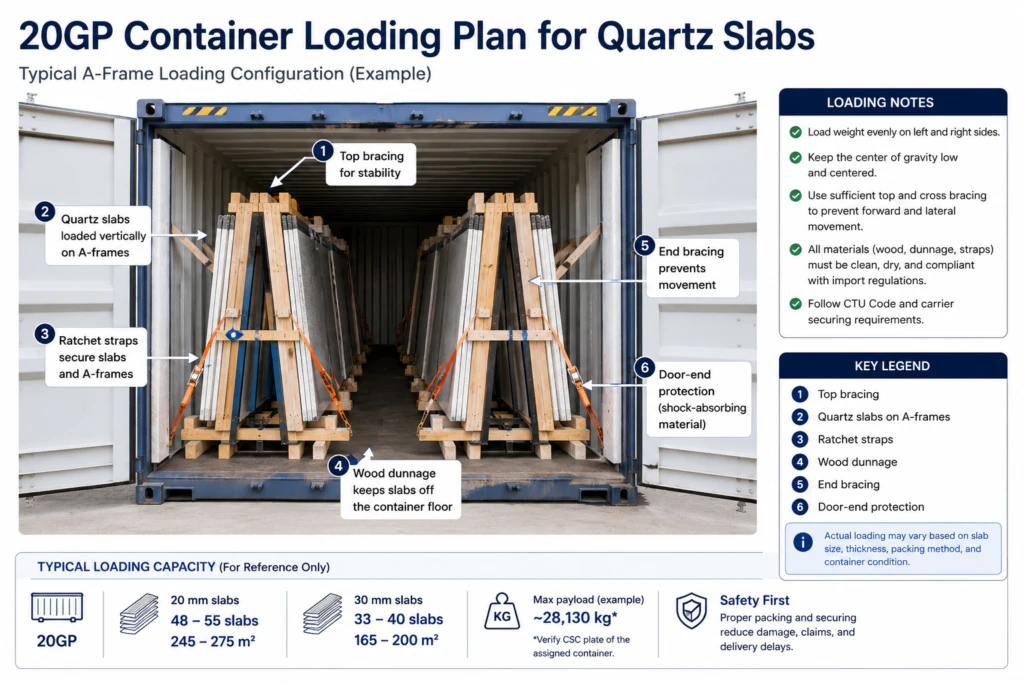
Packing method directly affects how many slabs fit. An A-frame system secures slabs vertically on a steel or wooden frame — the frame’s internal width and the bundle’s total nominal thickness determine capacity. Flat-packed wooden crates use a different stacking geometry with pallet or skid bases. Mixed bundling (different colours or formats in one container) introduces additional complexity. Always ask for a crate plan or loading diagram showing bundle positions, weights, and securing points before confirming your order. For inspection checkpoints, shipping marks and loading-photo requirements, use the Quartz Slab QC & Packing Guide.
3. Packing List Weight vs. VGM: The Documents That Matter
A recurring theme in quartz logistics is the gap between what the packing list says and what the container actually weighs. Buyers who only rely on packing list estimates risk VGM discrepancies, booking amendments, terminal holds, missed cut-offs, or denied vessel loading. Here is how the weight documents relate to each other.
Weight Data Flow from Quote to Shipment
| Document / Data | What It Contains | Used For | When It’s Available |
|---|---|---|---|
| Planning Estimate | Approximate slab weight based on nominal dimensions and density range | Initial RFQ, budget freight comparison, container format selection | Before order placement |
| Packing List — Net Weight | Declared slab or product net weight per bundle or per piece | Order confirmation, preliminary freight booking, commercial invoice | After production, before container loading |
| Packing List — Gross Cargo Weight | Product net weight + A-frame, crate, dunnage, strapping, and other packing materials | Freight booking update, destination handling planning | After packing configuration confirmed |
| Container Tare Weight | The empty container’s own weight (marked on the CSC plate and door) | VGM calculation (Method 2), payload verification | When container is assigned |
| Container Max Gross Mass | The maximum permitted total weight of the loaded container (CSC plate) | Payload ceiling check | Always — marked on container |
| VGM (Verified Gross Mass) | The verified total weight of the packed container — either by weighbridge (Method 1) or by summing certified cargo, packing, dunnage, securing, and container tare weights using a method approved by the competent authority of the State where the container is packed (Method 2, per SOLAS Guidelines) | SOLAS-mandated shipping declaration. A packed container cannot be loaded until an acceptable VGM has been obtained and submitted in time for the stowage plan — a missing or late VGM can result in missed sailings, booking amendments, and additional charges. (In some cases, the terminal or the master’s representative may obtain the VGM on the shipper’s behalf by prior agreement — but this is not a substitute for advance VGM planning.) | After container is packed — must be submitted before the VGM cut-off |
SOLAS VGM: The Verified Weight Required Before Vessel Loading
Under the SOLAS Convention, the shipper is responsible for providing a Verified Gross Mass for every packed container. A packed container cannot be loaded until an acceptable VGM has been obtained and submitted in time for the stowage plan. (In some cases, by prior agreement, the terminal or the master’s representative may obtain the VGM on the shipper’s behalf.) A packing list weight — even an accurate one — is not a VGM unless it has been verified through an approved method and submitted to the carrier. Confirm with your supplier and freight forwarder: who will provide the VGM, by which method, and by which deadline.
4. Five Route Limits to Confirm with Your Freight Forwarder
A container that loads legally at origin can still be illegal or unworkable at destination. Instead of relying on generalised regional rules, buyers should confirm the following five limits for the specific port, inland route, vehicle type, and date of shipment. Connect this route review with the broader quartz slab supply-chain and landed-cost framework.
| Limit | What to Ask Your Freight Forwarder | Why It Matters for Quartz |
|---|---|---|
| 1. Container Rated Payload & CSC Plate | What is the max gross mass, tare, and rated payload for the assigned container? | Confirms the absolute payload ceiling. Representative planning values for a common 20GP series: max gross mass near 30,480 kg, tare near 2,350 kg, leaving a rated payload of approximately 28,130 kg — but tare, max gross mass and payload vary by equipment series and manufacturer. Confirm the assigned unit’s CSC plate. |
| 2. Carrier & Terminal Acceptance Limit | Does the shipping line or terminal impose a weight limit lower than the container’s rated payload for this route? | Some carriers, terminals, or specific trade lanes enforce acceptance limits below the CSC-rated payload. |
| 3. VGM Requirement & Cut-off | What is the VGM submission deadline? Which verification method is accepted? | Late or missing VGM may result in missed sailings, booking amendments, terminal holds and additional charges. Confirm method and deadline before the loading date. |
| 4. Road Vehicle, Chassis & Axle-Group Limits | What is the maximum permitted gross combination mass for the truck and chassis on the planned route? What are the single-axle, tandem-axle, and bridge-formula limits? | Even if the container is within CSC limits, the road vehicle carrying it to the warehouse may exceed legal axle or gross combination mass. This is especially important for 30 mm and super jumbo loads. |
| 5. Final-Mile & Receiving-Site Restrictions | Can the delivery truck access the site? What forklift or crane capacity is available for unloading? What are the door height, aisle width, and floor loading at the warehouse? | A container that reaches the port is not yet delivered. Site access, equipment, and slab rack capacity must be confirmed before the container departs origin. |
Reverse-Engineer Your Slab Count from Destination Constraints
Instead of starting with slab dimensions and hoping the container plan works, start with your destination constraints:
1. Ask your freight forwarder for the maximum cargo payload (not just the container gross) allowed on the planned route and vehicle.
2. Subtract the confirmed A-frame, crate, dunnage, and securing weight.
3. Divide by the confirmed per-slab weight from the packing list to get your maximum slab count by weight.
4. Compare that against the slab count the packing geometry can physically accommodate (crate plan) — the lower number governs.
5. Verify that the total loaded container weight (cargo + packing + container tare) does not exceed the carrier’s acceptance limit or the destination vehicle limits.
This approach catches weight problems before they become expensive surprises — at the port gate or on the road.
5. How Weight and Slab Count Affect Your Cost per Square Metre
For FCL quartz slab shipments, the base ocean freight is typically a per-container rate — not a per-kilogram rate. (For LCL or breakbulk, weight-or-measure charging rules apply.) The weight-to-cost chain depends on two separate factors: Slab format and nominal thickness determine packing geometry — thicker slabs mean fewer slabs per A-frame or crate bundle. Unit weight determines whether payload, route, frame, or handling limits further reduce the practical count. Together, these two variables determine how many square metres a container can carry, and therefore the freight cost spread across each square metre delivered.
In short: 30 mm yields fewer square metres per container primarily because of the thicker nominal dimension and the packing geometry it imposes; the higher per-slab weight also tightens equipment, payload, and route constraints.
Cost Layers Where Weight Matters
| Cost Layer | How Weight Affects It | What to Confirm |
|---|---|---|
| 1. Material Cost (EXW / FCA / FOB) | Typically priced per m² or per slab. Minimal direct weight impact on unit price. | Confirm which Incoterms® rule applies and at which delivery point. For containerised cargo handed to the carrier at the factory or container yard, FCA is often the more accurate term. |
| 2. Packing Materials | Heavier or larger slabs require stronger frames, more dunnage, potentially higher packing cost and packing weight. | Is packing included in the material price? What is the confirmed packing weight per bundle? |
| 3. Origin Handling & Loading | Heavier individual slabs or bundles may require forklifts with higher capacity. Super jumbo may require crane loading. | Confirm loading equipment, labour cost, and any special handling charges for your slab format. |
| 4. Ocean Freight (FCL) | Generally quoted per container for standard shipments within carrier weight acceptance. Overweight surcharges may apply if the total container weight exceeds the carrier’s threshold. The freight cost per m² is determined by how many square metres fit in the container. | Confirm the per-container rate, any overweight or special-equipment surcharges, and the estimated slab count to calculate freight cost per m². |
| 5. Destination Terminal Charges | THC, documentation, and handling may scale with container type or weight category. | Get a terminal-charge estimate from your destination agent for your container type and total declared weight. |
| 6. Inland Trucking | Directly weight-sensitive. Total vehicle gross combination mass, axle loads, and route permits depend on the loaded container weight. | Provide the expected container gross weight (cargo + packing + tare) to your trucking provider. Confirm chassis type, route, and any overweight permit requirements. |
| 7. Warehouse Receiving & Handling | Per-slab or per-bundle weight dictates forklift or crane capacity, rack load rating and floor loading. Slab dimensions and equipment turning radius determine door clearance and aisle width. | Confirm forklift capacity, rack dimensions, floor loading, door height, aisle width, and staffing for slab handling at your warehouse. |
Illustrative Comparison: 20 mm vs. 30 mm — Same Container, Different m²
Illustrative scenario: A buyer plans a 3200 × 1600 mm order and is comparing 20 mm and 30 mm nominal thickness options. Both fit in a 20GP container with a single per-container ocean freight charge. The difference is in slab count — and therefore in freight cost per square metre.
| Planning Step | 20 mm (3200 × 1600) | 30 mm (3200 × 1600) |
|---|---|---|
| Planning slabs per 20GP | ~50 | ~35 |
| Approx. m² per container | ~256 m² | ~179 m² |
| Per-container ocean freight (illustrative) | Same | Same |
| Freight cost per m² delivered | Lower (same freight ÷ more m²) | Higher (same freight ÷ fewer m²) |
This example illustrates a general principle: 30 mm doesn’t just cost more per slab — it costs more per square metre delivered. The lower square-metre count per container is driven by the thicker nominal dimension and the packing-geometry constraints it imposes, while the higher per-slab weight also tightens equipment, payload and route limits. Together, these factors affect the landed cost per square metre. The exact cost difference depends on the specific freight rate, port pair, and packing configuration — request a crate plan and freight quote for your actual order to calculate it.
Build a Container Plan That Works
Planning a quartz slab order? Start with the weight data and destination constraints:
Email gm@asiaquartz.com or use the AsiaQuartz supply review form with your target slab format, nominal thickness requirements, approximate quantity, destination port, and timeline. The AsiaQuartz supply team can help you compare container loading scenarios, packing recommendations, and route planning across China, Vietnam, and Thailand supply options — with no obligation.
6. Special Considerations for Super Jumbo and Heavy-Format Orders
Super jumbo slabs (3530 × 2000 mm and similar) introduce weight and handling complexities that go beyond standard container loading. A single 30 mm super jumbo slab can exceed 500 kg — and at that weight, every step of the logistics chain needs explicit review, not assumptions.
What a Professional Crate / Loading Plan Should Include
| Element | What It Covers | Why It Matters for Heavy / Super Jumbo Orders |
|---|---|---|
| Bundle ID & Gross Weight | Each bundle or crate numbered with its confirmed gross weight | Enables per-bundle weight verification and VGM calculation. |
| Position & Orientation | Bundle location within the container, facing direction, and vertical/horizontal orientation | Critical for centre-of-gravity management and load distribution — especially for A-frame-loaded slabs. |
| Centre of Gravity | Estimated or marked centre of gravity for each bundle | Recommended by, and consistent with, CTU Code safe-packing principles. Essential for crane or forklift handling. |
| A-Frame or Crate Dimensions & Contact Points | Frame base dimensions, skid or bearer positions, and floor contact area | Determines floor load distribution and whether concentrated loads exceed container floor ratings. |
| Securing Points & Method | Lashing points, strap or chain ratings, bracing, blocking, and dunnage | Prevents longitudinal, transverse, and vertical movement during ocean and road transport. |
| Door-End Protection | Bracing or barriers preventing cargo shift toward the container doors | Protects receiving personnel — unsecured cargo at the door end is a serious safety hazard. |
| Loading & Unloading Sequence | Order of bundle placement and removal, including equipment requirements at each step | Prevents unstable partial loads and ensures the destination warehouse can safely unpack in the correct sequence. |
| VGM Declaration | Method used (weighbridge or certified calculation), total verified mass, and supporting records | Required for vessel loading. Must be submitted before the carrier’s VGM cut-off. |
| Loading Photos | Photos of each bundle in position, securing, door-end protection, and container markings | Visual record supporting the loading plan and receiving inspection. Can materially strengthen the evidence available during a cargo claim, though coverage and claim outcome depend on the policy terms and the circumstances of loss. |
CTU Code: Global Good-Practice Guidance for Container Packing
The IMO/ILO/UNECE Code of Practice for Packing of Cargo Transport Units (CTU Code) is a non-mandatory international code of practice providing guidance on safe packing, securing, load distribution, and centre-of-gravity management. For heavy quartz slab shipments — particularly super jumbo orders — the CTU Code’s guidance around concentrated loads, securing, and door-end protection is directly relevant. A supplier’s loading plan should be consistent with CTU Code principles. Unsecured or improperly distributed heavy cargo is not only a damage risk — it is a safety risk for everyone handling the container along the supply chain.
7. Weight-Related Questions for Your Purchase Planning
A supplier who provides only slab dimensions and a unit price isn’t giving you enough to plan logistics. Use these questions together with the quartz slab supplier evaluation guide before committing to an order.
- What is the confirmed per-slab or per-bundle weight on the packing list? Ask for actual weights, not catalogue estimates.
- How many slabs do you load per container for this format and nominal thickness? Ask for a crate plan or loading diagram — not just a number.
- What packing method do you use, and what is the confirmed packing material weight? A-frame, steel frame, wooden crate, or mixed bundling — each produces different packing weight and geometry.
- Who provides the VGM, by which method, and by what deadline? Confirm the VGM process before the container is packed — not after.
- Does the material price include packing, loading, and origin documentation? If not, what are the additional charges?
- What is the expected container gross weight (cargo + packing + container tare) for a full load? This is the number your freight forwarder and destination trucker need.
- Can you support container planning for mixed colours or mixed formats in the same shipment? Confirm minimum quantities per format and request a mixed-loading plan.
- Can you provide loading photos showing bundle positions, securing, door-end protection, and container markings? Visual evidence supports insurance, receiving inspection, and repeat-order consistency. See our QC & Packing Guide for the full pre-shipment inspection framework.
8. Insurance: What Your Cargo Policy Should Cover
Weight affects cargo insurance in two ways: larger, thicker or higher-value slabs may increase the declared value per piece, while heavier bundles increase handling, securing and breakage exposure. Standard marine cargo insurance may not automatically cover all the risks relevant to quartz slab shipments.
Before shipping, confirm with your insurer or broker:
- Whether breakage is a covered peril under the policy terms — and under what conditions
- Whether inadequate or improper packing is excluded, and what packing standards the insurer expects
- How pre-existing defects, concealed damage discovered after unpacking, and handling damage during unloading are treated
- The applicable deductible or excess and how it relates to per-slab value
- Claims notification deadlines and survey requirements — particularly whether a container survey or joint inspection is required upon opening
Loading Photos = Insurance Records
Loading photos are not just QC evidence — they are insurance documentation. If a slab arrives damaged, photos showing the original packing condition, bundle position, securing method, and door-end protection can materially strengthen the evidence available during a cargo claim, but coverage and claim outcome depend on the policy terms and the circumstances of loss. Ask for loading photos as part of your standard documentation package.
FAQ:
A 3200 × 1600 mm quartz slab at 20 mm nominal thickness typically weighs 225–260 kg. At 30 mm, the same slab typically weighs 340–390 kg. These are planning ranges — actual per-slab net weight depends on product formulation, density, actual thickness, dimensions and finish. Packing configuration affects shipment gross weight, not the slab’s own mass. Always use the factory’s packing list for booking and VGM for the final shipping declaration.
For FCL (full container load) shipments — which is how most quartz slab orders are shipped — the base ocean freight is generally quoted per container, not per kilogram, for standard shipments within the carrier’s weight acceptance policy. Overweight surcharges or special equipment fees may apply if the total container weight exceeds the carrier’s threshold. For LCL or breakbulk shipments, weight-or-measure charging rules apply. The key number for quartz buyers is the freight cost per square metre delivered — which depends on how many slabs (and therefore how many square metres) fit in the container.
For 3200 × 1600 × 20 mm slabs, a 20GP container may hold approximately 48–55 slabs, depending on the packing method, crate or A-frame design, dunnage, and destination route constraints. At 30 mm nominal thickness, the count typically drops to approximately 30–38 slabs. The practical limit is usually determined by packing geometry — not container payload alone. Request a crate plan or loading diagram from your supplier.
VGM stands for Verified Gross Mass — the verified total weight of a packed container. Under the SOLAS Convention, a packed container cannot be loaded until an acceptable VGM has been submitted in time for the stowage plan. A packing-list weight is not automatically a VGM. Method 1 weighs the packed container. Method 2 sums the cargo, packing, dunnage, securing materials and container tare using a certified calculation method approved by the competent authority of the State where the container was packed. Confirm who provides the VGM, which method is used, and the carrier’s submission deadline.
It may be possible, but mixed nominal thicknesses complicate packing geometry and load distribution. Different thicknesses mean different per-slab weights and bundle dimensions, which affects stacking, securing, and centre-of-gravity management. Confirm minimum quantities per thickness and request a mixed-loading crate plan from your supplier.
Yes. Super jumbo slabs (3530 × 2000 mm and similar) can exceed 500 kg per piece at 30 mm. They typically require higher-capacity forklifts or overhead cranes at the factory, port, and receiving warehouse. The crate or loading plan should address centre of gravity, floor load distribution, securing, door-end protection, and unloading sequence. Marine cargo insurance coverage should also be reviewed for these higher-value, higher-risk shipments.
Start with the per-container ocean freight quote. Estimate the slab count for each nominal thickness from your supplier’s crate plan. Divide the per-container freight by the total square metres for each option. Because 30 mm slabs yield fewer square metres per container, the freight cost per square metre delivered is typically higher — even if the per-container freight is identical. Request a full landed-cost comparison from your freight forwarder, factoring in inland trucking, terminal charges, and receiving costs.
Yes. Contact AsiaQuartz with your target slab format, nominal thickness, approximate quantity, and destination port. The supply team can help you compare container loading scenarios, packing recommendations, VGM coordination, and route planning — with no obligation.
Conclusion: Weight Planning Is Container Planning
Quartz slab weight is not just a technical data point — it’s the number that connects product specification, packing geometry, container loading, VGM compliance, destination route limits, and your final cost per square metre delivered. A quote without confirmed weight data and a crate plan is incomplete for logistics planning.
Before comparing suppliers, lock in the slab format and nominal thickness. Get the per-slab or per-bundle packing list weight. Request a crate plan or loading diagram. Confirm the VGM process. Then compare total landed cost per square metre — not just FOB or FCA unit prices — with the full logistics picture in view. For quartz, weight is the thread that ties the entire supply chain together.
Request Supply Review
Planning a quartz slab order? Start with the weight data and destination constraints.
Email gm@asiaquartz.com or use the AsiaQuartz supply review form with your target slab format, nominal thickness requirements, approximate quantity, destination port, and timeline. The AsiaQuartz supply team will help you review container loading scenarios, packing recommendations, VGM coordination, and landed-cost planning across China, Vietnam, and Thailand supply options — with no obligation.