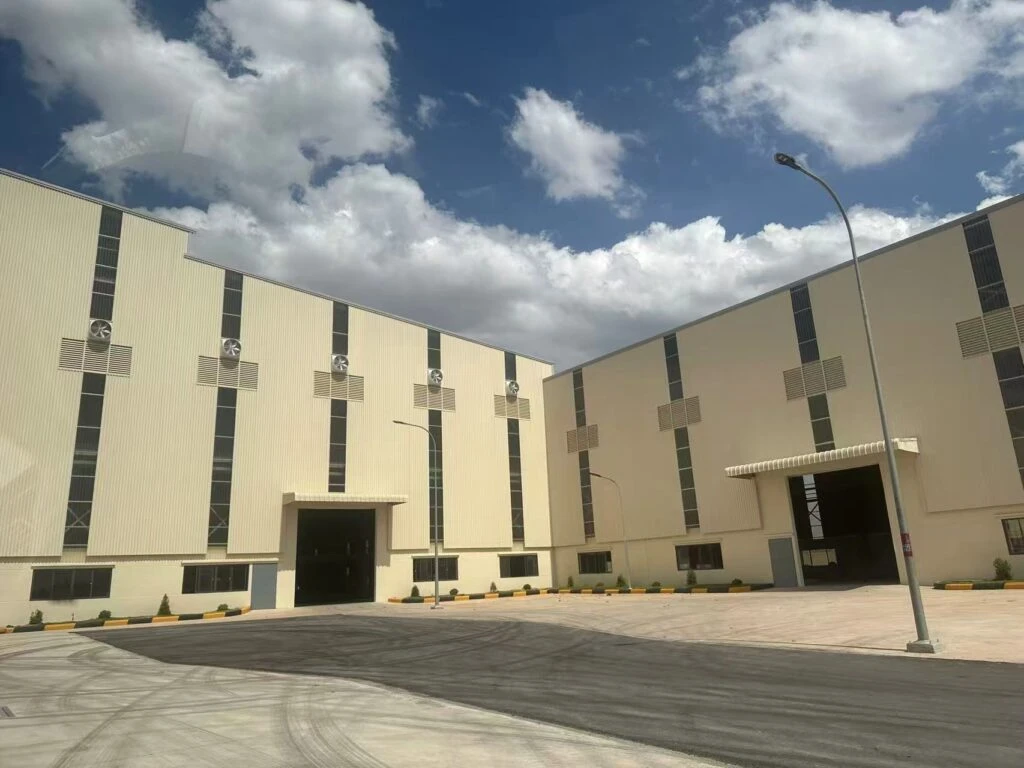
Prepared by: AsiaQuartz Editorial Team
Technical review by: AsiaQuartz Product, QC & Supply Chain Team
Last updated: July 2026
Quick answer: A quartz slab rack should be assessed from documented working load, engineering and installation information, permitted loading configuration, restraints, condition, inspection records and compatibility with the actual slab—not from tube thickness, visual size or slab count alone. Factory visitors should remain outside the slab fall zone and should never touch, lean on or informally test a loaded rack.
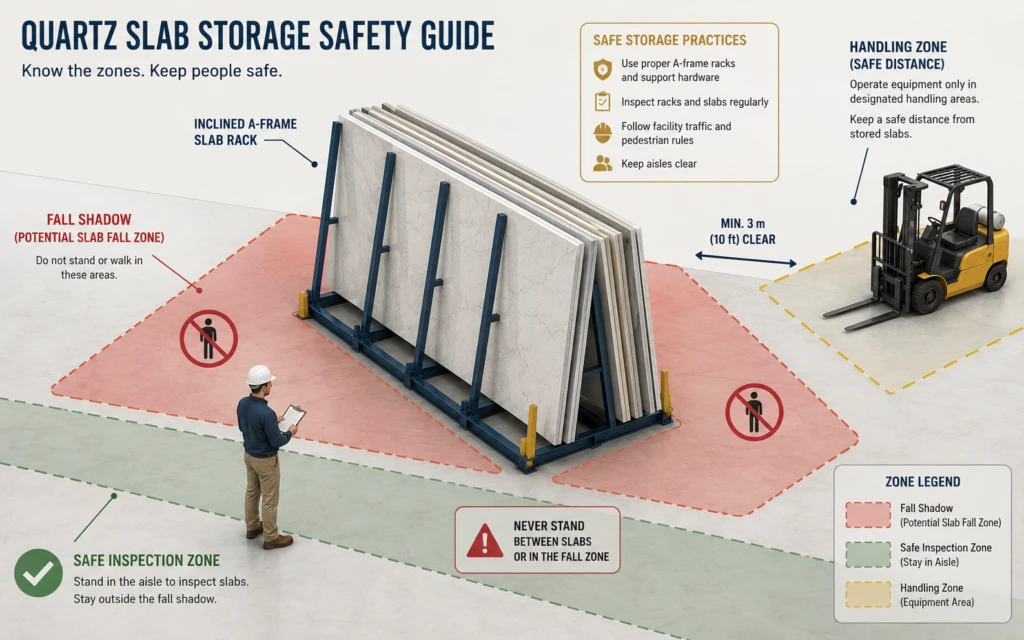
Safety boundary: Large slabs can cause fatal crushing injuries. Inspect storage areas only under the site’s authorized safe-work procedure. Stay outside the fall shadow, loading zone and suspended-load area. Do not enter between slabs or racks, remove restraints, operate handling equipment or physically test structural members.
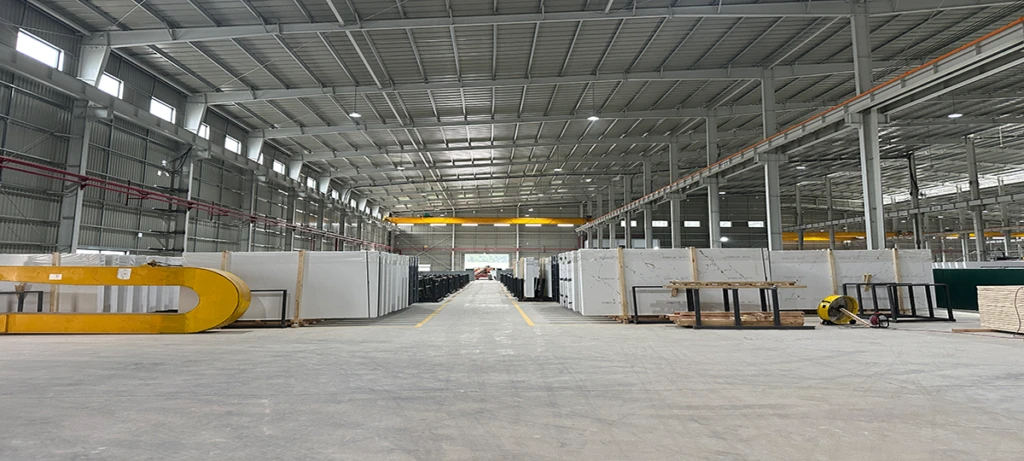
Production equipment makes the slab, but storage and handling controls determine whether the finished product remains protected, identifiable and safe to move. Poor storage can contribute to edge damage, scratching, unstable loads, handling delays and loss of traceability. It can also expose workers and visitors to severe struck-by and crushing hazards.
This guide does not provide rack engineering specifications. It explains what evidence a B2B buyer or auditor should request and what can—and cannot—be concluded from a factory walkthrough.Table of Contents
- Why Storage Systems Matter
- Functional Rack Categories
- Calculate the Actual Load
- Engineering and Load Evidence
- Restraints and Fall Prevention
- Safe Factory-Visit Inspection
- Condition and Maintenance
- Storage and Slab Flatness
- Rack-Based Traceability
- Supply-Agreement Requirements
- Buyer Checklist
- FAQ
Why Quartz Slab Storage Systems Matter
A storage system has to control several risks at the same time:
- Structural load: the rack, floor and anchorage must support the actual load and loading pattern.
- Stability: slabs must be restrained from shifting, sliding or collapsing as units are added or removed.
- Product protection: contact surfaces and handling practices should reduce edge, face and corner damage.
- Safe access: aisles, loading zones and work procedures must keep people outside fall and crush zones.
- Traceability: slab identity, batch, storage location and order allocation should remain connected.
- Workflow: storage should support controlled picking without unnecessary movement or unstable partial loads.
Functional Categories of Slab Storage Equipment
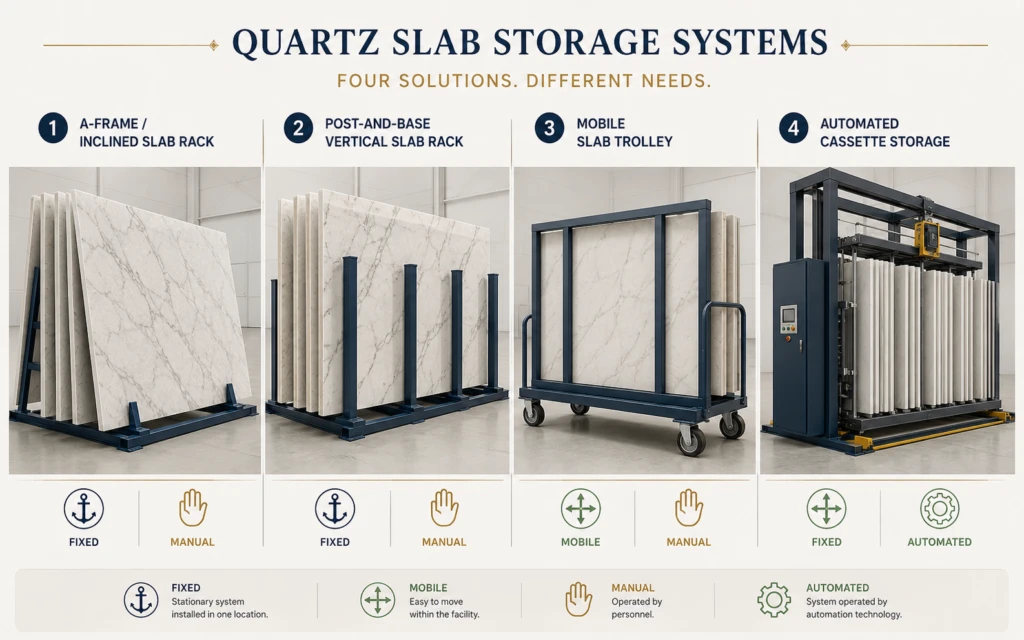
Factories use different storage and transport systems according to product, process and layout. The category name alone does not establish suitability or capacity.
| Functional Category | Common Role | Key Verification |
|---|---|---|
| A-frame or inclined storage frame | Finished-slab storage, order staging, transport frames and temporary production storage. | Rated working load, single- and double-side loading rules, restraints, base stability, anchorage and inspection records. |
| Post-and-base slab rack | Vertical slab storage between removable or fixed uprights. | Correct pole insertion, base condition, spacing, restraints, debris control and manufacturer instructions. |
| Horizontal or layered support system | Selected inspection, staging or product-specific storage. | Layer load, support spacing, surface separation, access method and limits on stacking. |
| Mobile rack or slab trolley | Controlled transfer between stations and small-load staging. | Rated load, wheel and brake specification, floor condition, movement rules and restraint during travel. |
| Automated cassette or warehouse system | High-density storage, automated picking and controlled inventory. | System interlocks, load data, inspection, software traceability and emergency procedures. |
A mature workflow is not defined by owning every rack type. It is defined by using equipment that is appropriate, documented, maintained and integrated with safe handling and traceability.
Calculate the Actual Slab and Rack Load
Slab load = finished length × finished width × finished thickness × declared density × quantity
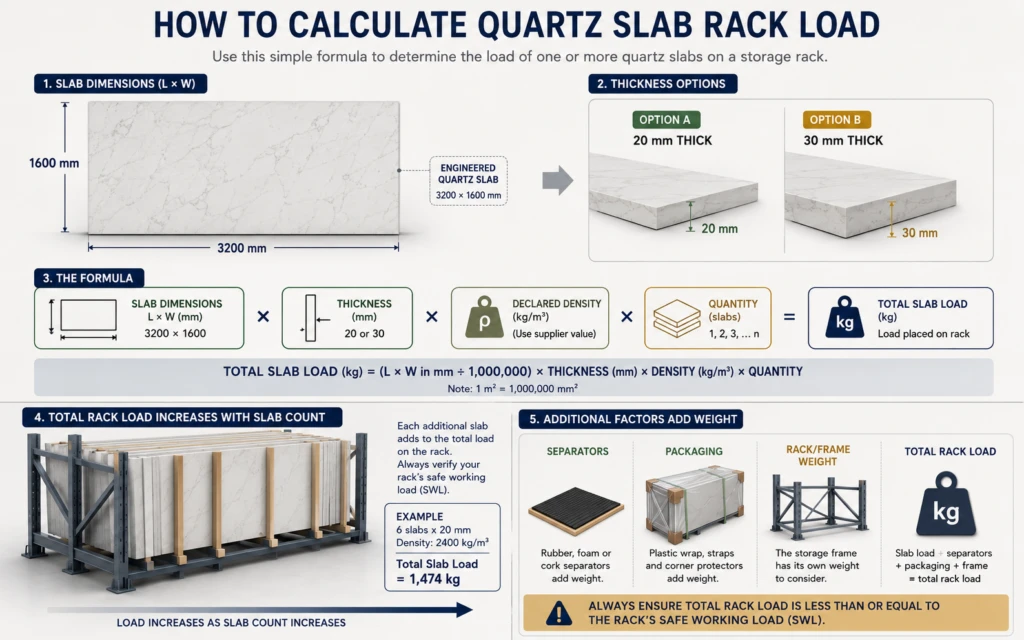
Add separators, packaging, frames and other components where relevant. Use the exact loading configuration—especially when a rack can be loaded on one side, both sides or unevenly during order picking.
Illustrative example using 2,400 kg/m³:
| Slab Format | Estimated 20 mm Weight | Estimated 30 mm Weight | Example: 12 Slabs |
|---|---|---|---|
| 3200 × 1600 mm | ≈ 246 kg each | ≈ 369 kg each | ≈ 2.95 t at 20 mm or 4.42 t at 30 mm, before separators and frame. |
Calculation example only. Use the product’s declared or measured weight and the rack manufacturer’s engineering data.
Do not approve capacity by slab count. “Twenty slabs per side” has no safety meaning without slab weight, rack rating, load distribution, restraint and installation conditions.
What Engineering and Load Evidence to Request
| Evidence | What It Should Clarify | Why It Matters |
|---|---|---|
| Rated working load / WLL | Total and side-specific load, permitted slab orientation and dynamic restrictions. | Provides the operating limit instead of a visual estimate. |
| Engineering or manufacturer documentation | Material, member design, welds, base, anchorage, restraints, assembly and permitted use. | Tube-wall thickness alone cannot demonstrate structural capacity. |
| Installation and floor information | Anchorage, level, slab-on-grade or elevated floor, safe floor load and required clearances. | A suitable rack can still be unsafe if installed on an unsuitable floor or incorrectly anchored. |
| Inspection and maintenance record | Inspection frequency, inspector, defects, repairs, retirement and return-to-service approval. | Shows whether damage is detected and controlled. |
| Safe operating procedure | Loading, unloading, partial-load control, restraints, equipment, fall zone and emergency response. | Rack safety depends on operation as well as structure. |
| Asset identification | Rack ID, manufacturer, date, rating label and inspection status. | Connects the physical rack to its records. |
Slab Restraints, Stability and the Fall Shadow
OSHA’s stone-slab handling guidance emphasizes that storage systems should be designed for imposed loads and should secure slabs against shifting, sliding and collapse. It also warns people to remain outside the slab’s fall shadow—the area on either side where a slab could land if it topples.
During a documented review, confirm:
- the restraint or secondary-bracing method;
- how the remaining slabs are secured when one slab is removed;
- whether single-side loading is permitted;
- whether poles or uprights are fully seated and free from obstruction;
- how temporary gaps are created for clamps or lifters without entering between slabs;
- how workers and visitors are kept outside the fall zone;
- whether lifting attachments are approved for the slab, finish and load.
How to Inspect a Storage Area Safely During a Factory Visit
- Request the site induction. Follow the factory’s designated route, PPE rules and photography restrictions.
- Use an authorized escort. Do not walk independently through storage or loading areas.
- Stay outside the fall shadow. Observe from marked aisles or a designated safe area.
- Stop during active handling where required. Do not stand near suspended loads, forklifts, cranes or slabs being separated.
- Do not touch the equipment. Never lean on a rack, push an arm, remove a restraint, test a wheel or enter between slabs.
- Review documents away from the hazard. Verify rating labels, rack IDs, inspection records and procedures in a safe location.
- Use photographs only when authorized. Record rack ID, condition and evidence gaps without entering restricted areas.
Rack Condition, Inspection and Maintenance
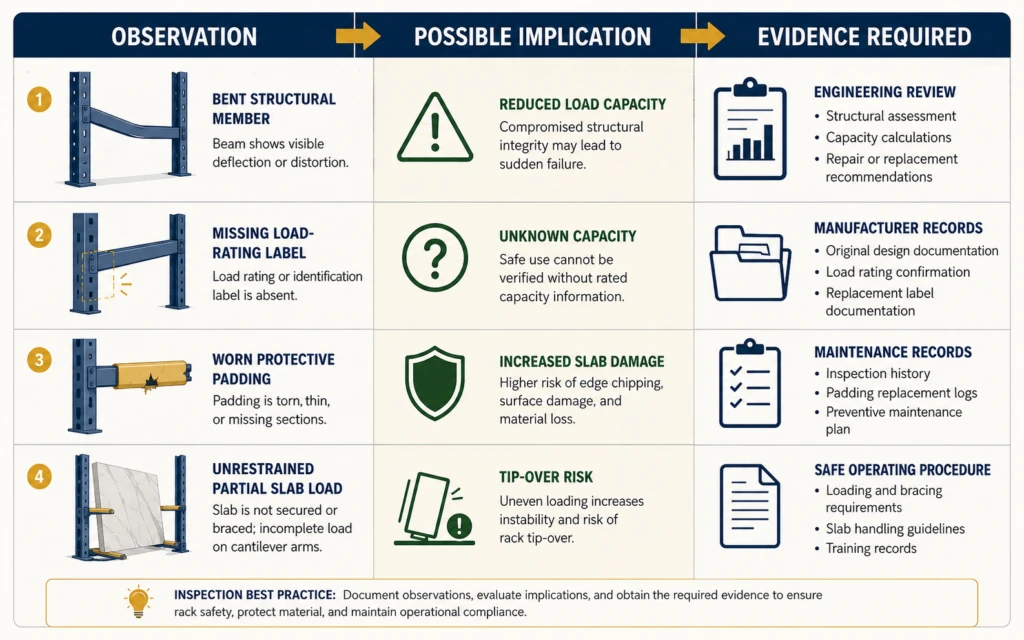
Visible damage is a reason to stop and request follow-up, not an invitation to test the rack. OSHA’s advisory guidance lists conditions such as cracked welds, cracked or deformed structural members, damaged supports and improperly seated poles as inspection concerns.
| Observation | Possible Implication | Evidence or Action Required |
|---|---|---|
| Cracked weld, corrosion or bent member | Possible structural damage or past overload. | Quarantine status, engineering assessment, repair record and return-to-service approval. |
| Missing or unreadable rating label | Capacity and permitted use cannot be confirmed at the rack. | Manufacturer record, asset register and validated replacement label. |
| Improvised shim, uneven base or damaged floor | Potential installation or load-distribution problem. | Installation review, floor assessment and corrective action. |
| Worn padding or bare contact surface | Increased risk of edge or face damage. | Maintenance record, product inspection and replacement of protection. |
| Unrestrained partial load | Slabs may shift as units are removed. | Stop-work review under the site procedure and restore approved restraint. |
| Forklift impact marks | Possible hidden rack damage and handling-control weakness. | Inspection, impact report and engineering disposition. |
Can Poor Storage Affect Slab Flatness?
Unsuitable or uneven support may contribute to changes in measured flatness, edge stress or handling damage, especially when slabs remain in storage for extended periods. However, storage is not the only possible cause of a flatness problem.
Other possible contributors include:
- forming and density variation;
- curing and cooling conditions;
- thickness variation or residual stress;
- handling while hot or before the product reaches the required condition;
- transport, packing and container support;
- measurement method and slab support during inspection.
To investigate, compare slab flatness records before storage, after storage and before shipment; review rack condition, load, support geometry, storage duration, curing records and measurement setup. A distorted rack is evidence requiring follow-up, not proof of a single root cause.
How Storage Locations Support QC Traceability
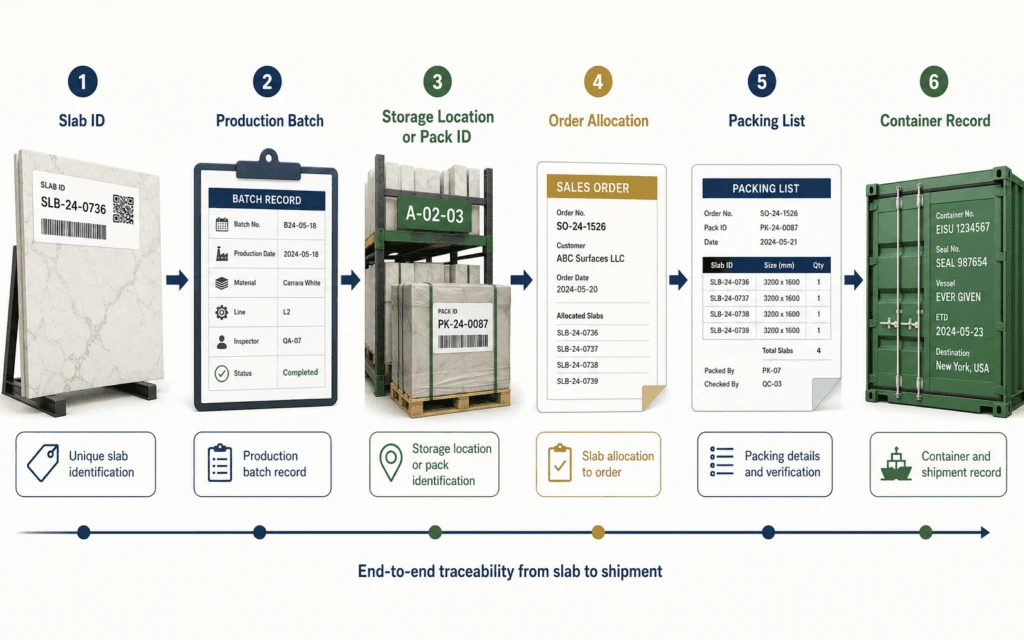
A well-controlled factory should be able to connect a finished slab to its production and shipment records. The physical storage location can be managed through rack and slot data, a bundle or pack ID, barcode, QR code, RFID or an ERP warehouse location.
Slab ID → Batch / production record → Storage location or pack → Order allocation → Packing list → Container record
The exact technology matters less than whether the chain is complete, current and testable. During a factory visit, select a finished slab or completed order and ask the team to demonstrate the trace in both directions.
What to Put in a Supply Agreement
Most buyers do not need to purchase the factory’s racks. A more practical approach is to define storage and handling requirements in the supplier agreement and verify them through audits, QC and shipment evidence.
- Use storage equipment with documented capacity for the actual slab and loading arrangement.
- Maintain rating labels, rack IDs and inspection status.
- Use approved restraints and protect contact surfaces.
- Remove damaged racks from service until formally assessed and released.
- Maintain safe handling procedures and trained operators.
- Preserve slab and batch traceability through storage, picking and packing.
- Provide evidence of corrective action where storage or handling damage is found.
- Reconcile the shipment’s slab IDs, pack IDs, rack or crate information and loading records.
Quartz Factory Rack and Storage Checklist
- Confirm the exact slab dimensions, thickness, density and calculated load.
- Obtain the rack’s documented rated working load and permitted loading configuration.
- Verify rack ID, manufacturer or engineering record, installation and inspection status.
- Confirm restraints for full and partial loads.
- Review anchorage, floor suitability and protection from vehicle impact.
- Check records for cracked welds, corrosion, deformation and repairs.
- Review contact protection and finished-slab damage records.
- Confirm safe aisles, exclusion zones and fall-shadow controls.
- Verify lifting and transport equipment ratings and operator procedures.
- Test slab-to-batch-to-storage-to-shipment traceability through records.
- Do not perform informal physical tests or enter the slab fall zone.
FAQ:
There is no safe universal slab count. Capacity must be based on the actual slab weight, loading arrangement, rack working-load rating, restraints, installation and manufacturer instructions.
A 3200 × 1600 × 20 mm slab is about 246 kg when calculated at 2,400 kg/m³; a 30 mm slab is about 369 kg. Actual weight is product-specific.
No. Structural capacity depends on the complete design, steel grade, section geometry, welds, supports, base, anchorage, load distribution and safety factors. Request engineering and rated-load documentation.
No. Do not touch, test-load or enter near a loaded rack. Observe from the designated safe area and verify condition through authorized inspection and engineering records.
No. Uneven or unsuitable storage may contribute, but forming, curing, cooling, thickness, transport and measurement conditions can also affect flatness. Confirm the root cause with records and measurements.
Not necessarily. Traceability can use rack positions, pack IDs, barcodes, QR codes, RFID or ERP locations. The requirement is a complete and testable link from slab to batch and shipment.
Review Storage and Handling Before Shipment
Share the slab format, thickness, quantity, rack or crate arrangement, factory location and inspection scope. AsiaQuartz can review storage, QC, packing, loading and traceability requirements.