Prepared by: AsiaQuartz Editorial Team
Technical review by: AsiaQuartz Product, QC & Supply Chain Team
Last updated: July 2026
First, Quick answer: terrazzo-look printed quartz creates a terrazzo-style visual through a controlled printed design on an engineered quartz slab. It is not the same material as aggregate-based artificial terrazzo. Specifically, the printed route can offer tighter control of pattern, base tone. And repeat-order references, while artificial terrazzo provides a genuine aggregate-through-body construction. In particular, buyers should choose by application, visual requirement, edge/cut-out behavior, technical data, and project specification — not by appearance alone.
First, terrazzo-look printed quartz and artificial terrazzo can look similar in a sample image, but they are different product routes. One creates the visual through a printed design on an engineered quartz slab; the other uses physical decorative aggregate bound into the slab. Specifically, that distinction affects how buyers should review the material, approve the visual, plan edges and cut-outs. And qualify the product for a project.
First, this guide is for importers, distributors, fabricators, builders. And project buyers deciding whether a terrazzo-style requirement is better served by printed quartz, artificial terrazzo slabs. Or a portfolio that includes both.
1. What Is Terrazzo-Look Printed Quartz?
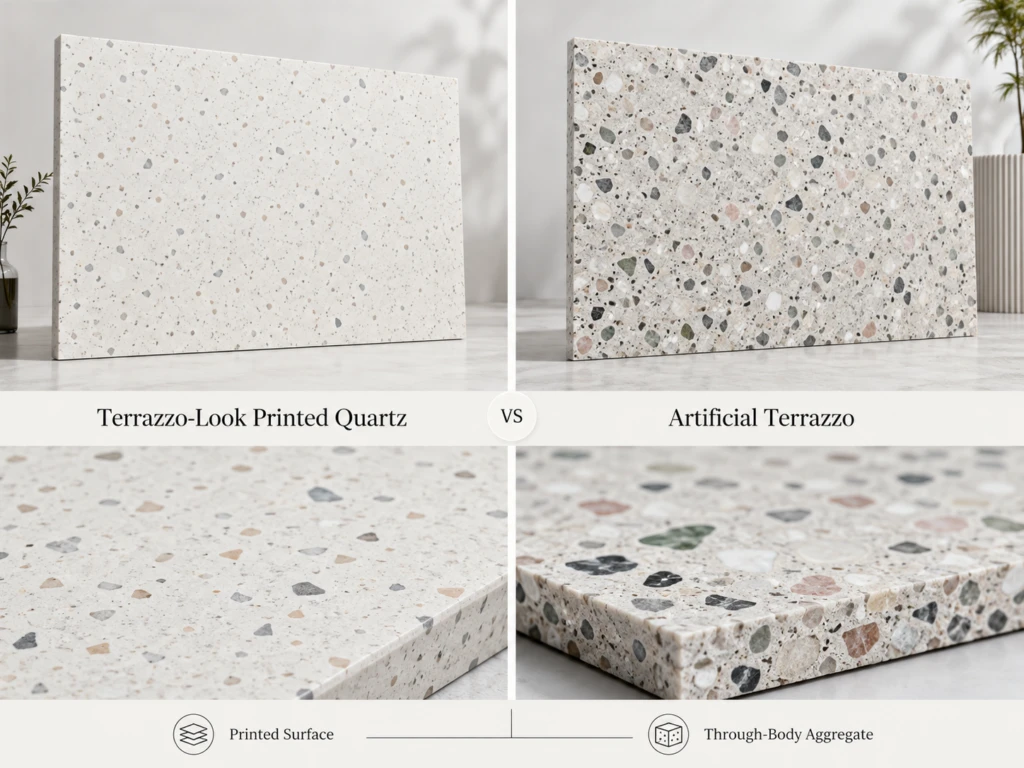
First, terrazzo-look printed quartz uses a controlled print design to reproduce visual cues associated with terrazzo. Such as scattered chips, speckled fields, mixed-color fragments. Or small-aggregate patterns. The terrazzo appearance comes from the printed design rather than from decorative aggregate distributed through the slab.
First, by contrast, AsiaQuartz’s artificial terrazzo program uses real decorative aggregate — which may include marble, quartz, glass, pebble. Or other selected materials depending on the product — bound into a matrix. Specifically, the aggregate is part of the material construction rather than only a visual pattern.
Because terrazzo-look printed quartz sits inside the printed-quartz program. Buyers should apply the same controls used for other decorative printed surfaces: full-slab visual review. However, approved references, batch review, repeat-order matching. And clear confirmation of whether the decorative effect is surface-focused or extends into the material depth for the selected product.
2. Where Terrazzo-Look Printed Quartz Can Fit
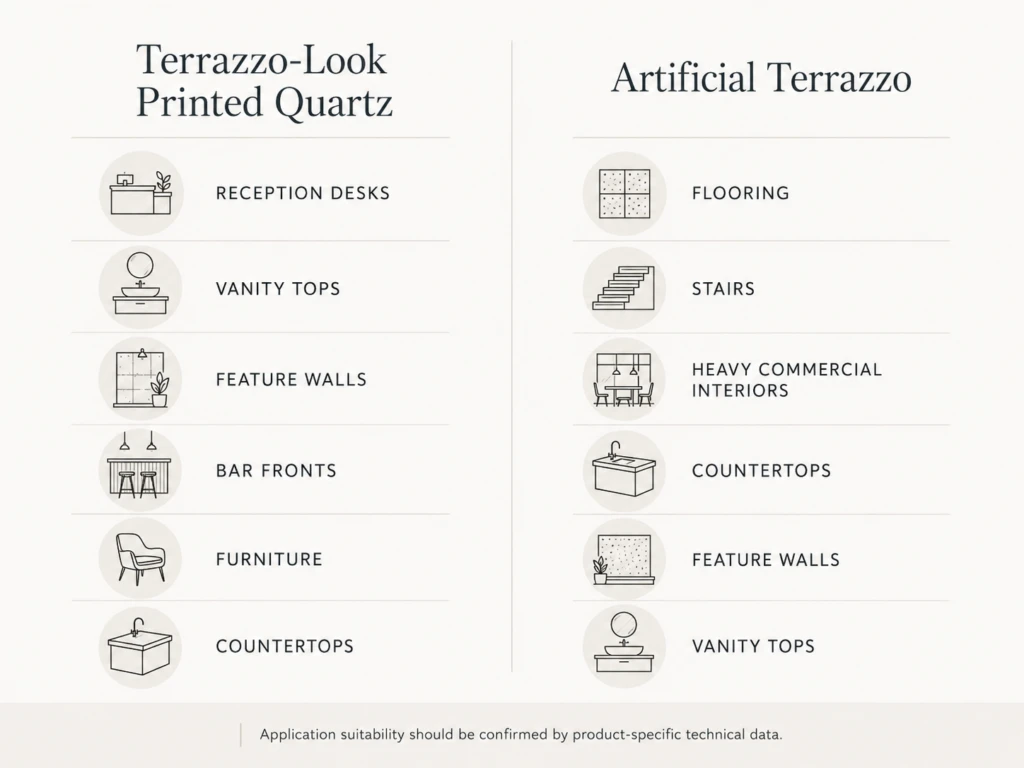
First, terrazzo-look printed quartz can be a candidate for countertops, vanity tops. Reception desks, bar fronts, feature walls, retail display surfaces, furniture components. And other interior applications where a controlled terrazzo-style visual is desired. It can also suit repeat-unit projects where buyers want a consistent pattern reference across multiple rooms or phases.
First, application suitability must still be confirmed from the exact product technical file. Do not assume that a printed quartz slab and an artificial terrazzo slab have equivalent wear, slip, impact, heat, chemical. Or flooring performance simply because the surfaces look similar.
First, Common specification mistake: approving a terrazzo-style visual before confirming what the project actually requires. If the specification calls for aggregate-through-body material, a printed look is not a substitute. If the requirement is primarily visual consistency and repeatability, the printed route may deserve review. Define the application and material requirement before approving the sample.
3. Terrazzo-Look Printed Quartz vs. Artificial Terrazzo
First, both routes can deliver a terrazzo aesthetic. But they should be compared by construction and project requirements rather than by a generic “better or worse” ranking.
| Consideration | Terrazzo-Look Printed Quartz | Artificial Terrazzo Slab |
|---|---|---|
| How the look is made | Controlled printed design on an engineered quartz slab | Physical decorative aggregate bound in a matrix |
| Visual repeatability | Potentially high when the approved print file, color reference, finish, and batch controls are locked | Natural-looking physical variation is expected; chip distribution is not pixel-identical |
| Batch matching | Managed through approved references, production images, and repeat-order review | Managed as a product- and batch-specific physical material with acceptable variation |
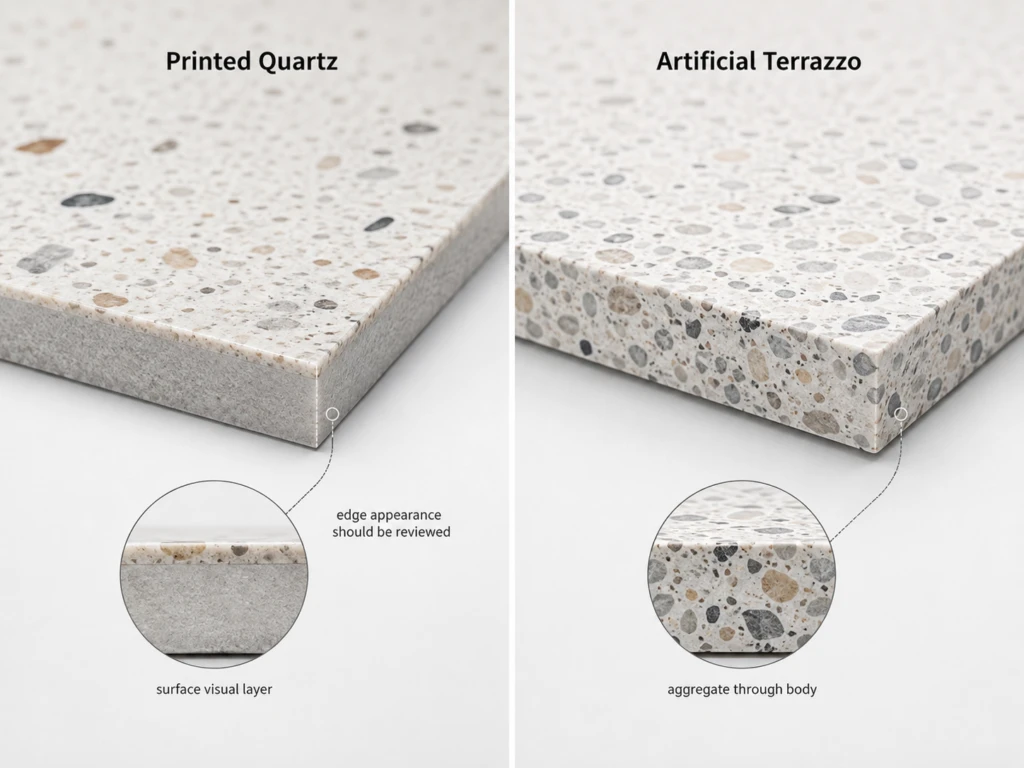
| Edges and cut-outs | Confirm whether the selected print is surface-focused or depth-printed; do not assume the face visual continues through every edge | Aggregate is part of the material body, so exposed edges reveal the aggregate structure |
| Typical project use | Countertops, vanities, feature surfaces, reception, retail and selected project components subject to technical qualification | Countertops, vanities, feature surfaces and other applications supported by the exact terrazzo product/system specification |
| Performance | Product-specific; verify the exact SKU and intended application | Product-specific; aggregate, binder, finish, thickness, and application system affect performance |
First, there is no useful universal durability winner in this comparison. The correct B2B question is whether the exact product meets the project’s performance and fabrication requirements. Specifically, require product-specific technical data rather than relying on category-wide claims.
4. Design Control Is the Printed Route’s Main Differentiator
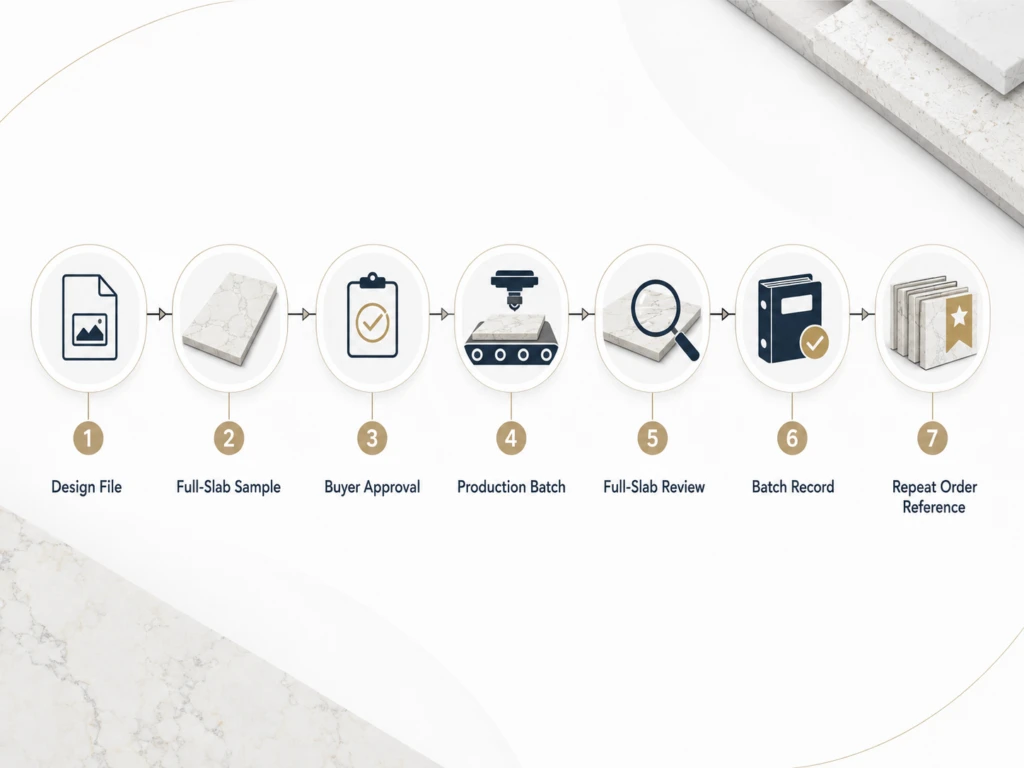
First, the printed route gives buyers a defined visual reference that can be reviewed before production: chip size. Chip density, base tone, color relationships, pattern scale, direction. And full-slab composition. This is particularly useful where the project requires repeated surfaces across multiple units, phases, or replacement orders.
First, that does not mean every repeat order will be visually identical without control. Repeatability depends on the approved reference, print file, substrate, finish, process settings, batch review. And agreed acceptance rules. A printed program should be managed through sample-to-batch controls rather than assumed to match because the design name is the same.
For a broader project workflow, see Printed Quartz in Commercial Projects.
5. B2B Sourcing Checklist for Terrazzo-Look Printed Quartz
Before approving a terrazzo-look printed quartz program, verify the points that can materially change the product or the project result:
- Confirm the product construction. Make sure the supplier clearly distinguishes printed quartz from aggregate-based artificial terrazzo and identifies the selected substrate and decorative process.
- Approve the full-slab visual. A small sample is useful for color and surface review, but it cannot show the complete pattern scale, chip distribution, or full-slab composition.
- Review edges, miters, and cut-outs. Confirm whether the decorative effect is surface-focused or extends into the depth of the selected product, especially for exposed edges and sink cut-outs.
- Lock the repeat-order reference. Define which approved sample, slab image, print file, color reference, and batch record will be used when the product is reordered.
- Confirm the thickness. AsiaQuartz’s approved standard reference for decorative printed slabs is 20 mm and 30 mm. Other thicknesses should be treated as special feasibility requests rather than assumed standard production.
- Separate appearance from performance. Request the product-specific technical file and qualify the exact application, especially where wear, impact, heat, chemical exposure, slip resistance, or other project performance matters.
- Confirm MOQ and development requirements. A custom terrazzo print or exclusive color can have a development minimum separate from the shipment quantity.
- Confirm packing for the actual order. Container counts and packing depend on slab size, thickness, product weight, packing design, destination, and payload. Use the QC & Packing Guide and Container Loading Guide instead of assuming one universal count.
6. When a Buyer May Carry Both Product Routes
First, some distributors and project buyers may choose to carry both artificial terrazzo slabs and terrazzo-look printed quartz because the products answer different specifications. Aggregate terrazzo can serve clients who require the actual aggregate material. While printed quartz can serve projects prioritizing a controlled terrazzo-style visual and a repeatable print reference.
When a client asks for “terrazzo,” the useful first question is not only the color or chip size. Ask whether the specification requires aggregate-through-body construction, a particular performance standard, or simply a terrazzo-style visual. However, that answer determines which product route should be qualified.
FAQ
First, terrazzo-look printed quartz is an engineered quartz slab that uses a controlled printed design to create a terrazzo-style visual. The visible chip or speckled pattern is created by the print rather than by decorative aggregate distributed through the slab body.
First, no. Terrazzo-look printed quartz uses a printed decorative design, while artificial terrazzo uses physical decorative aggregate bound into the material. Buyers should treat them as separate product categories with different visual, edge, fabrication, and application considerations.
First, do not assume flooring suitability from the product name or appearance. Flooring requires review of the exact product technical data, wear and slip requirements, installation system, traffic level, and project specification. If the specification requires aggregate-through-body terrazzo, a printed quartz surface does not satisfy that material requirement.
First, asiaQuartz’s approved standard reference for decorative printed quartz is 20 mm and 30 mm. Other thicknesses are special feasibility cases reviewed by product, application, MOQ, and production route.
First, printed designs can be managed with a high degree of visual control. But repeatability should be governed by approved references, print files, finish, process settings, and batch review. Specifically, buyers should define the acceptable match rather than assume automatic identity between production runs.
First, confirm whether the selected printed effect is surface-focused or extends into the material depth. Review actual edge, miter, and cut-out samples where those details are visible in the finished project.
First, custom visual development can be reviewed for selected printed-quartz programs. Feasibility, sample development, color approval, MOQ, production route, and repeat-order controls are confirmed for the specific request.
First, start with the Printed Quartz Collection. Then send the target terrazzo reference, application, thickness, quantity. And destination for a product and supply review.
Ready to Review a Terrazzo Program?
First, send the target visual, application, quantity, thickness, destination, and any project specification. AsiaQuartz can review whether the requirement is better suited to printed quartz, aggregate-based artificial terrazzo. Or a combination of both product routes.
How this article was prepared:
- Product definitions: printed-quartz and artificial-terrazzo descriptions are based on approved AsiaQuartz product-program information and the distinction between a printed decorative layer and aggregate-based slab construction.
- Technical controls: thickness guidance, sample approval, full-slab review, edge/cut-out review, batch matching, and order-specific qualification follow AsiaQuartz’s approved product and QC framework.
- Application guidance: example applications are decision-support references, not universal suitability claims. Performance must be confirmed against the exact product technical file and project requirements.
- Limitations: this article does not make universal durability, flooring, certification, or compliance claims for either category. Specifications, performance, MOQ, packing, and suitability are confirmed for the selected product and order.
First, Information status: AsiaQuartz product and supply guidance reviewed August 10, 2026. Product availability, formulations, print methods, specifications, production routes, and commercial terms can change. Specifically, confirm the current product technical file and written order documents before approval.
Related AsiaQuartz References
- Printed Quartz Slabs — commercial printed-quartz program.
- Printed Quartz Collection — current printed designs and color references.
- Artificial Terrazzo Slabs — aggregate-based terrazzo product program.
- Quartz Slab Specifications — slab specification reference.
Related Reading
- What Is Printed Quartz? — understand the printed surface, design control, limits, and QC process.
- Printed Quartz in Commercial Projects — project planning for hospitality, retail, multifamily, and other B2B applications.
- Artificial Terrazzo Slabs — review the aggregate-based product route.
- Quartz Slab QC & Packing Guide for Importers — inspection and packing controls before shipment.
- Printed Quartz Guides — continue through the printed-quartz knowledge cluster.