
Prepared by: AsiaQuartz Editorial Team
Technical review by: AsiaQuartz Product, QC & Supply Chain Team
Last updated: July 2026
First, commercial buyers are increasingly asking for engineered surfaces with documented low or very low crystalline-silica content. The drivers differ by project: worker-exposure policy, Australian product rules, fabricator preference, corporate material-health goals. Or a requirement for transparent product documentation.
First, that does not mean every product marketed as “silica-free quartz” is suitable for every hotel, clinic or retail environment. Commercial specification must still address stain and chemical resistance, heat, wear, edge behaviour, seams, colour consistency, fabrication, installation and replenishment.
Silica-free is a composition claim—not a complete performance or sustainability certification.
First, confirm the finished-product crystalline-silica result and then evaluate the exact SKU against the project’s performance. Emissions, ingredient-disclosure and installation requirements. Specifically, lEED and WELL certify projects; a slab does not become “LEED-certified” or “WELL-certified” simply because it contains less crystalline silica.
Where Silica-Free Quartz Can Fit in Commercial Projects
| Application | Potential Fit | Primary Approval Risks |
|---|---|---|
| Hotel guestroom vanities and kitchenette counters | Strong candidate for interior use when the exact product is tested and supported | Cosmetics, cleaners, hot appliances, seams, replenishment and batch shade |
| Reception desks, lobby features and wall panels | Useful where design consistency and low-silica documentation matter | Pattern scale, repeated panels, support system, fire/code requirements and edge appearance |
| Restaurant and bar counters away from direct cooking heat | Possible with project-specific stain, chemical and thermal review | Alcohol, citrus, oils, cleaners, scratches and direct hot-object exposure |
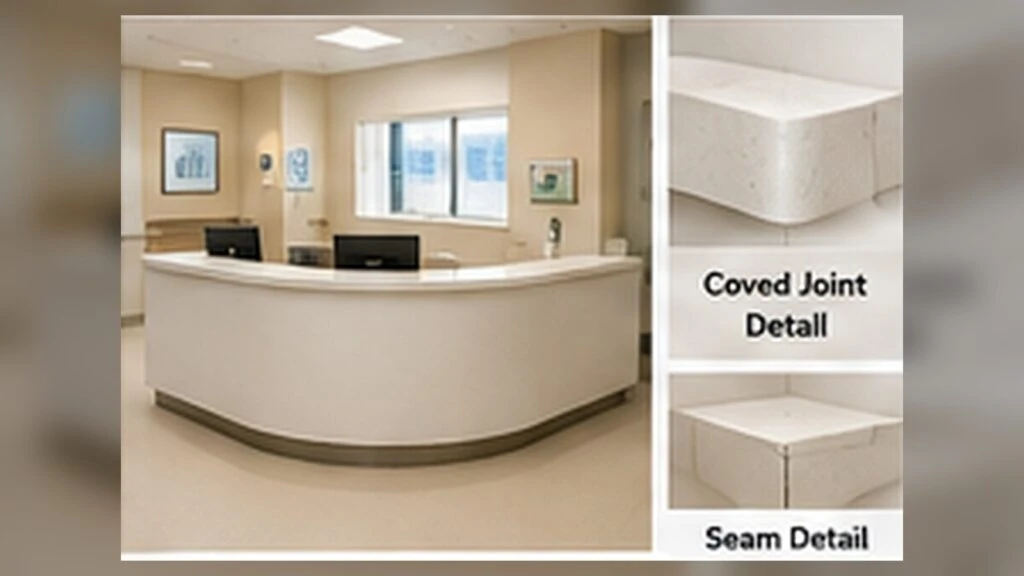
| Healthcare reception, vanity and non-critical work surfaces | Possible when approved by facility infection-control and maintenance teams | Disinfectants, seams, coved details, cleanability and product-specific chemical resistance |
| Retail display counters and feature surfaces | Strong visual-use case, including printed designs | Brand colour, cosmetics/solvents, abrasion, display lighting and replacement matching |
Hospitality: Durability, Maintenance and Design at Scale
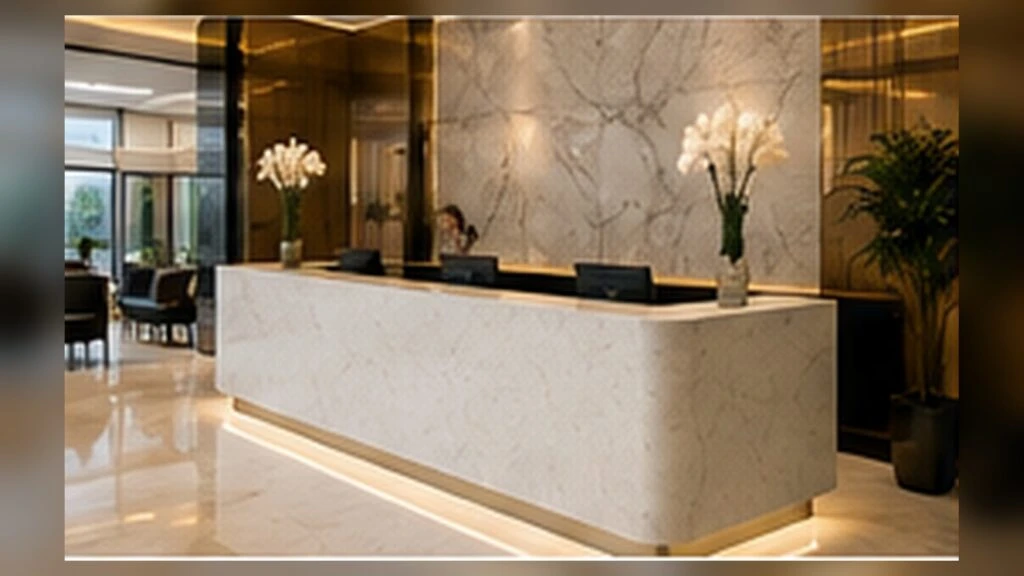
First, hospitality surfaces are repeatedly cleaned and exposed to cosmetics, coffee, wine, oils, citrus and guest misuse. The correct specification is based on the exact exposure list and service level, not a generic statement that the product is “non-porous.”
Evidence to request
- Water absorption or porosity evidence: use a product-appropriate method accepted by the project team or laboratory. Do not automatically cite natural-dimension-stone methods for resin-bound agglomerated stone without confirming applicability.
- Stain and chemical resistance: test the actual project agents, dwell times, cleaning procedure and finish.
- Heat-use limits: obtain written care instructions and test evidence where hot plates, kettles or appliances are relevant.
- Flexural and impact performance: review the method, specimen thickness, support conditions and edge-impact behaviour.
- Batch and replenishment controls: approve colour, pattern scale, variant set and retained reference material for phased projects.
- Fabrication mock-up: review mitres, sink cut-outs, seams, edges, adhesive colour and repair appearance.
First, Do not use a category-level value as the project specification. Water absorption. Flexural strength, hardness and chemical resistance vary by formulation, thickness and manufacturing control. Specifically, the project should approve test reports for the specific product or a clearly representative product family, with methods and acceptance criteria stated.
Healthcare: Cleanability Is a System Requirement
First, healthcare suitability depends on the surface, seams, coved transitions, installation. Cleaning protocol and the type of clinical area. A product that works at a reception desk may not be appropriate for a laboratory, sterile processing area or surface exposed to aggressive chemicals and heat.
Healthcare-specific questions
- Which cleaning and disinfecting agents are used? Test the exact concentrations and contact times used by the facility.
- How will seams and wall transitions be detailed? Joint width, adhesive, cove construction and installer capability can be more important than the slab colour.
- Is the surface used in a critical clinical process? Obtain approval from the facility’s infection-control, engineering and maintenance teams.
- Are antimicrobial claims being made? Request the test organism, method, treated component and durability of the claimed effect. Do not substitute an additive claim for an effective cleaning protocol.
- Can damaged areas be repaired or replaced? Retain samples and production information for future phases and repairs.
First, white and light-grey surfaces may help visual inspection in some settings. But colour alone does not establish hygiene. A patterned surface should not be rejected or accepted without the facility team’s review of visual inspection, cleaning and maintenance needs.
Retail and Commercial Interiors: Brand Control and Printed Quartz
First, printed silica-free quartz can support brand-led visual programmes because the decorative file, scale and colour direction can be controlled more deliberately than a random mineral-veining process. It still requires physical approval and batch controls.
| Retail Use | Specification Priority | Evidence to Approve |
|---|---|---|
| Luxury display and service counters | Pattern scale, seams, edge detail and repeat control | Full-slab visual, layout mock-up and fabricated edge sample |
| Cosmetics and beauty counters | Foundation, oils, alcohols, solvents and display-light exposure | Project-agent chemical test and colour/light review |
| Checkout and service counters | Abrasion, impact, edge protection and repair | Wear/impact evidence and fabricated mock-up |
| Feature walls and branded panels | Panel support, fire/code review, sequence and replacement | System-level approval, elevation layout and labelled slab sequence |
First, do not promise an exact brand-colour match based on a screen rendering. Define the colour reference, lighting, measurement method, finish, tolerance and visual approval. Also confirm whether the decorative effect is surface-only or continues through the edge; printed depth varies by product.
LEED v5 and WELL v2: What Product Documentation Can Support
First, lEED v5 launched for commercial rating systems in April 2025. WELL v2 also includes material transparency, VOC and material-optimization pathways. Specifically, neither system awards a project credit solely because a slab is marketed as silica-free.
Depending on the rating system, credit strategy and product category, the project team may request:
- Health Product Declaration, Declare label or another accepted ingredient-disclosure pathway
- Product-specific environmental product declaration where applicable to the selected credit
- VOC emissions testing using the method accepted by the project and rating-system pathway
- SDS/TDS and detailed product identity
- Third-party crystalline-silica content report with sample and product traceability
- Manufacturer declaration covering formulation and production location
- Other project-specific restricted-substance or procurement documents
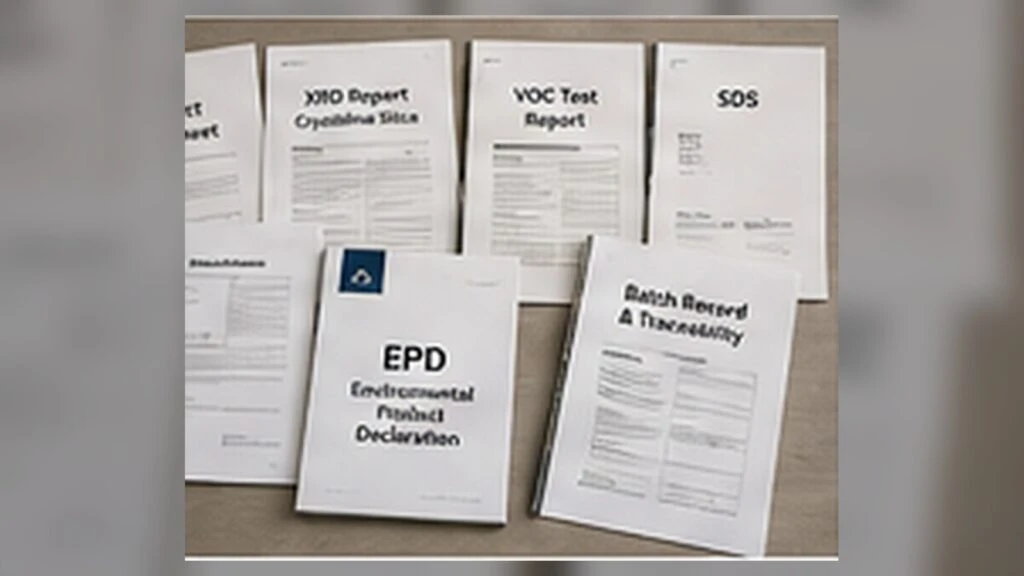
First, Ask the LEED/WELL consultant for the exact submittal list. An HPD, Declare label. VOC report or EPD supports a particular documentation pathway only when it meets the applicable programme rules and covers the actual product. Specifically, do not advertise the slab as “LEED compliant” or “WELL certified.”
Occupational-Silica Context
- Australia: work involving engineered stone benchtops, panels or slabs meeting the legal definition—including at least 1% crystalline silica by weight—is prohibited under the model WHS framework. Products outside the definition still require appropriate dust-risk management.
- California: the permanent Section 5204 standard imposes enhanced controls for artificial and certain natural stone work. California began 2026 emergency rulemaking concerning a proposed prohibition on fabrication of artificial-stone products containing more than 1% crystalline silica; it should be described as proposed unless formally adopted.
- United States federal: OSHA’s crystalline-silica standards are exposure-based and require assessment and controls where applicable.
- European Union: Directive (EU) 2017/2398 addressed respirable crystalline-silica dust generated by a work process within the occupational carcinogens framework; member-state implementation governs local obligations.
First, lower crystalline-silica content can reduce one source of occupational risk, but it does not eliminate dust or justify dry cutting. Glass, mineral and resin dusts still require process-specific assessment and controls.
Commercial Procurement: Eight Controls to Lock Down Early
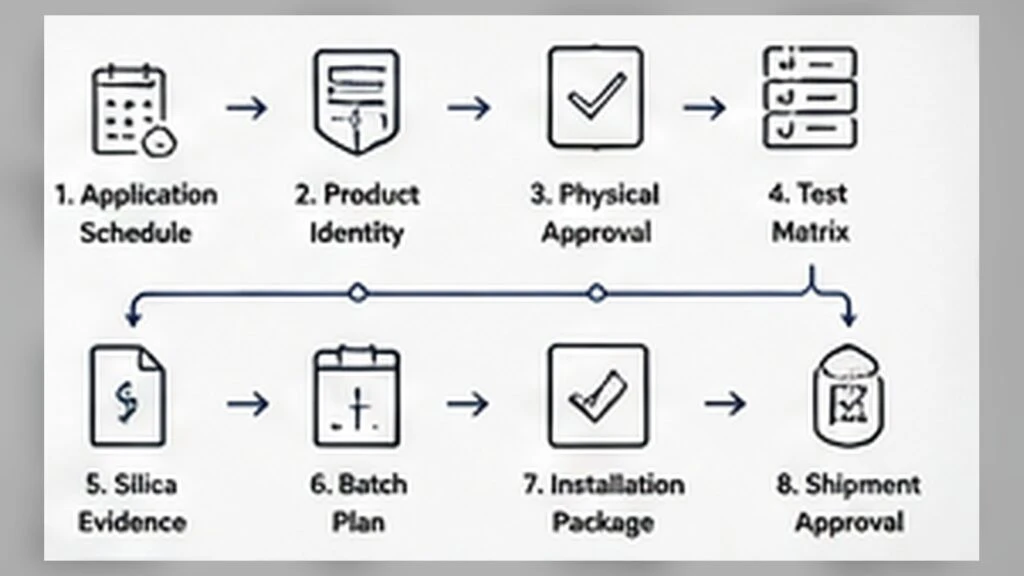
- Application schedule: identify each surface, orientation, environment, exposure and support condition.
- Exact product identity: SKU, formulation/revision, thickness, finish, printed route and production location.
- Approved physical references: colour/finish sample, large pattern sample and fabricated mock-up where required.
- Test matrix: product-specific methods, agents, conditions and pass/fail criteria agreed with the specifier.
- Crystalline-silica evidence: representative third-party report, reporting limit and change-control trigger.
- Batch plan: colour/pattern tolerance, print-file version, sequence, labels, retained reference and replenishment strategy.
- Installation package: support, joints, adhesives, cove/edge details, care guide and installer qualification.
- Shipment approval: QC records, full-slab photos, packing labels, loading evidence and document cross-check.
For the product-level approval workflow behind commercial projects, see our silica-free quartz for commercial projects overview.
Where Silica-Free Quartz Is Usually Not the First Choice
- Exterior or prolonged direct-UV applications unless the exact product and installation system are expressly rated for them
- Surfaces directly exposed to grills, fryers, open flame or sustained high heat
- Structural or load-bearing elements
- Flooring or stair applications without project-specific slip, abrasion, fire, substrate and installation-system approval
- Critical laboratory or clinical surfaces where the facility’s chemical, thermal or hygiene requirements exceed the product’s documented performance
FAQ
First, it can be, but durability is product-specific. Compare the exact SKUs using applicable test methods, representative thickness and the real project exposures. Specifically, do not infer performance from the silica label alone.
First, request the submittal list from the project’s sustainability consultant. Common requests may include ingredient disclosure, VOC emissions data, an EPD, SDS/TDS and product-specific composition evidence. Specifically, the required documents depend on the selected credit pathways and product category.
First, it can be developed toward an agreed palette, but final approval must be physical. Define the reference, finish, lighting, measurement method and tolerance, and approve a production-representative sample before the full run.
First, there is no stable universal percentage. The difference depends on formulation, design, finish, MOQ, testing, production changeover, logistics and market. Specifically, compare written quotations on the same specification and calculate cost per saleable installed unit.
First, no. It may materially reduce the RCS hazard and may affect product treatment in some jurisdictions. But other dusts and process hazards remain. Specifically, employers must follow the applicable workplace rules and risk assessment.
Official References and Further Reading
- Safe Work Australia — Engineered stone ban
- Cal/OSHA — Respirable crystalline silica standards and resources
- US OSHA — Crystalline silica resources
- EUR-Lex — Directive (EU) 2017/2398
- USGBC — LEED v5
- IWBI — WELL v2 architecture
- AsiaQuartz — Silica-Free Decorative Quartz Buyer Guide
- AsiaQuartz — Silica-Free Decorative Quartz QC Checklist
First, Methodology and disclosure
This article combines official regulatory and rating-system sources with general engineered-surface procurement practice. AsiaQuartz supplies printed and silica-free engineered stone products. Specifically, product availability and claims must be verified against the selected SKU, current test reports and project requirements. This material is not legal, occupational-health, infection-control or engineering advice.
First, Need samples and a project-specific documentation review?
Send the application schedule, destination market, performance requirements and certification goals. AsiaQuartz can review suitable product routes, samples. Specifically, test files and supply controls. → Submit a Commercial Inquiry