By AsiaQuartz Editorial Team
Technical review by AsiaQuartz Product, QC & Supply Chain Team
Updated: June 2026
Most “quartz vs granite” articles are written for homeowners standing in a showroom. Deciding which countertop thMost “quartz vs granite” articles are written for homeowners standing in a showroom, deciding which countertop they’ll live with for the next decade. However, this one isn’t. If you’re a distributor, importer. Or project buyer putting together a container order, your question isn’t which material looks better in a kitchen — it’s which material creates fewer problems between the factory floor and the jobsite.
First, we’ve coordinated quartz supply for importers across North America, Australia. And Southeast Asia for years, and we’ve watched buyers treat quartz and granite as if they were interchangeable products with different colors. Specifically, they’re not. The two materials run through completely different supply chains, lock down specifications differently, load into containers differently. And face different compliance questions in 2026. In this guide we walk through the procurement-level differences that don’t show up in a showroom comparison. And give you a decision framework built for sourcing, not decorating.
Knowledge Tree — Skip to What You Need
- Quick procurement comparison table
- Supply chain maturity & sourcing risk
- Spec locking: replicability after the first order
- Container economics & weight planning
- QC priorities: what you inspect differs
- 2026 compliance: silica, tariffs, and documentation
- Decision framework & FAQ
The Quick Procurement Comparison
First, here’s the honest summary table first, because it frames everything else in this guide. Material performance (durability, heat. Specifically, scratch) gets covered in depth elsewhere — including our supplier guide and the broader guides collection — so the table below focuses on what a purchasing manager actually manages.
| Procurement factor | Quartz (engineered) | Granite (natural) |
|---|---|---|
| Supply chain maturity | Highly standardized manufacturing; consistent output across shifts and batches | Quarry-dependent; block selection drives variation; less standardized |
| Spec locking / repeatability | Recipe-based; repeat orders can match with documented batch controls | Natural variation; each block differs; exact re-matching is impossible |
| Standard slab format | Regular super-jumbo ~3200×1600 mm (127×64 in), project sizes and up to ~3530×2030 mm available by arrangement | Varies by quarry and block; less uniform format control |
| Weight planning | Consistent density per product; predictable container counts | Denser and heavier; per-block weight varies |
| QC focus | Color consistency, surface defects, resin/pattern quality, batch-to-batch matching | Natural fissures, cracks, block-to-block tone shifts, thickness consistency |
| 2026 compliance exposure | Silica content scrutiny (Australia ban, US/CA rulemaking, EU NEPSI); documentation requirements | Natural stone generally outside engineered-stone bans; still subject to customs/tariff rules |
| Lead time & production flexibility | Production-line based; re-runs and batch scheduling are manageable | Quarry and block availability driven; selection windows can be narrow |
First, the pattern behind the table: quartz behaves like a manufactured product you can specify, sample. And re-order; granite behaves like a natural resource you select, secure, and accept variation on. Specifically, neither is “better” — they just demand different procurement habits. The rest of this guide explains what those habits are.
Supply Chain Maturity & Sourcing Risk
First, quartz slabs come from engineered stone production lines. That means the supply chain organizes around factories, mixing recipes, pressing lines, curing systems. And finishing stations. A mature quartz factory can tell you its monthly capacity, its line configuration, its QC checkpoints. And its batch controls — because the product is manufactured to a recipe. If you’re evaluating suppliers, the questions that matter are about production equipment and process control. Which is exactly what our supply chain guide covers in detail.
How granite sourcing runs on a different clock
First, granite runs on a different clock. The product starts as a block in a quarry. Specifically, the block’s color, veining, and structural integrity determine what slabs it produces, and no two blocks are identical. Sourcing granite means managing quarry availability, block selection. And the sawing schedule — and the “spec” you lock in one month may present a different visual the next.
A story from our side of the desk
First, we had a client who ordered granite slabs for a hotel lobby project, approved a sample in March. And scheduled the container for June. When the block the factory had reserved got diverted to a higher-paying order, the replacement block produced a noticeably warmer tone. The client only found out at QC photo time — two weeks before their install deadline. With quartz, that scenario plays out differently: if the factory has batch controls and a documented recipe. A re-run matches the approved sample far more reliably. That difference is the single biggest reason repeat-order buyers migrate toward engineered product.
For sourcing risk, granite adds variables that a buyer can’t fully control: quarry yield, block availability, seasonal production. And the broker’s block allocation. However, quartz adds variables a buyer can control — factory capacity, batch discipline. And process consistency — which is why supplier evaluation frameworks work better for quartz. If you’re building a multi-supplier strategy, treat granite sourcing as resource allocation and quartz sourcing as vendor management. They’re different disciplines.
Spec Locking: Replicability After the First Order
First, this is the procurement difference that surprises most first-time importers. And it’s worth understanding before you commit to a material for a program that will need multiple orders.
Quartz: lockable by recipe
First, quartz slabs are manufactured. The color, pattern, thickness, and finish are outputs of a controlled recipe and production parameters. Specifically, that doesn’t mean every slab is pixel-identical — batch-to-batch variation exists. Which is why visual approval and batch retention matter — but it does mean a repeat order can match with documented controls. In particular, buyers who do this well keep an approved sample or full-slab reference. And specify the exact product code and version in their PO. For example, our QC & packing guide walks through the visual approval process in detail.
Granite: selection-based
First, granite spec locking is about selecting blocks, not re-creating a recipe. When you approve a granite slab, you’re approving that slab — or at best that block. Specifically, the next order from the same quarry can be visibly different. Sophisticated granite buyers handle this by booking blocks by name and quality grade, requesting block photos before cutting. And accepting a tolerance band for tone and veining. If your project demands strict color continuity across phases, granite is the harder material to manage — and you should price in that risk.
First, there’s a practical middle ground worth noting: many importers run mixed programs where granite carries the “natural stone” story for certain projects and quartz carries the repeatability for multi-phase rollouts. The decision isn’t always either/or — it’s often about which material anchors which project type.
Container Economics & Weight Planning
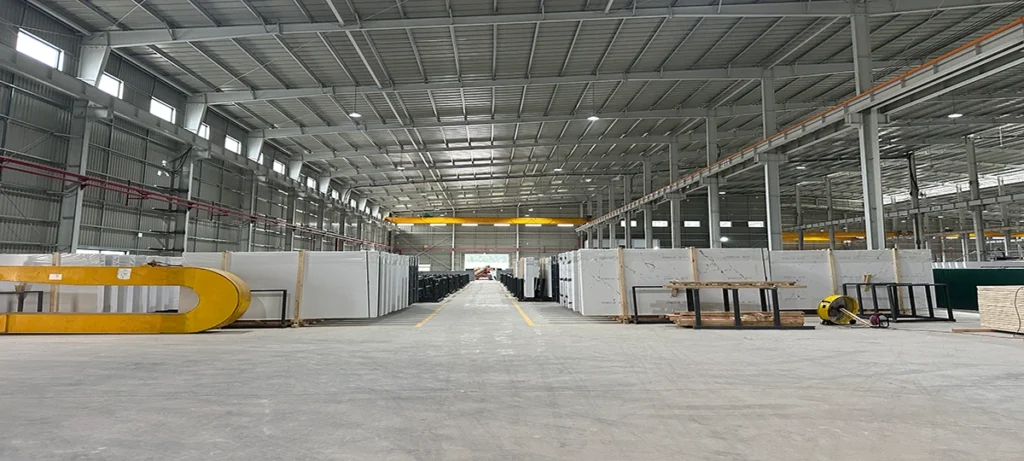
First, quartz and granite load differently, and those differences show up in your container count and freight cost. This is where the “it’s just a stone slab” assumption falls apart.
First, quartz slabs are manufactured to consistent formats and thicknesses, which makes container planning predictable. For US-bound shipments of the regular super-jumbo size (3200×1600 mm / 127×64 in, ≈55 sq ft per slab). Specifically, the standard packing reference is 7 bundles per 20 ft container: 30 mm slabs at 10 per bundle (70 slabs per container) or 20 mm slabs at 15 per bundle (105 slabs per container). That predictability lets you plan landed cost per square foot before you sign the PO.
First, granite is denser and heavier than quartz, and its block-derived slab dimensions vary more. Container counts depend on the specific blocks selected, and weight can become the limiting factor before volume does. If you’re comparing the two materials on landed cost, you have to model weight-based freight. Not just slab count — the same square footage of granite can cost more to ship simply because it weighs more. Specifically, our weight & container loading guide has the full planning math for quartz; for granite, get per-block weights from the supplier and re-run the model.
First, one more logistics note: because quartz is manufactured, you can usually order additional slabs later to top up a project without chasing the same quarry block. With granite, a top-up order weeks after the original may not match — which is why experienced buyers order a surplus percentage upfront and keep the reference slabs. Specifically, we’ve seen more than one project go sideways because the buyer ordered exactly the counted quantity of granite and then needed three more slabs mid-install.
QC Priorities: What You Inspect Differs
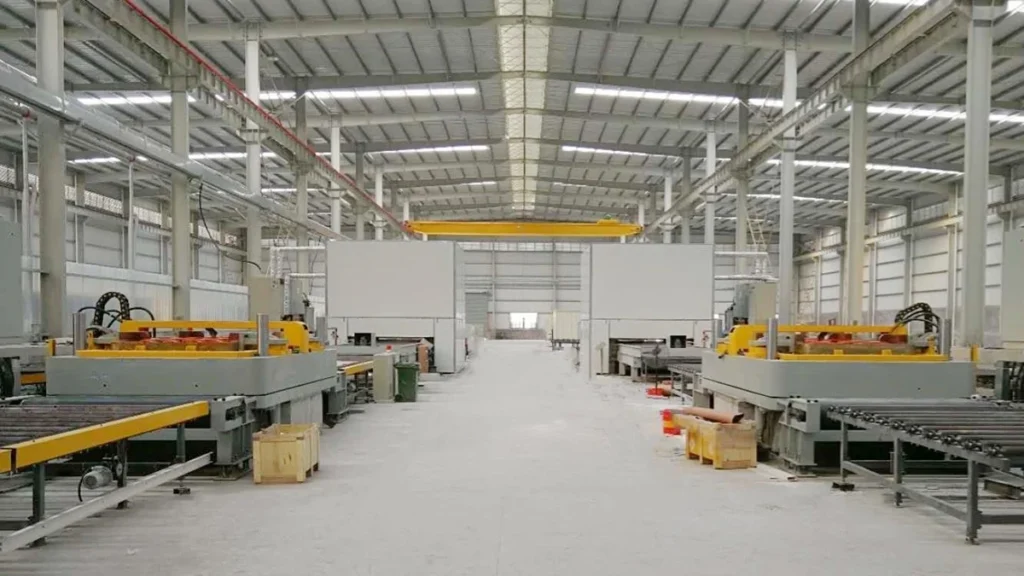
First, the QC checklist for quartz and granite overlap less than you’d think. If you’re inspecting both from the same supplier, the priorities split like this:
Quartz QC priorities
- Color and pattern consistency against the approved sample and product code
- Surface defects: pinholes, resin-starved areas, polishing marks, spots
- Batch-to-batch matching, especially if the order spans production runs
- Thickness tolerance and edge finish consistency (manufactured, so measurable)
- For printed or decorative quartz: pattern registration, ink adhesion, and repeat alignment
Granite QC priorities
- Natural fissures and micro-cracks — some are natural, some are damage; the distinction matters
- Block-to-block tone and veining shifts within the same order
- Thickness consistency after calibration (granite can vary more than engineered product)
- Resin treatment quality (many granite slabs are resin-treated to fill fissures; poor treatment shows up later)
- Edge quality after cutting and polishing
First, the takeaway: quartz QC is a consistency game — is this batch like the last batch, and does it match the sample? Granite QC is an acceptance game — do I accept this level of natural variation, and have I documented what I’m accepting? Specifically, buyers who apply granite-style inspection to quartz over-reject on minor variation; buyers who apply quartz-style inspection to granite under-document the variation they accepted. And end up with disputes later. In particular, our QC & packing guide covers the engineered-stone side of this in practical checklist form.
2026 Compliance: Silica, Tariffs, and Documentation
First, this is the area where the two materials have diverged most sharply in the last two years. And where a 2026 buyer has to be careful.
Quartz carries the silica documentation stack
First, engineered quartz sits at the center of the global crystalline silica debate. Australia’s engineered stone ban took effect in 2024. And its workplace exposure-limit framework is being overhauled with new WEL limits scheduled to take effect December 1, 2026. In the US, California’s rulemaking process and federal OSHA activity continue. And the EU’s NEPSI framework keeps pushing for lower crystalline silica exposure across the workplace. For buyers, the practical effect is documentation: silica content declarations, SDS, COA. And product compliance files are becoming part of standard import paperwork for quartz. Our silica-free surfaces hub tracks this landscape. And the silica-free guides collection has the market-by-market detail.
Granite sits outside the bans but not outside compliance
First, granite, as natural stone, sits outside the engineered stone bans in most jurisdictions. That doesn’t make it compliance-free — it still faces customs classification, tariff treatment. And (in some markets) inspection requirements — but it doesn’t carry the engineered-stone silica documentation burden. For buyers who want to avoid silica compliance entirely, natural stone remains a straightforward path; for buyers who need repeatable product and are willing to manage the documentation. Specifically, quartz’s compliance stack is manageable if you start early.
On the tariff side, both materials are subject to import duties that vary by destination and classification — the 2026 US safeguard case on quartz. For example, has made HTS classification and AD/CVD exposure a live question for quartz importers. However, granite faces its own tariff treatment in various markets. The point for this guide: compliance isn’t a tie-breaker that always favors one material — it’s a cost and process item you must model into the landed cost for your destination, with current rates. Specifically, verify the current treatment with your customs broker before committing.
Decision Framework & FAQ
First, here’s the framework we actually use when buyers ask us which material to source. Answer these five questions in order:
- Will you need repeat orders that must match? Yes → quartz (or accept granite block-booking discipline).
- Is strict color continuity critical across phases? Yes → quartz with documented batch controls.
- Is “natural stone” part of the product story you’re selling? Yes → granite earns its complexity.
- Do you want to avoid engineered-stone silica documentation entirely? Yes → natural stone path.
- What does the landed-cost model say? Run both through weight, freight, tariff, and QC-cost assumptions — don’t compare slab prices alone.
If your answers point in different directions, that’s normal — it usually means you need a mixed program, not a single-material bet.
FAQ
First, it depends on what you’re comparing. Granite block and slab prices can be lower in raw terms. But weight-driven freight, selection waste, and variation risk can flip the landed-cost comparison. Model your actual destination and order profile.
In most jurisdictions, no — the 2024–2026 bans target engineered stone products with high crystalline silica content. Granite is natural stone and generally outside those bans. However, always verify the current rule for your destination.
First, matching is harder than with quartz. You can book blocks by name and grade and request block photos, but tone and veining will vary. If matching is critical, engineered quartz is the safer repeat-order material.
First, quartz QC is consistency-focused (batch matching, surface defects, dimensional tolerance); granite QC is acceptance-focused (fissures, tone shifts, resin treatment). Budget inspection time and clear acceptance criteria for whichever you choose.
First, i wish more buyers asked this before signing. It’s not a deal-breaker — silica content declarations, SDS, COA, and product compliance files are manageable — but it’s a process item. Specifically, start the documentation request in the RFQ stage, not after the PO.
Building a slab program and not sure which material fits your market?
First, tell us your project type, target market. And order rhythm — we’ll walk through the quartz vs granite sourcing decision with you, including spec locking, container planning. And the 2026 documentation requirements. Request a supply review →
How This Article Was Prepared
- Regulatory and policy information: Summarized from publicly available legislative texts, regulatory announcements, and government agency publications as of August 2026. Source documents are cited in the article body where referenced.
- Industry context: Market observations and supply chain analysis are based on AsiaQuartz’s operational experience coordinating quartz supply and publicly available industry data. Container packing references follow AsiaQuartz’s approved US-bound packing reference for the regular super-jumbo size (3200 × 1600 mm format).
- Limitations: This article provides general business and educational information. It is not legal, customs, regulatory, or occupational-health advice. Importers, fabricators, and employers should consult qualified professionals for their specific situation. Regulatory requirements vary by jurisdiction and are subject to change.
About This Article
First, this article was prepared using current public information from government agencies, industry organizations, research institutions, trade publications, and other cited sources. AsiaQuartz-specific product and supply information was reviewed against the AsiaQuartz Single Source of Truth (SSOT). Specifically, external sources are used for market context and do not independently verify AsiaQuartz capabilities. Research and drafting tools may assist with source collection, structure, and language review. In particular, final claims, sources, and AsiaQuartz-specific information are reviewed before publication.
Information Status
First, based on publicly available information reviewed through August 15, 2026. Regulations, tariff treatment, customs classification, product availability, production routes, and commercial terms may change. Specifically, buyers should review the specific transaction with the relevant professionals and authorities. A small sample does not represent every characteristic of a full slab or every permitted production variation. Actual specifications should be confirmed through product-specific technical files and written order documents.
Sources and References
- Safe Work Australia, Engineered Stone Ban regulatory materials and workplace exposure limit reform, accessed August 2026
- US International Trade Commission, quartz slab trade case filings (safeguard/AD-CVD dockets), accessed August 2026
- EU NEPSI (European Network for Silica), Good Practice Guide and workplace exposure documentation, accessed August 2026
- Cal/OSHA, crystalline silica rulemaking materials, accessed August 2026
- AsiaQuartz SSOT, v1.1, last reviewed August 2026 (product specifications, packing reference, internal link registry)
Related Reading
Silica-Free Surface Guides — Full Collection
How to Choose a Quartz Slab Supplier for B2B Projects
First, Quartz Slab Supply Chain Guide 2026: Origin. QC, Landed Cost & Container Risk
Quartz Slab Weight & Container Loading Guide for B2B Buyers