Prepared by: AsiaQuartz Editorial Team
Technical review by: AsiaQuartz Product, QC & Supply Chain Team
Last updated: July 2026
Quick answer
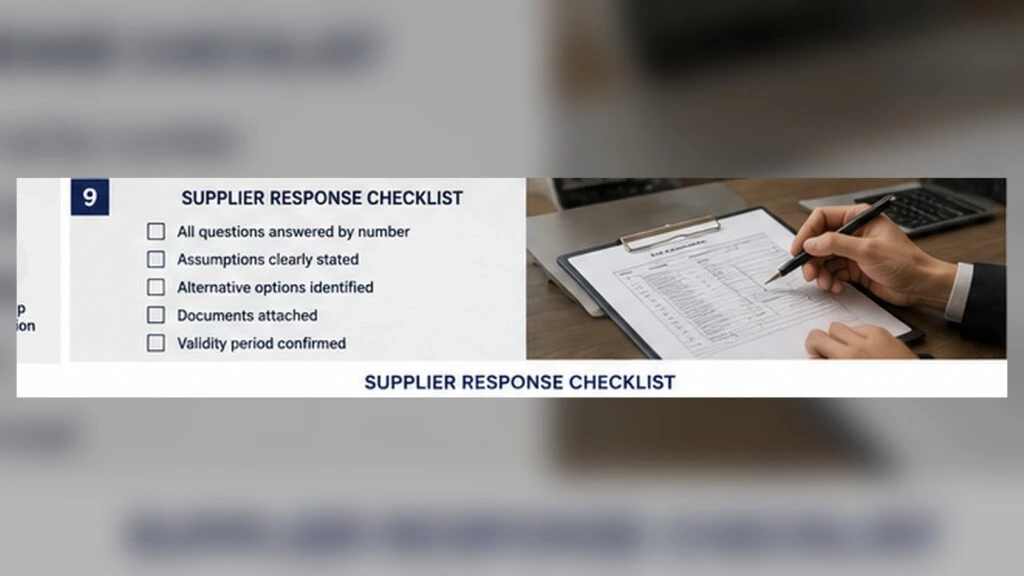
First, a useful quartz slab RFQ must standardize five areas: technical specification, compliance and origin evidence, logistics and Incoterms, commercial terms. And production/QC/after-sales. Specifically, require every supplier to answer the same numbered questions, mark non-applicable items as “N/A,” identify assumptions and attach product-specific evidence.
First, a short inquiry such as “quote ten containers of Calacatta quartz, 3200 × 1600 × 20 mm” rarely produces comparable answers. One supplier may quote a different usable size, another may exclude packing. Specifically, another may use FOB while the cargo is actually handed to a carrier at a terminal. And another may attach a test report for a different formulation.
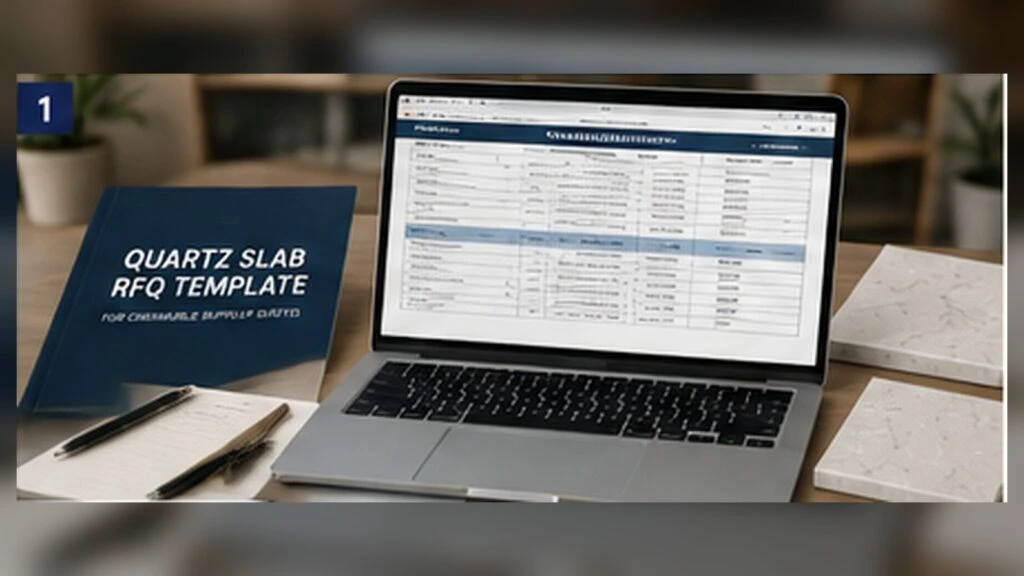
First, this article converts the Quartz Slab Supplier Evaluation Framework into a copy-ready procurement tool. Fill in the bracketed fields, send the same version to each prequalified supplier and preserve the answers in one comparison file.
How to use the template
- Lock the required specification and destination before issuing the RFQ.
- Send one controlled document version to every candidate.
- Require suppliers to answer by question number and identify every alternative.
- Use mandatory gates before scoring price or service.
- Issue a revised RFQ version if the specification changes; do not mix old and new quotes.
RFQ Section 1: Technical Specification
First, complete the buyer-input block before sending the RFQ. Do not insert universal tolerance numbers unless they come from the product, project drawing, contract or destination requirement.
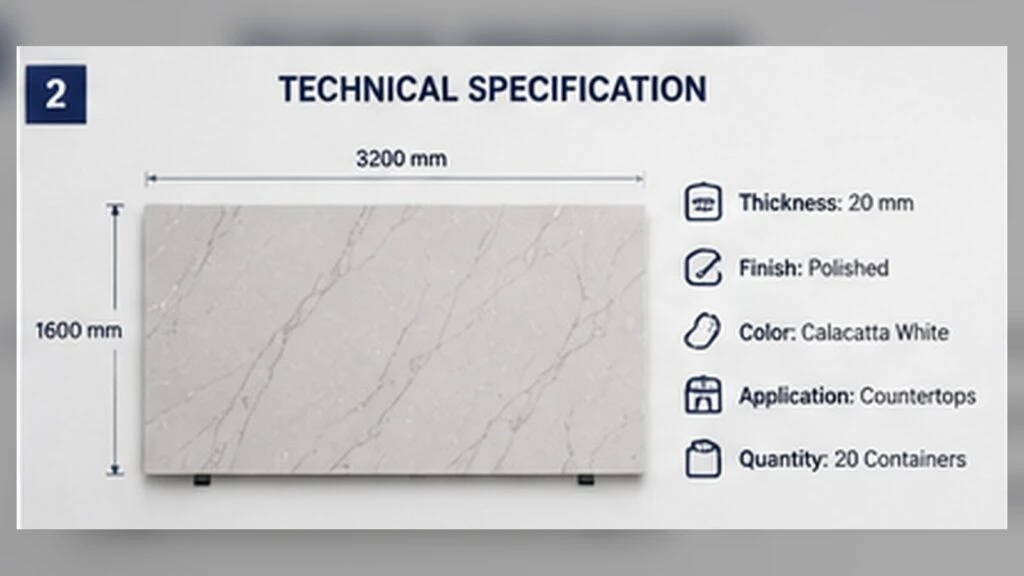
Buyer Input — Technical Specification
First, 1.1 Product type: [conventional engineered quartz / silica-free surface / printed quartz / other]
1.2 Design or color: [code/name + one approved visual reference; describe background. Vein color, scale. Specifically, direction and acceptable tone range]
1.3 Nominal slab format: [length × width in mm and inches]
1.4 Required usable size: [minimum trimmed usable length × width. If different]
1.5 Thickness: [nominal thickness + required tolerance or supplier-declared tolerance for review]
1.6 Finish: [polished / honed / matte / other]
1.7 Quantity: [slabs and containers; trial. In particular, one-time or recurring program]
1.8 Intended application: [countertops / vanities / wall panels / other]
1.9 Quality requirements: [flatness. Squareness, edge condition, pinhole/spot limits. For example, color control and other measurable acceptance criteria]
1.10 Destination: [country, port and project/customer requirements]
First, Supplier Response — Technical
Q1.1: Confirm whether the exact specification can be produced at the proposed manufacturing site. List every deviation.
Q1.2: State whether each size/thickness is regular production or special order. Specifically, provide MOQ, additional lead time and tooling/line limitations for special formats.
Q1.3: Attach the product-specific TDS and state the applicable test method and edition for every reported property.
Q1.4: Describe sample approval. Full-slab approval, batch variation and replenishment-reference controls.
Q1.5: State the measurement method and sampling plan used for dimensions. In particular, thickness, flatness, squareness and surface inspection.
Use the dedicated Quartz Slab Sizes & Dimensions page to assess alternative formats proposed by suppliers.
RFQ Section 2: Compliance, Silica and Origin Evidence
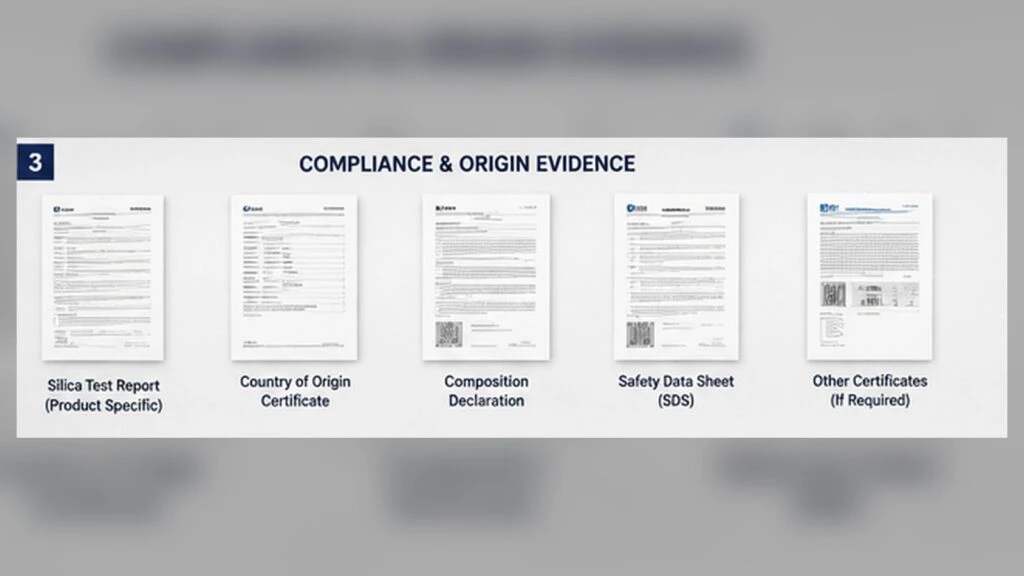
Supplier Response — Compliance and OriginQ2.1: Provide the finished-product SDS and the product specification/TDS for the exact quoted SKU.Q2.2: State the declared crystalline-silica content and attach a product-specific quantitative mineralogical report.
First, identify the laboratory, analytical method, sample preparation. Reporting basis and detection or quantification limits.Q2.3: If the product is marketed as silica-free. Specifically, low-silica or compliant with a specific threshold, state the exact claim, applicable market/project requirement, tested SKU and report coverage. Do not answer with a category-wide marketing statement.Q2.4: List the manufacturing site, exporter. In particular, contracting entity and expected Certificate of Origin issuer.Q2.5: Provide a manufacturing-process description showing where batching. Mixing, moulding/pressing, curing, calibration, polishing. For example, inspection and packing occur.Q2.6: Identify major cross-border material or semi-finished-product movements that may affect origin review. And provide supporting production records available for the order.Q2.7: Confirm which destination-market or project documents will be supplied before shipment and when they will be available.
Important origin note
First, a Certificate of Origin template does not, by itself, resolve U.S. country-of-origin or trade-remedy treatment. Substantial transformation is fact-specific. Specifically, share the actual process route with your customs broker or trade counsel before approving the origin assumption.
RFQ Section 3: Logistics, Packing and Incoterms
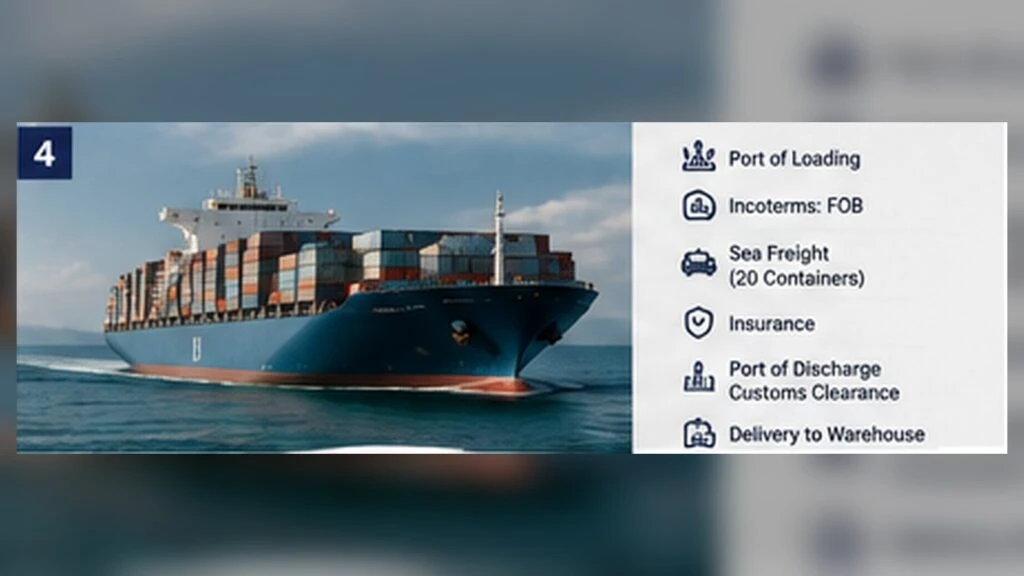
First, use one named Incoterm and place for every candidate. ICC guidance notes that FCA is generally more appropriate when containerized goods are handed to the carrier before vessel loading; FOB is appropriate only when the seller delivers the goods on board the vessel at the named port.
Buyer Input — Logistics Basis
Requested quotation basis: [FCA named place / FOB named port / other] Incoterms® 2020
Destination port: [port]
Container type: [20GP / other, subject to payload and packing review]
Unloading method: [forklift / crane / other]
Required shipment window: [date range]
First, Supplier Response — Logistics
Q3.1: Quote using the requested Incoterm and exact named place. State where delivery and risk transfer occur.
Q3.2: State the factory-to-delivery-point distance. Specifically, current inland transport cost, quotation date and validity.
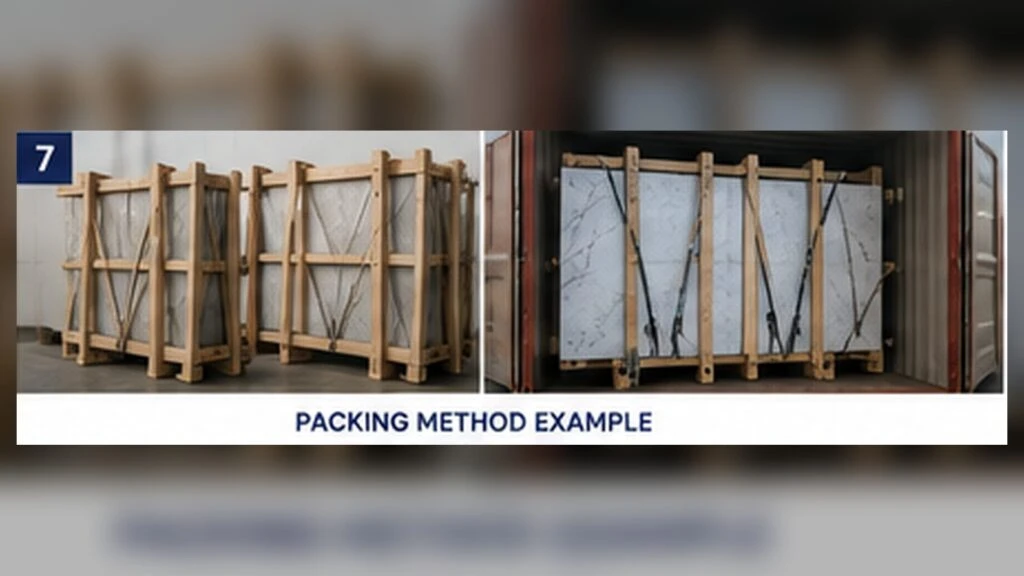
Q3.3: Provide the proposed packing design. Slab orientation, protective materials, rack/crate specification. In particular, net/gross weight and slabs per container.
Q3.4: Confirm whether wood packaging will be ISPM 15 compliant where applicable. Do not state “fumigation” unless that is the actual approved treatment.
Q3.5: Identify normal carrier/route options, direct or transshipment service. For example, estimated transit range and shipment frequency.
Q3.6: Attach sample packing. Loading, seal and container-condition records from a comparable shipment.
RFQ Section 4: Commercial Terms
First, Supplier Response — Commercial
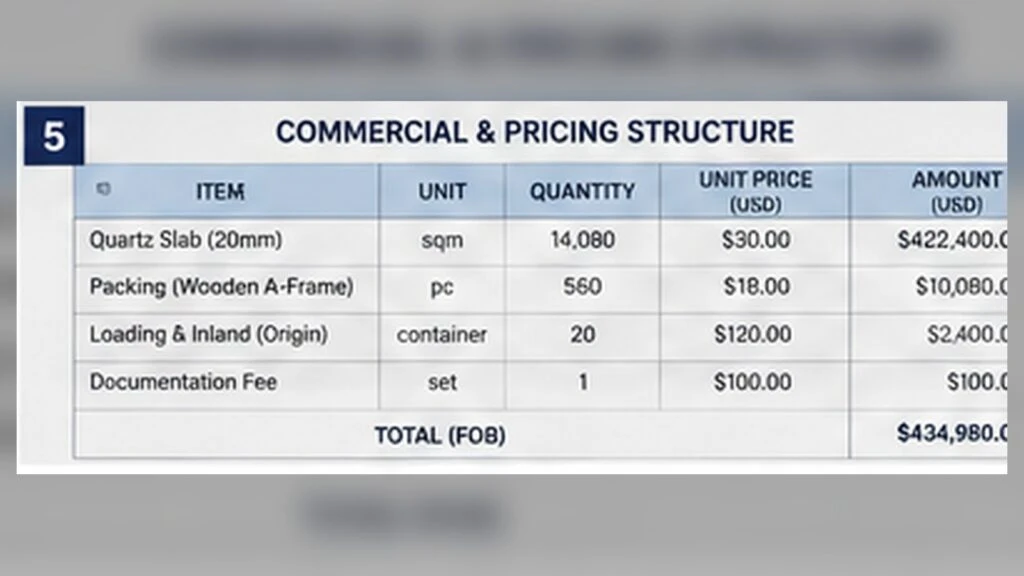
Q4.1: State price per slab and per square meter. Currency, quotation basis, inclusions and exclusions.
Q4.2: State MOQ by design, finish and thickness. Specifically, explain mixed-color or mixed-SKU container rules.
Q4.3: State volume tiers only where they apply to the same specification and commercial basis.
Q4.4: State deposit. Balance trigger, bank account beneficiary. L/C capability and document-release conditions.
Q4.5: State quotation validity and the events that allow repricing.
Q4.6: State production lead time, its starting event. In particular, sample-approval dependency, packing time and handover milestone.
Q4.7: Identify any separate charges for samples. Testing, inspection, special packing, labels, documentation or design development.
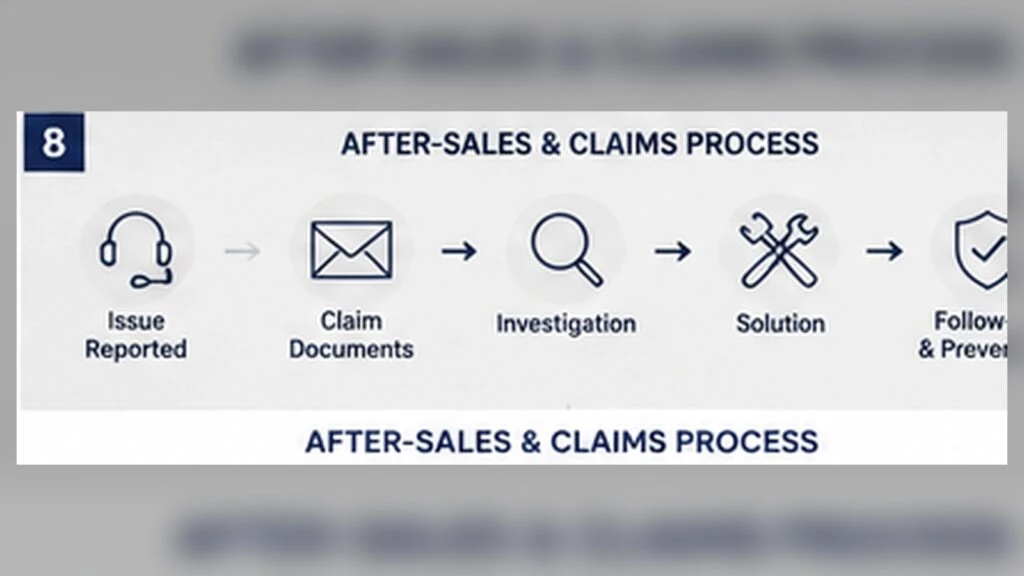
RFQ Section 5: Production, QC and After-Sales
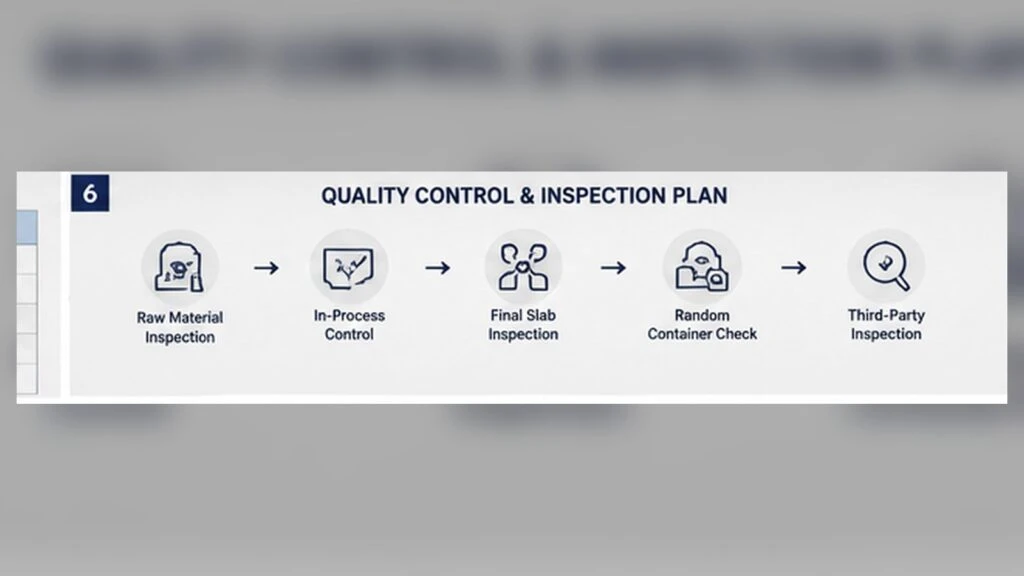
First, supplier Response — Production, QC and SupportQ5.1: Identify the actual manufacturing site and production line proposed for the order. State whether the supplier owns, operates or subcontracts the plant.Q5.2: Confirm the available production slot and realistic schedule for this order. If capacity data is confidential, provide the committed order window.Q5.3: Describe inspection stages, sampling, measuring equipment. Acceptance records and non-conforming-product control.Q5.4: Confirm whether buyer or third-party inspection is permitted and at which milestones.Q5.5: List the pre-shipment evidence provided: full-slab photos. Specifically, measurement records, batch/lot labels, packing photos, loading photos, seal and container-condition records.Q5.6: Describe the claims procedure: notice period. Contact, required evidence, investigation steps and available remedies.Q5.7: State previous experience with the destination market.
Where customer references are confidential, offer alternatives such as redacted shipment documents, audit reports or other verifiable evidence.
Mandatory Gates Before Comparing Scores
| Gate | Pass / Hold | Evidence |
|---|---|---|
| Exact or approved technical fit | ||
| Destination-required documents available | ||
| Silica claim supported for quoted SKU | ||
| Origin process route clear enough for review | ||
| Contracting, factory, exporter and bank identities resolved |
Quartz RFQ Comparison Matrix
First, score only suppliers that pass the mandatory gates. Use 1–5 per dimension and record the evidence behind the score. Specifically, apply project-specific weighting before receiving final quotes, not after seeing which supplier is cheapest.
| Dimension | Supplier A | Supplier B | Supplier C | Evidence / Clarification |
|---|---|---|---|---|
| 1. Technical specification and product match | ||||
| 2. Compliance, silica and origin evidence | ||||
| 3. Logistics, packing and Incoterms | ||||
| 4. Commercial terms | ||||
| 5. Production, QC and after-sales | ||||
| TOTAL / 25 | A total score does not override a failed mandatory gate. | |||
| Normalized landed cost | Use the same specification, Incoterm, destination and duty assumptions. |
RFQ Mistakes That Destroy Comparability
Using Different Specifications or Document Versions
First, assign a document number and revision date. When a requirement changes, issue a controlled revision to every candidate and request a complete revised quotation.
Prescribing Unsupported Universal Tolerances
First, do not copy a tolerance from an unrelated product or supplier. Use project requirements or ask suppliers to declare their production tolerance and measurement method for review.
Requesting “FOB Price” Without a Named Port and Incoterms Version
First, state the exact rule, named place and Incoterms® 2020. For containerized cargo, confirm whether FCA better reflects the handover point.
Accepting a Generic Test Report
First, check the tested SKU, site, sample identity, method, edition. Result and report coverage. A report from a different product family may be useful background but is not product-specific proof.
Changing the Score Weighting After Quotes Arrive
First, set mandatory gates and weighting before ranking suppliers. Otherwise the scoring model can be adjusted to justify the cheapest quote.
Treating Missing Answers as Automatic Fraud
First, a missing answer can reflect confidentiality, language or document-readiness gaps. Request one structured clarification. Specifically, keep critical unresolved issues as holds rather than replacing them with assumptions.
What to Do When Suppliers Skip Questions
- Technical deviation not disclosed: place the quote on hold until the product is defined.
- Silica or destination-required evidence missing: do not treat the claim as verified.
- Origin route unclear: obtain process details and professional review before relying on the duty treatment.
- Customer references confidential: accept alternative evidence if it is relevant and verifiable.
- Price complete but evidence weak: keep the quote outside the shortlist regardless of apparent savings.
Convert the RFQ Shortlist Into a Controlled Trial
First, the next step is not always one full container from every supplier. Select the lowest-risk validation route that can test the critical claims:
- approved samples and full-slab visuals;
- product-specific third-party testing;
- factory or quality-system audit;
- small production batch or retained batch sample;
- mixed trial container where the supplier permits it; or
- full pilot container for a high-volume program.
First, evaluate the operating process as well as the material: approval control, production updates. Dimensional records, batch traceability, packing, loading evidence and claims handling.
Submit Your Sourcing Requirements →
Build the complete sourcing workflow
- Compare Quartz Slab Suppliers — the parent evaluation framework.
- Quartz Slab Supplier Selection Guide — supplier-fit, samples and factory-review fundamentals.
- Quartz Slab QC & Packing Guide — turn the approved specification into inspection and packing controls.
- Quartz Slab Supply Chain Guide — calculate landed cost and supply-chain risk.
- Quartz Slab Sizes & Dimensions — evaluate proposed standard, project-size and super-jumbo formats.
Frequently Asked Questions
How many suppliers should receive the RFQ?
After prequalification, three to six suppliers is usually manageable. Use more only when you need broader market coverage and have the resources to review every response properly.
Should the RFQ be translated?
First, use the language in which both sides can discuss technical and commercial terms accurately. A bilingual version can reduce ambiguity. But the controlled English version should remain the reference if that is the contract language.
Can I shorten the quartz slab RFQ template?
First, yes. Keep at least one clear question in each of the five dimensions and retain all destination-required gates. Specifically, mark non-applicable questions as N/A rather than deleting the entire evidence category.
What if the supplier proposes a different slab size?
First, record the deviation, usable dimensions, MOQ, lead-time impact, packing effect and fabrication consequences. Do not compare the alternative price until the alternative is technically approved.
Should I ask for buyer references?
First, you can ask, but confidentiality may prevent disclosure. Accept relevant alternatives such as redacted shipment records, audit reports, destination-market export evidence or third-party verification.
Does the highest score automatically win?
First, no. Mandatory gates come first, and a controlled trial should verify critical claims. The score creates discipline; it does not replace professional judgment.
How this template was prepared
- RFQ structure: aligned with the five-dimension supplier-evaluation framework and separated into technical, compliance/origin, logistics, commercial and operating-control sections.
- Incoterms: the template distinguishes FCA and FOB because containerized cargo is often delivered to a carrier before vessel loading.
- Origin: substantial transformation is treated as a case-specific determination rather than a fixed production shortcut.
- Test evidence: the template requests product identity, method, edition, result and report coverage instead of treating a generic certificate as sufficient.
- Limitations: adapt the template to the product, project and destination market. It is not legal, customs, laboratory or contract advice.
First, Information status: Requirements, trade remedies, customs treatment, freight routes and commercial practices may change. Verify the current transaction with the relevant professionals and authorities.
Sources and references
- U.S. Customs and Border Protection — case-specific substantial-transformation analysis
- ICC — Incoterms® 2020 FOB explanatory notes
- ICC Academy — FCA or FOB for containerized goods
- ASTM C97/C97M — dimension-stone absorption and bulk specific gravity method
- ASTM C880/C880M — dimension-stone flexural-strength method
- BS EN 14617-1 — agglomerated-stone apparent density and water absorption
- BS EN 14618 — agglomerated-stone terminology and classification