
Prepared by: AsiaQuartz Editorial Team
Technical review by: AsiaQuartz Product, QC & Supply Chain Team
Last updated: July 2026
Quartz slab QC photos are one of the most practical ways for importers to review finished slabs before approving shipment—especially when they cannot visit the factory in person.
First, a useful photo package should show product identity, surface condition, dimensions, thickness, edges, batch labels. Packing and container loading. A few general factory photos are not enough to support a shipment-release decision.
First, this guide explains which photos to request, how to organize the evidence, what each image can verify. And when remote photos should be replaced by a live video review or third-party inspection.
Before the Photos: Define the Inspection Plan
First, put the photo requirements in the PI, PO or quality agreement before production. Define:
- lot and batch identity;
- critical, major and minor defect categories;
- 100% checks versus sampled checks;
- sample-selection method and locations;
- measurement points and order-specific tolerances;
- lighting, background and reference sample;
- file naming, original-resolution delivery and approval deadline;
- conditions for hold, rework, reinspection and release.
If acceptance sampling is used, define the plan rather than saying “check a few slabs.” ISO 2859-1:2026 provides AQL-indexed sampling schemes for lot-by-lot inspection by attributes. But the inspection level, AQL and defect classification must be selected for the order.
Quartz Slab QC Photos: 8 Categories to Request Before Shipment
A complete set of quartz slab QC photos should cover the following eight evidence categories.
1. Identity Board and Photo Index
First, Request: Begin each set with an identity board showing supplier. Factory, PO, SKU, batch, dimensions, thickness, finish, inspection date and inspector. Specifically, add an index that maps filenames to slab, bundle or A-frame IDs.
First, Review: Confirm that every later image can be linked to the order. Unindexed photos may show acceptable slabs from another batch.
2. Full-Slab Surface Coverage
First, Request: Wide, square-on images of the complete slab plus low-angle or glancing-light views. For veined or printed products, include enough slab IDs to evaluate pattern scale, direction, repeat and batch variation. Specifically, high-value projects may require 100% full-slab imaging; routine repeat orders may use an agreed sampling plan.
Review: Base colour, vein scale, polish, scratches, chips, pits, contamination, resin-rich areas, printing defects and unacceptable repetition.
First, Red flag: cropped beauty shots with no slab ID, no full edges and no reference scale. They are marketing images, not inspection evidence.
3. Defect Close-Ups with Location Reference
First, Request: Close-ups of every defect found, with a ruler or scale and a second image showing its location on the slab. The image should identify whether the defect is on the face, edge, corner or back.
First, Review: Compare defect type, size. Location and frequency with the written acceptance criteria. A close-up alone can exaggerate or hide commercial impact; the location view is essential.
4. Length, Width and Squareness Measurements
First, Request: Readable measurements at the positions defined in the inspection plan. Include length, width and diagonals when squareness is required. Specifically, show the tool zero point and slab ID.
First, Review: Compare actual readings with the purchase specification. Do not apply a generic tolerance from another article, product or supplier.
5. Thickness, Flatness and Edge Condition
Request: Thickness readings at multiple defined points with a calibrated caliper or gauge; straightedge or another agreed method for flatness/warpage; close-ups of all edge and corner conditions.
First, Review: Actual readings, within-slab variation, chips, cracks, repair, exposed voids, reinforcement or backing condition. Back mesh or another backing layer should be checked only when it is part of the ordered construction.
6. Labels and Batch Traceability
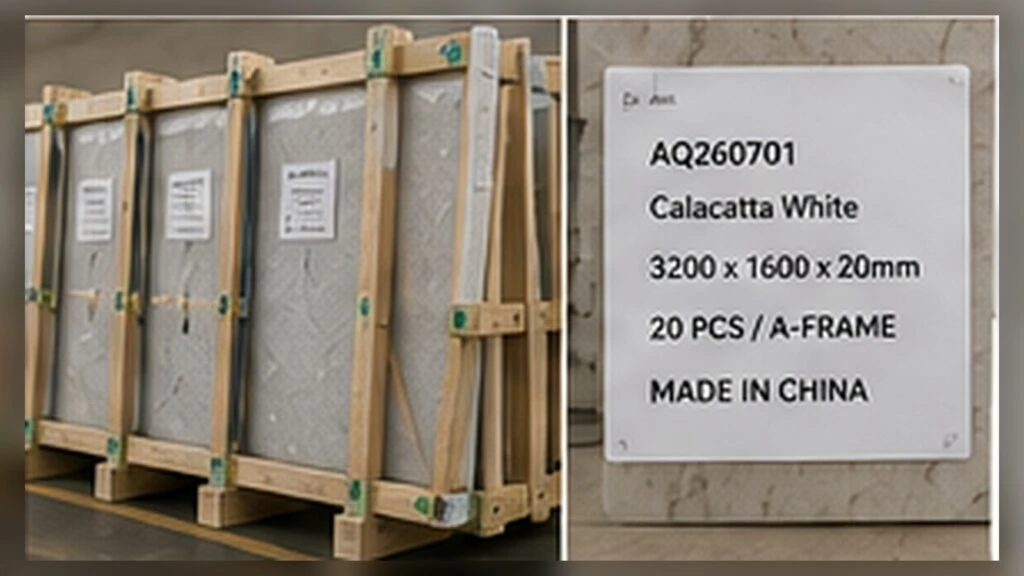
First, Request: Slab, bundle or A-frame labels showing SKU, colour, batch, quantity, size, PO and destination. Include a photo that maps the label to the physical bundle.
First, Review: Match labels against the packing list and QC index. Mixed batches or substituted SKUs require written approval before loading.
7. Packing Before and After Closure
First, Request: Images before the package is closed, showing interlayers, edge protection. Corner protection and slab arrangement; then images of completed bracing, straps and frame condition. Specifically, where solid-wood packaging is subject to destination phytosanitary rules, show the applicable ISPM 15 mark.
First, Review: No abrasive or contaminated interlayers, no strap contact directly on vulnerable edges. Structurally sound wood or steel frame, legible marks and packing that matches the agreed method.
8. Container Condition, Loading, Bracing and Seal
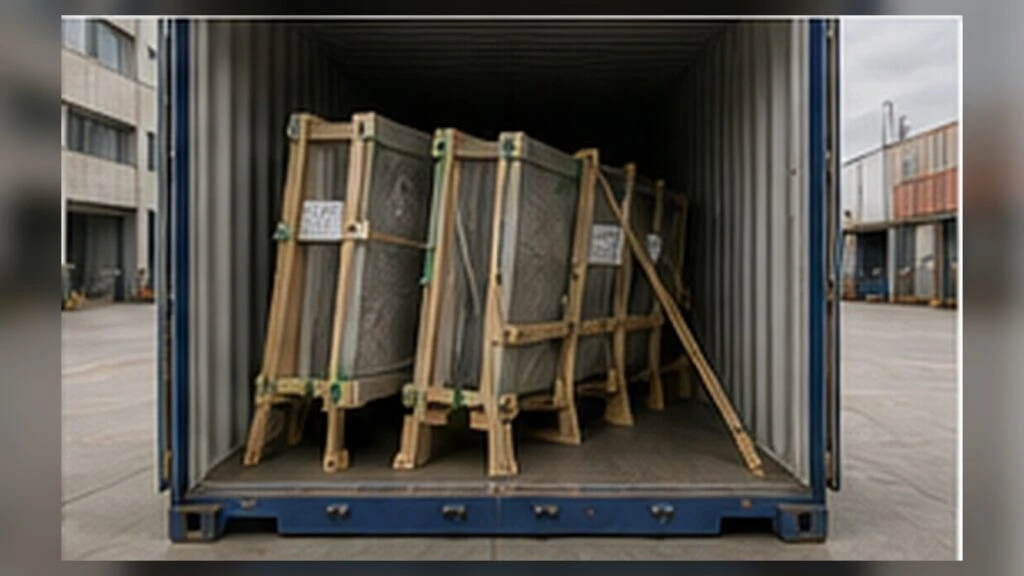
Request: Empty container interior and container number; floor, walls and roof condition; loading sequence; mid-load bracing; completed load; door closure; seal number.
First, Review: Container is clean and dry, loads are positioned and restrained according to the loading plan. Bundles are not leaning or free to shift, the container and seal numbers match the shipping records.
File and Evidence Rules
Use a predictable filename such as:
PO-SKU-BATCH-SLAB_OR_BUNDLE-VIEW-DATE-SEQUENCE.jpg Example: AQ260731-CALACATTA-A26-0417-SLAB038-FULLFACE-20260731-01.jpg
- Request original-resolution files, not screenshots or compressed chat previews.
- Keep the original files and the supplier’s transmission email or shared-folder record.
- Do not rely on embedded timestamps alone; they can be altered. Use identifiers within the scene and a documented inspection record.
- Keep accepted and rejected images in the shipment folder with the signed release decision.
- Protect customer, worker and facility information according to the agreed privacy and security rules.
How to Read the Photos
| Photo category | Useful evidence | Reason to hold release |
|---|---|---|
| Identity | PO, SKU, batch and inspection date are visible and consistent | Photos cannot be tied to the ordered batch |
| Surface | Full slab and low-angle views show acceptable appearance | Only cropped views, hidden edges or unexplained colour difference |
| Defects | Close-up plus location and scale | Defects shown without size, slab ID or location |
| Measurements | Readable tool and actual result at defined points | Tool is obscured, zero point missing or result outside specification |
| Thickness/flatness | Multiple points and agreed method | One convenient corner only or unexplained variation |
| Labels | Labels map to packing list and physical bundles | Mixed SKU/batch, handwritten changes or missing traceability |
| Packing | Protection visible before closure and finished package is sound | Direct strap contact, missing interlayers or damaged frame |
| Loading | Clean container, controlled sequence, bracing and matching seal | Wet floor, leaning load, missing bracing or inconsistent seal number |
What Photos Cannot Prove
Remote images cannot reliably verify:
- mineral or crystalline-silica composition;
- flexural strength, impact resistance or long-term durability;
- exact gloss or colour without calibrated conditions;
- hidden voids, internal cracks or concealed packing damage;
- whether the selected photos statistically represent the whole lot;
- the accuracy or calibration of a tool unless independently controlled.
First, use a live video call, retained sample. Independent laboratory or third-party inspection when the order risk requires more than supplier-generated evidence.
When to Escalate Beyond Photos
Live video verification
First, ask for an unbroken walk-through from the batch label to the selected slabs. Real-time measurements, all bundles and the loading area. Specifically, agree recording and privacy requirements before the call.
Third-party pre-shipment inspection
First, use independent inspection for a first order, new factory, changed formulation, high-value project. Repeated defects or any situation where the supplier’s evidence is incomplete. Specifically, define the inspector’s scope and sampling plan in advance.
Retained reference material
First, retain approved pre-production material and, where practical, a production coupon or cut-off linked to the batch. This is more useful than relying on photographs alone when investigating later differences.
Copyable QC Photo Request
First, please provide the complete pre-shipment QC photo package for PO [NUMBER]: 1. Identity board: supplier, factory, PO, SKU, batch, size, thickness, finish, inspection date. 2. Specifically, photo index linking every file to slab, bundle or A-frame ID. 3. Full-face and glancing-light slab photos according to the agreed coverage plan. 4. In particular, close-up and location photos for every recorded defect, with scale. 5. Length, width, diagonal, thickness and flatness evidence at the agreed points. 6. For example, edge, corner, back and ordered backing/reinforcement condition. 7. Labels and traceability mapping to the packing list. 8. For instance, packing before closure and after closure, including protection and frame condition. 9. Empty container, container number, loading sequence, bracing, completed load and seal. 10. As a result, original-resolution files delivered through [EMAIL / SHARED FOLDER]. Shipment release remains subject to written QC approval and resolution of any nonconformity.
FAQ:
First, there is no universal number. Coverage should follow the lot size, defect risk. Specifically, product type and inspection plan. A small set can be adequate if each image is indexed and evidential; hundreds of unlabelled images can still be useless.
For a high-value project, unique slabs or strict layout planning, 100% imaging may be appropriate. For stable repeat orders, sampled imaging may be enough when combined with an agreed acceptance plan and batch controls.
First, a readable measurement photo is stronger than a beauty shot, but it still depends on tool accuracy, measurement method and sample selection. Critical orders may require an independent inspector.
First, they can support a claim when original files, identifiers, measurements, transmission records and contract criteria align. Their legal weight depends on the contract, jurisdiction and authenticity of the evidence.
First, destination requirements vary. ISPM 15 regulates wood packaging material used in international trade through approved treatment and marking systems. Specifically, confirm the destination’s phytosanitary requirements with the forwarder or broker rather than using “fumigated crate” as a generic assumption.
Sources and methodology
- ISO 2859-1:2026 — AQL-indexed sampling schemes for lot-by-lot inspection by attributes
- International Plant Protection Convention — guidance on wood packaging material and ISPM 15
This checklist is an operational framework, not a replacement for a product-specific inspection standard, contract, independent inspection or laboratory test.
Continue Reading
- Quartz Slab QC & Packing Guide
- How to Choose a Quartz Slab Supplier
- Quartz Slab Weight & Container Loading Guide
- Quartz Slab Supply Chain Guide
Request a Supply & QC Review
AsiaQuartz can align your slab specification, photo evidence, pre-shipment inspection scope, packing records and shipment-release process.