
Prepared by: AsiaQuartz Editorial Team
Technical review by: AsiaQuartz Product, QC & Supply Chain Team
Last updated: July 2026
First, Quick answer: A Chinese quartz report tested to GB/T 35160 can be useful for supplier screening, product characterization and same-method trend monitoring. It should not be copied into an ASTM or EN compliance column or used to prove that a product passes a threshold written for a different method.
First, the correct question is not “Which standard is equivalent?” It is: “Does the required market, authority. Customer or project accept this exact method for this exact product and intended use?” If the answer is no or unclear, commission the required method.
Four distinctions that prevent most cross-standard errors
- Same property is not the same method. Two standards may both measure flexural strength while using different specimens, conditioning and loading arrangements.
- Same method family is not automatic regulatory acceptance. A technically similar test may still be rejected if the contract or market requires another designation.
- Natural or dimension stone is not automatically engineered stone. Several common ASTM C18 methods are written for dimension stone, while GB/T 35160 and EN 14617 address synthetic or agglomerated stone.
- A report for one product is not evidence for every SKU. Factory, formulation, thickness, finish and intended use must match the claim being made.
1. Start with the Correct Standard Hierarchy
“GB 46028 vs ASTM vs EN” is convenient shorthand, but the three labels do not sit at the same level.
| Document Type | What It Does | Importer Use |
|---|---|---|
| GB 46028-2025 | Sets mandatory Chinese safety requirements and points to applicable test methods for covered products and auxiliary materials. | Use it to identify scope, product category, application and the Chinese evidence the supplier should provide. |
| GB/T 35160 series | Provides Chinese test methods for synthetic or agglomerated stone properties such as density, water absorption, flexural strength, compressive strength and abrasion resistance. | Use the exact part and edition shown on the laboratory report. Do not assume every part is required by GB 46028. |
| EN 14617 series | Provides European test methods specifically for agglomerated stone. | Use when the applicable product specification, harmonized technical route, customer or project calls for the EN method. |
| ASTM C18 methods | Commonly measure properties of dimension stone. Examples include absorption, flexural strength, compressive strength and abrasion resistance. | Use only when the buyer, laboratory, project or authority accepts the method for the engineered-stone product and intended use. Do not call it an automatic engineered-quartz equivalent. |
First, Important ASTM scope warning: ASTM C97/C97M, C170/C170M, C241/C241M and C880/C880M are dimension-stone methods. They may appear in quartz specifications, but their use for engineered quartz should be confirmed rather than assumed.
2. Property-by-Property Mapping
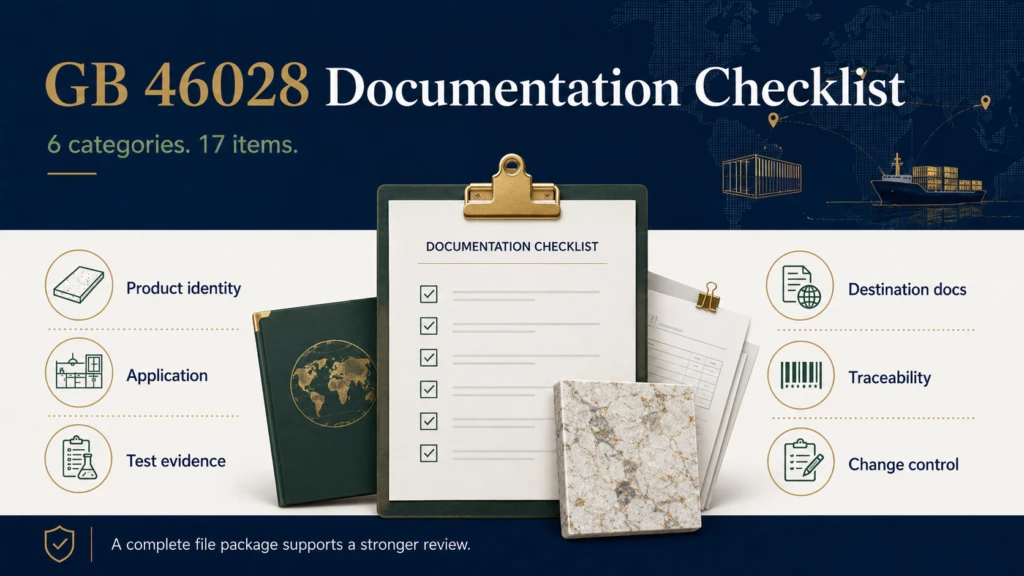
First, the table below identifies the nearest commonly discussed methods. It is a document-navigation tool, not an equivalence certificate. “Possible use” describes how an importer may use GB data without representing it as another method’s result.
| Property | China | Europe | United States | Possible Use of GB Data |
|---|---|---|---|---|
| Apparent density and water absorption | GB/T 35160.1-2017 Synthetic stone | EN 14617-1 Agglomerated stone | ASTM C97/C97M Dimension stone | Useful for supplier screening and same-method production trending. Do not claim that a GB result is an EN or ASTM result without testing or a validated correlation for the product. |
| Flexural strength | GB/T 35160.2-2017 Synthetic stone | EN 14617-2 Agglomerated stone; current edition to be confirmed | ASTM C880/C880M Dimension stone; quarter-point loading | Use for preliminary material comparison only. Do not compare a GB value directly with an EN or ASTM acceptance threshold unless a qualified technical review establishes an accepted relationship. |
| Compressive strength | GB/T 35160.3-2017 Synthetic stone | EN 14617-15 Agglomerated stone | ASTM C170/C170M Dimension stone | Use within the GB method for supplier or batch comparison. Specimen geometry, preparation and conditioning must be reviewed before any cross-method interpretation. |
| Abrasion resistance | GB/T 35160.4-2017 Synthetic stone | EN 14617-4 Agglomerated stone | ASTM C241/C241M Dimension stone subjected to foot traffic | Treat the results as method-specific. If abrasion performance is an acceptance requirement, test to the exact specified method rather than converting one result into another. |
| Impact resistance | GB/T 35160.6-2017 Synthetic stone | EN 14617-9 Agglomerated stone | No single ASTM engineered-stone counterpart should be assumed. | Use within the same method for product characterization. Ask the laboratory to identify a project-accepted U.S. method if impact resistance is contractually required. |
| Radionuclide indices | GB 6566 where applicable GB 46028’s classification table should not be generalized beyond its stated material scope | No direct EN 14617 equivalent to the Chinese index classification. | No direct ASTM engineered-quartz equivalent identified. | Retain as China-specific evidence when applicable. Do not use it as proof of crystalline-silica content, food-contact suitability or general product safety in another market. |
First, method editions can change. Confirm the current designation and edition with the issuing standards body, laboratory, destination-market requirement and customer specification before testing or contracting.
3. What Was Wrong with Simple “High / Medium / Low Comparability” Ratings?
First, a single comparability score can create false confidence. It hides several separate questions:
- Does each method cover the same product type?
- Are specimen dimensions and thicknesses the same?
- Are samples dried, water-saturated, conditioned or tested after ageing?
- Is loading applied in the same configuration and direction?
- Are the result units and calculation basis the same?
- Does the destination market accept the method for the intended use?
First, without a product-specific correlation study or an authority-approved conversion, exact claims such as “the methods differ by 10–20%” or “results are normally within 1–3%” should not be used. The difference may be smaller, larger or inconsistent depending on the product and procedure.
Never convert the label: A result of 45 MPa tested to GB/T 35160.2 remains “45 MPa tested to GB/T 35160.2.” It does not become an EN 14617-2 or ASTM C880/C880M result because the property name and unit look similar.
4. When GB Test Data Is Useful
4.1 Supplier Prequalification
First, a complete GB report can show that the supplier has identified the product, worked with a laboratory and produced measurable data. That is a stronger prequalification signal than a sales claim with no report. Specifically, it is still not final product approval for another market.
4.2 Same-Method Trend Monitoring
First, repeated reports using the same method, specimen preparation and laboratory can help identify process drift. Compare like with like: the same product family, thickness, finish. Specifically, test method and conditioning. A change in the result may trigger investigation even when a separate EN or ASTM method is used for formal approval.
4.3 Selecting Products for Destination-Market Testing
First, gB data can help prioritize which supplier or SKU should proceed to more expensive destination-market testing. It reduces blind selection; it does not remove the need for the specified test.
4.4 Supplementary Technical Files
First, where permitted, a buyer may retain GB reports as clearly labelled supplementary characterization data. The file should state the method used, the product tested and the limitation that the result is not a substitute for another required method.
5. When GB Data Is Not Enough
5.1 A Law, Harmonized Technical Specification or Contract Names the Method
If the applicable requirement specifies an EN, ASTM, ISO or other method. Use that method unless the responsible authority or customer formally accepts an alternative. A technically similar GB report is not automatic evidence of conformity.
5.2 The Report Does Not Match the Product
First, a report for a 20 mm polished light-colour slab should not automatically validate a 12 mm dark formulation, a backed panel or a product made at another facility. Ask the supplier to define the product family and justify report coverage.
5.3 The Product Scope Is Different
First, an ASTM dimension-stone method may be requested by a U.S. project. But that does not mean ASTM created it as a direct engineered-quartz equivalent. Specifically, the specification writer, laboratory and buyer should confirm its suitability.
5.4 The Requirement Concerns a Different Hazard
First, gB 46028 physical-property or radionuclide evidence does not establish crystalline-silica content. Airborne exposure control, fire performance, food-contact suitability or chemical emissions. Specifically, those require separate evidence.
6. EU and US Procurement Boundaries
6.1 European Union
First, under the EU Construction Products Regulation framework, products covered by an applicable harmonized technical specification or European Technical Assessment follow that route for declared performance and CE marking. A GB report may be supplementary information. But it does not replace the applicable harmonized assessment method or technical assessment.
First, do not assume that every quartz slab or countertop has the same CPR route. Product form, intended use and the applicable harmonized product standard or assessment route must be confirmed. Also note that Regulation (EU) 2024/3110 is the new CPR framework and applies through a transition with existing technical specifications and product-family measures.
6.2 United States
First, there is no single federal “ASTM quartz certificate” that universally approves engineered quartz for every use. ASTM methods may be incorporated into customer specifications, building requirements, laboratory programs or industry documents. Specifically, the purchase order should identify the exact method, edition, specimen condition and acceptance value rather than writing only “ASTM compliant.”
7. A Six-Step Cross-Standard Review Process
| Step | Action | Decision Output |
|---|---|---|
| 1 | Identify the legal manufacturer, factory, product classification, exact SKU and intended use. | A defined product and application—not a generic “quartz slab.” |
| 2 | List every requirement from the destination market, project, customer and contract. | A requirement matrix with exact standard numbers, editions and acceptance criteria. |
| 3 | Inventory the supplier’s GB reports and confirm each report’s method, edition, sample and laboratory. | A verified evidence list showing what the supplier actually tested. |
| 4 | Classify each GB report as required Chinese evidence, useful supplementary data, or not relevant to the destination requirement. | No relabelling or silent substitution. |
| 5 | Commission missing testing to the exact required method on a representative product and document sample selection. | Formal evidence aligned with the market or contract. |
| 6 | Link approved reports to production lots and use consistent methods for ongoing QA monitoring. | A continuing evidence chain from type testing to the shipped batch. |
8. Cross-Standard Report Red Flags
- The report title says only “international standard test” without a designation and edition.
- A supplier copies a GB result into an EN or ASTM specification table and marks it “pass.”
- An ASTM dimension-stone method is described as a universal engineered-quartz certification.
- A one-page summary is supplied without specimen details, test conditions or laboratory pages.
- Different colours, thicknesses, finishes or factories are grouped under one report without a technical coverage statement.
- The report uses a withdrawn or superseded method without explaining why that edition is contractually applicable.
- A radionuclide, physical-property or chemical-composition report is presented as evidence for an unrelated hazard.
See how the classifications connect in our silica-free vs low-silica classification guide before comparing test data across markets.
9. International Standardization Is Developing—but Do Not Assume Convergence
First, iSO/TC 328 was created in 2020 to develop definitions, requirements and test methods for engineered stone. ISO 19947:2026, Engineered stone — Vocabulary, was published in March 2026. That is a useful step toward common terminology.
First, it does not mean that existing GB, EN and ASTM performance tests are already interchangeable. Until an accepted international method, correlation study or authority-approved route applies to the product. Specifically, buyers should continue to specify and report the exact method used.
FAQ:
First, no, not by default. It may support supplier screening or characterization, but it remains a GB/T result. Specifically, use EN 14617-2 when the applicable requirement calls for that method unless the responsible customer or authority formally accepts another route.
First, aSTM C880/C880M is scoped to dimension stone. Some projects or laboratories may specify or accept it for engineered quartz, but that use should be explicit. Specifically, do not describe it as an automatic engineered-stone equivalent.
First, no. A larger numerical margin may support the decision to test, but it does not prove a pass under another method. Specimen geometry, conditioning, loading and calculation can affect the result.
First, they may be retained as clearly labelled supplementary data where relevant. But they do not replace the applicable harmonized technical specification, European Technical Assessment or required declaration route.
First, no. GB/T 35160 is a test-method series. The applicable GB 46028 requirement depends on product category and application. Specifically, additional properties may also be requested under another product standard, project specification or buyer requirement.
No. Crystalline-silica composition and workplace exposure are separate topics. A physical-property or radionuclide report cannot be used as silica-free evidence.
Related Reading
- GB 46028-2025: A Practical Compliance Guide for Quartz Importers — Scope, application boundaries and supplier evidence
- GB 46028-2025 Documentation Checklist for Quartz Importers — A 17-point supplier verification checklist
- Silica-Free Quartz Procurement Guide — Composition evidence and supplier verification
- Quartz Slab Sizes, Dimensions & Thickness Options — Product-format and thickness specifications
- Quartz Slab QC & Packing Guide — Connecting technical evidence to the shipped batch
How this article was prepared:
- Chinese standards: GB 46028-2025 status and the GB/T 35160.1, .2 and .3 titles and status were checked against China’s official national-standard platform. The remaining GB/T 35160 parts were treated as separate test methods rather than automatically required GB 46028 evidence.
- ASTM methods: Current ASTM scope pages were reviewed for C97/C97M, C170/C170M, C241/C241M and C880/C880M. These documents are dimension-stone methods; ASTM C880/C880M specifies quarter-point loading.
- European methods: Current BSI records were reviewed for EN 14617-1, EN 14617-2, EN 14617-4, EN 14617-9 and EN 14617-15. Edition status should be reconfirmed before contracting or testing.
- EU regulatory context: The European Commission’s CPR guidance and Regulation (EU) 2024/3110 were used to describe the role of harmonized technical specifications, European Technical Assessments, declared performance and CE marking without assuming one route for every quartz product.
- ISO development: ISO/TC 328 and ISO 19947:2026 were checked through ISO’s official records. Publication of a vocabulary standard does not establish equivalence among existing test methods.
- Limitations: This article provides a procurement framework, not a legal determination, engineering approval or method-correlation study. Confirm the exact product standard, test method, edition and acceptance criteria with the relevant authority, customer, laboratory and contract.
- Last standard-reference check: August 3, 2026.
Send the product specification, intended market and available GB, ASTM or EN reports for an order-specific gap review.