Prepared by: AsiaQuartz Editorial Team
Technical review by: AsiaQuartz Product, QC & Supply Chain Team
Last updated: July 2026
A printed quartz pattern should not be selected from a catalogue image alone. The same large-vein design can work well on a reception desk and create severe repetition or seam problems across a long wall. A subtle pattern may suit a multi-unit programme but disappear in a large lobby viewed from twenty metres away.
The procurement sequence should therefore be: application first, performance second, visual direction third, SKU last. This guide provides a project-based framework for narrowing pattern options before sampling and production approval.
Important construction note
“Printed quartz” can describe different decorative routes. Some products have a surface-applied decorative layer; some use deeper transfer or penetration processes; some combine printing with through-body effects. Do not assume that the vein continues through a cut edge, that two slabs can be book-matched, or that the printed face is suitable for every fabrication and wear condition. Confirm the exact SKU construction.
Step 1: Pass the Application-Suitability Gate
Pattern selection starts only after the surface is confirmed suitable for the application. Record the following before comparing designs:
- Orientation: horizontal worktop, vertical wall, furniture panel, vanity, reception desk or another use
- Environment: indoor dry area, wet area, direct sunlight, heat exposure, food contact, chemicals or heavy wear
- Fabrication: straight cuts, mitres, waterfall ends, sink cut-outs, curved edges, grooves or complex CNC work
- Viewing distance: close-up residential viewing or long-distance commercial viewing
- Layout: single slab, repeated modules, long runs, adjacent slabs or replacement phases
- Project controls: slip, fire, hygiene, VOC, structural support or other code/specification requirements
A pattern recommendation is incomplete if the supplier has not first checked whether the product is rated and tested for the intended use. In particular, do not specify resin-bound printed quartz as flooring, exterior cladding, a structural element or a high-heat cooking surface unless the exact product system has appropriate evidence and written manufacturer approval.
Step 2: Match Project Type to Pattern Behaviour
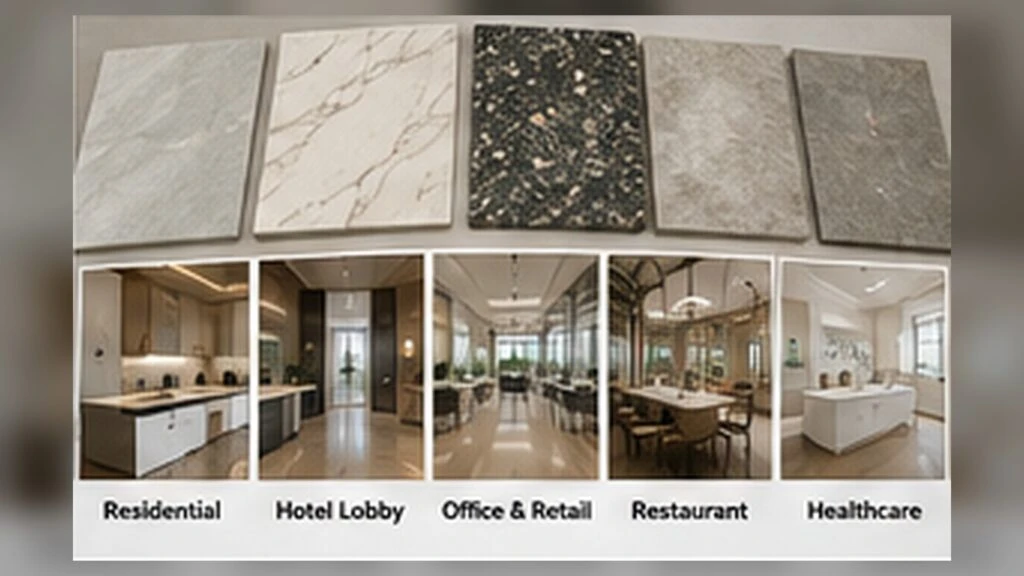
| Project Type | Useful Pattern Directions | Main Risks to Check | Approval Evidence |
|---|---|---|---|
| Luxury residential and premium multi-unit | Calacatta, Statuario, Taj Mahal, onyx or other marble-inspired directions | Vein scale, seam location, repetition, edge continuity, warm/cool colour shift | Large sample, full-slab images, layout simulation and fabricated edge trial |
| Hotel lobbies and large commercial spaces | Warm neutrals, low-contrast stone, terrazzo-look and controlled large-scale movement | Visual noise at distance, repeating modules, long-wall transitions and replacement matching | Elevation mock-up, repeated-slab sequence and viewing-distance review |
| Offices and retail interiors | Solid, cement-look, low-contrast mineral and brand-aligned custom colour | Glare, fingerprints, colour under store lighting, abrasion and chemical exposure | Lighting mock-up, finish sample and project-specific cleanability test |
| Restaurants and cafés | Warm limestone, travertine, subtle mottling and low-contrast stone directions | Food stains, cleaners, heat, scratches, visible joints and repair appearance | Stain/chemical trial, heat-use instructions and fabricated counter mock-up |
| Healthcare, laboratories and clean environments | Solid or restrained low-contrast designs selected with the facility team | Disinfectant compatibility, seams, coved details, visual inspection and maintenance protocol | Facility-approved cleaner test, seam mock-up and infection-control review |
Luxury Residential and Premium Multi-Unit
Large-vein marble looks are effective when the project needs a strong focal surface. The risk is not the pattern family itself; it is the relationship between vein scale, slab size and fabrication layout. A vein that looks balanced on a slab photo may be cut away by a sink opening or produce an awkward stop at a mitred waterfall end.
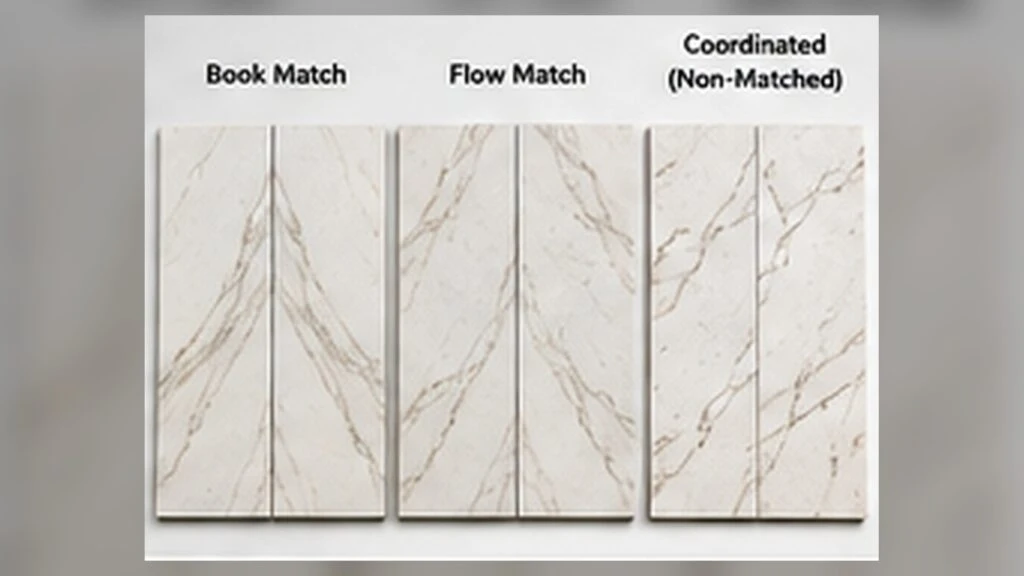
Before approval, obtain a full-slab image with dimensions, mark the intended cut plan, and decide whether the project requires book-matched pairs, flowing visual continuity or simply coordinated slabs. Treat book-matching as a product capability that must be confirmed, not a default feature.
Hotel Lobbies and Large Commercial Spaces
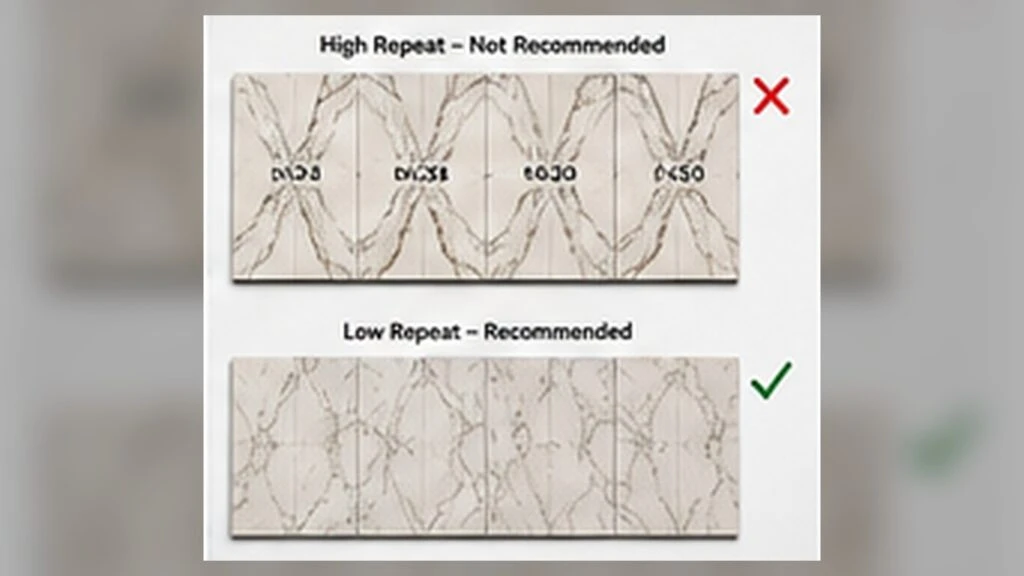
Large spaces are viewed from multiple distances. Very high-contrast veins can become visually busy across repeated panels, while fine detail may disappear from the main viewing point. Low-contrast stone, earth tones and terrazzo-look patterns are often easier to repeat because they do not depend on one continuous directional vein.
Ask the supplier to show the proposed number of print variants or slab images available for the actual product. Then simulate the planned sequence across the elevation. The objective is not random variation; it is controlled variety without obvious cycling.
Offices and Retail Interiors
Solids and cement-look designs can support minimalist interiors and brand displays, but surface finish matters as much as colour. A polished finish can create reflections under track lighting; a matte or textured finish may reduce glare but must still meet the project’s cleanability and wear requirements.
For brand colours, approve the colour under defined lighting and on the actual substrate/finish. Printed colour can be adjusted, but it should not be described as an exact Pantone or RAL match unless the contract defines the measurement method, tolerance and reference standard.
Restaurants and Cafés
Warm stone and restrained movement usually age better than a highly directional feature pattern on heavily used counters. However, a visual direction does not prove commercial durability. Test the exact finish against the project’s coffee, wine, oil, citrus, cleaners and heat-use conditions, and confirm that the care instructions are realistic for staff.
Healthcare, Laboratories and Clean Environments
Colour does not make a surface hygienic. Cleanability depends on the material, finish, seams, edge/cove details, installation and cleaning protocol. White or light grey may support visual inspection in some facilities, but the facility’s infection-control and maintenance teams should decide whether a pattern is acceptable.
Do not rely on generic “antimicrobial” marketing. Request product-specific cleanability and chemical-resistance evidence for the disinfectants actually used.
Step 3: Control Pattern Scale, Repetition and Slab Sequencing
Printed surfaces require a different definition of consistency from solid-colour slabs. The buyer should approve both the base colour and the pattern behaviour.
| Control Item | What to Agree | Evidence Before Production |
|---|---|---|
| Base colour | Reference sample, measurement method, instrument/geometry, illuminant, tolerance and visual acceptance | Signed sample and colour-reading record where required |
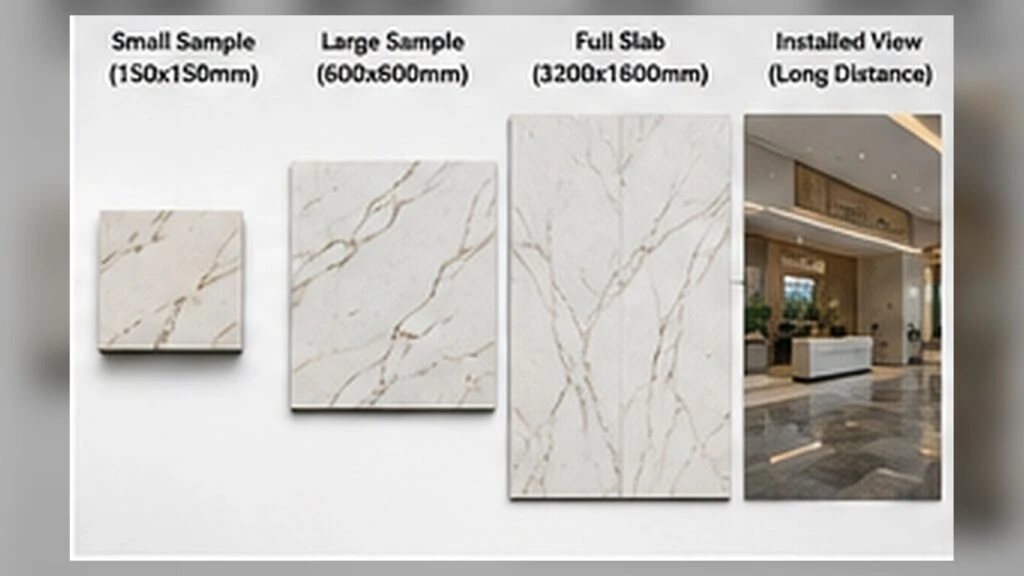
| Print scale | Vein/chip size relative to full slab and final cut pieces | Full-scale digital layout plus large physical sample |
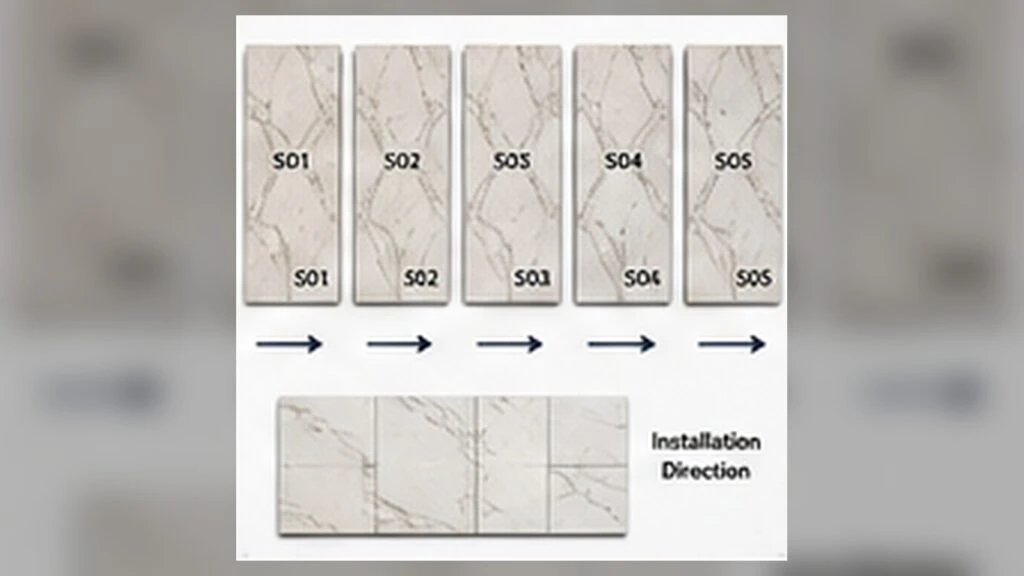
| Repeat interval | Number and identity of pattern variants; acceptable repeat frequency | Variant set or representative full-slab images |
| Direction | Top/bottom, left/right, rotation rules and slab labelling | Sequencing diagram and label convention |
| Book/flow matching | Which slabs or pairs are designed to coordinate and what seam result is realistic | Pair images or dry-layout mock-up |
| Replenishment | Retained sample, print file, formulation version and replacement tolerance | Retention and change-control plan |
A Delta E target can be useful for the base colour, but “imperceptible” is not a universal threshold. Perception changes with the colour-difference formula, gloss, texture, lighting, viewing distance and observer. State the measurement conditions and pair instrument readings with visual approval.
Step 4: Use the Right Approval Sample
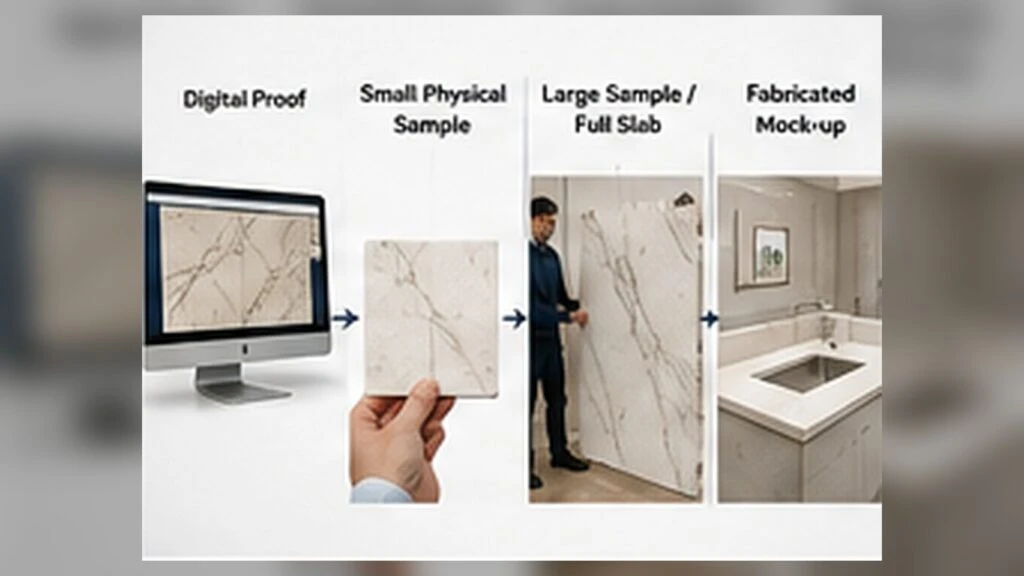
Digital proof
Use a rendering or print proof to reject unsuitable directions and confirm approximate scale, orientation and layout. It cannot prove true colour, gloss, texture, edge appearance or decorative-layer durability.
Small physical sample
A small sample confirms substrate colour, finish and local detail. It may be misleading for large veins or large terrazzo elements because it shows only a small crop of the pattern.
Large sample or full-slab review
Use a large panel, full-slab image or physical slab review for high-value projects, long visible runs and patterns with strong direction. Include a scale reference and identify the exact print-file and formulation version.
Fabricated mock-up
For mitres, waterfalls, sink cut-outs, reception desks and other focal details, approve a fabricated mock-up. A face sample cannot show what happens at the edge, seam or repair point.
Sampling time and cost are order-specific. Ask for a written schedule covering artwork, proof, physical sample, revisions, fabrication trial and final approval. Do not build the project programme around generic “3–5 day” or “10–14 day” assumptions.
Step 5: Define Custom Pattern Development Correctly
“Custom pattern” can mean several different services. AsiaQuartz can review the following routes subject to product, technical and commercial feasibility:
- Existing design with controlled colour adjustment: alter the base tone or vein colour while preserving the approved pattern structure.
- Reference-led development: create a new visual direction from legally usable reference material without promising an exact copy of a natural slab or another supplier’s protected design.
- Bespoke artwork: develop an original pattern from an agreed brief, palette, scale, repeat strategy and application map.
Before artwork starts, agree who owns the source image and final print file, whether the design is exclusive, permitted markets, revision rounds, colour references, slab orientation, repeat rules and what happens if the final physical result differs from the screen proof.
MOQ, slab dimensions, finishes, sample cost, development charge and production lead time should be stated in the product-specific quotation. They should not be treated as permanent factory-wide numbers.
Seven-Step Printed Quartz Selection Workflow
- Map the application: list each surface, orientation, exposure and fabrication detail.
- Set performance gates: identify heat, chemicals, wear, hygiene, fire, slip or code requirements.
- Choose a pattern family: narrow to two or three visual directions that fit the project.
- Review full-slab behaviour: scale, repetition, direction, seam and replacement strategy.
- Approve physical evidence: finish sample, large pattern sample and fabricated mock-up where needed.
- Write production controls: reference sample, colour method, print-file version, variant set, labels, batch and change control.
- Approve shipment evidence: full-slab photos, sequencing, QC records, packing labels and retained references.
FAQ
Send a legally usable high-resolution reference, project type, applications, lighting conditions, preferred scale and direction, and two or three non-negotiables. Also state whether you need a colour adjustment, a similar visual direction or an original exclusive design.
There is no universal number for every colour and finish. Use a project-agreed target for the base colour, define the colour-difference formula and measurement conditions, and retain visual approval under controlled lighting. Pattern elements are intentionally variable and should be controlled separately.
Yes, but each pattern may require separate samples, production runs, labels and lead-time controls. Build a finish schedule that identifies which pattern, orientation, finish and batch applies to each location.
No. Printing can reproduce colour and two-dimensional visual character, but natural stone may have depth, translucency, mineral reflection and variation that a resin-bound printed surface does not reproduce exactly. Approve the printed product on its own merits.
The purchase agreement should define the approved reference, measurable tolerances, visual acceptance process, print-file and formulation version, inspection stage and remedy. A buyer preference change after approval is different from a documented production deviation.
Related Guides
- Printed Quartz Knowledge Hub
- Printed Quartz Slab Collection
- Quartz Product Specifications
- Cut-to-Size Project Ordering
- How to Import Quartz Slabs from China
Need help narrowing patterns for a project?
Send the project type, application list, approximate quantity, visual references and delivery market. AsiaQuartz can review pattern direction, sampling requirements, fabrication risks and supply controls before quotation.