
Prepared by: AsiaQuartz Editorial Team
Technical review by: AsiaQuartz Product, QC & Supply Chain Team
Last updated: July 2026
Standard quartz QC is straightforward. You check dimensions, thickness, surface polish, packaging, and maybe a few slab samples for color consistency. Most factories and third-party inspectors have a well-rehearsed checklist for this.
A silica-free decorative quartz order is different. You’re asking two things at once — that the silica content meets a compliance threshold, and that the decorative layer looks right and will stay that way. The QC process needs to cover both, and the tests aren’t always the same ones you’d run on a standard printed quartz order.
This checklist covers the additional controls that matter when a decorative surface is sold with a low-silica or “silica-free” claim. Use it alongside your standard quartz slab QC checklist — not instead of it. For supplier selection, technical routes and procurement planning, see our Silica-Free Decorative Quartz Buyer Guide.
Important scope note: “Silica-free” is a commercial claim, not a universal certification category. In Australia, the engineered-stone ban applies to covered benchtops, panels and slabs that contain at least 1% crystalline silica by weight and meet the rest of the legal definition. A product-specific laboratory report, formulation identity and traceability chain are needed before using a compliance claim. Lower silica content also does not eliminate fabrication dust or the need for wet processing, extraction, PPE, training and other workplace controls.
Checkpoint 1: Product Identity and Crystalline-Silica Verification
What to check:
- The report identifies the exact product, formulation version and decorative treatment being supplied.
- The sampled material is representative of the current production route. Where the decorative layer is a separate coating or treatment, agree with the laboratory whether the substrate, the finished composite, or both should be analysed.
- The report states the analytical method, sample-preparation procedure, result, detection or reporting limit, test date and laboratory identity.
- The laboratory’s accreditation scope is appropriate for the method used, where accredited testing is required by the buyer, project or jurisdiction.
- The product/SKU, batch or lot reference on the report can be linked to the production and shipping records.
- For an Australian compliance claim, the result and reporting limit support a conclusion below 1% crystalline silica by weight. Results close to the threshold require additional scrutiny of reporting limits, measurement uncertainty and sample representativeness.
Why this matters:
A report for a plain substrate, an older formulation or a different decorative product does not establish the status of the goods being shipped. At the same time, requiring one generic “finished slab XRD” test without defining the sample can create false confidence: a thin decorative layer may be diluted during composite sample preparation, while a coating-only sample may not represent the whole slab. Moreover, the correct testing plan should be agreed with a competent laboratory and tied to the actual product construction, rather than copied from an unrelated project.
Release gate: Do not release a regulated-market shipment on the basis of an unrelated, undated or untraceable “zero-silica” certificate. A fixed six- or twelve-month validity period is not universal. The report must match the current formulation and production route, and retesting should be triggered by changes to fillers, pigments, primers, coatings, suppliers, production lines or process conditions.
Checkpoint 2: Decorative-Layer Resistance to Separation
What to check:
- The test is performed on the actual decorative system and the actual low-silica substrate being supplied.
- The report identifies coating or print-layer thickness, surface preparation, curing conditions, specimen conditioning and failure location.
- The selected method is suitable for the coating thickness, texture and substrate. ISO 2409 can be used as an empirical pass/fail or classification screen when applicable, but it is not a quantitative measurement of adhesion.
- ASTM D3359 should not be used automatically for stone or mineral substrates: it was developed for relatively ductile coating films on metallic substrates. Any use outside that scope should be justified and agreed in writing.
- Acceptance criteria are agreed before production and linked to a validated reference product, project specification or laboratory recommendation.
Why this matters:
A printing or coating process that performs well on conventional quartz may behave differently on glass-based, mineral-based or other alternative substrates. Surface preparation, primer selection, curing and thermal history can all change resistance to separation. However, the purpose of this checkpoint is not to collect a familiar standard number; it is to confirm that the test method and acceptance criteria are technically suitable for the actual product combination.
If a quantitative bond-strength value is required, ask the laboratory to recommend an appropriate pull-off or other method validated for the coating/substrate system. Do not convert an ISO 2409 class or ASTM tape rating into a bond-strength value.
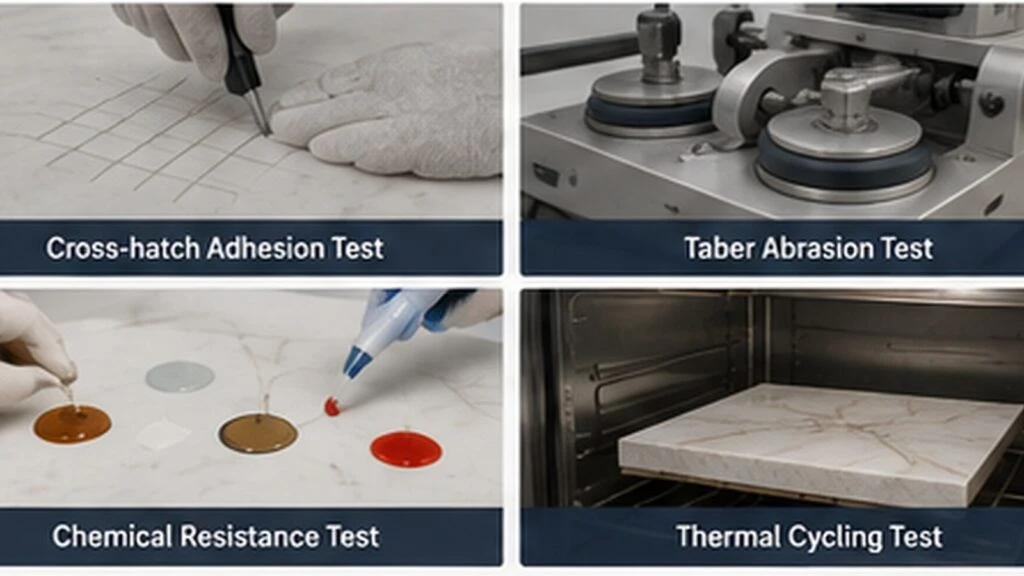
Checkpoint 3: Wear, Chemical and Thermal Durability of the Decorative Surface
What to check:
- Abrasion or wear testing is performed on the finished decorative surface and current substrate.
- The report states the exact method, abrasive wheel or medium, load, number of cycles, conditioning, endpoint and result.
- Pass/fail limits are defined for the intended application and compared with an approved control or written product specification.
- Chemical-resistance checks cover the cleaners, stains and household substances relevant to the intended market.
- Where the product may experience heat or temperature cycling, the agreed test examines visible colour change, blistering, cracking, separation or loss of gloss after exposure.
Why this matters:
“Taber tested” is not a meaningful acceptance statement unless the wheel, load, cycles and endpoint are specified. Different procedures can produce very different results. In fact, the same applies to chemical and thermal checks: the buyer and supplier need a written method and acceptance limit that reflect the intended use. These tests should be treated as product-qualification and change-control evidence, while routine batch QC confirms that production remains within the approved process window.
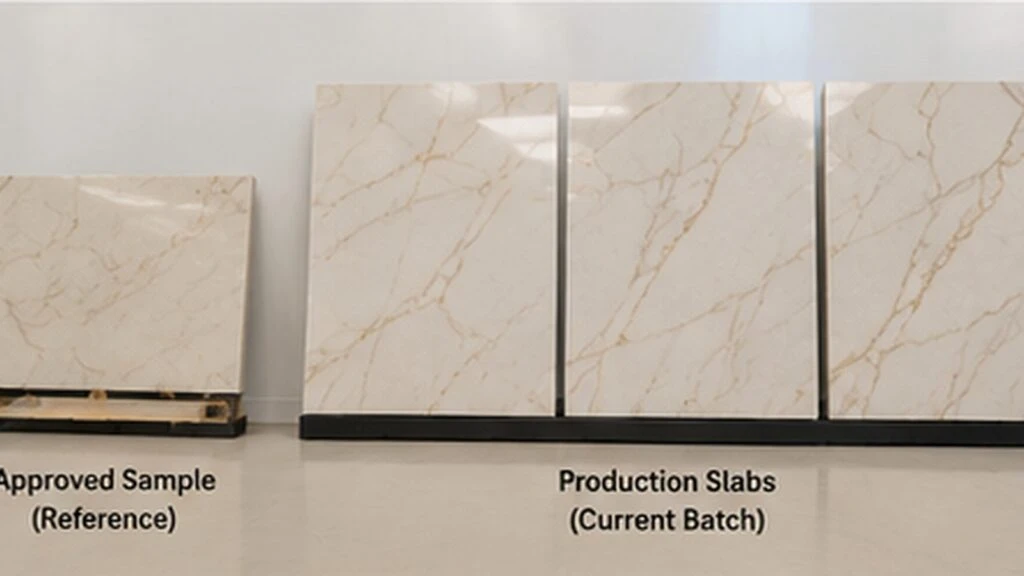
Checkpoint 4: Color and Pattern Consistency — Batch vs. Approved Reference
What to check:
- Production slabs are compared with the approved reference made on the same substrate and decorative system.
- Review takes place under defined lighting, ideally including controlled daylight-equivalent lighting and the relevant warm interior lighting.
- Photos identify the batch, slab number, date and lighting conditions; camera settings and white balance should be controlled when photos are used as evidence.
- Base tone, vein direction, pattern scale, density, contrast, repetition and visible print or transfer defects are checked against written acceptance rules.
- Where colour tolerance is commercially critical, agree an instrument, measurement geometry, reference points and Delta E limit before production. Instrument readings should support—not replace—full-slab visual review.
Why this matters:
Alternative substrates can change opacity, undertone and colour rendering. A pattern approved on conventional quartz is not an approval for the same file printed on a different body. Batch evidence must compare like with like: the actual decorative system on the actual substrate.
A small approved sample also cannot demonstrate full-slab composition, pattern repetition or vein placement. The QC plan should therefore include representative full-slab images and a defined number of physical slab checks.
Checkpoint 5: Packaging and Decorative-Surface Protection
What to check:
- Interleaving material is clean, non-abrasive, chemically compatible and thick enough to prevent surface-to-surface contact.
- Protective film, where used, has been validated not to stain, imprint or leave adhesive residue on the decorative finish.
- Edges and corners are protected, crates or A-frames are adequately braced, and straps do not create point loads on the slab faces.
- Crate, product, batch and slab identification match the QC records, packing list and test-document chain.
- Packing photos record the slab orientation, separators, bracing, labels and container loading before doors are closed.
Why this matters:
Contact marks, residue and scuffs may be more visually conspicuous on directional or high-contrast decorative designs, even when the underlying material is not intrinsically more fragile. Packing therefore needs to be qualified for the actual finish, route, crate configuration and handling method rather than copied from a generic solid-colour program.
Checkpoint 6: Formulation Change Control and Batch Traceability
What to check:
- The supplier records the formulation version, filler and pigment lots, primer or coating lot, print file/version, production line and batch date.
- Every crate and shipment document can be traced back to the inspected production batch.
- The purchase order requires advance notification and re-approval before changes to raw materials, decorative chemistry, substrate supplier, print file, line or curing process.
- Retained samples and QC records are stored for an agreed period to support claims, replenishment and repeat orders.
- Any non-conformance, rework or replacement slabs are identified separately and re-inspected before release.
Why this matters:
A product can pass qualification and still fail later if the supplier changes a filler, coating, pigment, line or curing condition without revalidation. Change control connects laboratory evidence to the actual batch. Without that connection, the buyer has a certificate for a product history—not proof for the shipment.
Pair the QC checks with our silica-free surface QC and documentation review guide to keep claims, samples and documents on one product reference.
QC Inspection Checklist Summary
Print this checklist or convert it into your inspection form. Define the responsible party, evidence required and acceptance criteria before production starts.
| # | Checkpoint | What to Verify | Evidence / Method | Pass? | Ref |
|---|---|---|---|---|---|
| 1 | Product identity and crystalline silica | Current formulation and decorative treatment identified; representative sample; method, reporting limit and traceability support the stated claim | Product-specific lab report + sample chain | ☐ | |
| 2 | Resistance to decorative-layer separation | Method suitable for thickness, texture and substrate; specimen and failure mode identified; agreed acceptance criteria met | Validated screening or bond test | ☐ | |
| 3 | Wear, chemical and thermal durability | Exact parameters and endpoints stated; results meet application-specific written limits | Qualification report / agreed routine check | ☐ | |
| 4 | Colour and pattern batch consistency | Same-substrate reference, controlled lighting, full-slab review, slab and batch identification | Visual record + optional colour measurement | ☐ | |
| 5 | Packaging and surface protection | Compatible separators and film, edge protection, bracing, labels and loading photos | Packing inspection and photo record | ☐ | |
| 6 | Change control and traceability | Formulation, decorative materials, print version, line, batch and crates linked; changes notified and re-approved | Batch record + change log | ☐ | |
| 7 | Standard quartz slab QC | Dimensions, thickness, flatness, edges, surface finish, defects, quantity and packing | Order-specific standard QC plan | ☐ |
Row 7 is not a placeholder. This article covers the controls added by the decorative low-silica combination. It does not replace dimensional, visual, quantity and packing inspection. Use our Quartz Slab QC & Packing Guide as the base inspection framework.

For conventional printed quartz orders: Apply the print, colour, full-slab and packing controls that are relevant to that product, but do not reuse a low-silica compliance claim or test report. Every product route needs its own approved specification and evidence chain.
FAQ:
Use it for the applicable visual and slab-quality controls, but add product-identity, crystalline-silica verification, substrate-specific decorative-layer qualification and change control. The key question is whether the evidence is tied to the exact substrate, decorative system and batch being shipped.
Use a written sampling plan based on order size, defect criticality, supplier history and the maturity of the product route. Document and identity checks may require 100% review, while destructive laboratory tests are normally performed on representative specimens rather than on finished saleable slabs. Moreover, visual pattern and surface inspection may use an AQL plan, an increased first-order sample, or 100% review for project-critical designs. Define the plan before inspection.
Do not release the shipment under a verified low-silica or “silica-free” claim. Arrange suitable testing on a representative, traceable sample or withhold the compliance claim and shipment until the documentation gap is resolved. A supplier declaration alone is not equivalent to product-specific evidence for a regulated or contract-specified order.
No. A cross-cut result is an empirical screening or classification result under defined conditions. It does not measure bond strength and does not replace abrasion, chemical, thermal or application-specific qualification. The method also needs to be suitable for the coating thickness, texture and substrate.
They cover the additional risks created by combining a decorative treatment with a low-silica claim. Shipment release still requires standard slab QC, approved commercial specifications, quantity checks, packing and loading evidence, document review and any destination- or project-specific requirements.
Request QC Support for Your Silica-Free Order
How this article was prepared:
- Method: The QC points combine standard engineered-surface inspection practice with additional controls for product identity, decorative-layer qualification, crystalline-silica evidence and change control. ISO 2409 is referenced as an empirical cross-cut classification method where applicable; ASTM D3359 is noted with its metallic-substrate scope limitation. Test selection and acceptance criteria must be validated for the actual product construction.
- Product and material knowledge: Observations about substrate-dependent print adhesion, color rendering differences between silica-based and silica-free bodies, and batch consistency challenges are based on AsiaQuartz supply coordination experience and common industry understanding of decorative engineered stone production.
- Regulatory context: Under the Australian model WHS framework, covered engineered-stone benchtops, panels and slabs containing at least 1% crystalline silica by weight are within the banned engineered-stone definition when the other legal criteria are also met. Testing, sampling and documentary requirements should be confirmed for the actual product and jurisdiction.
- Limitations: This checklist is a practical inspection guide, not a legal compliance certification. Specific AQL levels, sample sizes, and pass/fail criteria should be determined based on the buyer’s commercial requirements, destination market regulations, and supplier history. XRD test methodology, laboratory accreditation requirements, and regulatory thresholds may vary by jurisdiction. Test methods referenced are examples; the specific standard version and test parameters should be confirmed with the testing laboratory. This article does not constitute QC certification, product warranty, or legal advice.
About this article:
This article was prepared using current public information from government agencies, industry organizations, research institutions, trade publications, and other cited sources. AsiaQuartz-specific product and supply information was reviewed against the AsiaQuartz Single Source of Truth (SSOT). In addition, external sources are used for market context and do not independently verify AsiaQuartz capabilities. Research and drafting tools may assist with source collection, structure, and language review. Final claims, sources, and AsiaQuartz-specific information are reviewed before publication.
Information status:
Based on publicly available information reviewed through July 30, 2026. QC methodologies and test standards described are illustrative of common industry practice. Specifically, actual inspection criteria, AQL levels, sample sizes, and pass/fail thresholds are order-specific and should be determined between buyer and supplier. Regulatory thresholds (silica content) are subject to change. A small sample does not represent every characteristic of a full slab or every permitted production variation. Actual specifications should be confirmed through product-specific technical files and written order documents.
Sources and References
- ISO 2409:2020, Paints and varnishes — Cross-cut test
- ASTM D3359-23, Standard Test Methods for Rating Adhesion by Tape Test
- Safe Work Australia — Engineered stone ban
- AsiaQuartz SSOT, v1.1, last reviewed July 2026
- AsiaQuartz, “How to Source Decorative, Marble-Look Quartz That’s Also Silica-Free,” July 30, 2026
- AsiaQuartz, “Quartz Slab QC & Packing Guide for Importers”
Continue Reading
- Silica-Free Decorative Quartz: A Buyer’s Guide to Marble-Look Surfaces — The full buyer’s guide this checklist is built from: supplier qualification, technical routes and procurement planning.
- Quartz Slab QC & Packing Guide for Importers — The standard QC framework all quartz orders should follow — dimensions, thickness, polish, flatness, and packaging.
- Silica-Free Quartz Procurement: What B2B Buyers Should Know Before Sourcing — Supplier verification, XRD documentation, and the silica-free procurement framework.
- What Is Printed Quartz? A B2B Guide to Benefits, Limitations, QC, and Sourcing — How printed quartz works and what buyers should understand before ordering printed slabs.
- Need the base inspection framework? Use the Quartz Slab QC & Packing Guide for Importers.
- Ready to discuss your order? Request QC Support →