Prepared by: AsiaQuartz Editorial Team
Technical review by: AsiaQuartz Product, QC & Supply Chain Team
Last updated: July 2026
Quick answer: For a fair terrazzo vs quartz comparison, compare precast terrazzo slabs with engineered Quick answer: For a fair terrazzo vs quartz comparison, compare precast terrazzo slabs with engineered quartz slabs. Poured cement terrazzo and epoxy terrazzo flooring are different site-installed systems with different contractors, substrates, joints, curing and risk allocation. Neither material category is automatically cheaper, more sustainable, longer-lasting or silica-free. The decision should be based on the exact product, application, installation route, technical evidence and project priorities.
Most material comparisons fail because “terrazzo” is treated as one product. A precast terrazzo slab ordered from a factory is not procured or installed in the same way as a poured terrazzo floor. Mixing those routes allows one side of the comparison to inherit the best characteristics of several different systems.
This guide keeps the main comparison narrow: precast terrazzo slabs versus engineered quartz slabs. Poured cement and epoxy terrazzo are addressed separately where they materially change the procurement decision.Table of Contents
- Define the Product Route
- Quick Comparison
- Cost and Risk Structure
- Fabrication and Installation
- Performance Evidence
- Maintenance and Repair
- Silica and Market Classification
- Sustainability Documentation
- Application Fit
- Decision Matrix
- Buyer Checklist
- FAQ
1. Define What You Are Comparing
Precast Terrazzo Slabs and Units
Factory-produced material made with selected aggregate and a cementitious, resin or hybrid matrix, supplied as slabs, tiles, stair components, wall panels or other precast units. Product composition, thickness, size, sealing and fabrication procedures are manufacturer-specific.
Review the current AsiaQuartz artificial terrazzo slab program for available supply formats and project discussion.
Engineered Quartz Slabs
Factory-produced engineered surfaces using a mineral or recycled-filler system with a binder and pigments. Conventional quartz-rich products can contain high levels of crystalline-silica-bearing aggregate, while low-silica and zero-silica formulations also exist.
See the AsiaQuartz classic quartz slab range for conventional factory-produced slab options.
Poured Cement Terrazzo
A site-installed flooring or wall system placed over a prepared substrate, then cured, ground and finished. The installer, substrate, divider strips, joints, curing and site conditions are central to performance.
Epoxy Terrazzo Flooring
A thin-set resin-matrix terrazzo system installed on site. It is not equivalent to a factory slab and should be compared with other seamless or resinous flooring systems using the exact project specification.
For system definitions and specification boundaries, review the National Terrazzo & Mosaic Association technical specifications.
Primary comparison in this article: precast terrazzo slab versus engineered quartz slab. Poured systems are included only where the application or procurement route is different.
2. Precast Terrazzo Slab vs Engineered Quartz Slab
| Decision Area | Precast Terrazzo Slab | Engineered Quartz Slab | Evidence to Request |
|---|---|---|---|
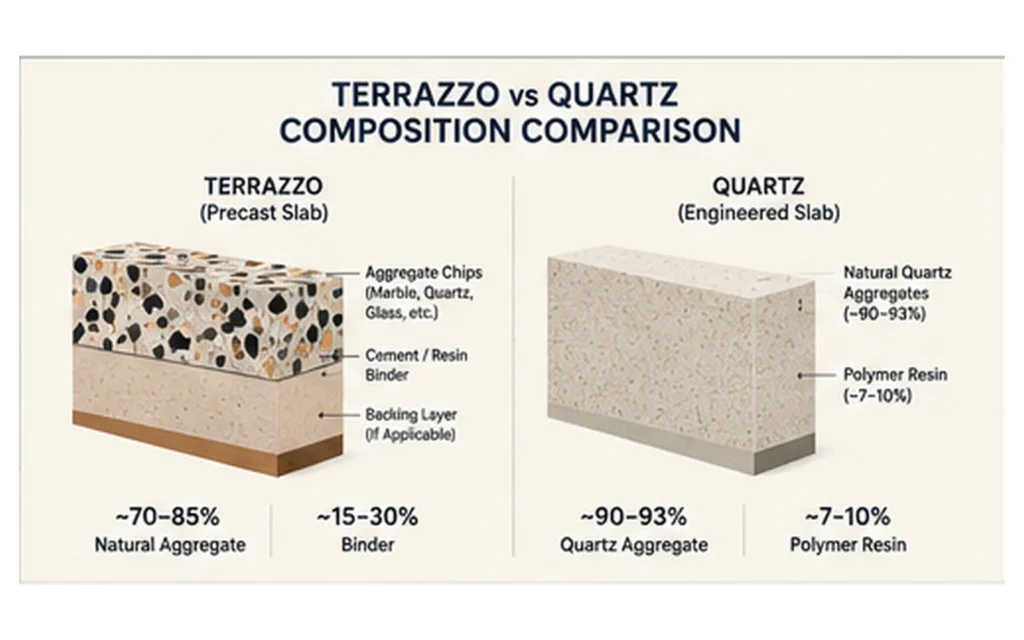
| Composition | Aggregate and matrix vary by product; may be cementitious, resin-based or hybrid. | Aggregate or filler and binder vary by formulation; may be quartz-rich, low-silica or zero-silica. | SDS, composition statement, product-specific test report and technical data sheet. |
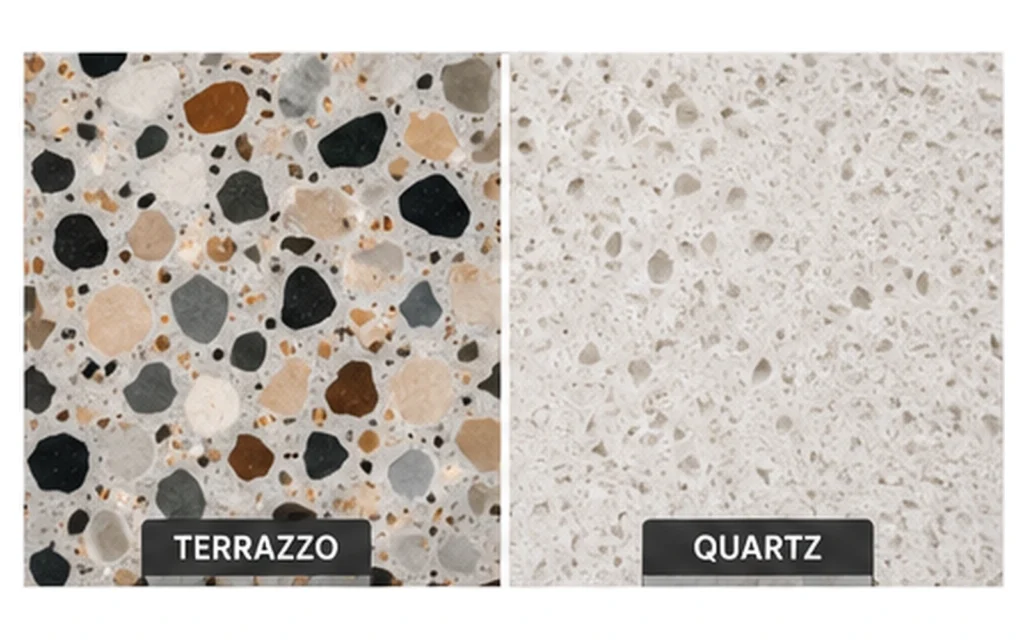
| Visual character | Aggregate size, type and distribution create natural or intentional variation. | Often offers more controlled repeatability, but veined and printed products can still vary by slab and sequence. | Full-slab images, reference slab, acceptable variation and batch-approval rules. |
| Formats | Slabs, tiles and precast components; sizes and thicknesses are product-specific. | Slabs, prefabs and cut-to-size components; sizes and thicknesses are product-specific. | guaranteed finished dimensions and usable area, weight and fabrication limits. |
| Fabrication | May use the same broad equipment categories as stone fabrication, but tooling, polishing, sealing and edge behavior depend on the matrix and aggregate. | Tooling and processing depend on composition, surface system and manufacturer instructions. | Fabrication manual, approved test cut, edge mockup and adhesive compatibility. |
| Maintenance | May require sealing or product-specific treatment; grindable systems can offer broader refurbishment options. | Usually designed for routine cleaning with more limited face-refinishing options, depending on product and finish. | Care guide, sealer specification, repair procedure and warranty. |
| Silica status | Cannot be inferred from “terrazzo.” Quartz aggregate or other crystalline-silica-bearing materials may be present. | Cannot be inferred from “quartz” alone because modern formulations vary. | Representative composition testing and destination-market classification review. |
| Sustainability claims | May include recycled aggregate, local materials or product-specific EPDs. | May include recycled filler, lower-silica formulations, EPDs or other disclosures. | Product-specific EPD, recycled-content declaration, ingredient disclosure and project-credit review. |
3. Compare Total Project Cost, Not Material Price Alone
A reliable cost comparison starts with a project-specific bill of quantities and responsibility matrix. Material price per square meter is only one part of the result.
Where the project uses factory-cut components, compare the material route together with the AsiaQuartz cut-to-size project supply framework.
| Cost Component | Questions for Precast Terrazzo | Questions for Engineered Quartz |
|---|---|---|
| Material | What aggregate, matrix, finish, thickness, customization and batch size are required? | What design, composition, thickness, origin and finish are required? |
| Samples and approval | Is a full slab, tile panel or custom aggregate trial required? | Is a full-slab visual, reference slab or printed-pattern approval required? |
| Fabrication | Will the material require sealing, special abrasives, fill work or product-specific edge treatment? | Are there printed, coated, low-silica or special-finish fabrication limits? |
| Installation | What substrate, adhesive, joint, support and sealing requirements apply? | What support, seam, adhesive, cutout and warranty requirements apply? |
| Logistics | What are the slab or component weights, rack requirements and replacement risks? | What are the slab formats, container plan, packing and replacement-stock requirements? |
| Maintenance | Who will seal, clean, repolish or repair, and how much downtime is permitted? | What cleaning, heat, chemical and repair limitations must the operator follow? |
Poured terrazzo requires a separate cost model. It includes substrate preparation, divider strips, site labor, curing, grinding, finishing, protection and specialist-contractor availability. Do not use a slab-only comparison for a site-installed terrazzo floor.
4. Fabrication, Installation and Schedule
Precast terrazzo slabs
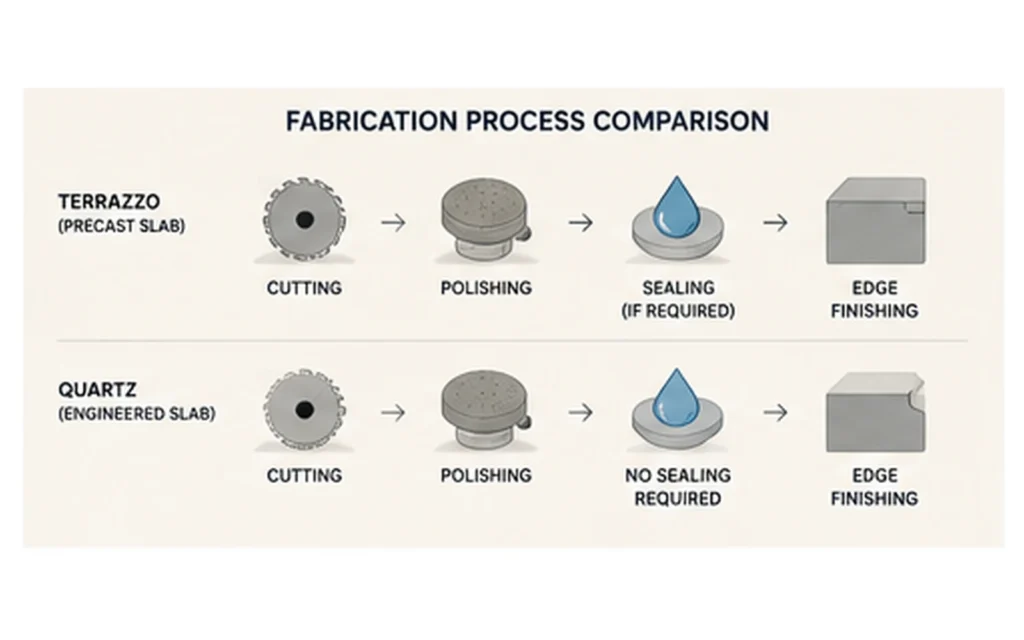
Precast terrazzo may be processed with the same broad categories of saws, CNC equipment and edge-finishing machinery used for other engineered or natural stone. That does not mean the settings are interchangeable. Aggregate hardness, matrix type, porosity, reinforcement, thickness and finish can change blade, feed, coolant, abrasive, sealing and adhesive requirements.
Engineered quartz slabs
Quartz fabrication is also product-specific. A conventional quartz-rich slab, printed surface, coated product and low-silica formulation may require different handling, polishing or repair controls. Use the exact manufacturer instructions and test representative offcuts before production.
Any cutting, grinding or polishing plan should also follow applicable dust-control requirements. See OSHA’s crystalline silica guidance for the U.S. workplace context.
Poured terrazzo
Poured cement or epoxy terrazzo is a specialist trade. Project duration depends on substrate readiness, joint design, area segmentation, matrix, curing or setting, crew capacity, grinding sequence, site access and protection. Obtain a project schedule from the installer rather than applying a universal number of days or weeks.
Do not assume “same tools, no retraining.” Approve a physical edge or installation mockup, record the successful trial procedure and confirm the installer or fabricator accepts responsibility for the exact product.
5. Compare Performance Using Test Evidence
Category-level statements such as “terrazzo is more durable” or “quartz is more stain resistant” are too broad for procurement. Performance depends on the exact system, application and test method.
| Performance Area | Variables That Matter | Recommended Evidence |
|---|---|---|
| Water absorption and staining | Matrix, porosity, finish, sealer, chemical exposure and maintenance. | Product-specific absorption and stain or chemical-resistance results using applicable methods. |
| Abrasion and wear | Aggregate, matrix, finish, traffic, wheels, grit and cleaning. | Applicable abrasion test, reference installations and maintenance plan. |
| Flexural and impact behavior | Thickness, reinforcement, support, cutouts, edge geometry and installation. | Product-specific flexural data, fabrication manual and project engineering where required. |
| Thermal exposure | Resin, cement matrix, sealer, hot equipment, sustained heat and thermal shock. | Manufacturer limits for the exact product and application. |
| UV and color stability | Binder, pigment, aggregate, exposure and coating or sealer. | Product-specific exterior or UV suitability statement and test evidence. |
| Slip resistance | Finish, maintenance, contamination, wet conditions and installation slope. | Applicable slip-resistance testing for the installed finish and use. |
6. Maintenance, Repair and Refurbishment
Quartz is often selected where routine cleaning and visual consistency are priorities. Some terrazzo systems are selected because the surface can be filled, ground, resealed or repolished as part of a planned refurbishment program. Neither description applies universally.
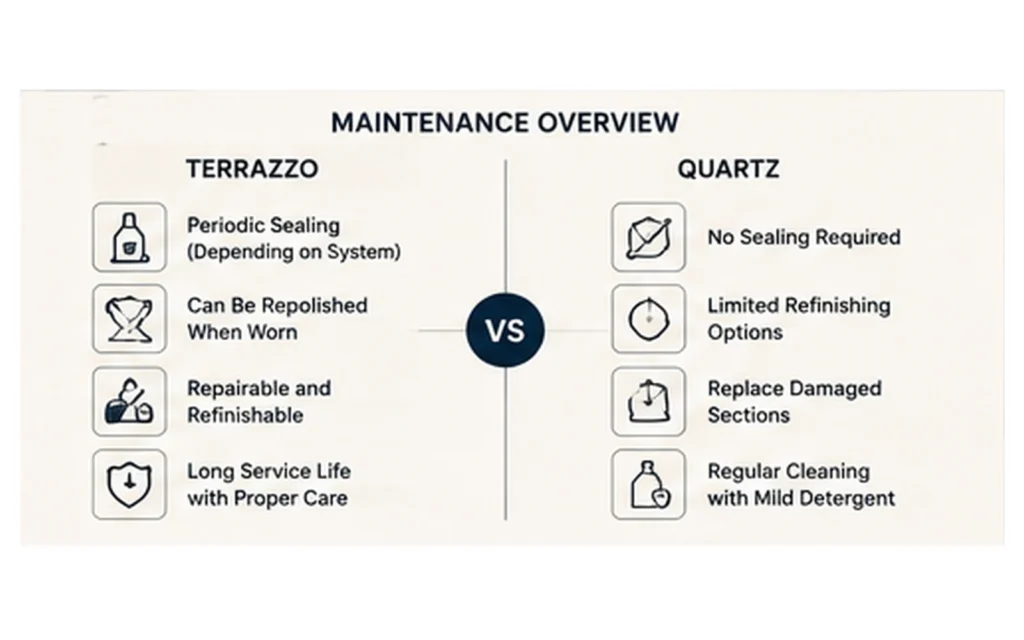
- Cementitious terrazzo: maintenance may include product-specific sealing, neutral cleaning and periodic professional restoration.
- Epoxy terrazzo: care depends on the resin system, finish, chemicals and manufacturer or installer procedure.
- Precast terrazzo slab: confirm whether the face, edges and repairs can be locally refinished without creating gloss or aggregate differences.
- Engineered quartz: routine care and repair limits depend on the exact formulation and surface system; aggressive face grinding can permanently change some products.
A repaired terrazzo surface is not automatically invisible. Final appearance depends on the depth and extent of damage, aggregate match, matrix color, age, finish, sealer and skill of the repair contractor.
7. Crystalline Silica, Dust Risk and Market Classification
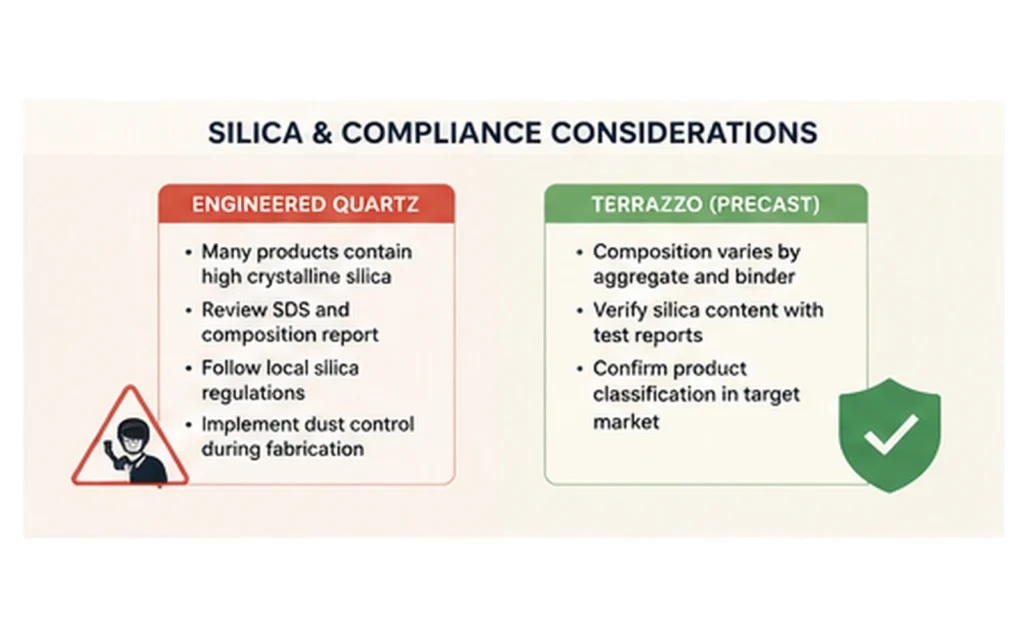
The material name does not establish crystalline-silica content. Terrazzo can contain quartz or other silica-bearing aggregate. Engineered quartz products can be quartz-rich, low-silica or silica-free formulations. Obtain product-specific evidence.
For fabrication and installation, the hazard arises when work generates respirable dust. Review the SDS, composition data, exposure-control requirements and applicable workplace rules for every product. Lower crystalline-silica content does not mean dust-free or hazard-free.
Australia’s engineered-stone prohibition: the current engineered-stone prohibition uses a specific legal definition that includes an artificial product containing at least 1% crystalline silica by weight, created by combining natural stone materials with other constituents and then hardened. The rules also list excluded product categories. Product classification must be reviewed against the current legal definition and exact composition—not the marketing name alone.
For a market-by-market procurement summary, read the AsiaQuartz Engineered Stone Ban Guide.
For a silica-sensitive project, use this sequence:
- identify the exact SKU and formulation;
- obtain representative composition testing with the test method and reporting limit;
- confirm the destination-market product definition and exclusions;
- review the SDS and fabrication controls;
- connect the test report to the production batch and shipment documents.
8. Sustainability Claims Require Product Documentation
Terrazzo may use recycled glass, stone waste or other recycled aggregate. Quartz and other engineered surfaces may also use recycled fillers or alternative raw materials. The percentage and environmental significance must be demonstrated for the exact product.
Ask for:
- recycled-content declaration stating whether the percentage refers to aggregate or total product weight;
- pre-consumer and post-consumer definitions;
- Environmental Product Declaration where available;
- ingredient or material-health disclosure where required;
- VOC documentation for binders, sealers and site-applied adhesives;
- manufacturing location and transport information;
- maintenance and expected replacement or refurbishment scenario.
LEED and similar systems are project-level frameworks. A single product does not earn certification by itself. Product documents may contribute to a selected credit pathway, but the project sustainability professional must confirm the applicable rating-system version, credit and evidence.
USGBC explains that products can contribute documentation toward project credits but do not receive LEED certification independently; see LEED information for product manufacturers.
9. Where Each Route Commonly Fits
| Application | Precast Terrazzo Slab | Engineered Quartz Slab | Poured Terrazzo |
|---|---|---|---|
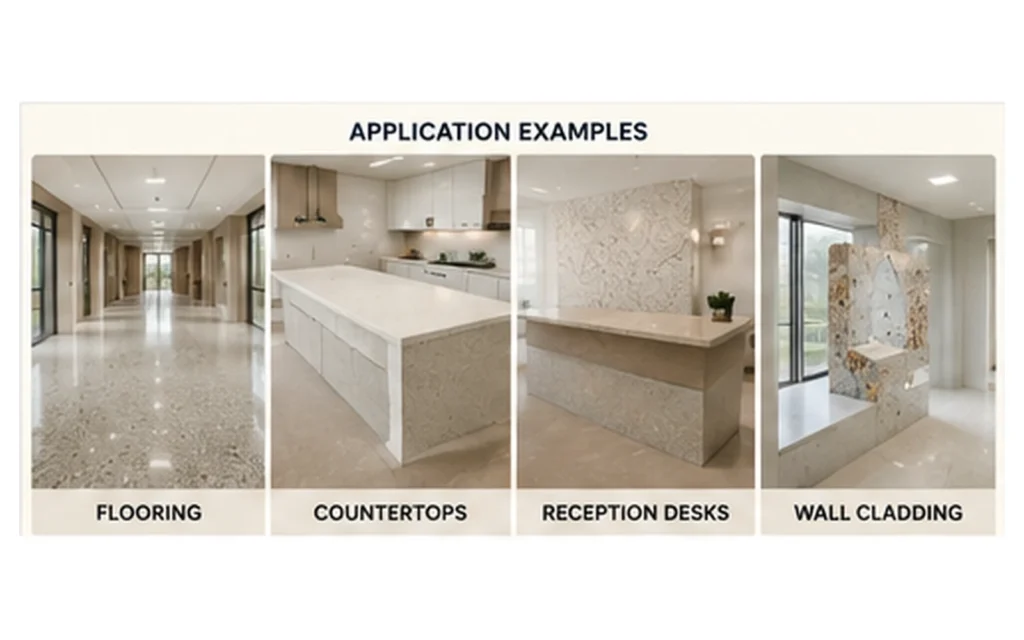
| Countertops and vanities | Suitable where aggregate appearance, custom design or product-specific compliance documentation is valued. | Strong option where controlled repeatability, prefabrication and routine maintenance are priorities. | Usually not the primary procurement route for conventional tops. |
| Reception desks and feature surfaces | Useful for custom aggregate and architectural character. | Useful for controlled stone visuals, printed designs and repeat programs. | Possible only where the complete site system is intentionally designed. |
| Wall panels and stairs | Precast panels and stair components can be specified by product and support system. | Slab or cut-to-size wall and stair applications require product-specific fabrication and engineering. | Vertical or stair terrazzo systems are specialist applications. |
| Large commercial floors | Tiles or precast units can be used where joints and modular installation are acceptable. | Not automatically suitable; verify product, slip, joints, support and manufacturer approval. | Often the relevant terrazzo route where a continuous site-installed floor is required. |
| Repeat residential or hotel programs | Can work where batch variation is controlled and approved. | Often practical where repeatability, prefab supply and replacement planning are important. | Generally evaluated as a separate flooring subcontract, not a slab program. |
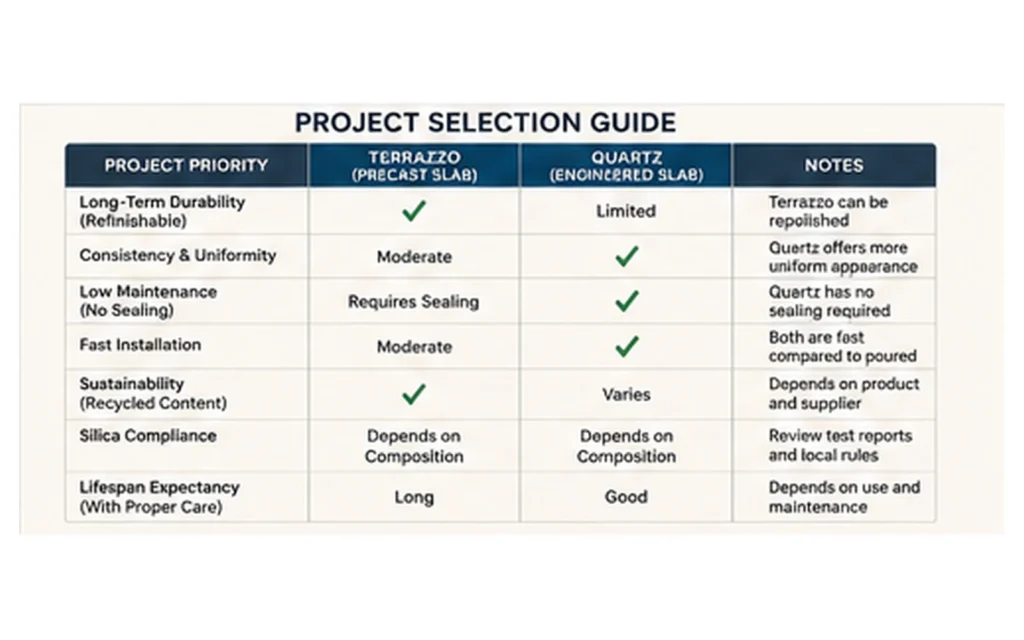
10. A Weighted Procurement Decision Matrix
Do not use a single rule such as “floors equal terrazzo” or “countertops equal quartz.” Score the exact product and project.
| Decision Dimension | Questions to Resolve |
|---|---|
| Application | Floor, wall, countertop, stair, reception desk or exterior? |
| Product route | Precast cementitious, precast resin, poured cement, epoxy terrazzo, quartz-rich slab, printed quartz or low-silica surface? |
| Visual control | How much variation, aggregate movement, vein sequence or repeatability is acceptable? |
| Installation capability | Does the local fabricator or installer accept the product and provide a tested method? |
| Compliance | What composition, dust-control and product-classification evidence is required? |
| Maintenance | Can the owner support sealing, restoration, shutdowns or specialist repair? |
| Supply risk | Are samples, replacement stock, repeat batches, logistics and lead times approved? |
| Sustainability | Which EPD, recycled-content, ingredient and VOC documents are required for the project? |
| Total cost | What is the installed, maintained and risk-adjusted cost over the project’s planned use? |
11. Buyer Evidence Checklist
Before shipment approval, connect product evidence to the AsiaQuartz Quartz Slab QC & Packing Guide so slab IDs, inspection records, packing and container evidence follow one traceable workflow.
- Confirm whether the quotation is for precast slab, tile, component or site-installed terrazzo.
- Identify the exact matrix, aggregate or filler system and surface finish.
- Obtain current TDS, SDS, composition evidence and applicable test reports.
- Approve a representative physical sample and full-format visual where appearance matters.
- Confirm finished dimensions, thickness, weight, usable area and tolerances.
- Obtain product-specific fabrication, sealing, adhesive and installation instructions.
- Complete an edge, seam or installation mockup where risk is material.
- Review maintenance, repair, refurbishment and warranty limitations.
- Verify silica and destination-market classification from evidence, not category names.
- Validate recycled content, EPD, ingredient and VOC claims for the exact SKU.
- Compare total installed cost, schedule, replacement stock and responsibility allocation.
- Connect approved samples and reports to the production batch and shipment records.
FAQ:
Not necessarily. The same broad equipment categories may be used, but tooling, feed, cooling, polishing, sealing, adhesives and handling depend on the exact terrazzo matrix, aggregate and manufacturer instructions.
No. Terrazzo can contain quartz or other crystalline-silica-bearing materials. Verify the exact composition and representative test report.
Not as a universal rule. Compare the exact matrix, finish, sealer, chemical exposure and test method. Cementitious terrazzo, epoxy terrazzo and different engineered quartz formulations can perform differently.
No. Grinding, filling and repolishing may reduce damage visibility, but aggregate match, matrix color, aging, finish and repair depth affect the final appearance.
There is no category-wide answer. Compare product price, samples, fabrication, installation, substrate, sealing, logistics, schedule, maintenance, replacement and risk allocation for the exact project.
No. LEED is assessed at project level under a selected rating-system version and credit pathway. Product documentation may contribute, but the project team must confirm eligibility and submit the required evidence.
Only with clear qualifications. Poured terrazzo is a site-installed flooring system, while quartz slabs are factory products. Their substrates, contractors, joints, schedules and risk allocation are different.
Related reading:
- Artificial Terrazzo Slabs
- Classic Quartz Slabs
- Silica-Free & Low-Silica Surfaces
- Engineered Stone Ban Guide
- Quartz Slab Sizes, Dimensions & Thicknesses
- Quartz Slab QC & Packing Guide
Sources and methodology
- National Terrazzo & Mosaic Association — Technical Specifications. Used to distinguish terrazzo floor and wall systems and their system-specific requirements.
- NTMA — Epoxy Terrazzo. Used to identify epoxy terrazzo as a thin-set, site-installed resin-matrix system rather than a generic slab category.
- NTMA — Terrazzo Maintenance. Used for the principle that terrazzo maintenance is system-specific and still requires care.
- Safe Work Australia — Engineered Stone Ban. Used for the current Australian legal definition and listed exclusions.
- OSHA — Crystalline Silica. Used for fabrication-dust and worker-exposure context.
- U.S. Green Building Council — LEED Information for Product Manufacturers. Used for the principle that individual products contribute to project credits but do not earn certification independently.
- U.S. Green Building Council — LEED v4 Materials Framework. Used for product transparency, EPD and multi-attribute material-selection context.
Method: The article separates precast terrazzo slabs, poured cement terrazzo and epoxy terrazzo before comparing procurement decisions. It avoids universal prices, life spans, installation durations, thermal limits, MOQs and recycled-content percentages. Product-specific documents and project-specific installer input take priority.
Limitations: This article is general procurement guidance, not architectural, engineering, occupational-safety, sustainability-certification or legal advice. Verify current requirements with qualified project professionals.
Information status: Reviewed July 27, 2026. Regulations, product formulations and rating systems may change.
Research and AI disclosure: Research and drafting tools assisted with source collection, structure and language review. Final technical claims and AsiaQuartz-specific information require human editorial and technical approval before publication.
For broader origin, QC, packing and delivery planning, review the Quartz Slab Supply Chain Guide.
Compare Terrazzo and Quartz for Your Project
Share the application, drawings, quantity, target market, installation route, compliance requirements and schedule. AsiaQuartz can review the product format, evidence package, samples, QC, packing and supply route.