Prepared by: AsiaQuartz Editorial Team
Technical review by: AsiaQuartz Product, QC & Supply Chain Team
Last updated: July 2026
Quick answer: Choose prefab when approved project dimensions and installation allowances fit a predefined component program. Choose cut-to-size when pieces must follow controlled drawings, unique dimensions or project-specific cutouts. Choose full slabs when local fabrication flexibility is more valuable than factory-finished components. The right answer depends on drawings, as-built verification, installer capability, QC, packing, replacement planning and total installed cost.
Prefab, cut-to-size and full-slab quartz are not simple quality tiers. They are different supply formats that assign fabrication, dimensional control, installation coordination and replacement risk to different parties.
This guide compares those formats at the procurement level. It should be read with the parent guide, What Is Prefab Quartz?, and the order-specific Quartz Product Specification Routes.Table of Contents
- Define the formats
- Six decision factors
- Risk ownership
- Total installed cost model
- Decision matrix
- Hybrid orders
- RFQ inputs
- FAQ
1. Define the Three Supply Formats
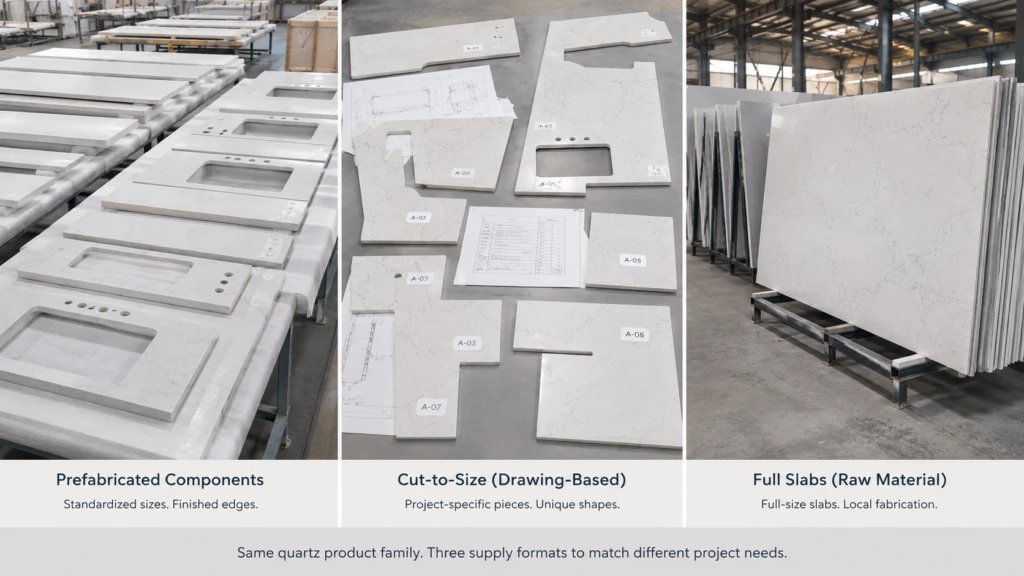
Supplier terminology is not perfectly uniform. For this guide, “prefab” means predefined or repeat component formats; “cut-to-size” means drawing-based factory fabrication; and “full slab” means slabs supplied for downstream fabrication.
| Review Area | Prefab Quartz | Cut-to-Size Quartz | Full Slab |
|---|---|---|---|
| What is ordered | Predefined countertop, vanity, island or backsplash formats. | Components produced from approved drawings and a piece schedule. | Full slabs supplied for fabrication after delivery. |
| Starting inputs | Component format, dimensions, product, thickness, edge, cutout option and quantity. | Approved drawings, revisions, piece IDs, dimensions, cutouts, edges, joints and quantities. | Product code, slab format, thickness, finish, quantity and intended fabrication. |
| Factory scope | Defined cutting, edge finishing and selected repeat options. | Drawing-specific cutting, edges, holes, cutouts, labels and project packing. | Slab production, finish, QC and export packing. |
| Local scope | Site verification, handling, dry fitting, support, seams, fixtures and qualified installation; limited adaptation only where approved. | Site verification, piece mapping, handling, dry fitting, support, seams, fixtures and qualified installation. | Templating, fabrication, cutouts, edges, dry fitting and installation. |
| QC focus | Format, dimensions, edges, repeat cutouts, labels, batch appearance and packing. | Drawing revision, every unique interface, piece IDs, cutouts, edges, matched sets and packing sequence. | Surface, dimensions, thickness, finish, batch reference and slab packing. |
| MOQ and timing | Order-specific. Confirm current availability, production arrangement, quantity, customization, QC, packing and target schedule with the selected supplier. | ||
Material equivalence: Prefab and cut-to-size components may come from the same product family, but do not assume they are identical. Confirm the exact SKU, formulation, thickness, finish, batch or production reference and supporting documents.
2. Six Decision Factors That Matter
Factor 1: Dimensional Repeatability
Prefab is a strong candidate when the approved dimensions, joints, wall allowances and edge details fit an available repeat format without unapproved field modification. Cut-to-size is more appropriate when pieces are unique or drawing-specific. Full slabs preserve the most downstream flexibility.
Do not decide from nominal architectural dimensions alone. Compare the proposed supply format with verified as-built conditions, cabinet dimensions, wall conditions, fixtures, seams and installation allowances.
Factor 2: Drawing and Design Control
Cut-to-size depends on disciplined drawing control. Every drawing should identify revision, piece ID, dimensions, edge details, cutouts, joints and installation interfaces. Production, QC, labels and packing must reference the same approved set.
Prefab reduces the number of unique drawings, but it does not remove the need to verify that the project was designed around the selected component format. Full-slab supply is more tolerant of late dimensional decisions because fabrication occurs after local templating.
Factor 3: Local Fabrication and Installation Capability
Factory-finished components reduce local cutting and edge work, but they do not install themselves. Both prefab and cut-to-size pieces require qualified handling, site verification, dry fitting, support, levelling, seams, sink or appliance coordination and installation responsibility.
Full slabs require a capable local fabricator. Prefab and cut-to-size require a capable installation team and a clear process for any permitted field adjustment. When local expertise is limited, reduce complexity rather than assuming a finished piece can be installed by an unqualified general trade.
Factor 4: Interchangeability and Replacement Strategy
Standardized prefab pieces may allow a common spare to serve multiple units, but only when the layouts and product appearance are truly interchangeable. Unique cut-to-size pieces require piece-specific replacement records. Full slabs may allow local remanufacture, subject to material availability and batch appearance.
The replacement plan should address:
- Which pieces are unique and which are interchangeable.
- Whether spare pieces should ship with the original order.
- How the approved product, color, finish and drawing revision will be retained.
- How replacement pieces will be labeled, packed and matched.
- What local repair or remanufacture options exist.
Factor 5: QC, Piece Mapping and Packing
Prefab uses repeated checkpoints, but repetition can hide process drift if the inspection only reviews the first piece. Cut-to-size requires tighter drawing and piece-ID control because every component may be different. Full slabs require more downstream fabrication control.
Use the sibling Prefab Quartz QC Checklist for pre-shipment review and the Quartz Slab QC & Packing Guide for slab-level inspection principles.
Factor 6: Installed-Cost and Schedule Exposure
Do not compare only the factory unit price. The lowest quoted format can become the highest-cost route when it creates field modification, low container utilization, unique replacements, local remanufacture or schedule delay.
Illustrative scenario: A project selects a predefined vanity format before confirming the actual cabinet depth and wall allowance. The pieces arrive within the supplier’s approved format but do not fit the final site condition. The issue is not that prefab is inherently inferior; the failure occurred because the project dimensions and supply format were never aligned before order approval.
3. Who Owns Which Risk?
| Risk Area | Prefab | Cut-to-Size | Full Slab |
|---|---|---|---|
| Standard-format fit | Buyer/project team must prove the project can use the selected format. | Buyer/project team must provide accurate approved drawings; factory must execute them. | Local template and fabrication team controls the final dimensions. |
| Drawing revision | Lower drawing complexity, but component schedule still required. | High dependence on revision control and piece mapping. | Local fabrication drawings and templates control production. |
| Factory fabrication | Repeat process control and format consistency. | Unique-piece accuracy, interfaces and identification. | Limited to slab production and finish. |
| Site variation | Project team must define acceptable allowances and approved field adaptation. | As-built accuracy and drawing verification remain critical. | Local templating can absorb more variation before fabrication. |
| Replacement | May use interchangeable spares where formats are genuinely repeatable. | Usually piece-specific and drawing-specific. | May be fabricated locally if matching material is available. |
| Installation | Qualified handling and installation remain necessary for all three routes. | ||
4. Compare Total Installed Cost—not a Universal Price Table
A defensible comparison uses the same destination, product reference, quantity, schedule and service assumptions for all formats.
| Cost Element | Questions to Model |
|---|---|
| Product and factory fabrication | Exact SKU, thickness, finish, edges, cutouts, drawing work, yield, setup and quantity. |
| Export packing | Crate type, piece protection, labels, crate weights and mixed-format complexity. |
| Origin and container freight | Incoterm, origin charges, container type, practical load plan, freight date and surcharges. |
| Insurance, duty and import charges | Declared value, policy terms, tariff classification, duties, taxes, broker and destination fees. |
| Inland delivery and handling | Drayage, warehouse handling, unloading equipment, site access and crate distribution. |
| Local fabrication or adaptation | Templating, cutting, edges, cutouts, seams, permitted field adjustment and local repair. |
| Installation | Qualified labor, support, sinks, plumbing coordination, levelling, seams and schedule. |
| Damage, spare and replacement exposure | Interchangeability, replacement lead time, local remanufacture, batch continuity and critical-path impact. |
| Usable installed output | Divide the complete program cost by accepted and installed pieces, units or square metres—not by ordered pieces alone. |
Comparison formula: total approved product and fabrication cost + packing + origin logistics + freight + insurance + duty/tax + destination logistics + local work + installation + expected replacement exposure, divided by usable installed output.
Use current, written quotations and route-specific assumptions. A fixed percentage premium between prefab and cut-to-size is not reliable across products, factories, projects or destinations.
5. Project Decision Matrix
| Project Condition | Starting Route to Review | Key Verification |
|---|---|---|
| Approved layouts use repeat dimensions that fit an available component program. | Prefab candidate | As-built fit, allowances, edge/cutout options, spare strategy and local installation. |
| Pieces are unique or must follow room-, unit- or phase-specific drawings. | Cut-to-size candidate | Drawing revision, piece schedule, interfaces, first article, labels and packing sequence. |
| Design dimensions are not frozen or local templating is required. | Full-slab candidate | Local fabricator capability, slab availability, batch continuity and fabrication schedule. |
| Most pieces repeat, but selected features are unique. | Hybrid candidate | Consolidated product reference, two production scopes, piece mapping, crate plan and replacement ownership. |
| The project lacks verified dimensions or qualified installation planning. | Do not approve format yet | Resolve drawings, as-built conditions, installation responsibility and acceptance criteria first. |
6. Hybrid Orders: Useful, but More Complex
A project can combine formats—for example, repeat kitchen tops as prefab, unique vanities as cut-to-size and feature elements from full slabs. The benefit is format-specific efficiency. The cost is coordination.
Before approving a hybrid order, confirm:
- One consolidated product and piece schedule.
- Exact SKU and finish alignment across formats.
- Separate QC checkpoints for repeat and unique pieces.
- Crate grouping, labels and installation sequence.
- Container load planning and crate gross weights.
- Spare and replacement responsibility for each format.
- Supplier evidence that the required factory or partner can execute both scopes.
Do not reject a supplier merely because its core business is slabs. Review actual CNC capability, drawing-control process, first-article procedure, QC records, piece mapping, packing and completed project references.
7. Information to Include in the RFQ
- Project type, destination and installation schedule.
- Exact product reference, color, finish and thickness.
- Approved drawings or a clear list of candidate standard formats.
- Piece quantities, IDs, rooms, units and phases.
- Edges, cutouts, holes, joints, backsplashes and matched sets.
- Requested tolerances, measurement methods and inspection plan.
- Labels, packing groups, crate weights and unloading constraints.
- Spare, replacement and future-reorder requirements.
- Documents, destination-market requirements and target Incoterm.
- Separate quotations for prefab, cut-to-size, full-slab or hybrid routes using the same assumptions.
FAQ
Q: What is the main difference between prefab and cut-to-size quartz?
Prefab uses predefined or repeat component formats, while cut-to-size components are produced from approved drawings and piece schedules. Both are supply formats rather than guarantees of identical material, quality, lead time or commercial terms.
Q: Does cut-to-size quartz eliminate the need for a qualified installer?
No. Factory fabrication reduces on-site cutting, but both prefab and cut-to-size pieces still require site verification, safe handling, dry fitting, support, levelling, seaming, fixture coordination and qualified installation.
Q: Can prefab and cut-to-size pieces be mixed in one order?
Yes, when the supplier can coordinate both production routes, piece identification, packing, loading and replacement planning. The buyer should approve one consolidated piece schedule and packing plan.
Q: Is prefab always cheaper than cut-to-size?
No. Prefab can be efficient when predefined formats fit the approved project dimensions, but an unsuitable format can create field modification, replacement and delay costs. Compare total installed cost using order-specific quotations, packing, freight, duties, installation and contingency assumptions.
Q: Which format is safer for a first-time importer?
The safer route is the format that matches verified dimensions, local installation capability, supplier competence, packing, replacement strategy and the buyer’s ability to control drawings and approvals. There is no universal safest default.
Q: Can prefab and cut-to-size use the same quartz product?
They may be produced from the same product family, but equivalence should be confirmed by exact SKU, formulation, thickness, finish, batch or production reference, and supporting documents.
Method: This article intentionally avoids universal MOQ, lead-time, price-premium, contingency and distance thresholds. Commercial terms and suitability must be modeled for the exact product, drawings, supplier, destination, packing, installation and schedule.