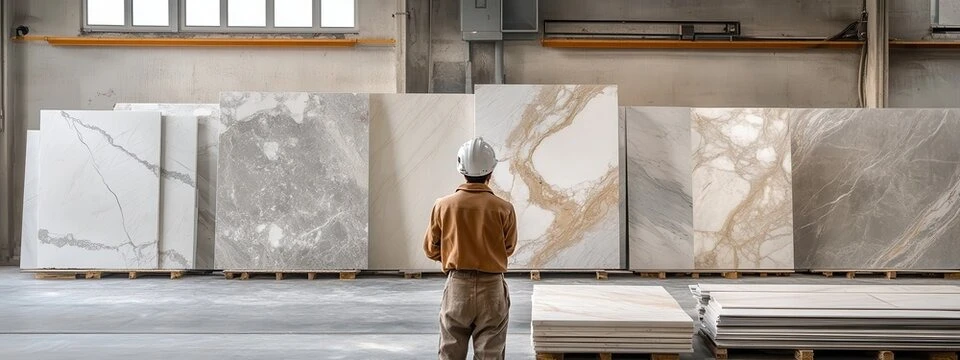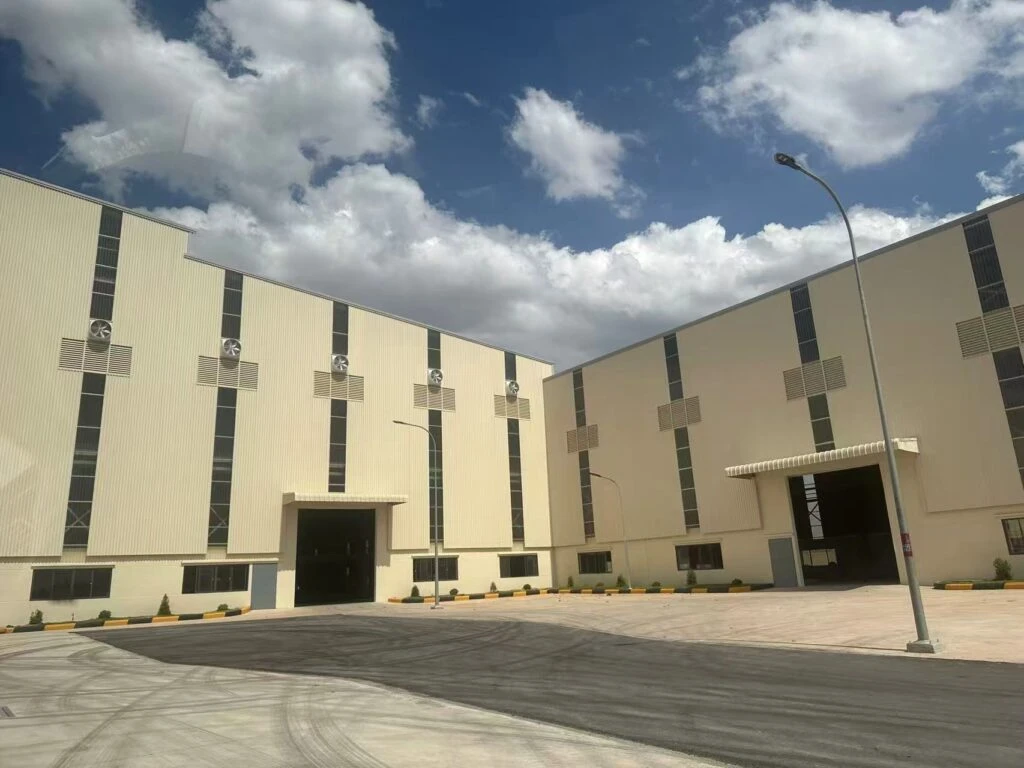
Introduction: Why Printed Quartz Is Different in Commercial Projects
First, commercial projects run on different rules than one-off residential work. Deadlines are tighter, quantities are larger. And the cost of a wrong material decision can multiply across hundreds of rooms, counters, or units. That is why printed quartz should be evaluated not only as a design surface. But as a controlled B2B supply program.
For project buyers, the key questions are practical: can the approved sample be compared with the production batch? Can the slab size, finish, thickness, packing method, and QC evidence be confirmed before shipment? However, can future phases be reviewed against reference samples and batch records? These questions matter more than a beautiful catalog image.
First, this guide explains where printed quartz can work well in hotels, offices, retail, restaurants, multi-family housing, and student housing. It also highlights the risks that buyers should check before approving a commercial order. For product-level details, review the AsiaQuartz printed quartz slab program and the basic What Is Printed Quartz? guide before confirming a container or project order.
1. Hotels & Hospitality: Visual Consistency Across Repeat Spaces
First, hotels often use the same surface concept across many guest bathrooms, reception desks, lobby walls, restaurant counters, and bar areas. In this setting, the buyer does not only need one impressive slab. Specifically, the buyer needs a repeatable visual direction, approved samples, batch review, and shipment documentation that can support a controlled rollout.
First, printed quartz is useful when a hospitality project needs a marble-look or stone-look appearance without depending on natural block variation. The current AsiaQuartz printed quartz product page positions printed quartz for hotel vanities. Specifically, reception desks, retail counters, apartment kitchens. And commercial interiors, with jumbo slab sizes, sample approval, batch matching support, pre-shipment QC, export packing, and container supply support.
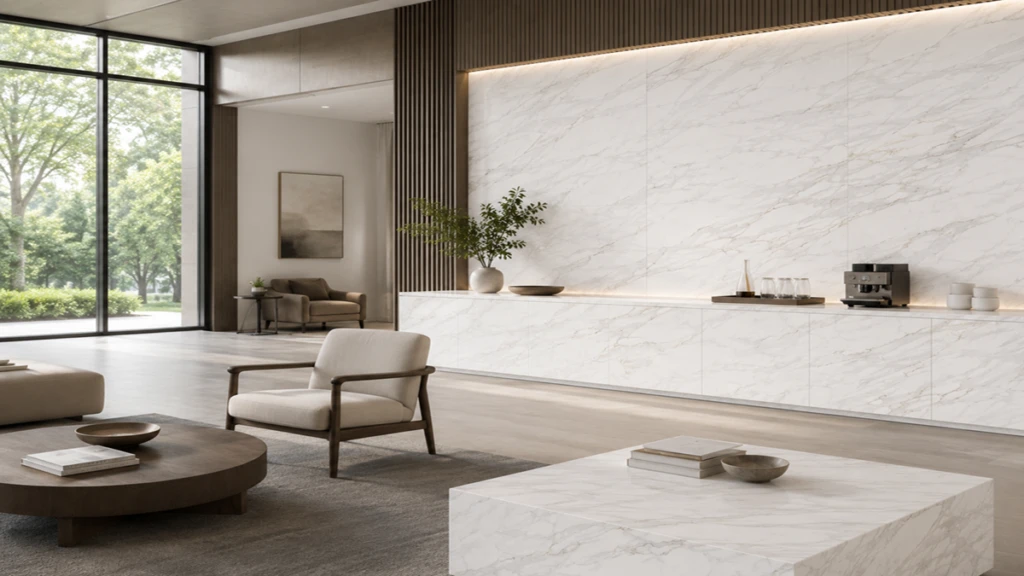
For lobby walls, reception fronts, vanity programs. And public-facing surfaces, large-format slabs can reduce visible joints when the layout is planned early. However, buyers should review available slab dimensions on the Quartz Slab Specifications page and confirm whether the selected color series. Thickness, finish. And packing method fit the project use case.
First, avoid describing printed quartz as a perfect substitute for every natural stone application. Marble and onyx still have a place where natural uniqueness is central to the design story. Specifically, printed quartz is strongest when the project needs controlled appearance, practical indoor maintenance, sample-to-batch review, and repeat supply planning.
2. Office & Corporate Interiors: Reception Desks, Meeting Rooms, and Feature Areas
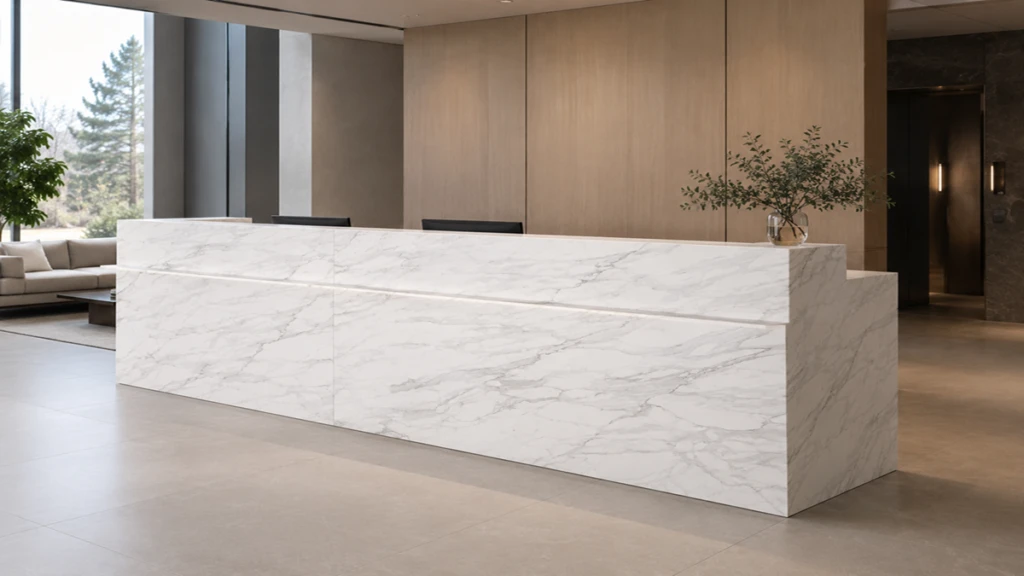
First, office projects usually need a surface that looks premium but remains practical for daily traffic, cleaning, and replacement planning. Reception counters, pantry areas, boardroom tables, elevator lobby panels. And feature walls are common applications where printed quartz can create a consistent stone-look identity without requiring natural stone block selection.
For corporate interiors, the main value is not only the face pattern. Buyers should approve the edge appearance, miter detail, finish, thickness. And full-slab visual scale before fabrication. A dark marble-look reception desk with waterfall edges. For example, should be reviewed with edge samples or miter samples rather than only a small face chip.
When printed quartz is used in meeting tables or feature walls, ask for complete slab visuals and project-specific QC evidence. The Quartz Slab QC & Packing Guide explains why pre-shipment inspection. However, slab photos, packing records. And loading evidence are important before shipment approval.
3. Retail & Restaurant: Brand Repeatability and Practical Indoor Use
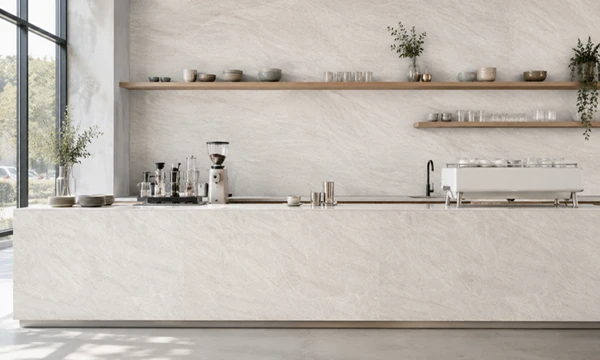
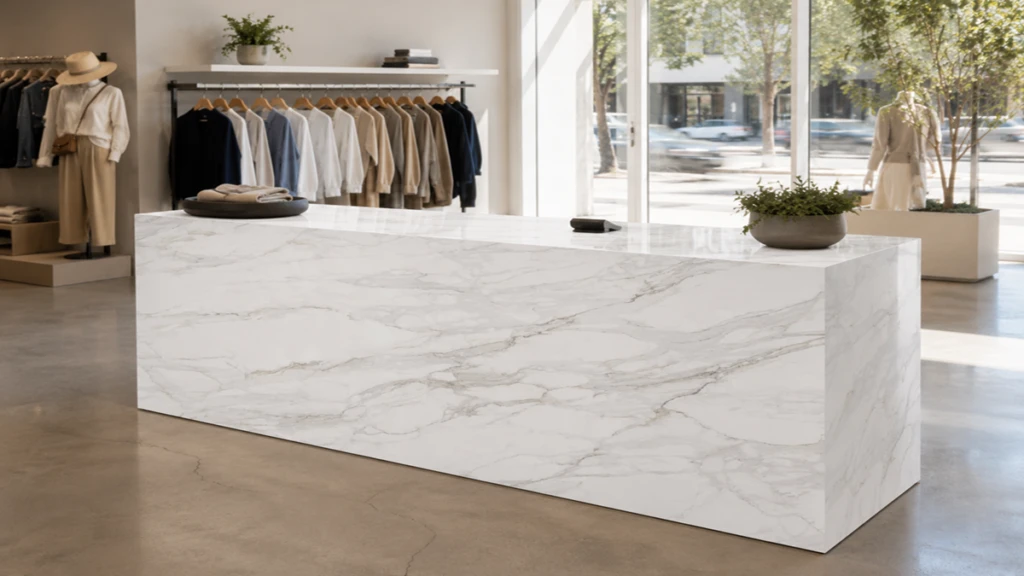
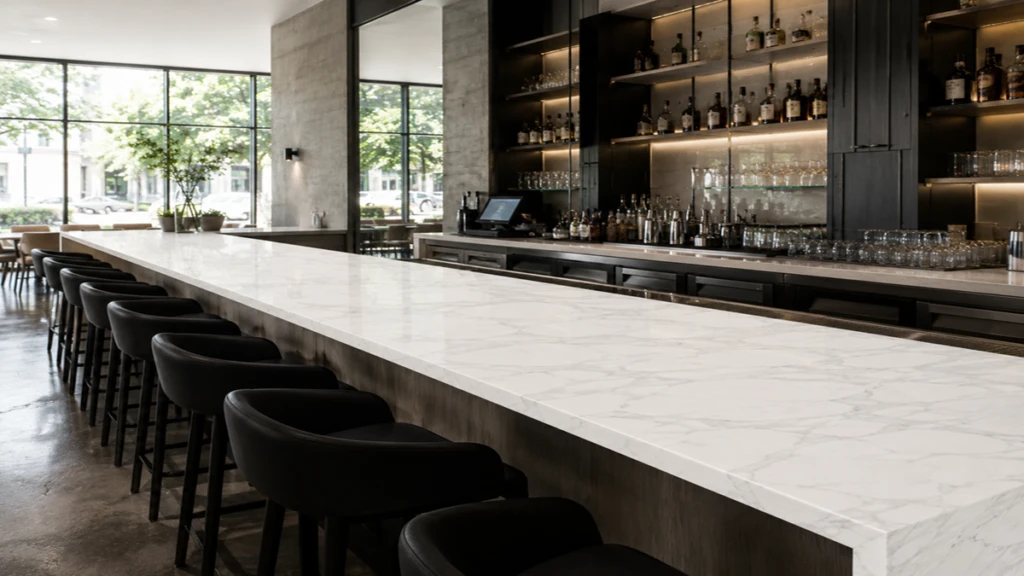
First, retail and restaurant spaces place surfaces under constant visual pressure. Display counters, checkout counters, bar tops, restaurant tabletops. And front-of-house service counters must look intentional under strong lighting and frequent cleaning. Printed quartz can help chain stores and commercial interiors repeat a consistent surface identity across multiple locations.
First, the right wording here is important: printed quartz can be easier to maintain than many natural stones in indoor commercial settings. But it is still not indestructible. Specifically, buyers should confirm finish, cleaning guidance, stain-resistance data where available. And application limits before using it in food-service or high-contact areas.
⚠️ Important Application Limitations for Retail & Restaurant Projects
For direct heat, heavy back-of-house kitchen use, outdoor exposure, strong solvents. Or aggressive cleaning chemicals, printed quartz should not be assumed to be suitable. However, stainless steel, porcelain, sintered stone, or other surfaces may be better for certain functional zones. Printed quartz is usually better positioned for front counters, dining surfaces, reception areas, hotel vanities, and selected interior panels after technical review.
4. Multi-Family & Student Housing: Repeat Layouts and Controlled Supply
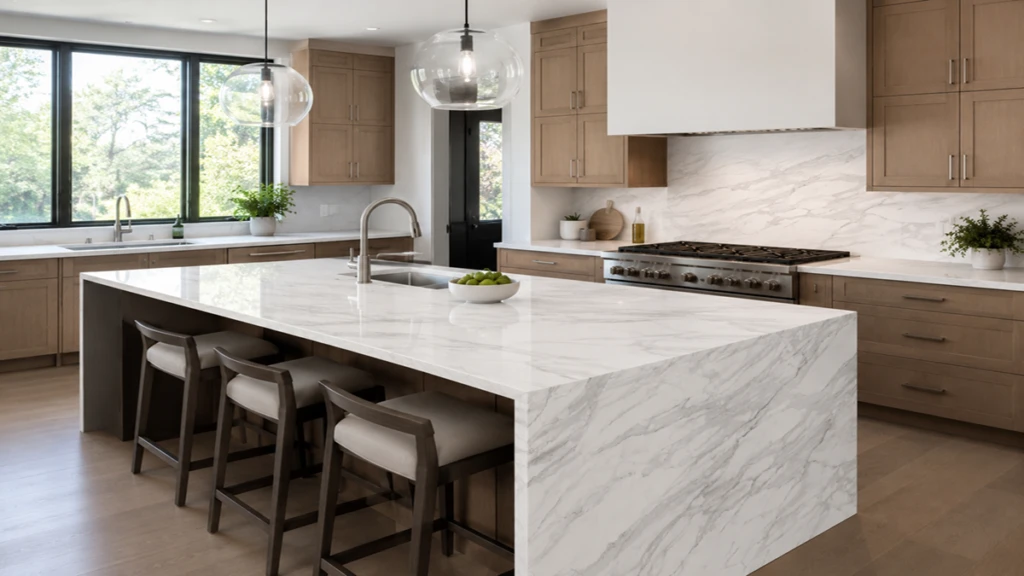
First, multi-family and student housing projects are quantity-driven. A small specification error can repeat across hundreds of kitchens, bathrooms. Or vanity programs. Specifically, printed quartz can make sense when developers want a marble-look upgrade but still need repeatable supply, manageable maintenance. And predictable review steps.
For repeat unit layouts, cut-to-size quartz project supply can change the economics because dimensions. Labels, packing sequence. And delivery planning can be reviewed around drawings and size schedules. This can reduce on-site confusion and improve installation planning, especially when layouts are repeated across many units.
First, thickness should be specified carefully. 20 mm remains a safer default for many standard countertop applications. 15 mm may fit selected vanities. Panels, supported applications. Or project-specific systems. But only after confirming substrate support, spans, edge requirements. And local fabrication practice. 30 mm may be used where the market or design expects a heavier visual profile.
Commercial Application Snapshot
| Project Type | Common Printed Quartz Use | Specification Notes |
|---|---|---|
| Hotel / hospitality | Vanities, reception counters, bar counters, lobby wall panels | Confirm sample, finish, slab size, edge detail, packing method, and future replenishment plan. |
| Office interiors | Reception desks, meeting tables, pantry counters, feature walls | Check miter detail, full-slab pattern scale, finish behavior, and lighting conditions. |
| Retail / restaurant | Display counters, checkout counters, dining surfaces, front-of-house counters | Use for indoor commercial surfaces after confirming cleaning guidance and technical limits. |
| Multi-family housing | Kitchen counters, vanity programs, backsplashes, repeat apartment layouts | Consider cut-to-size planning, labeling, packing sequence, and thickness review. |
| Student housing | Durable-value kitchen and bathroom surfaces in repeat layouts | Avoid overpromising. Confirm care guidance, substrate support, and project-specific thickness. |
5. Printed Quartz vs Natural Stone in Commercial Planning
First, natural stone remains valuable for projects where authenticity, depth, and one-of-a-kind variation are part of the design intent. Printed quartz should not be presented as superior in every application. Specifically, its advantage appears when the project needs a controlled marble-look appearance, repeatable sample approval, practical indoor maintenance. And a clearer supply path for multiple rooms, counters, or phases.
First, compared with natural marble, printed quartz can reduce some common project uncertainties. Such as block-to-block visual variation, future replenishment difficulty, sealing expectations. And sample mismatch. The actual cost comparison still depends on slab size, thickness, finish, fabrication method, packing, freight, waste planning, and maintenance expectations.
For buyers comparing materials at project scale, start with quartz slab specifications. Then review project supply planning and the supplier’s supply chain capability before locking a commercial material package.
| Factor | Natural Marble | Standard Quartz | Printed Quartz |
|---|---|---|---|
| Visual identity | Unique natural variation; powerful for luxury projects. | Stable colors and simpler veining; strong for stock programs. | Controlled marble-look or stone-look visuals for repeat commercial supply. |
| Repeatability | Can vary by block and lot; future matching can be difficult. | Generally stable in standard colors. | Can support visual review and batch matching when managed with references and QC records. |
| Maintenance | Often requires sealing and careful stain/etching management. | Practical for many indoor countertop uses. | Lower maintenance than many marbles, depending on product series, finish, and application. |
| Project fit | Luxury spaces where natural authenticity is the design value. | Builder programs, simple stock colors, prefabs, and classic countertops. | Hotels, retail counters, reception desks, apartments, and commercial interiors needing design consistency. |
| Buyer risk | Variation, sealing, cost swings, and future replenishment. | Less dramatic design movement in some lines. | Edge realism, pattern repetition, UV questions, and batch control must be checked. |
6. What Specifiers Often Get Wrong
Relying on screen color instead of physical samples
First, digital renderings and phone photos are not reliable approval standards for commercial surfaces. Review a physical sample under the actual lighting conditions of the finished space whenever possible.
Approving a small chip without seeing the full slab
First, a small chip cannot show full-slab pattern scale, repeat movement, vein direction. Or how the design behaves across a long counter or wall panel.
Ignoring edge and miter appearance
For reception desks, waterfall counters, thick visual edges, and exposed side panels, request edge or miter samples before bulk approval.
Assuming future batches will automatically match
First, future orders should be compared against reference samples, saved slab records, or batch photos. Do not treat future matching as automatic.
Using printed quartz where outdoor exposure is unclear
First, outdoor use should not be assumed. Ask for UV or colorfastness information, warranty terms, and application guidance before specifying printed quartz in exposed areas.
💡 Commercial Approval Rule
First, do not approve a commercial printed quartz order from a catalog image alone. Review a physical sample, full-slab image, finish, edge detail, and batch-review method before bulk production.
7. Order Planning for Printed Quartz Commercial Projects
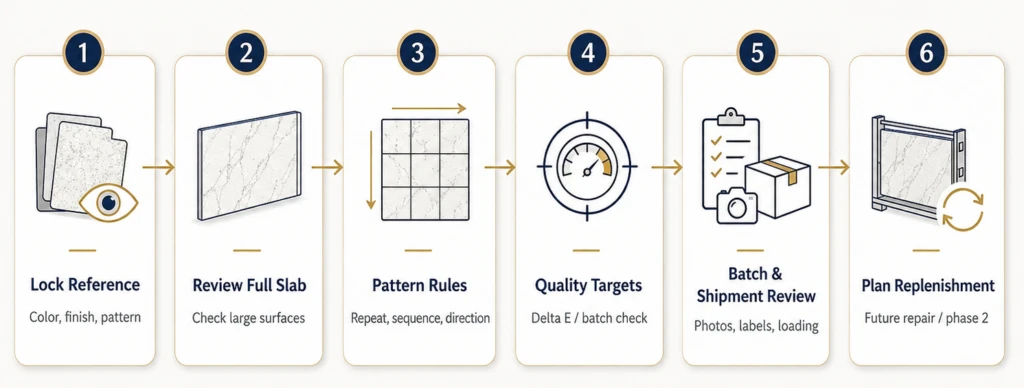
First, printed quartz adds extra review steps that may not exist with simple solid-color slabs. These steps are not bureaucracy; they are the controls that help buyers reduce mismatch, delay. And dispute risk before a container leaves the factory.
Step 1: Lock the approved visual reference
First, confirm the selected color, finish, pattern scale, vein direction. And acceptable tone range with a physical sample or larger reference panel before production.
Step 2: Review full-slab images
Ask for complete slab visuals when the project includes lobby walls, long counters, reception desks, full-slab backsplashes, or repeated apartment surfaces.
Step 3: Agree on pattern variation rules
For large visible areas, discuss how pattern repetition, slab sequencing, and layout direction will be managed. Do not assume adjacent slabs will look random without review.
Step 4: Define measurable quality targets where needed
If color tolerance is critical, ask whether a Delta E target, color-reading record. Or sample-to-batch comparison can be included in QC documentation.
Step 5: Plan batch review and shipment approval
Before balance payment and shipment release, review slab photos, batch records, packing photos, labels, and loading records.
Step 6: Plan replenishment before the project finishes
Ask whether reference samples, print files, large cut-offs, or retained batch records can support future repair or phase-two ordering.
For broader logistics, packing. And container-level risk control, compare the Quartz Project Supply Guide and the Quartz Slab Supply Chain Guide before finalizing the purchase order.
First, 📋 Preparing a Bid? Request a Commercial Project Specification Pack
For buyers actively preparing commercial project bids, AsiaQuartz can provide a structured Commercial Project Specification Pack — including sample references. Slab dimension and thickness options, batch QC documentation examples, packing specifications. And estimated lead time guidance — tailored to your project type and quantity. Contact our team with your project brief to request the pack.
FAQ:
First, yes, printed quartz can be useful for hotel vanities, reception desks, retail counters, apartment kitchens, feature walls. And commercial interiors when the project requires controlled visual design, batch review, practical indoor maintenance, and repeat supply planning.
First, outdoor use should not be assumed. Direct sunlight, UV exposure, heat, moisture, and warranty terms must be reviewed before specifying printed quartz outdoors. For fully exposed spaces, porcelain or sintered stone may be more appropriate depending on the project.
First, there is no universal percentage. Pricing depends on color series, slab size, thickness, finish, quantity, packing, freight, fabrication waste, and project documentation. Specifically, buyers should compare landed cost and total project risk, not only FOB price.
First, mOQ depends on whether the buyer uses an approved catalogue pattern or requires new visual development, color calibration, special packaging. Or a project-specific production run. Specifically, confirm the MOQ after the sample and product path are defined.
First, it may be possible to approximate the look with photos, samples. And print development, but it should not be described as pixel-perfect natural stone matching. Specifically, the buyer should approve a physical sample and full-slab visual before committing to mass production.
First, service life depends on product series, application, installation, cleaning method, exposure, and maintenance. Avoid fixed lifetime promises unless they are supported by product-specific warranty terms and technical documentation.
At minimum, request approved sample records, full-slab or production photos, thickness and size checks. Finish review, packing photos, loading records, SDS or available technical data. And any project-specific QC documents required by the destination market.
How AsiaQuartz Supports Printed Quartz Commercial Buyers
First, asiaQuartz supports B2B printed quartz buyers with product selection, sample approval, slab size and thickness review, batch photos, QC documentation, export packing. And container-level planning. Specifically, buyers can start from the printed quartz product page, compare related product specifications. And then contact the AsiaQuartz team with target color. In particular, quantity, destination market, timeline. And project requirements.
If the project also requires low-silica or silica-free surface planning, review the separate Silica-Free Surface Options page rather than treating standard printed quartz and low-silica compliance as the same discussion.
Conclusion: Use Printed Quartz When Design Control and Repeat Supply Matter
First, printed quartz is strongest when a commercial project needs marble-look or stone-look design. Visible sample approval, full-slab review, batch evidence, QC documentation. And repeat supply planning. It is not a universal replacement for natural stone, porcelain, or stainless steel. Specifically, it is a practical option when the surface specification, fabrication method, and project environment match the product.
First, this article is part of AsiaQuartz’s Printed Quartz Guides series. For technical specifications, pricing. Or to request a Commercial Project Specification Pack for your upcoming bid, visit the printed quartz product page or contact our team.