Prepared by: AsiaQuartz Editorial Team
Technical review by: AsiaQuartz Product, QC & Supply Chain Team
Last updated: July 2026
First, Quick answer: A terrazzo slab buying guide should start by defining the product route—not by assuming every terrazzo slab is resin-bound. Cement-based, suitable for the same application or fabricated with the same settings. Specifically, compare the exact composition, aggregate grading, finish, intended use, fabrication instructions. Physical sample, full-slab appearance, product-specific documents and order-level QC before approval.
First, artificial terrazzo can describe more than one factory-produced surface. Some products are resin-bound precast slabs, some are cementitious precast slabs or components. And others belong to poured terrazzo systems rather than export slab supply. The visual language may be similar, but the binder, density, water behavior, fabrication, installation, maintenance and application evidence can differ substantially.
First, this article focuses on precast terrazzo slabs and components supplied for B2B projects. It explains how to compare products without turning supplier claims, catalog images or broad industry assumptions into unsupported specifications. For a material-route comparison, see Terrazzo vs Quartz: A B2B Procurement Guide. For available AsiaQuartz programs, see Artificial Terrazzo Slabs.Table of Contents
- Define the Product Route
- Binder and Composition
- Aggregate Selection
- Formats and Dimensions
- Finishes and References
- Application Evidence
- Fabrication and Edge Trials
- Composition, SDS and Dust
- Terrazzo-Specific QC
- Sample-to-Batch Approval
- RFQ and PO Requirements
- Supplier Comparison
- Buyer Checklist
- FAQ
1. Define the Product Route Before Comparing Prices
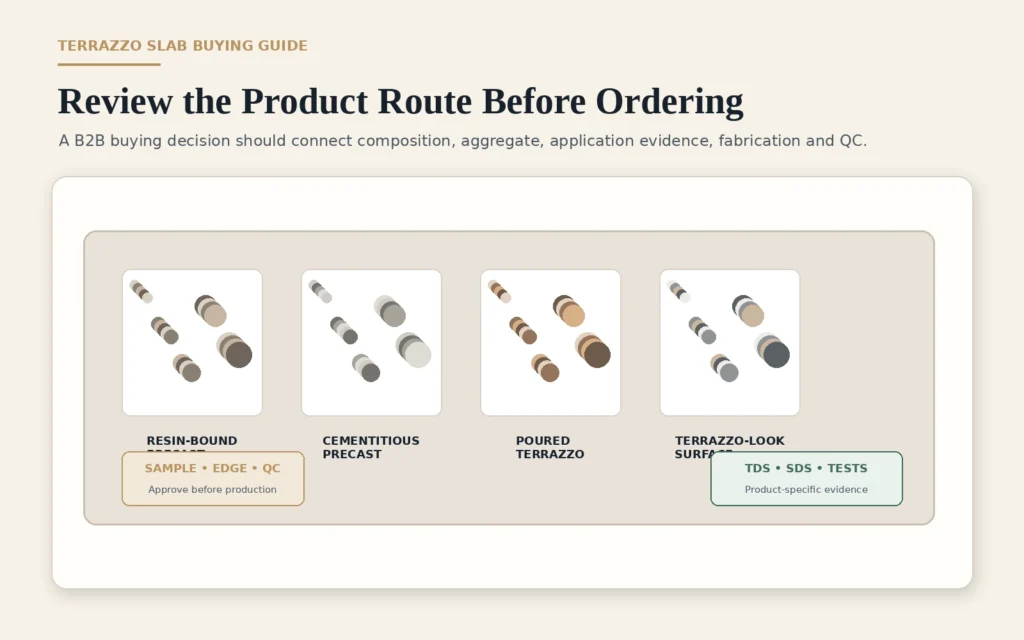
First, the word “terrazzo” does not identify one universal product. The National Terrazzo & Mosaic Association publishes separate technical information for epoxy, cementitious and other terrazzo systems. As well as precast and vertical applications. Review the NTMA technical specifications for system distinctions.
| Product Route | Supply Form | Buyer Questions | Do Not Assume |
|---|---|---|---|
| Resin-bound precast terrazzo slab | Factory-produced slab or component with a polymer/resin matrix and decorative aggregates. | Exact binder, aggregate, fabrication guide, heat/chemical limitations, finish and indoor/outdoor approval. | That all resin systems are identical or compatible with every engineered-stone fabrication setting. |
| Cementitious precast terrazzo slab or unit | Factory-produced slab, tile, stair tread, panel or custom unit with a cement-based matrix. | Density, absorption, sealing, reinforcement, edge design, installation, curing history and exterior evidence. | That it behaves like resin-bound quartz or that it is automatically suitable outdoors. |
| Poured terrazzo system | Site-installed or contractor-installed floor or vertical system. | System thickness, substrate, divider strips, curing, grinding, installer qualifications and site schedule. | That slab pricing or slab fabrication rules can be used to estimate the installed system. |
| Terrazzo-look quartz or printed surface | Engineered surface using a terrazzo-style visual rather than a full-depth terrazzo aggregate structure. | Pattern route, edge appearance, repeat, print depth, color control and full-slab visual. | That a terrazzo visual proves full-depth aggregate composition. |
Commercial comparison rule: Compare like with like. A resin-bound precast slab, a cementitious slab. A printed terrazzo-look surface and a poured floor system should not be treated as four quotations for the same product.
2. Review the Binder, Matrix and Declared Composition
First, “Binder + aggregate” is a useful starting concept, but not a complete product specification. Ask for the exact matrix or binder description, aggregate/filler declaration, pigment route, reinforcement where used. And any recycled-content claim that will appear in project documentation.
Composition Evidence
Product data sheet, SDS, declared density, binder type, aggregate description, reinforcement statement and available composition or recycled-content documents.
Performance Evidence
First, product-specific test reports relevant to the application, such as absorption. Stain resistance, wear, slip, flexural behavior, chemical resistance, heat, UV or freeze-thaw.
Fabrication Evidence
Cutting, drilling, edge, support, cooling, tooling and handling instructions for the exact product route.
Maintenance Evidence
Cleaning products, sealing requirements, permitted refinishing and repair guidance for the selected finish and application.
First, do not infer low absorption, food-service suitability, exterior use or “no sealing required” from the word resin. Do not infer outdoor durability, heavy-traffic performance or mandatory sealing from the word cement. Specifically, those are product- and system-specific conclusions.
3. Approve Aggregate Type, Grading and Distribution
First, terrazzo can use marble, granite, quartz, glass, porcelain, mirror, mother-of-pearl and other permitted aggregates. NTMA materials information reflects this broad range. But the actual chip grading, shape, color, distribution and permitted variation must come from the selected supplier and product. See the NTMA industry overview.
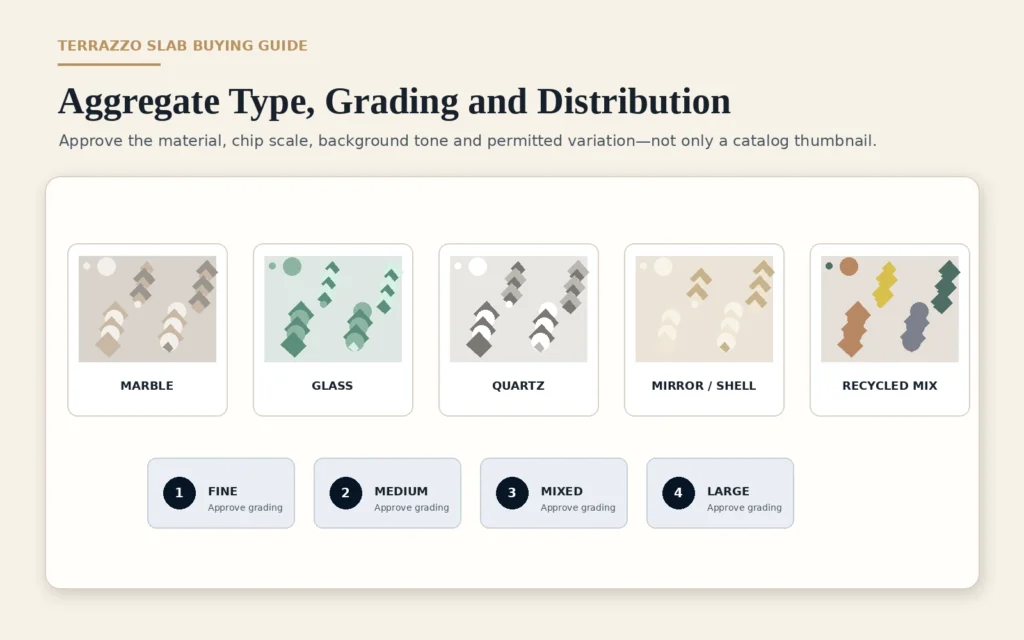
| Aggregate Variable | What It Changes | Evidence to Approve |
|---|---|---|
| Material type | Color, hardness, reflectivity, chemical response, edge character and polishing behavior. | Material declaration, sample, edge sample and relevant test evidence. |
| Chip grading | Fine, medium, mixed or large-chip visual scale. | Declared grading range or approved product reference. |
| Chip shape | Rounded, angular or irregular appearance and possible edge behavior. | Close-up sample, full-slab image and fabrication trial. |
| Distribution | Visual density, clustering, empty zones and slab-to-slab variation. | Approved reference, full-slab visual rule and batch comparison. |
| Background matrix | Contrast, overall tone and perceived variation between batches. | Physical sample, color reference and permitted tone range. |
| Special inclusions | Reflective, translucent, recycled or decorative effects. | Exact product declaration and application-specific durability evidence. |
First, Visual variation needs a written rule. “Natural variation” should not be used as an unlimited exception. Define what constitutes acceptable distribution, clustering, voids, background-tone variation and adjacency between visible slabs.
4. Confirm Slab, Tile and Precast Component Formats
First, artificial terrazzo may be offered as full slabs, tiles, stair treads, wall panels, vanity pieces or other precast components. There is no universal terrazzo slab dimension or thickness. Specifically, format availability depends on the binder, aggregate, press or casting route, reinforcement, finish, product and order.
For each quotation, separate:
- nominal or marketed format;
- guaranteed finished dimensions;
- minimum usable cutting area;
- thickness range and within-piece variation;
- edge condition and squareness;
- declared density and calculated unit weight;
- maximum recommended fabricated piece;
- packing and handling orientation.
First, use the Quartz Slab Dimension Tolerances & RFQ Guide for nominal, finished and usable-size wording. Where the project uses factory-finished pieces, review Cut-to-Size Project Supply.
First, Thickness is not a substitute for a fabrication trial. A thicker slab may change stiffness, edge appearance and weight. But it does not independently prove that chipping, voids, cutouts or edge durability have been controlled.
5. Approve the Finish with a Measurable Reference
First, common finish descriptions include polished, honed/matte and textured or application-specific finishes. Do not assign a universal gloss range to these names unless the supplier provides the instrument. Specifically, angle, measurement points and permitted range for the exact product.
| Finish Review | Buyer Requirement | Risk if Omitted |
|---|---|---|
| Approved visual | Physical sample or larger reference showing matrix and aggregate at the selected finish. | Catalog rendering does not match actual sheen or aggregate exposure. |
| Surface acceptance | Written criteria for pinholes, voids, resin fill, exposed aggregate, polishing marks and touch-up. | “Terrazzo character” is used to justify avoidable surface defects. |
| Slip or wear evidence | Product-specific data where flooring or wet-area use is proposed. | Finish is selected visually without confirming functional requirements. |
| Maintenance route | Cleaning, sealing, refinishing and repair instructions. | Incorrect cleaners or maintenance methods change the finish. |
6. Approve the Product for the Intended Application
Application approval should be evidence-based. A product that performs adequately as an indoor wall panel is not automatically suitable for a hotel floor, food-service counter or exterior façade.
| Application | Evidence and Design Questions |
|---|---|
| Countertop, vanity or tabletop | Stain and chemical exposure, absorption, heat limitations, cutouts, support, edge design, seam strategy, cleaning and repair. |
| Flooring | Wear, slip, substrate, load, piece size, joints, installation system, cleaning and refinishing. |
| Wall cladding | Unit weight, backing, fixing system, panel size, edge treatment, substrate and movement. |
| Stairs and precast units | Geometry, reinforcement, nosing, support, lifting points, installation tolerances and replacement strategy. |
| Exterior use | UV, absorption, freeze-thaw where relevant, thermal cycling, fixing, drainage, sealing and local climate. |
| Food-service or chemical exposure | Product-specific chemical and stain data, cleaning agents, hygiene requirements and local compliance review. |
First, total installed cost should be compared by project scope. Precast slabs may simplify selected logistics or installation steps compared with a poured system. But transport, fabrication, substructure, seams, edge work, installation and maintenance can change the final economics.
7. Require Fabrication Instructions and an Edge Trial
First, some resin-bound precast terrazzo products may be processed with equipment commonly used for engineered stone. That does not mean the same blade, feed rate, cooling, support, drilling, edge sequence or polishing process should be used without review.
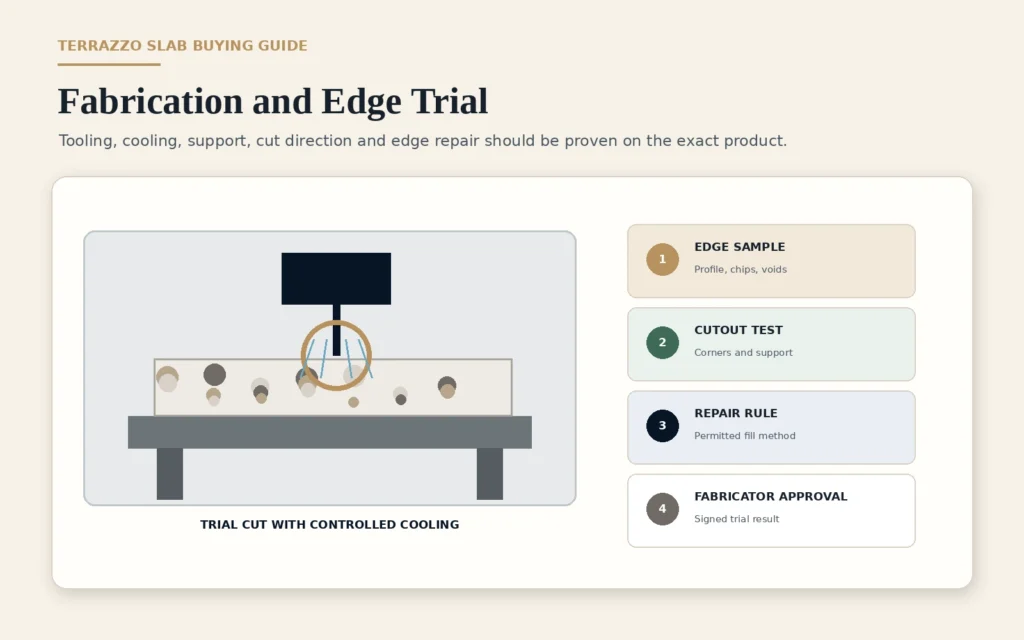
Before a production order involving exposed edges, large cutouts, thin strips or high-value components, request:
- the supplier’s fabrication instructions for the exact product;
- a trial cut across representative aggregate zones;
- an exposed-edge sample at the specified profile;
- a drill or cutout trial where sinks, faucets or fixings are required;
- confirmation of support, handling and lifting requirements;
- a written method for filling or repairing permitted edge voids;
- approval by the destination fabricator before production release.
First, Do not normalize chipping as “physics.” Chipping may be influenced by aggregate. Binder, voids, cure, blade, feed rate, cooling, support, cut direction and edge distance. Specifically, record the trial method and result instead of assuming that a thicker slab automatically solves the problem.
8. Review Composition, SDS and Fabrication Dust Controls
First, a product name such as “terrazzo” does not prove that the material is silica-free. Terrazzo may contain quartz, granite, sand or other crystalline-silica-bearing constituents, while some products use alternative fillers. Specifically, review the exact SKU, SDS, composition declaration and available test evidence.
First, oSHA explains that cutting, grinding and polishing stone and engineered-surface products can create hazardous respirable crystalline silica exposure. Product selection does not replace engineering controls, wet methods, ventilation, housekeeping, respiratory protection where required, training or local workplace compliance. Specifically, see OSHA crystalline silica guidance.
First, Procurement file: Keep the SDS and composition evidence linked to the product code. Batch, fabrication instructions and destination-market review. Specifically, do not use a generic “terrazzo” SDS for every product route.
9. Build Terrazzo-Specific QC into the Order
Terrazzo QC should combine dimensional and surface inspection with an approved visual reference and batch traceability.
| QC Item | What to Define | Evidence |
|---|---|---|
| Background tone | Approved reference and permitted tone range. | Physical sample, reference image and batch comparison. |
| Aggregate distribution | Permitted density, clustering, empty zones and adjacency variation. | Full-slab visual sampling and written acceptance rule. |
| Voids and pinholes | Maximum size, frequency, location and permitted repair route. | Close-up images and inspection record. |
| Surface finish | Approved finish, polishing marks, resin fill and exposed-aggregate criteria. | Reference sample and finish inspection. |
| Edge integrity | Permitted voids, chipping, repair and exposed-edge standard. | Edge trial and representative finished piece. |
| Dimensions and thickness | Finished size, usable area, thickness map, squareness and measurement method. | Slab- or piece-level dimensional record. |
| Traceability | Product, batch, bundle, slab or component identification. | Labels, packing list and QC record linkage. |
| Packing and loading | Protection, separator, rack, restraint and loading plan. | Packing photos, loading photos and shipment records. |
First, use the Quartz Slab QC & Packing Guide as the base workflow. Then add the terrazzo-specific visual, void, aggregate and edge criteria above.
10. Use a Sample-to-Batch Approval Workflow
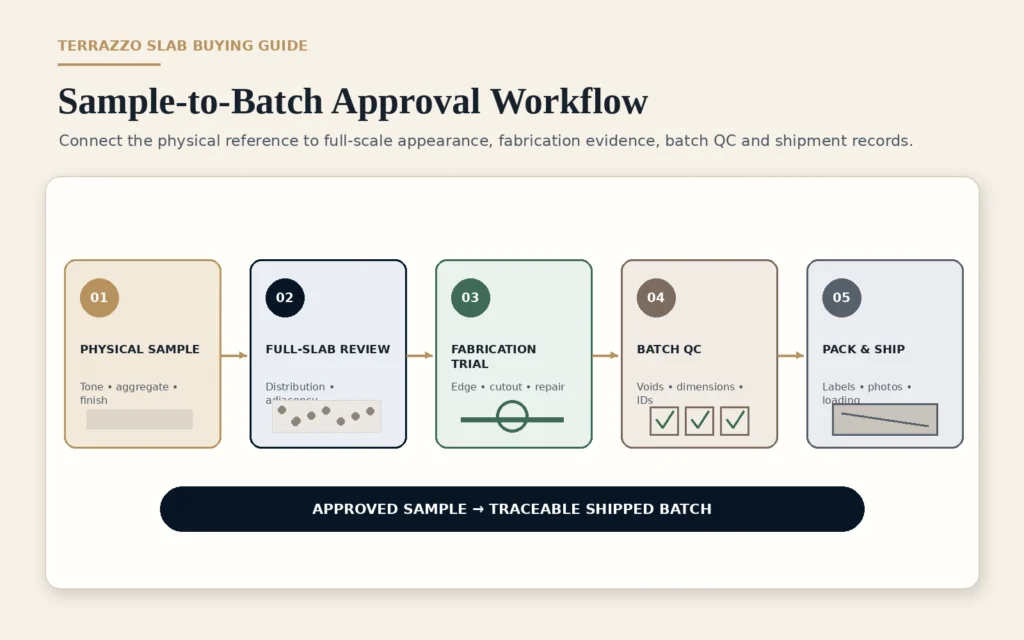
Step 01Define Route
Confirm binder, aggregate, finish, application and required documents.
Step 02Approve Sample
Review matrix tone, chip type, grading, finish and edge sample.
Step 03Review Full Scale
Check full-slab or full-component appearance, distribution and visible adjacency.
Step 04Release Batch
Approve QC records, labels, packing, loading and written deviations.
First, a small sample is useful for color and material review. But it cannot represent every chip distribution, void, full-slab relationship or finished edge. For large visible areas, require larger visuals or reference pieces before approving production.
11. RFQ and Purchase-Order Requirements
PRODUCT ROUTE
Product code / collection:
Resin-bound precast / cementitious precast / other:
Binder or matrix declaration:
Aggregate materials and grading:
Background color / approved reference:
Finish:
Production origin:

APPLICATION
Intended use:
Indoor / exterior:
Exposure conditions:
Required test or compliance documents:

FORMAT
Nominal format:
Guaranteed finished size:
Thickness range:
Minimum usable area:
Edge condition:
Density / unit weight:
Maximum fabricated piece where relevant:

VISUAL AND QC
Approved physical sample:
Full-slab or full-component reference:
Permitted aggregate-distribution variation:
Permitted tone variation:
Void / pinhole criteria:
Edge acceptance and repair rule:
Dimensional measurement method:
Inspection sample plan:
Batch / bundle / slab traceability:

FABRICATION AND INSTALLATION
Fabrication guide required:
Trial cut / edge / cutout approval:
Support and lifting requirements:
Installation or sealing instructions:
Maintenance instructions:

COMMERCIAL
Quantity / MOQ:
Lead time:
Packing route:
Loading plan:
Nonconformity and approval authority:
First, Do not write “industry standard” without a document. Every numerical requirement should identify the supplier document. Test report, approved sample or signed quality agreement that supports it.
12. Compare Suppliers by Evidence, Not General Quartz Capability
First, a supplier may have strong quartz production but limited experience with the selected terrazzo route. Ask for evidence tied to terrazzo rather than general factory scale.
Product Capability
Current terrazzo collection, binder routes, aggregate handling, finishes, formats, edge samples and custom-development process.
Process Control
Mixing, distribution, void control, cure, calibration, finishing, repair and batch-separation records.
Evidence Quality
Product-specific TDS/SDS, test reports, sample-to-batch linkage, dimensional records, full-slab visuals and inspection documents.
Project Execution
Drawing review, fabrication communication, packaging, loading, replacement planning and documented nonconformity handling.
First, aggregate origin can matter where color, grading or repeat supply is critical. But the buyer should request a practical continuity plan rather than assuming imported aggregates are automatically better. Specifically, ask how the supplier controls approved references, alternate sources, retained samples and repeat-order matching.
13. Buyer Checklist Before Approval
- Identify whether the quotation is for resin-bound precast, cementitious precast, poured terrazzo or a terrazzo-look engineered surface.
- Obtain product-specific TDS, SDS and composition evidence.
- Approve aggregate material, grading, background tone and permitted distribution variation.
- Confirm format, finished dimensions, usable area, thickness, density and unit weight.
- Approve finish, void, pinhole and exposed-aggregate criteria.
- Review application-specific performance evidence.
- Request fabrication instructions and complete an edge or cutout trial where relevant.
- Review silica-bearing constituents and fabrication dust controls.
- Define dimensional, visual, edge and traceability QC in writing.
- Link samples, full-slab visuals and QC records to the shipped batch.
- Confirm packing, rack, restraint, loading and destination handling.
- State how repaired, downgraded, held or rejected material will be handled.
- Confirm MOQ, lead time, custom-development route and repeat-order limitations by quotation.
FAQ:
First, no. Factory-produced terrazzo may use resin or cementitious matrices and may be supplied as slabs, tiles or precast components. Confirm the exact product route.
First, some resin-bound products may use equipment commonly found in engineered-stone shops. But tooling, feed rate, cooling, support, edge sequence and fabrication approval remain product-specific.
First, no. Thickness can affect stiffness and edge geometry. But chipping also depends on binder, aggregate, voids, cure, tooling, feed rate, cooling, support and cut design. Specifically, use a representative trial.
First, do not assume. Follow the exact product’s maintenance and installation instructions. Specifically, sealing requirements can vary by binder, finish, application and supplier.
Potentially, but the product and installation system must be approved for wear, slip, substrate, joints, piece size, maintenance and project conditions.
First, no. Some terrazzo products may contain quartz, granite, sand or other crystalline-silica-bearing constituents. Review the exact SDS, composition declaration and available test evidence.
First, connect the approved sample to larger-format visuals, full-slab or full-component review. Product-specific documents, fabrication trials, QC records, labels, packing and shipment evidence.
First, not necessarily. A terrazzo-look surface may use printed, pigmented or distributed decorative effects without the same full-depth aggregate structure. Confirm the product route and edge appearance.
Related reading:
- Artificial Terrazzo Slabs
- Terrazzo vs Quartz: B2B Procurement Guide
- Quartz Slab QC & Packing Guide
- Quartz Slab Dimension Tolerances & RFQ Guide
- Cut-to-Size Project Supply
- Request Samples and Product Documents
Sources and methodology
- National Terrazzo & Mosaic Association — Technical Specifications. Used to distinguish terrazzo systems and precast/vertical application routes.
- National Terrazzo & Mosaic Association — Industry Overview. Used for broad aggregate-material context.
- OSHA — Crystalline Silica. Used for fabrication-dust and workplace-control context.
- ASTM C616/C616M-22. Used only to clarify that the standard concerns quartz-based natural dimension stone and is not an artificial-terrazzo slab specification.
- BS EN 14618:2009 — Agglomerated Stone, Terminology and Classification. Used for terminology and classification context, not as a universal terrazzo performance or tolerance standard.
First, Method: This guide separates product route, composition, aggregate approval. Format, finish, application evidence, fabrication, dust review and order-level QC. Specifically, it does not present universal chip sizes, weights, gloss ranges, dimensions, prices, MOQs, lead times or application approvals.
First, Limitations: This is general B2B procurement guidance. Product-specific TDS, SDS, test reports, fabrication manuals, approved samples, drawings, installation requirements and signed quality agreements take priority.
First, Information status: Reviewed July 28, 2026. Product portfolios, technical documents, standards and workplace requirements may change.
First, Research and AI disclosure: Research and drafting tools assisted with source collection, structure and language review. Final technical claims and AsiaQuartz-specific information require human editorial and technical approval before publication.
Review the Exact Terrazzo Product Before Ordering
First, share the application, selected product or visual reference, format, finish, quantity, destination, required documents and QC expectations. AsiaQuartz can review the product route, samples, full-slab visuals, fabrication requirements, packing and supply plan.