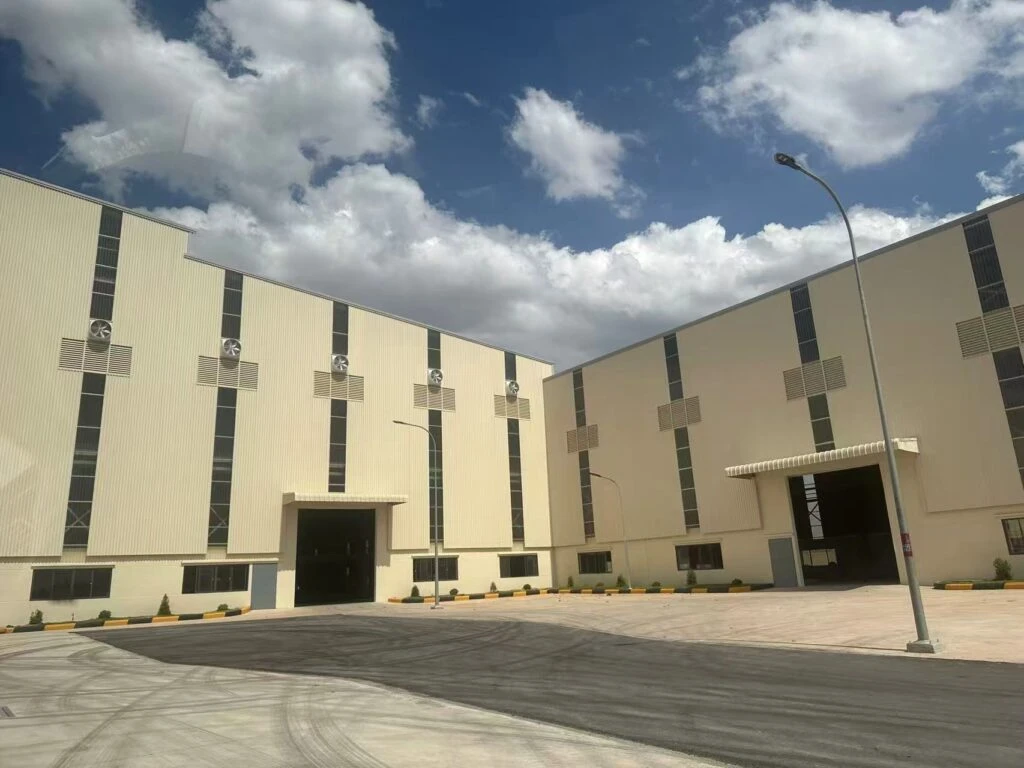
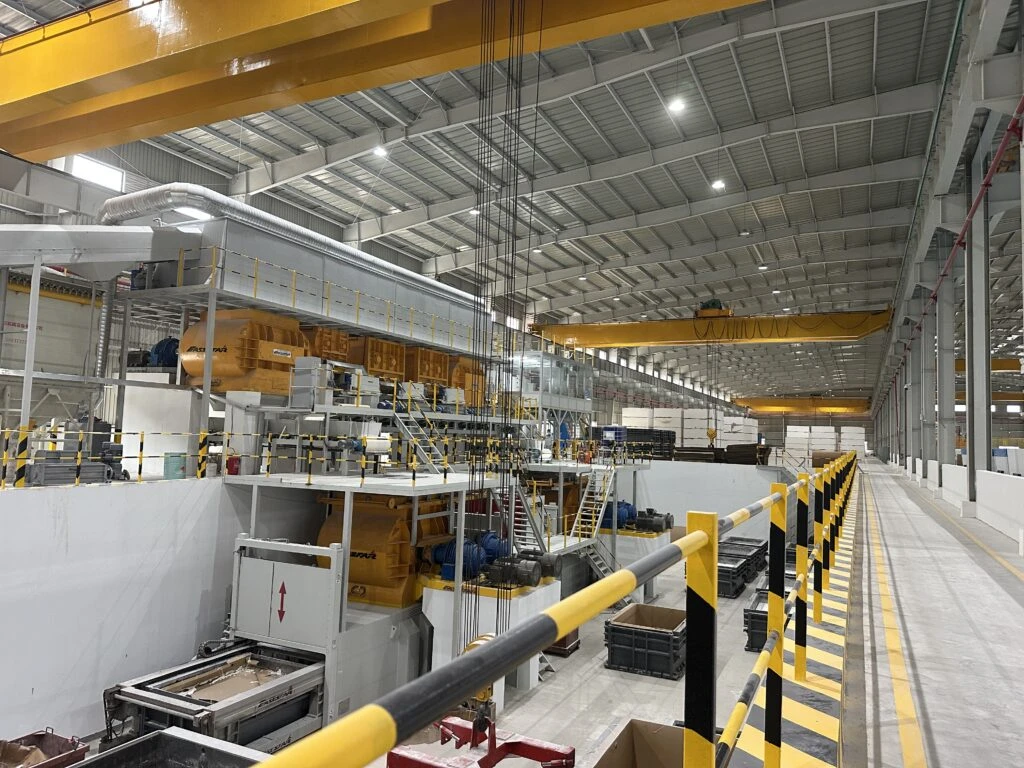
Prepared by: AsiaQuartz Editorial Team
Technical review by: AsiaQuartz Product, QC & Supply Chain Team
Last updated: July 2026
Quick answer: For a conventional resin-bound, vacuum-vibro-compressed quartz line, buyers can evaluate the factory through seven practical system groups: raw-material control, mixing, distribution, vacuum vibro-compression, curing, cooling and demolding, and final calibration/cutting/polishing. This is an evaluation framework—not a universal industry standard. Equipment capability should be verified through current condition, maintenance, process records and finished-product results rather than brand or age alone.
Scope boundary: This article focuses on conventional resin-bound slab production using vacuum vibro-compression and heat curing. Other engineered-surface routes—including resin-bound zero-silica, cementitious, geopolymer, wet-cast and printed-surface systems—may combine, replace or add production stages.
A sample proves that a factory can make at least one acceptable piece. It does not prove that the line can repeat the result over a complete order. A stronger supplier review connects the factory-floor process with batch records, maintenance evidence and inspection results from actual production.Table of Contents
- How to Use This Framework
- Raw-Material Batching
- Mixing and Cleanout
- Distribution and Pattern Formation
- Vacuum Vibro-Compression
- Curing System
- Cooling and Demolding
- Calibration, Cutting and Polishing
- Observation vs. Evidence
- Maintenance and Capacity
- Zero-Silica Route Boundaries
- Buyer Checklist
- FAQ
1. How to Use the Seven-System Framework
The seven groups below make a complex line easier to audit. A factory may use a different layout, combine equipment or add decorative, printing, backing, sealing or automated-inspection systems. The question is not whether the floor plan matches this article. The question is whether each required process function is controlled, recorded and connected to finished-slab acceptance.
| System Group | What It Controls | Buyer Evidence |
|---|---|---|
| Raw-material control | Identity, proportion, moisture, contamination and traceability | Approved formulation, lot records, scale calibration and storage controls |
| Mixing | Dispersion, wetting, color distribution and batch repeatability | Batch sequence, mixer cleanout, timing records and retained samples |
| Distribution | Material placement, thickness preform and decorative layout | Standard work, design reference and operator or automation controls |
| Pressing | Compaction, de-airing, density and dimensional formation | Approved process range, trend records, maintenance and finished-product tests |
| Curing | Binder polymerization or hardening profile | Product-specific time and temperature records and cure verification |
| Cooling/demolding | Handling readiness, dimensional stability and damage prevention | Defined release criteria, handling method and nonconformance records |
| Finishing | Thickness, dimensions, edge quality, surface finish and final inspection | Measurement plan, tooling maintenance, finish criteria and QC records |
2. Raw-Material Storage, Identification and Batching
Assess whether the factory can connect each finished slab to controlled inputs. Look for clearly identified materials, protected storage, defined shelf-life or condition controls where applicable, calibrated weighing equipment and a record that captures the actual batch—not only the target recipe.
- Segregation: Aggregates, powders, pigments, binders, initiators and additives should be protected from unintended mixing.
- Lot traceability: The factory should be able to link material lots to a production batch and finished-slab IDs.
- Measurement capability: Scale capacity and resolution should be appropriate for the amount being dosed; the approved tolerance must come from the product and process specification.
- Material condition: Moisture, temperature, contamination and storage age may affect formulations differently and should be controlled where relevant.
A tidy storage area is not enough. Request a recent batch record and compare the material IDs and recorded quantities with what is physically in use.
3. Mixing, Dispersion and Cleanout Between Products
The mixer must produce a repeatable compound suitable for the next forming stage. Buyers should not infer performance from mixer type alone. Evaluate whether the equipment is appropriate for the formulation, whether the operating sequence is defined and whether the factory controls residue during color or product changeovers.
- Is the charging order documented?
- Are mixing time, speed or other relevant parameters recorded?
- Does the factory define a cleanout and release check before switching colors or formulations?
- Are changes made through an approved process, or by undocumented operator judgment?
- Can the mixer feed the forming station without uncontrolled waiting or premature reaction?
4. Distribution, Paving and Decorative Pattern Formation
Distribution controls how the compound reaches the mold, belt or tray and how decorative components are placed. Manual work is not automatically inferior, and automation is not automatically consistent. Both require a defined method, trained operators and a reference standard.
Buyer question: Ask which aspects of a design are machine-controlled, which depend on operator technique and how the approved pattern is compared with production. This reveals the real repeatability model more clearly than the word “automatic.”
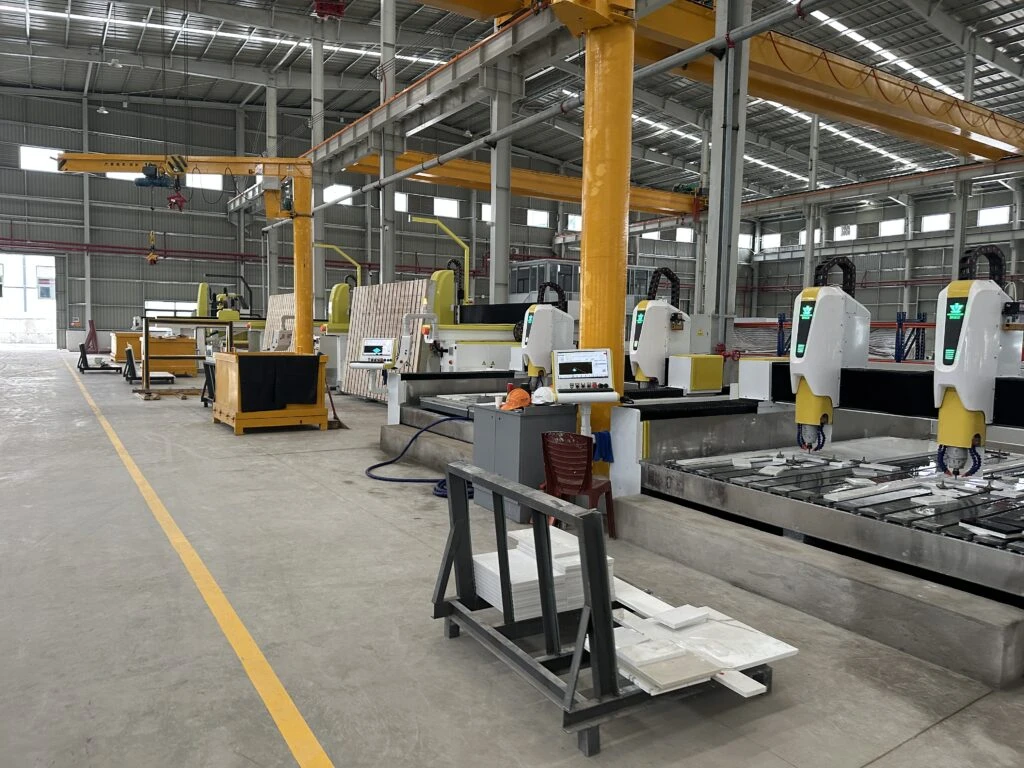
5. Vacuum Vibro-Compression: The Forming Stage
Published engineered-stone processes commonly use a vacuum vibration press to compact a mixture of mineral or stone-like particles and a binder. The required vacuum, vibration, pressure and cycle sequence are product- and equipment-specific; this article does not provide universal operating values.
What buyers can observe
- control-panel stability and alarm history;
- condition of seals, membranes, molds, belts and contact surfaces;
- repeatability of the operating sequence;
- evidence of preventive maintenance rather than only breakdown repair;
- how deviations are identified, quarantined and linked to slab IDs.
What buyers should not assume
A changing gauge reading does not prove a specific defect, and a steady display does not prove correct compaction. Confirm the approved equipment range, sensor calibration, historical trends and finished-product data such as density, water absorption or other product-specific tests.
6. Curing System and Product-Specific Cure Profile
For conventional polyester-resin quartz, curing commonly involves controlled heating that hardens the binder. The appropriate oven design, zone arrangement, time, temperature and cooling transition belong to the exact formulation and equipment.
- Confirm that the product has an approved cure profile.
- Review how temperature is monitored, recorded and associated with a batch.
- Check whether sensors are calibrated and whether the factory reviews deviations.
- Ask how the factory confirms cure adequacy beyond simply completing an oven cycle.
- Review whether line loading and conveyor or batch timing remain within the approved process.
Multi-zone control may offer useful process flexibility, but the number of zones alone does not prove product quality. Evidence must show that the actual slab received the approved thermal treatment.
7. Cooling, Demolding and Intermediate Handling
Cooling and demolding should occur under product-specific release criteria. Observe spacing, support, rack condition, contact protection and the handling method used before the slab reaches final finishing.
Warping, cracking or edge damage can have multiple causes—including formulation, forming, curing, cooling, support and handling. Record the condition, then use batch history and measurement data to determine where follow-up is needed.
8. Calibration, Cutting, Polishing and Final Inspection
The finishing line converts the formed slab into the ordered thickness, size and surface finish. Evaluate the system as a chain rather than counting polishing heads or judging gloss by eye.
Calibration
Review multi-point thickness measurements, equipment condition, tool-change control and the method used to verify flatness or thickness tolerance.
Cutting
Check dimensional measurement, squareness, edge condition, blade or tool maintenance and how nonconforming slabs are identified.
Polishing
Review the approved abrasive sequence, water quality, head condition, surface reference and any instrumented finish requirement.
Final QC
Confirm lighting, measurement points, slab identification, defect classification, retained references and release authority before packing.
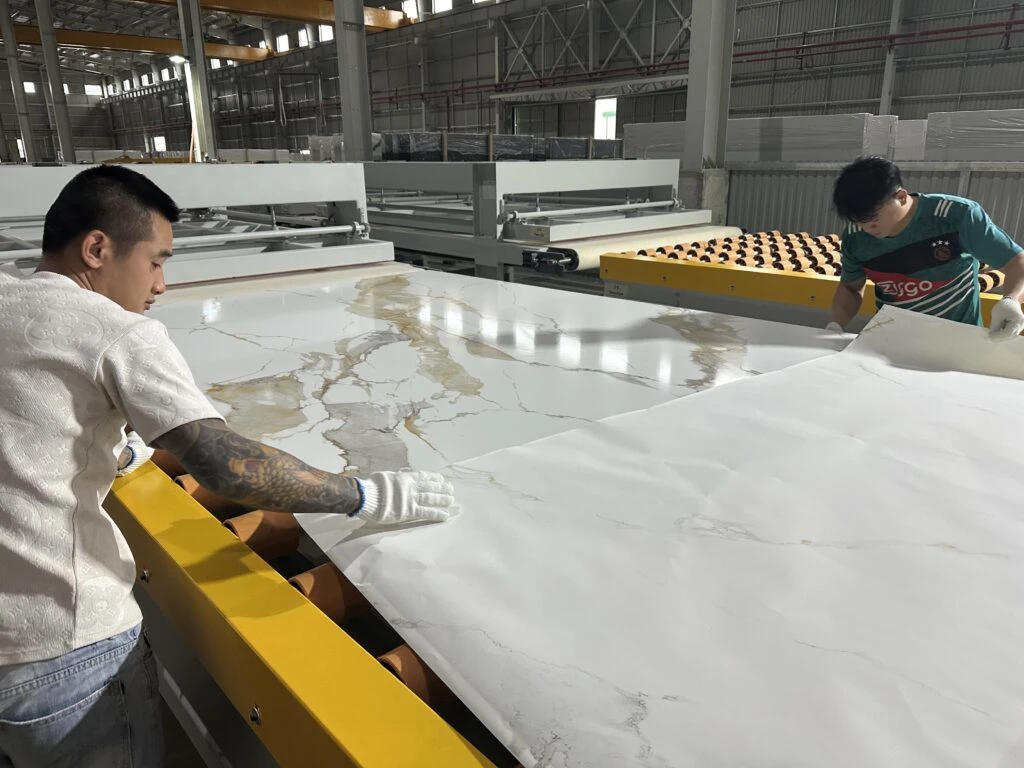
9. Use “Observation → Possible Implication → Confirmation Evidence”
| Observation | Possible Implications | Evidence Needed |
|---|---|---|
| Vacuum or pressure trend appears unstable | Sensor, seal, pump, hydraulic, control or material-feed variation | Approved range, calibration, alarm/trend data, maintenance and product results |
| Visible bow or twist after curing | Formulation, forming, cure, cooling, support or storage issue | Flatness measurements, batch record, cure profile and handling review |
| Repeated surface marks | Mold, belt, handling, calibration or polishing source | Mark pattern, equipment inspection and affected slab traceability |
| Color variation across production | Raw material, batching, mixing, cure, finish or lighting difference | Retained reference, controlled-light comparison, batch data and color records where specified |
10. Equipment Condition, Maintenance and Real Capacity
Brand, installation date and nameplate capacity are useful context, but none is sufficient alone. Evaluate preventive maintenance, critical spare-parts strategy, calibration history, recurring alarms, actual qualified output for the target product, operator training and change-control discipline.
Use records to distinguish isolated maintenance events from recurring capability limits. Do not assume that an older line is poor or that a new line is stable.
11. What Changes for Zero-Silica and Low-Silica Products
Zero-silica is a composition claim, not one equipment architecture. A resin-bound product using alternative fillers may retain much of the conventional line structure, while a cementitious or geopolymer product may need different mixing, forming, curing, storage and finishing systems.
For a route-by-route comparison, read Zero-Silica Production Lines vs. Traditional Quartz. For an on-site audit workflow, use the Quartz Factory Visit Checklist.
12. B2B Buyer Checklist
- Confirm the exact product route and approved specification.
- Map the factory’s real layout to the required process functions.
- Request batch, maintenance, calibration and finished-QC records.
- Observe normal production where possible and document operating conditions.
- Separate visual observations from unconfirmed root-cause conclusions.
- Link equipment capability to actual test data and order-specific tolerances.
- Review qualified output, bottlenecks, spare parts and contingency capacity.
- Confirm how rejected material is identified, segregated and dispositioned.
FAQ:
No. Seven systems are used here as a practical buyer-evaluation framework for a conventional resin-bound vacuum-vibro-compressed line. A factory may combine, split or add stages.
No. Brand and original design matter, but current condition, maintenance, control capability, operator competence and verified production results must be reviewed together.
No. A visit can show process controls and evidence gaps, but long-term performance requires product-specific test data, retained samples and field history.
Request an equipment list, maintenance and calibration records, a recent batch record, the product specification and evidence linking process controls to finished-slab QC.
Sometimes, depending on the aggregate and binder route. A resin-bound zero-silica formulation may retain much of the line architecture, while cementitious or other inorganic systems may require major changes.
Record the observation, list possible implications and identify the records or product tests needed to confirm the cause. Do not treat one visual signal as a definitive diagnosis.
Review a Quartz Factory or Production Route
Share the product, destination market, expected volume, factory location and available technical records. AsiaQuartz can help structure a supply and production-capability review.