Prepared by: AsiaQuartz Editorial Team
Technical review by: AsiaQuartz Product, QC & Supply Chain Team
Last updated: July 2026
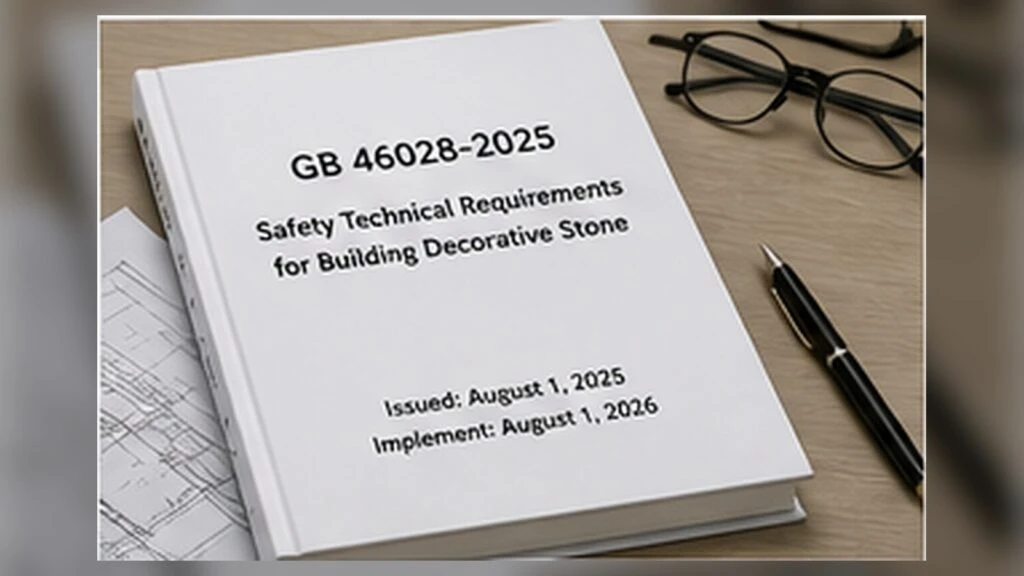
Status on July 31, 2026: GB 46028-2025, Safety Technical Requirements for Building Decorative Stone, was published on August 1, 2025 and takes effect on August 1, 2026. It is a mandatory Chinese national standard. This guide is commercial procurement guidance, not a clause-by-clause legal interpretation.
A new mandatory Chinese standard is about to enter force, and the stone industry has reduced it to a memorable headline: thin stone cannot be dry-hung on walls. That summary is useful for attracting attention, but it is too broad for purchasing decisions.
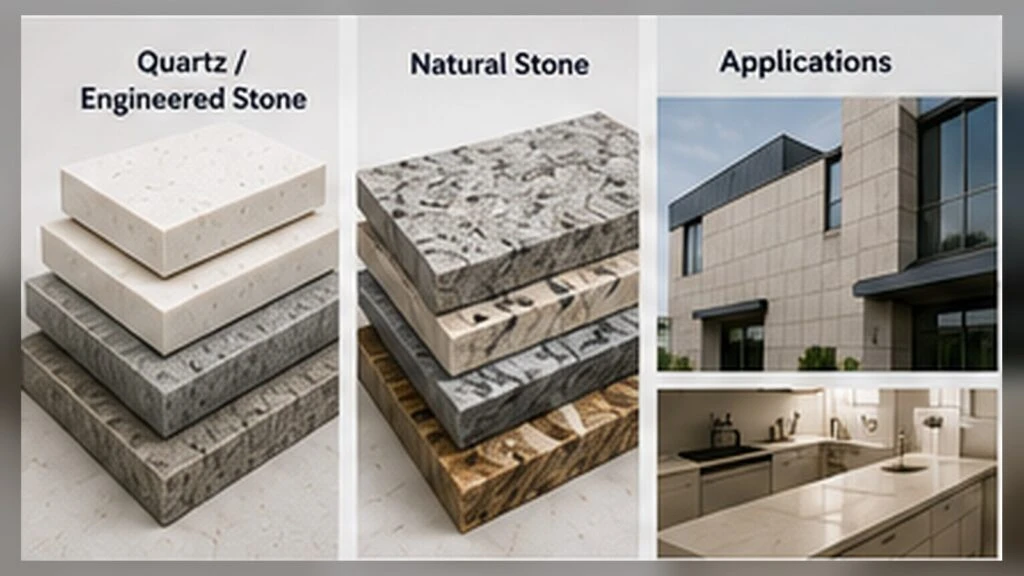
GB 46028-2025 covers building decorative natural stone, engineered or agglomerated stone, and certain adhesives and protective agents used in production or installation. For an international quartz buyer, the practical question is not simply, “Is the factory compliant?” It is:
- Does the standard apply to this product, use and transaction?
- Which clause and test method support the supplier’s claim?
- Does the evidence identify the same SKU, construction and production route being shipped?
- What separate destination-country requirements still apply?
1. What the Official Record Confirms
The National Public Service Platform for Standards identifies GB 46028-2025 as a mandatory national standard under the Ministry of Industry and Information Technology. Its official scope covers safety technical requirements, test methods, inspection rules and other requirements for building decorative natural stone, engineered stone, and relevant adhesives and protective agents.
| Item | Official status | Buyer implication |
|---|---|---|
| Standard | GB 46028-2025 | Use the exact number and edition in supplier requests. |
| Chinese title | 建筑装饰石材安全技术要求 | Ask suppliers and laboratories to quote the same title. |
| Publication date | August 1, 2025 | Do not confuse publication with effective date. |
| Effective date | August 1, 2026 | Evidence and contracts should use the effective edition from that date. |
| Standard type | Mandatory national standard | A voluntary company certificate is not a substitute for required product evidence. |
2. The Most Important Boundary: Dry-Hung Wall Stone Is Not the Same as a Countertop Slab
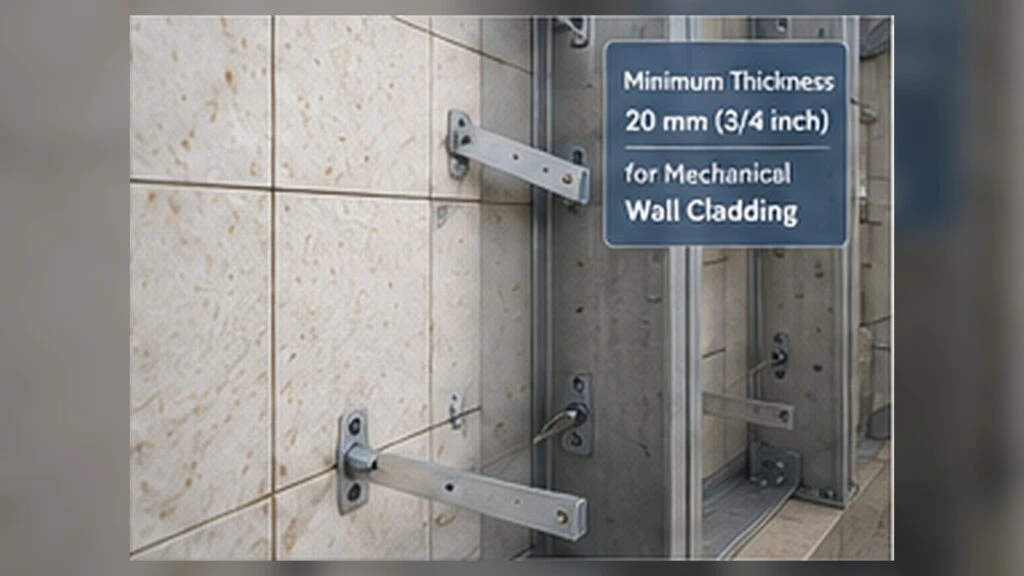
The standard contains requirements for stone panels used in dry-hung installations. That is a mechanically fixed wall or façade application. It is not the same construction condition as a kitchen countertop supported by cabinets, a vanity top, a furniture panel or a cut-to-size component bonded to a substrate.
Do not turn a dry-hanging rule into a universal thickness rule. A statement such as “stone under 20 mm is prohibited” is incomplete unless it identifies the material category, finish, application and installation method. A 15 mm countertop slab and a dry-hung exterior panel are different products in different risk conditions.
Before asking whether a slab is compliant, define the intended use in writing:
- countertop or vanity;
- interior bonded wall panel;
- interior mechanically fixed panel;
- exterior façade or dry-hung cladding;
- flooring, stairs or other architectural component.
The supplier should then map the product to the relevant standard clause and test report. A generic statement that “our factory meets the new GB standard” is not enough.
3. What the Standard Does — and Does Not — Prove for an Export Buyer
It can strengthen the factory’s domestic quality-control baseline
A mandatory product-safety standard can push factories to formalize product classification, testing, inspection records and control of adhesives or protective agents. That is useful to buyers because it creates more structured evidence to request.
It is not an international product approval
GB 46028-2025 does not replace the destination market’s tariff classification, product regulation, workplace-silica rules, building code, food-contact requirements, project specification or customer warranty terms.
It does not automatically certify every export SKU
A factory may produce multiple slab constructions, thicknesses, formulations and product families. Evidence for one product should not be assumed to cover another. Export buyers should verify whether the report covers the actual product, production facility and test edition.
Avoid unsupported marketing language. Do not advertise “GB 46028 certified,” “China safety approved,” or “fully compliant with all international standards” unless you possess product-specific evidence and understand exactly what the claim means. A safer statement is: “Product-specific reports are available for review against the agreed specification and applicable standards.”
4. Six Documents to Request from the Supplier
- Product classification statement. Identify whether the item is resin-bonded engineered stone, inorganic engineered stone, natural stone or another construction.
- Application statement. Countertop, bonded interior panel, dry-hung interior panel, exterior cladding or another use.
- Clause-and-test matrix. The supplier should identify which GB 46028-2025 requirements apply to the product and which test method supports each claim.
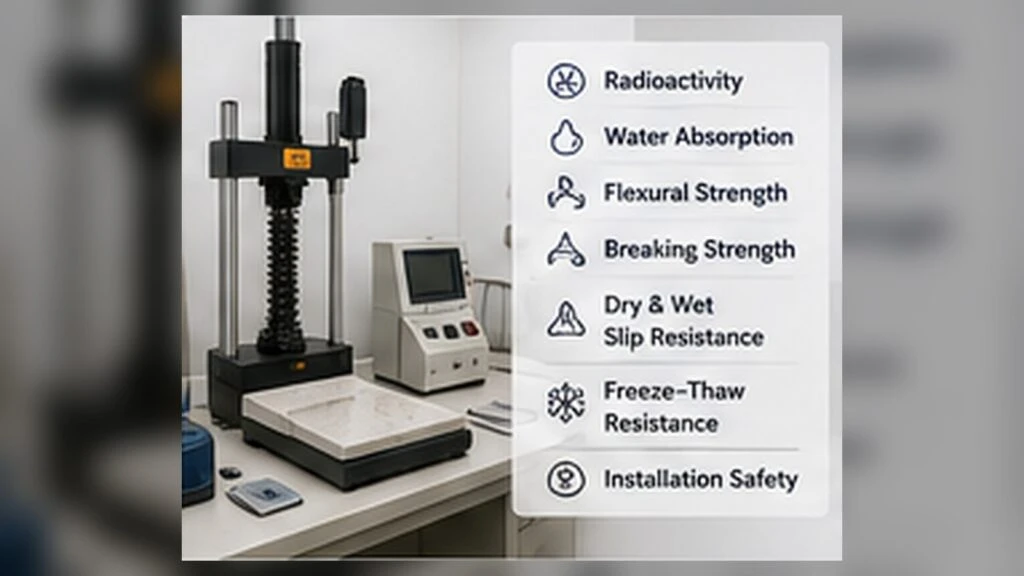
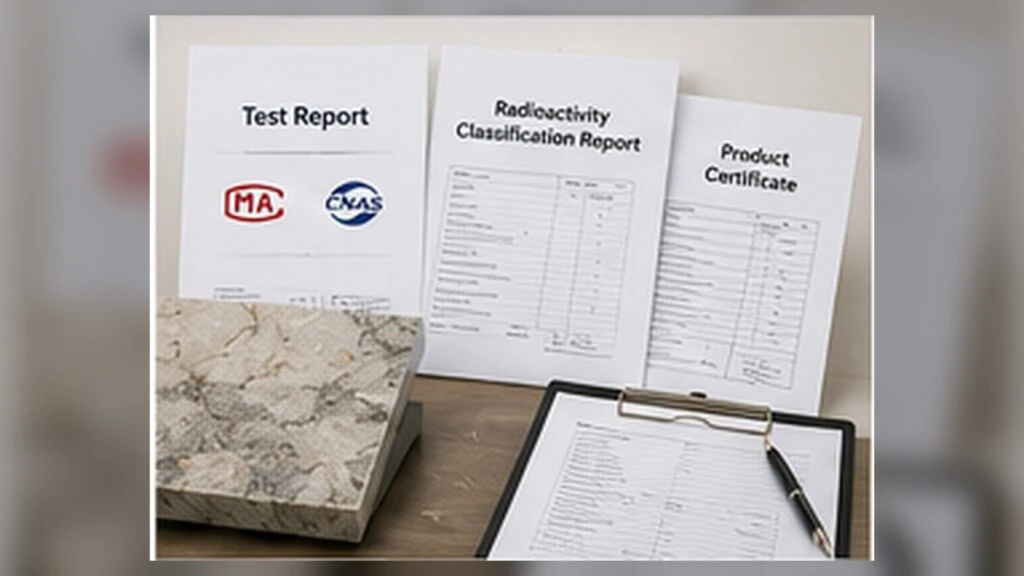
- Product-specific test reports. Reports should identify the legal manufacturer, factory, SKU, thickness, finish, specimen description, test method, report date and result.
- Batch or production traceability. Link the approved product and report to the production lot, slab labels, packing list and shipping documents.
- Change-control statement. Require written notification before changes to resin, aggregate, filler, reinforcement, backing, protective treatment, production facility or slab construction.
5. How to Review a Test Report
| Check | Acceptable evidence | Red flag |
|---|---|---|
| Product identity | SKU, dimensions, finish and construction match the order | Report uses a broad family name only |
| Manufacturer | Factory and legal entity are identifiable | Report belongs to another company or unexplained facility |
| Method | Exact standard and edition stated | “Tested to international standard” without a number |
| Result | Measured result and requirement shown separately | Only “PASS” appears, with no data or acceptance criterion |
| Laboratory scope | Laboratory competence and relevant accredited scope can be checked | Logo or accreditation mark is used without a verifiable scope |
| Traceability | Report sample can be linked to the ordered product and current formulation | Old report, different thickness or unclear sample source |
6. Questions to Ask a China Quartz Supplier
- Which GB 46028-2025 clauses apply to our exact product and intended use?
- Which legal entity and facility manufactured the tested sample?
- Does the report cover our slab thickness, finish, backing and formulation?
- What changed in your QC plan before the August 1, 2026 effective date?
- How will you notify us if the formulation, line or production facility changes?
- Which destination-market reports remain separate from the GB documentation?
Pair this standard with our GB-compliant silica-free surface documentation guidance to connect test evidence to a specific product and order.
7. What Buyers Should Do Now
For a repeat countertop order from an established factory, the standard should trigger a documentation review — not panic. Update the purchase specification, request the relevant product reports, and verify that the report identity matches the order.
For a new supplier, project wall application or unusual slab construction, go further: obtain a controlled copy of the standard, ask the supplier or laboratory for a written clause matrix, and have the intended application reviewed by the relevant designer, engineer or compliance professional.
Most importantly, keep three evidence packages separate:
- China product evidence: applicable GB requirements and factory records;
- destination evidence: local product, customs, safety and building requirements;
- commercial evidence: approved sample, PI, QC criteria, packing specification and batch records.
FAQ:
No. The widely discussed thickness provisions relate to defined stone-panel applications, including dry-hung installation. A countertop supported by cabinets is not the same application. Review the product and installation clause rather than applying one headline to every slab.
Do not assume that. The standard is a Chinese mandatory national standard, but the evidence required for a particular export transaction depends on product scope, contract, destination rules and the applicable Chinese legal framework. Ask for product-specific reports, not a generic certificate.
No. It can be part of the supplier evidence package, but it does not replace destination-country product requirements, workplace-silica rules, project specifications or customer approvals.
A product-specific report with measured results, exact method, sample identity, manufacturer, laboratory information and traceability to the current SKU or production route. A one-page marketing certificate is much weaker.
Sources and methodology
- National Public Service Platform for Standards — GB 46028-2025 record
- National Public Service Platform for Standards — detailed standard record
- China Building Materials Federation — 2025 standards work report
Limitations: This article summarizes official status and procurement controls. It is not a substitute for the controlled Chinese standard text or legal, engineering or destination-market advice. Clause applicability should be checked against the actual product and use.
Need a Product-Specific Documentation Review?
AsiaQuartz can help align the slab specification, supplier evidence, pre-shipment QC records and shipping documents for a China or multi-origin quartz order.