
Prepared by: AsiaQuartz Editorial Team
Technical review by: AsiaQuartz Product, QC & Supply Chain Team
Last updated: July 2026
Quick answer: A useful factory visit combines advance document review, structured observation of normal production and follow-up evidence that connects process controls to finished slabs. Record what you see, identify possible implications and request the data needed to confirm them. Do not diagnose equipment faults from one visual signal, judge silica risk by visible dust or treat unavailable confidential records as automatic proof of wrongdoing.
Audit level: A short walk is a screening visit. A complete production audit requires enough time to review the line, records, people, safety controls and sample evidence. Define the scope before travel so the factory and buyer understand what will be reviewed.Table of Contents
- Before the Visit
- Observation Method
- Raw Materials and Batching
- Mixing, Distribution and Pressing
- Curing, Cooling and Finishing
- QC and Traceability
- Safety and Dust Control
- Zero-Silica Additional Checks
- After the Visit
- Remote Alternative
- Condensed Checklist
- FAQ
1. Request Evidence Before the Visit
Ask for information early enough that the supplier can obtain internal approval, redact customer details and identify the correct staff for the meeting. The purpose is to understand what evidence exists—not to force unrestricted access to confidential formulas or customer data.
| Request | Purpose | Acceptable Alternatives |
|---|---|---|
| Production schedule | Identify which lines and products will be running | Live run of another representative product or a scheduled follow-up video |
| Equipment list | Understand forming, curing, finishing and inspection capability | Controlled on-site review if model data is confidential |
| Recent product test report | Connect line capability to the target SKU or closest qualified product | Accredited external report plus internal batch verification |
| Batch-record template | See which parameters and material lots are recorded | Redacted completed record or live system demonstration |
| Maintenance/calibration evidence | Assess process-control reliability | Read-only review on site, service certificates or third-party audit |
| Nonconformance process | Understand reject identification, segregation and disposition | Procedure plus anonymized examples |
2. Use a Three-Part Observation Method
1. Observation
Write only what was seen or measured: a reading changed, a slab was unsupported, a record was unavailable or a rejected slab was unmarked.
2. Possible Implication
List more than one reasonable explanation. Avoid turning a symptom into a final diagnosis.
3. Confirmation Evidence
Identify the procedure, trend record, maintenance record, test result or follow-up trial needed to resolve the question.
4. Disposition
Classify the issue as resolved, controlled by another measure, requiring follow-up or incompatible with the order.
3. Raw-Material Storage and Batching
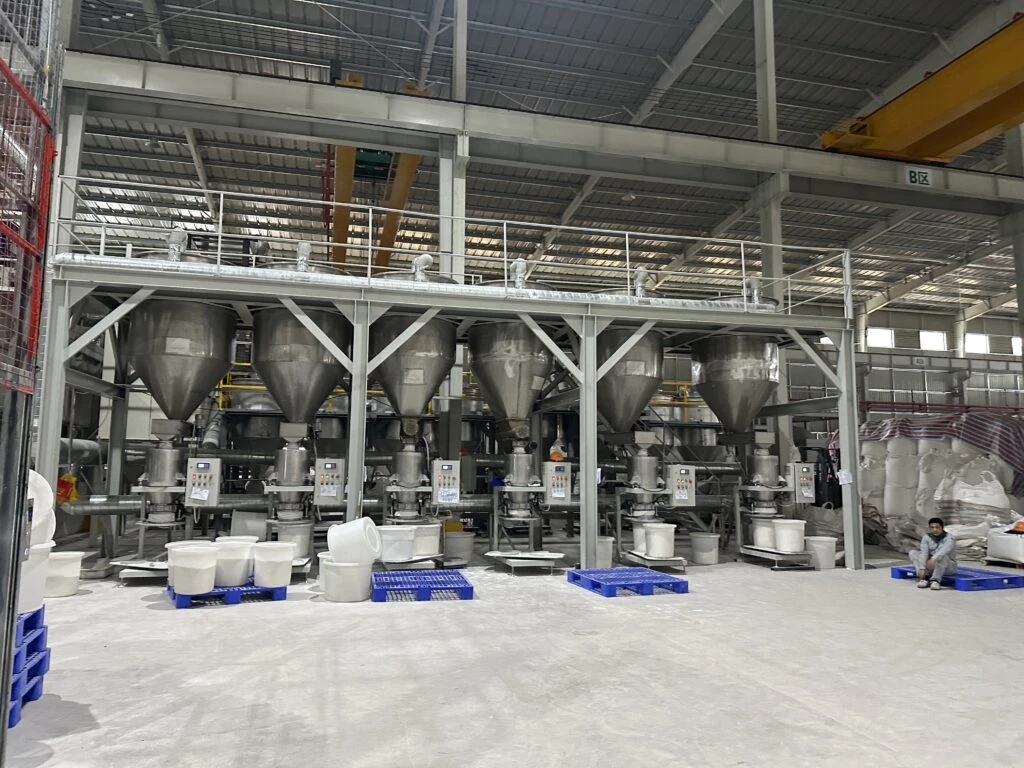
Observe
- material identification, lot labels and storage protection;
- separation of aggregates, powders, pigments, binders and additives;
- scale condition, calibration status and operator recording;
- first-in/first-out or other shelf-life control where relevant;
- the link between a batch record and the materials physically being used.
Ask
- How is a material change approved and recorded?
- What happens when weighing is outside the approved tolerance?
- How are moisture- or temperature-sensitive inputs controlled?
- Can the factory trace a finished slab back to raw-material lots?

4. Mixing, Distribution and Forming
Observe a normal operating sequence where possible. A demonstration may be useful, but record whether the speed, staffing, supervision or product differs from routine production.
| Station | What to Observe | Follow-Up Evidence |
|---|---|---|
| Mixing | Charging sequence, timing control, cleanout, residue and transfer to the next station | SOP, batch record, changeover record and retained sample |
| Distribution | Material placement, pattern control, operator adjustments and preform consistency | Approved design reference, work instruction and production comparison |
| Press/forming | Control sequence, alarms, seal/membrane condition, mold/belt condition and deviation handling | Manufacturer range, calibration, trend data, maintenance and finished-slab results |
Do not apply generic thresholds for pressure fluctuation, cycle speed or vacuum. Compare actual operation with the approved equipment and product specification.
5. Curing, Cooling, Calibration and Polishing
- Curing: Confirm that time and temperature are recorded for the relevant product and that sensors are calibrated.
- Cooling: Review support, spacing, release criteria and handling before finishing.
- Calibration: Ask where thickness is measured and how the factory responds to multi-point variation.
- Cutting: Review dimensional control, edge quality and tool maintenance.
- Polishing: Confirm the approved surface reference, water management, abrasive control and final inspection conditions.
Important: The number of polishing heads, presence of a multi-zone oven or use of a well-known press brand are capability indicators—not proof that the target slab meets the order. Verify finished-product measurements and records.
6. QC, Nonconformance and Traceability
A factory does not need every possible test in-house. It does need a defined method to verify the characteristics it claims, using calibrated internal equipment or qualified external laboratories as appropriate.
- Check whether current procedures identify test methods, frequency, sample identity and acceptance criteria.
- Review whether retained samples are labeled by SKU, batch and date.
- Ask how failed results are quarantined, investigated, retested and dispositioned.
- Confirm that first-quality, downgraded, reworked and scrapped slabs remain distinguishable.
- Check whether the report issued to the buyer can be traced to the slabs loaded.
7. Safety and Dust Control Are Part of Operational Maturity
Do not ask a factory to create dust merely for a demonstration, and do not judge respirable crystalline silica exposure by what is visible. Fine RCS can be invisible to the naked eye. Review the product SDS, processing controls, extraction, water suppression, respiratory protection, housekeeping and any applicable exposure-monitoring records.
UK status as of July 2026: HSE has issued engineered-stone COSHH guidance and is conducting an enforcement campaign focused on effective controls, including avoiding uncontrolled dry processing. HSE states that this guidance is not a new law or formal product prohibition. Buyers should verify current requirements for each market.
8. Additional Checks for Zero-Silica and Low-Silica Claims
First identify the production route. A resin-bound zero-silica product and a cementitious zero-silica product may require very different controls.
- Composition definition: What does the supplier mean by zero-silica or low-silica, and what market threshold applies?
- Raw-material identity: Which fillers, aggregates and binder category are used?
- Segregation/changeover: Are lines dedicated, campaign-run or shared under a validated cleaning procedure?
- Sample and test traceability: Does the composition report identify the exact SKU and representative sample?
- Method capability: What method, reporting limit, uncertainty and laboratory qualification apply?
- Batch connection: How is the test evidence linked to production and shipped slabs?
For Australia, the current prohibition definition includes engineered-stone benchtops, panels and slabs containing at least 1% crystalline silica by weight, subject to the official scope and exclusions. Products below 1% are outside that definition, but dust from any processed stone product can still create health risks.
9. After the Visit: Close Evidence Gaps
Within your internal review, classify each issue using a simple evidence status:
| Status | Meaning | Typical Next Step |
|---|---|---|
| Supported | Observation and records are consistent | Include in the supplier-qualification record |
| Partially supported | Control exists but evidence is incomplete | Request additional record, trial or third-party verification |
| Unresolved gap | Important claim cannot yet be verified | Limit order scope, add inspection or pause approval |
| Incompatible | Capability or control does not meet the order requirement | Change route, product or supplier |
Confidentiality or restricted photography is not automatically a failure. Evaluate whether the supplier offers another credible way to resolve the evidence gap.
10. When You Cannot Visit the Factory
- conduct a live, time-stamped video walkthrough during production;
- use a qualified third-party auditor with a defined checklist;
- request redacted records and current product reports;
- approve a controlled trial order before scaling volume;
- require batch-level pre-shipment evidence and retained references.
11. Condensed Factory Visit Checklist
- Confirm the target product, market and production route.
- Review requested records and note unresolved items before arrival.
- Observe normal production conditions and record any demonstration differences.
- Audit raw materials, batching, mixing, distribution, forming, curing and finishing.
- Review maintenance, calibration, alarms and nonconformance handling.
- Check worker-safety and dust-control systems without relying on visible dust.
- Connect test reports, retained samples and batch IDs to finished slabs.
- Score evidence—not impressions—and assign a follow-up action to each gap.
FAQ:
A short walk can screen obvious gaps, but a meaningful equipment and records review requires enough time to observe the line, interview responsible staff and compare records. Define the scope rather than relying on a universal duration.
Not automatically. Treat unavailable records as an evidence gap. Consider redacted records, a controlled on-site review, third-party audit, trial order or increased inspection coverage.
No. Respirable crystalline silica can be invisible to the naked eye. Review product composition evidence, SDS information, control measures and applicable monitoring rather than judging visible dust.
No. Housekeeping is important, but production capability also requires controlled materials, calibrated equipment, documented parameters, effective maintenance and verified product results.
A remote review cannot reproduce every on-site observation, but live video, records, third-party inspection, retained samples and a controlled trial order can reduce uncertainty.
Rate evidence by process function: documented control, partially supported control or unresolved gap. Keep observed facts separate from assumptions and connect each rating to records or product data.
Prepare a Structured Quartz Factory Review
Share the target product, destination market, factory location and available documents. AsiaQuartz can help define the visit scope, evidence checklist and follow-up inspection plan.