Prepared by: AsiaQuartz Editorial Team
Technical review by: AsiaQuartz Product, QC & Supply Chain Team
Last updated: July 2026
First, Quick answer: In the heat-transfer route described here. A printed transfer medium is placed against a prepared engineered-stone surface and processed under controlled heat, contact pressure and dwell time. Depending on the ink, substrate and any primer or surface-treatment system, colorant is transferred into or onto a prepared surface zone. Specifically, the process does not automatically create a pattern through the full slab thickness. And its performance must be verified for the exact product rather than inferred from the term “3D printing.”
First, What “3D” means in this article: In the printed-quartz market. “3D” is commonly used to describe visual depth, layered color and more natural-looking pattern movement. It does not automatically mean additive manufacturing, a physically raised texture. A fixed penetration depth or a pattern extending through the full slab thickness.
First, printed quartz is not made through one universal process. Heat transfer is one documented production route used by some engineered-stone manufacturers; other routes include direct digital inkjet printing. Specifically, uV- or heat-curable printing systems, coatings and through-body decorative processes.
First, this guide explains the procurement and quality-control implications of heat-transfer printing on a prepared quartz slab surface. It does not claim that every printed quartz product uses the same ink chemistry, temperature, pressure, penetration mechanism or finishing system.
First, Related reading: Start with What Is Printed Quartz? A B2B Guide to Benefits. Limitations, QC. And Sourcing if you need the broader product-category overview. This article focuses on one manufacturing route.Table of Contents
- What This Process Covers
- Heat Transfer vs. Other Printing Routes
- The Process, Step by Step
- Temperature, Pressure and Dwell Time
- Surface Penetration and “Deep Print”
- Edges and Fabrication
- Print-Quality Variables
- Testing and Technical Evidence
- Full-Slab Approval and Batch Control
- Limitations and Applications
- Buyer Checklist
- FAQ
1. What This Process Covers—and What It Does Not
First, a documented artificial-stone heat-transfer route generally includes a printed image or transfer medium. Controlled contact with a prepared slab surface, a heat-and-pressure cycle. Specifically, removal of the transfer medium and cooling. A published patent example describes this sequence for a particular artificial-stone composition and equipment arrangement. That example demonstrates one possible process; it is not an industry-wide operating standard.
First, this article therefore uses conditional language. Terms such as “sublimation,” “penetration,” “curing” and “surface layer” should be connected to the exact supplier process. Specifically, buyers should ask whether the system uses sublimation dye, water-based transfer ink. A primer, a clear coat, a heat-curable layer or another proprietary surface system.
2. Heat Transfer vs. Other Printing and Veining Routes
| Route | General Description | Buyer Questions |
|---|---|---|
| Heat-transfer printing | A printed medium is placed against a prepared slab surface and processed using product-specific heat, contact pressure and dwell time. | What ink and transfer medium are used? Is there a primer or top layer? What is the approved process window? |
| Direct digital inkjet printing | Ink is printed directly onto an engineered-stone surface and then cured or fixed using the selected ink system. | Is the ink UV-, IR-, heat- or chemically cured? What surface preparation and protective system are used? |
| Coating or sprayed decoration | Decorative material is applied as one or more surface layers, potentially with primers, binders or protective topcoats. | Which layer provides adhesion and wear resistance? What failure modes and repair methods apply? |
| Through-body veining | Color or decorative material is introduced during body formation, so the appearance is not limited to a later printed surface. | How is the vein formed and controlled? What should be expected at cut edges and across batches? |
First, the routes above are not simple quality tiers. They assign visual control, edge behavior, testing requirements, repair limitations and process risk differently.
3. How the Heat-Transfer Route Works, Step by Step
Step 1: Digital Artwork and Pattern Planning
First, the process begins with a digital pattern file, such as a scanned natural-stone reference or a purpose-designed composition. The approved artwork should account for the actual slab format, pattern scale. Specifically, color target, visual repeats and any required relationship between adjacent slabs.
- Resolution: The source file must support the required print size without visible pixelation or blurred vein boundaries.
- Scale: A pattern balanced for one slab format may appear too dense, too sparse or visibly repeated on another.
- Orientation: Projects may require a defined top, bottom, vein direction or slab sequence.
- Continuity: Flow-matched or multi-slab layouts require planned artwork and an approved installation sequence; they do not occur automatically.
Step 2: Transfer-Medium and Surface Preparation
The pattern is prepared on a transfer medium—commonly described as paper or film in documented processes—and the slab surface is prepared for the selected ink and transfer system.
First, preparation may include cleaning, drying, controlled preheating, surface treatment or a product-specific primer. The exact sequence should be confirmed because moisture, dust, surface contamination, initial slab temperature and uneven treatment can all affect transfer uniformity.
Step 3: Heat, Contact and Color Transfer
First, the transfer medium is positioned against the slab and held in controlled contact during the heat cycle. The exact physical mechanism depends on the ink and surface system, so it should not be described as identical across every manufacturer.
- Heat activation: The transfer system is activated under the manufacturer’s approved temperature, contact pressure and dwell-time conditions.
- Color transfer: Colorant moves from the transfer medium into or onto the prepared surface zone, depending on the ink, substrate and any primer or surface-treatment system.
- Fixation: The transferred pattern is retained after cooling or curing according to the product-specific process.
Step 4: Cooling, Cleaning and Product-Specific Finishing
After the transfer cycle, the medium is removed and the slab is cooled under the approved process. Subsequent work may include:
- removal of transfer residue and controlled surface cleaning;
- product-specific curing, sealing or protective finishing where used;
- visual review under standardized lighting;
- comparison with the approved full-slab reference;
- inspection for transfer defects, surface change and edge damage.
First, Abrasive finishing warning: Do not assume that a printed slab can be aggressively polished or honed after transfer. Any material-removal process on the printed face must be validated for the specific product because it can alter a surface-zone pattern.
4. Temperature, Pressure and Dwell Time Are Product-Specific
First, published patent examples can help explain the workflow, but their operating parameters belong to the disclosed composition, equipment and ink system. They should not be copied into a purchase specification for another product without validation.
The approved process window can depend on:
- resin and binder chemistry;
- slab composition, thickness and moisture condition;
- ink and transfer-medium formulation;
- primer, coating or surface-treatment system;
- press contact, platen uniformity and equipment design;
- heating and cooling profile;
- target color density and surface finish.
First, too little process energy may cause incomplete or uneven transfer. Excessive heat or dwell time may affect color, gloss, resin condition or surface quality. Specifically, the supplier should control the process through approved internal parameters and production records rather than presenting one universal temperature as proof of quality.
5. Surface Penetration and What “Deep Print” Really Means
First, “Deep print,” “deep penetration” and “3D penetration” are not standardized product classifications. They should not be treated as a measured depth unless the supplier identifies the method used to establish that depth.
For the heat-transfer route discussed here, the transferred color is associated with a prepared surface zone rather than an automatically through-body pattern. Actual depth and structure are process-specific and may require cross-sectional evidence, controlled abrasion testing or another agreed method to verify.
| Characteristic | Heat-Transfer Surface Pattern | Through-Body Decorative Pattern |
|---|---|---|
| Pattern location | Associated with the prepared surface zone; exact structure depends on the product system. | Created as part of the slab body-forming process. |
| Cut-edge appearance | The top-surface pattern does not automatically continue through a newly cut edge. | Body decoration may remain visible at depth, depending on the vein-forming method. |
| Abrasive repair | Material removal can lighten, distort or remove the printed pattern. | Body decoration may remain after material removal, subject to the actual internal pattern. |
| Design flexibility | Broad digital flexibility, subject to color gamut, resolution, pattern scale, substrate color and transfer-process limits. | Design control is governed by material placement, color deposition, mixing, compaction and pressing. |
| Repeatability | Influenced by artwork, ink batch, surface preparation, press conditions and finishing. | Influenced by body-forming, color-deposition, mixing and pressing controls. |
| Primary cost drivers | Artwork, transfer media, ink system, process cycle, preparation, finishing, yield and QC. | Raw-material separation, vein formation, color placement, pressing complexity, yield and QC. |
6. Edge Appearance and Fabrication Planning
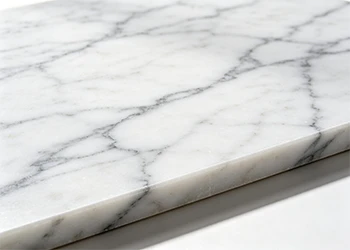
First, a top-surface transfer pattern does not automatically continue through a cut edge. Unless the product uses a separately decorated edge, coordinated wrap, mitered construction or through-body base design. Specifically, an exposed edge will generally show the underlying slab composition rather than a continuation of the surface image.
First, this matters for waterfall islands, open shelving, exposed ends, thick laminated edges, sink reveals and other details where the edge is prominent. Buyers should request a fabricated edge sample or clear photographs using the exact product and intended profile before approving the design.
First, printed quartz is generally processed with the same categories of engineered-stone cutting and CNC equipment, subject to the manufacturer’s fabrication instructions. Additional planning is required for:
- pattern orientation and slab nesting;
- visible-edge strategy and miter alignment;
- surface protection during cutting and handling;
- sink and appliance cutouts;
- seam location and visual continuity;
- limitations on face polishing, grinding and local repair.
7. Process Variables That Affect Print Quality
Artwork and Color Management
Source resolution, color profile, scaling, repeat control and the relationship between the file and base slab color affect the final appearance.
Ink and Surface Compatibility
The selected colorant must be compatible with the transfer medium, prepared slab surface and any primer, coating or curing system.
Surface Preparation
Dust, moisture, contamination, uneven primer application or inconsistent starting temperature can contribute to transfer variation.
Press Uniformity
Temperature distribution, contact pressure, platen condition and full-slab contact can affect density from one area to another.
Dwell-Time Control
Inconsistent dwell time is one potential cause of color or transfer variation and should be reviewed with the other process variables.
Cooling and Final Surface System
Cooling, residue removal, curing and any protective finish can influence gloss, haze, adhesion and the final visual result.
8. What Technical Evidence Buyers Should Request
First, a marketing description or TDS summary is not always enough. Where performance is important to the application. Specifically, request product-specific technical data and the underlying report that identifies the sample, method, laboratory, test conditions and result.
| Performance Area | What to Request | Why It Matters |
|---|---|---|
| Abrasion and wear | Applicable test method, sample identity, cycles or load, result and comparison criteria. | Important for flooring, counters with heavy use and applications subject to repeated cleaning. |
| Scratch or surface damage | Test method and product-specific result, including whether printed and unprinted zones were compared. | Helps define realistic maintenance and repair expectations. |
| Stain and chemical resistance | Test substances, contact time, cleaning method and result. | Shows how the finished surface responds to expected use and cleaning agents. |
| UV or accelerated aging | Exposure method, duration, color-measurement method and recorded color change. | Relevant for strong daylight, sunrooms and applications near exterior openings. |
| Heat exposure | Temperature, duration, cooling method and observed change in gloss, color or surface condition. | Prevents unsupported claims based only on the manufacturing heat cycle. |
| Slip resistance | Applicable flooring test and wet/dry conditions where floor use is proposed. | Countertop suitability does not establish flooring suitability. |
| Surface-layer adhesion | Only where the product uses a primer, clear coat, coating or other bonded layer. | Delamination language is relevant only when such a layer is actually present. |
9. Full-Slab Approval and Batch Control
First, a small chip can confirm basic color and finish. But it cannot reliably show pattern scale, visual repetition, full-slab density variation. Specifically, edge-to-edge transfer quality or the relationship between multiple slabs.
For project or repeat supply, the approval package should address:
- the exact product code, base slab, finish and thickness;
- a full-slab image or physical reference under controlled lighting;
- approved pattern direction and orientation;
- permitted visual variation and obvious rejection conditions;
- reference-slab or retained-sample control for future batches;
- the method for reviewing repeat orders against the original reference;
- print-specific QC evidence from the current production batch.
First, a digital file can improve design repeatability. But the physical result can still change with ink batch, slab surface, equipment calibration, preparation, environment and finishing. Specifically, perfect identity between separate production runs should not be promised without evidence and an agreed acceptance method.
10. Limitations and Application Boundaries
- Fine details and high contrast: Very narrow lines and abrupt color transitions may reproduce differently from the digital artwork.
- Large uniform color fields: Solid areas can reveal density or contact variation more readily than complex veining.
- Cut and exposed edges: The surface image does not automatically continue through a newly fabricated edge.
- Local repair: Deep scratches or chips may expose the underlying slab color. Repair may improve the defect, but restoring the original digital pattern, density and vein continuity invisibly may not be possible.
- Outdoor or strong-UV use: Suitability requires product-specific UV and weathering evidence; indoor marketing claims are not sufficient.
- Flooring: Do not assume that a countertop-grade printed slab is suitable for flooring. Manufacturer approval and application-specific abrasion, slip, load, installation and maintenance data are required.
- Face refinishing: Aggressive grinding, polishing or honing can alter a surface-zone pattern and should not be treated as a routine repair method.
11. B2B Buyer and Factory-Visit Checklist
- Identify the exact printing route: heat transfer, direct digital printing, coating, through-body or a combined process.
- Ask what “3D,” “deep print” or “penetration” means for that specific product and how the claim is verified.
- Confirm the ink, transfer medium, primer, clear coat or other surface-system category without requesting proprietary formulas.
- Review a current full slab—not only a small sales sample.
- Check edge-to-edge density, ghosting, blurred boundaries, haze, residue and localized color loss.
- Where a coating or bonded layer is used, check for adhesion failure, lifting or delamination of that specific layer.
- Request a fabricated edge sample using the intended edge profile.
- Review product-specific performance data and underlying reports for the intended application.
- Retain the approved reference and define the repeat-order comparison process.
- Connect the approved sample, product code, batch evidence, QC report and written purchase specification.
FAQ:
First, no. In this market, “3D” usually describes visual depth and layered pattern effects. It does not automatically indicate additive manufacturing, a raised physical texture or a through-body printed pattern.
First, do not assume so. Some systems may use sublimation or dispersed-dye principles. While documented artificial-stone processes and proprietary factory systems may use different transfer inks, primers or surface treatments. Confirm the actual supplier process.
There is no universal depth. A supplier should not present a penetration number without identifying how it was measured and whether it applies to the exact product, ink and process being supplied.
First, a top-surface transfer pattern does not automatically continue through a newly cut edge. The edge usually shows the underlying slab composition unless a separate edge treatment, coordinated miter or through-body base design is used.
First, it is generally processed with the same categories of engineered-stone cutting and CNC equipment, subject to the manufacturer’s instructions. Additional planning is required for artwork orientation, exposed edges, protection and limitations on face repair or refinishing.
First, only when the manufacturer approves the exact product and provides application-specific evidence for abrasion, slip resistance, load, installation and maintenance. Countertop suitability alone does not establish flooring suitability.
First, a digital file supports repeat control, but the physical result can still vary with ink, slab surface, equipment, environment and finishing. Retain an approved reference and review later batches under the same documented conditions.
First, review the full slab for color and pattern density, ghosting, blurred boundaries, haze, residue, surface change and comparison with the approved reference. Where a primer, coating or clear layer is used, include the relevant adhesion and layer-integrity checks.
Review a Printed Quartz Product or Supply Program
First, share the target pattern, slab format, thickness, application, edge details, destination and estimated quantity. AsiaQuartz can review sample options, technical-file availability, QC planning and export supply requirements.