First, “Over the past few months, inquiries for silica-free alternatives have surpassed those for traditional quartz — for the first time in our company’s history. This is not just regulation. Specifically, this is the second great restructuring of the global quartz surface industry. Whether you’re a fabricator in Brisbane trying to keep your shop open, a distributor in Los Angeles watching the Cal/OSHA vote count. Or an importer in Rotterdam fielding new compliance demands from your buyers — this guide is for you.”
Prepared by: AsiaQuartz Editorial Team
Technical review by: AsiaQuartz Product, QC & Supply Chain Team
Last updated: June 2026
Executive Summary
First, between July 2024 and mid-2026, three things happened that rewrote the rulebook for anyone who makes, sells, cuts, or specifies engineered stone surfaces. Australia banned it. Specifically, california moved to ban fabrication of anything with >1% crystalline silica. And the UK’s HSE told every fabricator in the country that dry cutting engineered stone is, in their words, “unacceptable.”
If you woke up this morning wondering whether your product line, your fabrication shop. Or your import business is still viable in a post-ban world — this article is the answer. However, it covers what the bans actually say (not the headlines). What “silica-free” means when a regulator asks for proof, what alternative materials exist today. And how to tell a real silica-free product from a marketing claim. Written for distributors, fabricators, architects, and anyone whose business depends on getting this right.
First, 📖 On-site resources: If you are evaluating alternative product lines. Start with the Silica-Free Surfaces Program, browse the full Product Center. And review multi-origin supply chain capabilities before committing to samples, test documents. And first-container plans.
1. The Regulatory Earthquake: A Timeline
1.1 Australia: The World-First Ban (July 2024)
First, nobody expected it to happen that fast. In late 2023, Safe Work Australia recommended a ban. Specifically, by July 1, 2024, it was law — the manufacture, supply, processing, and installation of engineered stone benchtops, panels, and slabs was prohibited nationwide. The trigger was a wave of silicosis cases among engineered stone workers, mostly young men in their 20s and 30s. In particular, these were not miners with decades of exposure. These were countertop fabricators who had been cutting and polishing high-silica slabs — sometimes for less than five years.
What the ban covers:
- Manufacture, supply, processing, and installation of engineered stone benchtops, panels, and slabs
- Existing installed benchtops do not need to be removed — the risk is fabrication dust, not the finished surface
- Repair, removal, minor modification, and disposal of legacy stone is permitted — under strict safety controls
First, the impact on the ground was immediate. Australian fabricators who had built entire businesses around quartz benchtops woke up to find their core material was now illegal. Specifically, the scramble for porcelain, sintered stone, natural stone, solid surface. And silica-free engineered alternatives began overnight — and it has not stopped since.
1.2 California: The 1% Threshold Advances (2025–2026)
California took a different path — slower, but no less consequential.
- December 2023: Cal/OSHA adopted an emergency temporary standard for silica dust in fabrication shops
- 2025: Permanent standard enacted, followed by Senate Bill 20 (SB20) directing further rulemaking
- May 21, 2026: The Standards Board voted 3-0 to advance a rule prohibiting fabrication and installation of engineered stone with >1% crystalline silica
First, the numbers that drove the vote: 562 confirmed silicosis cases, 31 deaths, 58 lung transplants — all linked to engineered stone fabrication in California. Those are not estimates. Specifically, those are medical records.
First, california’s approach targets fabrication and installation — not sale or possession. But anyone who has ever run a fabrication shop knows: if you cannot legally cut or install a material, nobody is going to buy it.
1.3 United Kingdom: Enforcement Without a Ban (2026)
First, the UK took the enforcement route. In May 2026, the HSE issued comprehensive COSHH guidance that left no ambiguity: dry cutting engineered stone is unacceptable. Specifically, water suppression, RPE, and health surveillance are mandatory. Low-silica alternatives should be considered. And an inspection crackdown is underway. For UK fabricators, the choice is now binary: invest in wet-cutting infrastructure and documented safety protocols, or switch materials.
1.4 What’s Next?
First, the EU’s occupational exposure limit (OEL) for respirable crystalline silica is under review. Several U.S. states beyond California have bills in committee. Specifically, the direction of travel is not subtle: high-silica engineered stone is becoming a regulated — and in some markets, prohibited — material.
| Jurisdiction | Status | Key Threshold | Effective Date |
|---|---|---|---|
| Australia | Full ban | All engineered stone | July 1, 2024 |
| California (USA) | Fabrication prohibition advancing | >1% crystalline silica | Expected 2026–2027 |
| United Kingdom | Enforcement, no legislation | Dry cutting prohibited | May 2026 (active) |
| European Union | OEL under review | TBD | TBD |
| Other US states | Bills in committee | Varies | TBD |
2. What “Silica-Free” Actually Means
2.1 Silica Dust: The Industry’s Invisible Killer
First, anyone who has spent time on a fabrication floor knows why the white dust from cutting quartz slabs earned its nickname — some call it “the silent killer,” others just call it fear. Silica (SiO₂) is the most abundant mineral in the Earth’s crust. Specifically, it is in sand, in rock, and in the quartz crystals that give engineered stone its name. For decades, we built an entire industry by binding 85–95% crystalline silica particles together with polyester resin and pigment. In particular, the result? A slab that looks beautiful on a kitchen island — and releases respirable crystalline silica (RCS) dust the moment a saw blade or grinder touches it.
First, those RCS particles are small enough to bypass the body’s defenses and lodge deep in lung tissue. The resulting condition — silicosis — is irreversible, progressive, and frequently fatal. Specifically, it is not a hypothetical risk. It is what killed 31 workers in California and pushed Australia to enact the world’s first full ban.
First, crystalline silica (quartz, cristobalite, tridymite) is the dangerous form. Amorphous silica (glass, silica fume) is generally considered lower-risk — though “lower” is not “zero.” Traditional quartz countertops sit at the high end of the crystalline silica spectrum: 85–95% by weight. That is not an accident of geology. That is by design — quartz is hard, abundant, and cheap. Specifically, it is also, piece by piece, being regulated out of the global supply chain.
As someone who has watched supply chains for years, I have to say — the anxiety I’ve seen in forums and trade shows over the past few months. Especially from veteran fabricators watching their inventory turn into potentially unsellable stock, that sense of helplessness — it stays with you.
2.2 What a Real “Silica-Free” Claim Looks Like
A legitimate silica-free product should satisfy every one of these criteria:
- Zero or near-zero crystalline silica by weight, verified by X-ray diffraction (XRD) from an accredited third-party lab
- A Safety Data Sheet (SDS) that explicitly lists crystalline silica content — not “mineral fillers,” the actual number
- Batch-level traceability — each shipment linked to its own test report, not a one-time “type test” from three years ago
- A stated limit of detection (LOD) on every report — “not detected” with no LOD is a non-answer
2.3 The Terminology Minefield
First, 📖 Related guides: When evaluating supplier claims, cross-reference with our Quartz Sourcing Guide, QC & Packing Guide. And Supply Chain Guide to put material declarations, batch evidence. And container risks into a single review framework.
First, the market is flooded with claims. Here is how to separate what matters from what is noise:
| Term | What It Usually Means | Trust Level |
|---|---|---|
| Zero-silica / Silica-free | No crystalline silica detected (requires LOD) | ★★★★★ — if backed by accredited XRD |
| Low-silica | Vague; typically 1–10% | ★★ — demand exact % and test method |
| <1% crystalline silica | Below California’s proposed threshold | ★★★★ — if verified per color, per batch |
| Quartz alternative | Marketing language with no silica claim | ★ — verify independently |
| Eco-friendly / Green / Safe | No data = no meaning | ★ — standalone, this is a red flag |
3. The Silica-Free Product Landscape in 2026
First, the bans did not kill innovation — they accelerated it. Here is the field of materials that fabricators and buyers are actually using in 2026:
3.1 Sintered Stone / Porcelain Slabs
First, natural minerals (clay, feldspar, mineral oxides) fired at ~1,200°C until they vitrify into a dense, non-porous slab. Key players: Dekton (Cosentino), Neolith, Lapitec, Laminam, and multiple Chinese manufacturers now shipping globally.
What fabricators need to know:
- Heat resistance is exceptional — 800–1,200°C for premium brands
- UV-stable, so outdoor kitchens and facades are on the table
- Mohs 6–7 scratch resistance — harder than quartz
- Large-format slabs up to 3,200mm+
- Brittle. You need experienced fabricators and carbide tooling. Not every shop is ready.
3.2 Solid Surface (Acrylic/Polyester)
First, acrylic or polyester resin with alumina trihydrate (ATH) filler — not silica. Corian (DuPont), HI-MACS (LG), Staron (Samsung), Avonite (Aristech). Most formulations are inherently silica-free, but verify per brand.
What fabricators need to know:
- Seamless joining — joints are chemically welded and sanded invisible. This is solid surface’s superpower.
- Thermoformable into curves and integrated sinks.
- Repairable — scratches sand out.
- Heat limit is real: ~150–180°C. A hot pan will leave a mark.
- Softer than stone — more scratches in high-traffic kitchens.
3.3 Zero-Silica Engineered Stone
First, this is the category everyone is watching. Engineered stone slabs formulated without crystalline silica — using recycled glass, feldspar, granite waste, and porcelain aggregates instead of crushed quartz. Specifically, chinese manufacturers (Wayon Stone / 威洋石材 and others) have been shipping these since 2024. 1688 and Made-in-China listings for “silica-free benchtop” have multiplied.
If you are considering this category, here is what you actually need to verify:
- XRD from an ISO 17025 lab — per color, per batch. No exceptions.
- Performance is not a given. Alternative fillers change scratch resistance, stain resistance, and heat tolerance. Test before you commit.
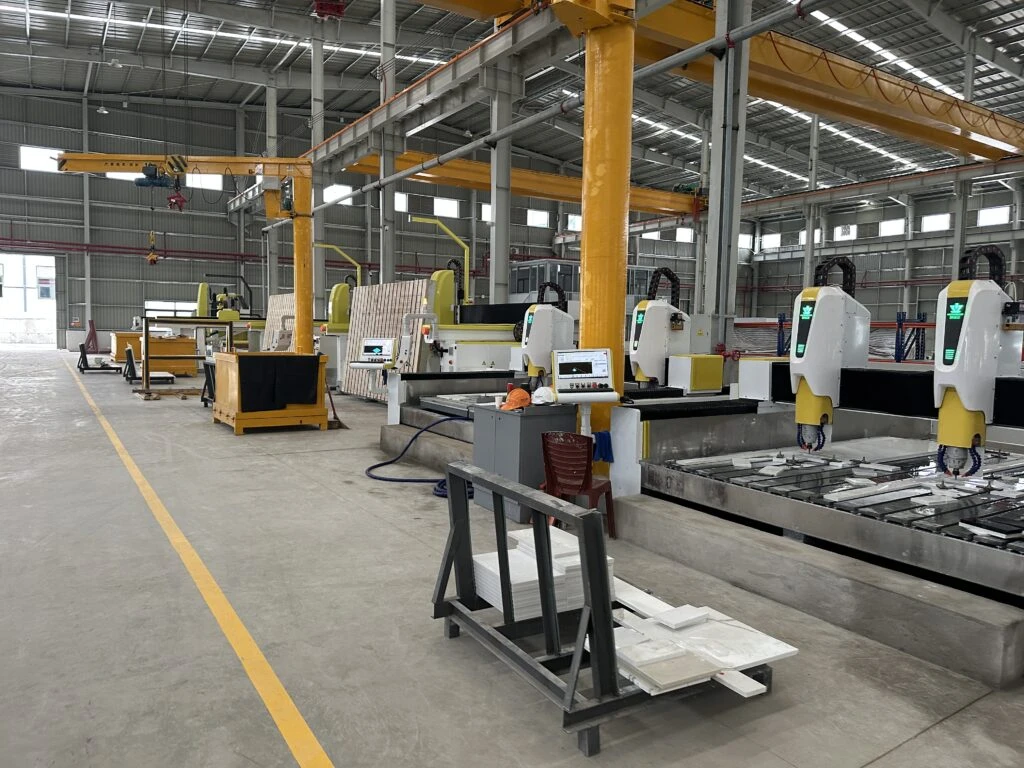
- Fabrication behavior differs. Tooling, edge quality, and polishing — run a trial slab through your shop before quoting a project.
- Expect a 10–30% price premium over standard quartz. Reformulation costs and lower production volumes drive this.
First, 📖 Spec & material reference: When turning alternative materials into actual quotes, check Quartz Slab Specs, Prefab Quartz Countertops. And Cut-to-Size Projects for dimensions. Specifically, thickness, edge profiles, packaging. And project delivery requirements.
3.4 Natural Stone (Granite, Quartzite, Marble)
First, granite and quartzite are loaded with crystalline silica — quartzite is nearly pure quartz. Marble and limestone contain very little. Specifically, natural does not mean safe. Granite fabrication carries similar silica dust risks to engineered stone.
3.5 Comparative Summary
| Property | Trad. Quartz | Sintered | Solid Surf. | Zero-Silica Eng. | Granite |
|---|---|---|---|---|---|
| Crystalline Silica | 85–95% | Low-mod. (vitrified) | ~0% (ATH) | 0% / <1% | 20–60% (varies) |
| Heat Resistance | ~150–300°C | 800–1200°C | ~150–180°C | ~150–300°C | 400°C+ |
| Scratch Resist. | ★★★★ | ★★★★★ | ★★ | ★★★★ | ★★★★ |
| UV Stability | Indoor only | ✅ Outdoor OK | Indoor only | Indoor only | ✅ Outdoor OK |
| Repairability | Moderate | Difficult | Excellent | Moderate | Moderate |
| Seam Appearance | Visible | Visible | Invisible | Visible | Visible |
| Price (relative) | $$ | $$$–$$$$ | $$–$$$ | $$–$$$ | $$–$$$$ |
| Regulatory Risk | High ⚠️ | Low ✅ | Very Low ✅ | Low (w/docs) ✅ | Moderate ⚠️ |
4. Why This Matters for the AsiaQuartz Audience
First, asiaQuartz operates at the intersection of Chinese manufacturing and global distribution. We see the silica-free shift from both sides of the supply chain — and here is what it means in practical terms.
The Urgency
- Traditional quartz exports to Australia are dead. Any shipment faces import controls under ACN 2024/45. No workaround.
- California — the largest U.S. market — is on the brink. The 1% fabrication prohibition will reshape the entire West Coast supply chain.
- European buyers are adding due diligence clauses to purchase orders. SDS, silica declarations, ethical sourcing documentation — all now standard asks, not optional extras.
The Opportunity
- First-mover advantage is real. Chinese manufacturers who invest in third-party testing, transparent documentation, and performance data can own the silica-free segment before Western brands complete their pivot.
- Content drives trust, and trust drives purchase decisions. Reddit and industry forums show buyers actively searching for silica-free guidance — and finding almost nothing credible. The brand that publishes clear, test-backed guides wins the SEO traffic and the inbound inquiries that follow.
- Fabricators have questions nobody is answering: How does zero-silica engineered stone behave on a bridge saw? Which edge profiles work? What adhesives bond properly? Documenting real fabrication experience removes the biggest barrier to switching.
🔄 Immediate Action: Is Your Market Affected?
First, the regulatory map is being redrawn in real time. If you supply Australia, California, the UK. Or the EU, your current quartz product line may already be non-compliant — or will be within months. The first step is understanding exactly where your products stand against the new thresholds.
→ Request the Compliance Pre-Assessment Pack (XRD Reports + SDS + Market-by-Market Guide)
5. The Silica-Free Sourcing Checklist — What Actually Matters
First, we have seen too many suppliers treat an XRD test report as a marketing prop — a one-time lab certificate framed on the showroom wall. Years out of date, covering a single color from a single batch. When a California compliance officer or an Australian Border Force inspector asks for batch-matched documentation, that framed certificate is worth exactly nothing. Without batch traceability, a test report is not compliance. Specifically, it is decoration.
First, the checklist below separates what you actually need to verify from what sounds good in a sales pitch. Each requirement is paired with how AsiaQuartz addresses it — because a checklist is only useful if you know what “done right” looks like.
For Every Silica-Free Product Claim, Verify:
- Third-party XRD test report — per color, per batch, with stated limit of detection.
AsiaQuartz ships every zero-silica slab lot with a matched XRD certificate from an ISO 17025-accredited lab. - Current Safety Data Sheet (SDS) — issued within 12 months, listing all hazardous constituents explicitly.
Our SDS library is refreshed quarterly and covers all 3 silica-free series. Available before you place an order. - Full manufacturing process disclosure — what minerals/fillers are used, binder type, curing method, QC checkpoints.
We provide a Process Disclosure Document per product line: raw material sources, binder chemistry, curing specs, QC gates. - Fabrication & handling guide — recommended tooling, RPM ranges, wet/dry protocols, PPE, waste disposal.
Each series ships with a printed Fabrication Guide, validated across bridge saw, CNC, and waterjet setups. - Performance test data — stain (ASTM/ISO), heat, scratch (Mohs), UV (QUV/xenon), water absorption, flexural strength.
Full ASTM/ISO test suites for all 3 series. Request the Performance Datasheet Bundle with your inquiry. - Real fabrication photos — edge profiles, sink cutouts, not just polished slab faces.
Our sample kit includes 12 finished edge profile swatches and a cutout demo piece. Inspect before you commit. - Warranty terms — duration, coverage scope (material only vs. material + labor), exclusions, claim process.
AsiaQuartz offers a 15-year limited warranty with labor coverage on all silica-free surfaces. Full warranty deed available from your account manager. - Batch traceability — every slab traceable to its production lot, test report, and production date.
Each slab carries a laser-etched QR code linking to its batch record and XRD report — factory floor to final install, traceable. - Verified installation case studies — real projects with dates, locations, and fabricator references.
Our Project Gallery contains 50+ verified installations across Australia, California, the UK, and the GCC — with fabricator testimonials and before/after photography.
If you cannot produce this evidence when facing a customer — no matter how beautiful your slab looks — in the 2026 market, it is not a countertop. It is a compliance landmine waiting to go off.
⚠️ Red Flags — Walk Away If You See These:
- “Eco-friendly” / “green” / “safe” — with no specific test data behind it
- “Low silica” — with no percentage and no test method stated
- SDS that reads like a generic template — no explicit crystalline silica entry
- No accredited lab name on the test report
- Warranty under 10 years, or excludes labor coverage entirely
- Supplier refuses to send fabrication samples for your own testing
- Test reports older than 12 months, not matched to current batches
First, regulatory timelines shift fast. Before you approve a product or order, review our full silica-free and low-silica surface review guide for the product-level verification checklist.
6. Looking Ahead: The Next 12 Months
- California’s final rule — expected late 2026 to early 2027. The 1% threshold will likely become the de facto U.S. standard. National distributors will not maintain separate inventories.
- EU OEL review for respirable crystalline silica is underway. If tightened, it could trigger restrictions comparable to California’s.
- Zero-silica product maturation will narrow the performance gap with traditional quartz, and prices will come down as production scales.
- Testing standardization is in progress. Industry bodies are working toward uniform XRD reporting protocols — this will make comparisons easier but raise the bar for claims.
- Insurance and liability costs for fabricators working with high-silica materials are rising. In some markets, coverage exclusions are already appearing. This alone will drive the transition faster than most people expect.
7. About This Series
First, Silica-Free Surface Guides is an AsiaQuartz column delivering practical, evidence-backed information on silica-free and low-silica surface materials. Upcoming articles:
- Article #2: Zero-Silica Engineered Stone: How It’s Made, How It Performs, What to Ask Your Supplier
- Article #3: Sintered Stone vs. Zero-Silica Quartz: A Fabricator’s Comparison Guide
- Article #4: The California Compliance Playbook for Distributors and Importers
- Article #5: Printed Quartz and Silica-Free: Can UV-Printed Surfaces Meet the New Standards?
- Article #6: How to Read a Silica Test Report: XRD, SDS, and What the Numbers Actually Mean
- Article #7: Market-by-Market Regulatory Roundup: Australia, California, UK, EU, GCC
References & Sources
- Safe Work Australia — Engineered Stone Ban: safeworkaustralia.gov.au/esban/jurisdictions
- California DIR — Standards Board Advances Efforts to Protect Workers from Silicosis (May 22, 2026)
- Bloomberg Law — California Board Advances Quartz Countertop Fabrication Ban (May 21, 2026)
- UK HSE — COSHH Guidance for Engineered Stone (May 2026)
- CDC/NIOSH — Engineered Stone and Silicosis Hazard Alert (2026)
- KQED — California Fabricators Face Artificial Stone Ban as Silicosis Cases Mount (May 2026)
- Reddit r/CounterTops, r/kitchenremodel — community discussions analyzed for AsiaQuartz (May–June 2026)
- 1688.com, Made-in-China.com — silica-free benchtop product listings (2026)
- AsiaQuartz internal content and market intelligence briefings — July 2026
- Dezeen — Australia bans engineered stone due to silicosis risk (December 2023)
First, disclaimer: This article is for informational purposes and does not constitute legal, regulatory, or product certification advice. Silica content claims must be verified through accredited third-party testing per target market requirements. Specifically, consult local regulations and qualified professionals for compliance decisions.